

Only about half of talent acquisition leaders report their recruiting CRM actually helps them do their job better. That number alone should prompt a close look at what's going wrong. AI recruitment tools failed to meet initial expectations for 47% of organizations within the first 18 months of deployment. The problem is rarely the technology itself. It runs deeper, into how systems connect, how data flows, and how teams are set up to use what they've purchased. This guide breaks down the core reasons recruiting CRMs fall short, what the real costs look like, and what talent leaders at leading organizations are doing differently.
Table of Contents
- The promise versus reality of recruiting CRMs
- Integration and data fragmentation: The silent CRM killers
- The real-world cost of failed recruiting CRMs
- How talent leaders are transforming CRM outcomes
- A fresh take: Why the real CRM problem isn't technology
- Ready to turn CRM insights into action?
- Frequently asked questions
Key Takeaways
| Point | Details |
|---|---|
| Integration is crucial | The biggest CRM failures stem from poor integration and fragmented data, not flawed AI. |
| Hidden costs add up | Manual clean-up and missed candidates can drain resources and slow down hiring results. |
| Process beats platform | Refining processes and ensuring data quality drive more success than pursuing the latest CRM features. |
| Peer insights matter | Learning from talent leader communities and benchmarks helps avoid pitfalls and accelerate improvement. |
The promise versus reality of recruiting CRMs
Recruiting CRMs enter organizations with significant expectations attached. They are sold as platforms that will centralize candidate data, automate outreach, surface top talent from existing pipelines, and generate actionable insights for hiring decisions. Talent leaders invest in them expecting reduced time-to-fill, stronger candidate relationships, and a more strategic use of recruiter capacity.
The reality, however, is frequently different. Many large organizations find that their CRM sits alongside disconnected applicant tracking systems, recruiter email threads, and informal spreadsheets that hold critical candidate notes. The result is a fragmented picture of the talent pipeline, and the CRM becomes just another system to maintain rather than a central source of truth.
Current talent acquisition trends point to growing frustration with HR technology that promises intelligence but delivers complexity. Leaders consistently report three recurring issues: low recruiter adoption, limited automation impact, and data that cannot be trusted for reporting.
| CRM promised benefit | Common real-world outcome |
|---|---|
| Unified candidate pipeline | Fragmented data across ATS, email, and spreadsheets |
| Automated candidate nurturing | Manual follow-up still required due to poor CRM setup |
| AI-powered candidate matching | Inaccurate matches due to incomplete or inconsistent data |
| Faster time-to-fill | Delays from duplicate records and manual data cleanup |
| Improved reporting and analytics | Reports that don't reflect actual hiring activity |
| Better candidate experience | Communication gaps and dropped candidate threads |
"Talent leaders report that CRM and HR-tech value is undermined by poor integration and data fragmentation across ATS, spreadsheets, and email, which forces manual cleanup and limits what matching and automation can learn from." — AI recruitment practitioner perspectives: Multi-platform reality check
The table above captures what talent acquisition teams encounter frequently. When candidate data lives in three or four separate tools, none of those tools can function as designed. The CRM cannot recommend relevant candidates if it has never seen half of them. AI features cannot learn from data they cannot access. This is the value gap, and it begins before the first automation ever runs.
Decisions around choosing hiring tech often focus heavily on features and vendor demonstrations rather than on integration readiness and internal process alignment. That is where many deployments start to go wrong.
Integration and data fragmentation: The silent CRM killers
Now that the value gap is clear, it is worth examining the technical reasons most CRMs stumble before they deliver.
Integration gaps occur when key systems used in recruiting, specifically the ATS, CRM, email client, calendar, sourcing platforms, and any legacy spreadsheet processes, are not synchronized in real time or at all. Data fragmentation is the result: candidate information exists in multiple places, is updated inconsistently, and cannot be reliably aggregated.
The practical consequences are significant. Recruiters spend time on manual data entry rather than candidate engagement. Reporting reflects only part of the picture. AI-driven features like automated matching or candidate scoring rely on historical and current data inputs. When those inputs are incomplete or contradictory, the AI surfaces poor recommendations. Recruiting teams quickly lose trust in the system, and adoption drops further.

AI recruiting gaps are frequently traced back to this exact problem. The AI itself is not flawed, but it is only as good as the data environment it operates within.
| Factor | Integrated CRM stack | Fragmented CRM stack |
|---|---|---|
| Data source | Single synchronized pipeline | Multiple disconnected tools |
| Candidate records | Clean, deduplicated, current | Duplicate entries, outdated info |
| AI matching accuracy | High, based on complete data | Low, based on partial inputs |
| Recruiter workload | Reduced through automation | Increased by manual cleanup |
| Reporting reliability | Consistent and auditable | Inconsistent, requires reconciliation |
| Time-to-hire impact | Improved over time | Stagnant or worsening |
Research consistently shows that CRM value is undermined by fragmentation. When AI tools learn from broken or incomplete datasets, every downstream recommendation carries that error forward. Teams end up correcting AI outputs manually, which defeats the purpose of automation entirely.
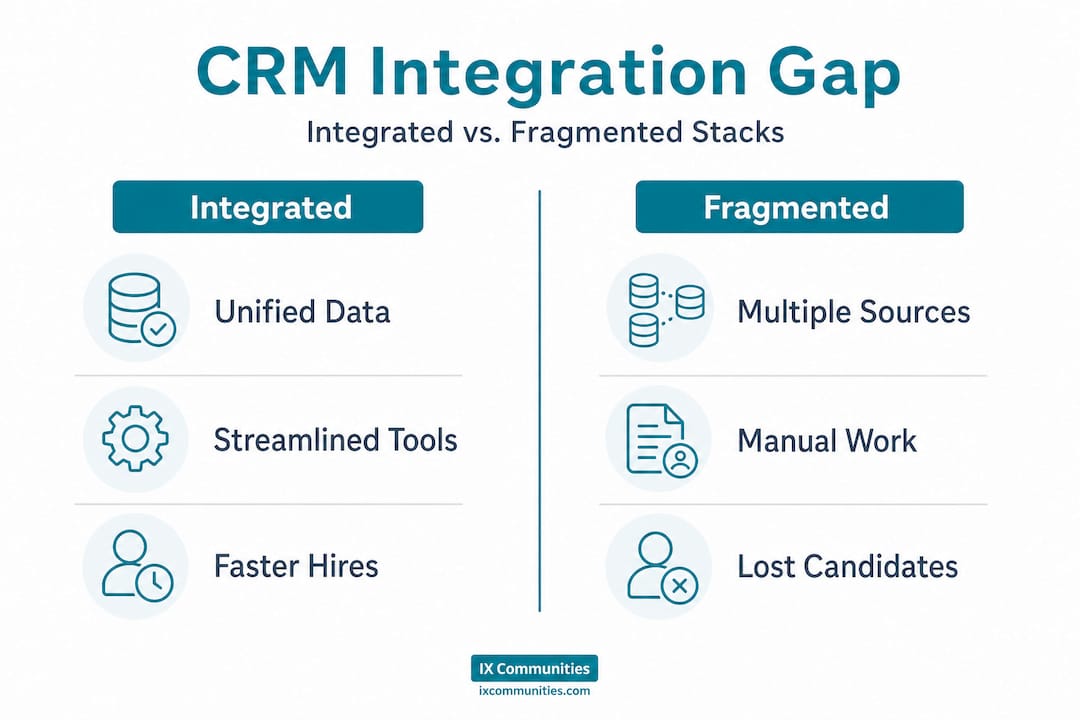
A meaningful share of recruiting AI initiatives miss expectations within 18 months. The cause most often cited is not the AI concept itself. It is the integration and data infrastructure that the AI depends on.
Key symptoms of a fragmented recruiting stack include:
- Recruiters maintaining their own spreadsheets because the CRM data is unreliable
- Duplicate candidate profiles appearing in both the ATS and CRM
- No single owner of data hygiene across recruiting systems
- Sourcing platform data that never flows into the CRM
- Reporting dashboards that require manual correction before use
Understanding how talent management connects with recruiting is important context here. When talent management and recruiting systems are not aligned, data fragmentation reaches beyond the recruiting function and affects broader workforce planning.
Pro Tip: Auditing your data flows and system sync points before any new CRM deployment, or before optimizing an existing one, saves months of rework later. Map every system that touches a candidate record and document who owns updates in each.
The real-world cost of failed recruiting CRMs
Understanding root causes is useful. But what do these failures actually cost your organization in practical terms?
The most visible cost is time. When a CRM is not functioning as designed, recruiters default to manual processes. They search multiple systems to compile candidate history. They re-enter data that should have transferred automatically. They send outreach manually that should have been automated. These tasks accumulate quickly across a team of ten or twenty recruiters.
A second cost is candidate drop-off. Candidate authenticity in AI-driven recruitment depends partly on consistent, timely communication. When a CRM fails to trigger automated follow-up messages or loses track of where a candidate is in the pipeline, that candidate may receive no communication at all. Top candidates, who typically have multiple opportunities in progress, will move on. The organization loses not just the candidate but the time invested in that relationship.
Recruiter fatigue is a third consequence that does not always get measured. Recruiters who spend a significant portion of their day cleaning data, reconciling records, or troubleshooting system errors are less able to focus on the work that requires human judgment: building relationships, evaluating cultural fit, and advising hiring managers. Recruiter training for AI tools is frequently cited as a gap, but training cannot overcome a broken data foundation.
The three most costly hidden impacts of CRM failure in large organizations are:
- Delayed time-to-hire. When candidate pipelines are fragmented and automation is unreliable, every role takes longer to fill. At scale, across dozens of open roles, this adds up to significant lost productivity and increased contractor or interim costs.
- Reduced offer acceptance rates. Candidates who experience poor communication or feel like they have fallen through the cracks are less likely to accept offers. This affects the organization's ability to close competitive positions.
- Employer brand damage. Candidates talk. A broken recruiting process reflects on the organization's overall brand. Negative candidate experiences, even ones caused entirely by a CRM failure, become part of how talent perceives the employer.
AI recruitment tools failing to meet expectations affects 47% of organizations within 18 months. Across large organizations that have invested in premium CRM platforms, this represents a significant return-on-investment problem. The financial cost of licensing, implementation, and training for a tool that is not delivering value is substantial.
Pro Tip: Consistent data hygiene routines, even simple ones like a weekly deduplication check and a monthly audit of candidate status fields, can restore enough data integrity to make an existing CRM significantly more useful without any new investment.
How talent leaders are transforming CRM outcomes
Given those real costs, what are the strategies that set leading organizations apart? The following framework reflects what high-performing talent acquisition teams are doing to address CRM challenges directly.
-
Map your current system architecture before making changes. Before adjusting any process or adding new tools, leading talent leaders document every system that a candidate record touches from first contact to hire. This includes sourcing platforms, ATS, CRM, email, scheduling tools, and any reporting systems. This map reveals where data breaks down and where integration is missing. It is a diagnostic step, not a technical one. Anyone on the talent team can participate.
-
Conduct structured interviews with recruiters and hiring managers. The people using the CRM every day know exactly where it fails them. Structured interviews or short surveys reveal which workarounds have become standard practice. If recruiters are maintaining personal spreadsheets, that is a signal that a specific CRM function is not working. If hiring managers are requesting information that should come from the CRM but doesn't, that identifies a reporting gap. Recruiting best practices consistently emphasize the importance of internal feedback loops as a diagnostic tool.
-
Run a focused pilot before scaling any new configuration or tool. Rather than rolling out a CRM change across the full team, top-performing organizations select a single team or region and test the new configuration at smaller scale. This approach surfaces hidden integration issues early. It builds internal advocates who can support broader rollout. And it generates real data on whether the change is improving outcomes before the organization commits fully.
-
Establish clear data ownership and feedback loops. Every data field in the CRM should have a defined owner. That does not mean one person enters all data. It means one role is accountable for the accuracy of each category of data. Pairing this with a regular feedback cycle, where recruiters report data issues and those issues are actually resolved, builds the kind of trust that drives adoption.
Future skills for recruiters increasingly include data fluency and process design thinking. The ability to diagnose a broken workflow and propose a structured fix is becoming as important as sourcing or relationship skills.
Recruiting AI initiatives miss expectations primarily due to integration and data issues rather than the concept of AI itself. This is a fixable problem. It requires process discipline and clear ownership, not new technology purchases.
Pro Tip: Small pilot wins build internal trust and expose integration issues before they affect the whole team. Document results carefully and share them widely. A clear before-and-after comparison is the most effective way to secure continued investment in CRM improvement.
Benchmarking your own CRM progress against peer organizations is one of the most effective ways to identify gaps and validate your approach. Knowing where you stand relative to organizations of similar size and complexity helps prioritize where to focus.
A fresh take: Why the real CRM problem isn't technology
Most articles about CRM failure focus on features, vendor choices, or implementation timelines. Those factors matter, but they are secondary to something more fundamental: leadership habits and process discipline.
The pattern seen repeatedly in large organizations is this. A new CRM is selected with significant enthusiasm. Implementation happens. Training occurs. Then, gradually, old behaviors return. Recruiters fall back on their own tools. Data entry becomes inconsistent. The CRM becomes one more system to maintain rather than the platform that drives hiring decisions.
The technology did not fail. The change management did.
Chasing the newest CRM features is a way of avoiding the harder work: defining clear data ownership, aligning team behaviors, and building feedback loops that actually lead to process improvement. No CRM vendor can do that work. It requires internal leadership.
Tools do not resolve miscommunication between recruiting teams and hiring managers. They do not fix unclear accountability for data quality. They do not replace a culture of continuous process improvement. These are leadership responsibilities.
The organizations that get the most from their recruiting CRM are not necessarily running the most sophisticated platform. They are running a platform that their team actually trusts, with data that reflects reality, owned by people who care about keeping it accurate. The AI executive search reality check for 2026 points in the same direction: AI sophistication is not what drives results. Data clarity and team alignment do.
Redefining success for a recruiting CRM means asking not "does it have AI matching?" but "do our recruiters trust what it tells them?" That is a process and culture question before it is a technology question.
Ready to turn CRM insights into action?
If you're seeing patterns in this article that reflect your own CRM challenges, you're not alone. Talent leaders across large organizations are working through the same integration, adoption, and data quality barriers right now.
ESIX, TLIX & IXCommunities provide a secure peer environment where talent acquisition leaders benchmark their CRM progress, share what's working, and learn from organizations that have navigated these exact challenges. Through peer mentoring for talent leaders, structured benchmark surveys, and a broader community of talent leadership professionals, members gain the real-world context that no vendor presentation provides. Explore membership details to learn how your team can access these resources and move forward with greater confidence.
Frequently asked questions
What is the top reason recruiting CRMs fail in large organizations?
The primary cause is poor integration and data fragmentation across ATS, spreadsheets, and communication tools, which forces manual cleanup and prevents automation from functioning accurately.
How soon do AI-powered recruiting tools show signs of failure?
Research shows that 47% of organizations experience disappointing results from AI recruitment tools within the first 18 months of deployment.
Can poor CRM performance affect talent brand?
Yes. Breakdowns in candidate communication and inconsistent data management create negative candidate experiences that damage employer reputation and reduce offer acceptance rates over time.
Is buying a new CRM the best solution for performance issues?
In most cases, no. Improving data flow, resolving integration gaps, and establishing clear process ownership delivers greater impact than replacing the platform, and at significantly lower cost.