

AI is automating recruitment tasks at scale, but the gap between hype and performance is widest exactly where it matters most: executive hiring. At the senior leadership level, the qualities that predict success, such as strategic judgment, cultural alignment, and the capacity to lead through uncertainty, resist algorithmic capture. Talent acquisition leaders at large organizations are discovering that deploying AI in executive search without understanding its limits can expose the business to hiring errors, reduced diversity, and misaligned leadership. This article identifies where AI falls short, why those gaps exist, and how to build a more effective approach.
Table of Contents
- Why AI struggles with executive search: Key context
- The credibility gap: Assessing intangible leadership qualities
- The data dilemma: Diversity, equity, and inclusion risks
- Where AI adds value—and where human insight remains essential
- Why the 'AI will revolutionize executive search' narrative misses the point
- Connect with experts shaping the future of executive recruiting
- Frequently asked questions
Key Takeaways
| Point | Details |
|---|---|
| Human insight matters most | AI augments executive search but can't replace nuanced judgment, context, or relationship-building. |
| Bias is a real risk | AI can perpetuate or amplify diversity gaps if not checked by human oversight and best practices. |
| Best-fit uses for AI | AI works best for initial screening, sourcing, and data gathering, not for final executive appointments. |
| Peer learning gives an edge | Learning from peers and benchmarking helps maximize AI's benefits while minimizing downsides. |
Why AI struggles with executive search: Key context
Executive recruiting is not a volume problem. It is a judgment problem. Most AI recruitment tools were built to solve high-volume, repeatable tasks: parsing thousands of resumes, matching keywords, and scheduling interviews at speed. Those capabilities have real value. But senior leadership search operates on different terms.
At the executive level, what distinguishes a good hire from a great one rarely appears in a LinkedIn profile. Factors like leadership philosophy, boardroom presence, stakeholder management style, and the ability to drive cultural change are qualitative by nature. Current AI models have no reliable way to assess them. As research on executive search challenges confirms, AI systems are highly effective at automating high-volume, repeatable recruitment tasks but lack subtlety in evaluating senior leadership potential.
Several specific factors explain why AI hits a wall in this context:
- Qualitative fit is hard to encode. Values alignment, leadership style, and interpersonal chemistry do not translate cleanly into data fields.
- Strategic context is invisible to algorithms. Whether a candidate can navigate a post-merger integration or lead a board through a crisis requires situational judgment that AI cannot model.
- Boardroom dynamics are not predictable. Stakeholder relationships, power structures, and organizational politics are fluid and context-dependent.
- Training data reflects the past. AI learns from historical hiring decisions, which may not reflect what your organization needs for the future.
"The promise of AI in recruiting is real for operational roles, but executive search demands a level of contextual intelligence that current systems are simply not designed to deliver."
For organizations already benchmarking AI's performance across talent functions, the data consistently shows a performance ceiling when AI tools are applied to senior-level roles. Tools designed for AI and executive roles can support certain stages of the process, but they do not replace the nuanced evaluation that executive search requires.
With the stage set, let's dig into the specific executive search factors where AI is hitting a wall.
The credibility gap: Assessing intangible leadership qualities
Research is clear that most executive failure is not a credentials problem. It is a fit problem. Vision, resilience, emotional intelligence, and the ability to adapt under pressure consistently separate effective executives from ineffective ones. These are precisely the qualities that AI and soft skills assessment cannot reliably evaluate: AI cannot effectively evaluate soft skills, emotional intelligence, or situational leadership, which are traits critical to executive success.

AI tools compensate by relying on proxies: educational pedigree, tenure patterns, and past employer prestige. Those signals carry some predictive value, but they are incomplete. A candidate who built a high-performing team at a mid-size company may be exactly right for your needs, even if the profile doesn't match the conventional pattern.
The contrast between human and AI assessment at the executive level is significant:
| Assessment dimension | Human evaluator | AI system |
|---|---|---|
| Cultural fit | Assessed through dialogue and observation | Inferred from keyword patterns |
| Leadership vision | Explored via structured interviews | Not measurable |
| Resilience under pressure | Evaluated from case discussion | Not detectable |
| Stakeholder communication style | Observed directly | Absent from data |
| Credentials and experience | Reviewed systematically | Parsed efficiently |
This table shows that AI performs well on the dimensions that matter least at the executive level, and is largely absent on the dimensions that matter most.
For organizations exploring AI limitations in executive search, the practical implication is straightforward. Use AI to build a broad, credential-verified candidate pool. Do not use it to assess fit, potential, or leadership character. Those judgments require human interaction and cannot be safely delegated to an algorithm.
The value of peer mentoring value lies partly in how experienced practitioners share hard-won knowledge about exactly these assessment challenges.
Pro Tip: Use AI for skills and credential filtering, but never as the sole decision-maker for final executive selection. Reserve human judgment for evaluating leadership qualities that don't appear in a resume.
The data dilemma: Diversity, equity, and inclusion risks
Beyond leadership assessment, AI also introduces risks around fairness and inclusion. Here's where those risks are most acute.
AI systems learn from historical data. If the executives hired over the past two decades skewed toward a narrow demographic profile, the AI will identify that profile as the benchmark for success. The result is not neutral. It is systematically biased toward reproducing the past. As research on AI bias in recruiting documents, biases embedded in AI training data can lead to less diverse and less inclusive shortlists for executive roles.
The risks of automated shortlisting include:
- Qualified candidates from underrepresented groups being screened out before a human reviewer sees their profile
- Proxy variables like institution name or career path acting as stand-ins for race or gender
- Lack of transparency in how the algorithm ranks candidates, making bias difficult to detect or challenge
"Organizations that rely on AI shortlisting without bias auditing are not making objective decisions. They are automating their past preferences."
The impact on representation can be significant. When AI tools filter executive candidates without human oversight, shortlists often reflect narrower demographic ranges than manually reviewed pools.
| Screening method | Gender diversity in shortlist | Racial diversity in shortlist |
|---|---|---|
| AI-only automated screening | Lower | Lower |
| Human-only review | Moderate | Moderate |
| AI plus human oversight | Higher | Higher |
Combining AI reach with human review produces stronger outcomes on both dimensions. Organizations developing a diversity strategy at the executive level cannot afford to treat AI as a neutral tool.
Accessing community best practices from peers navigating the same DEI challenges can accelerate the development of more equitable screening protocols.
Where AI adds value—and where human insight remains essential
We've examined the risks and limitations of current AI. Now, let's see how it can be put to work most effectively while protecting your standards.
AI does add real value in executive recruiting when applied at the right stages. The key is knowing exactly where its contribution ends and where human discretion must take over.
Stages where AI meaningfully supports the executive search process:
- Sourcing at scale. AI can identify a broad universe of candidates across platforms, databases, and professional networks far faster than any research team.
- Credential and experience verification. Parsing role history, tenure, and education at volume is a genuine efficiency gain.
- Market mapping. AI can generate a competitive landscape of available talent in a given function or industry segment.
- Scheduling and logistics. Interview coordination and candidate communication can be largely automated without quality risk.
- Early-stage screening. Filtering for minimum criteria, such as required experience thresholds and geographic parameters, reduces manual load.
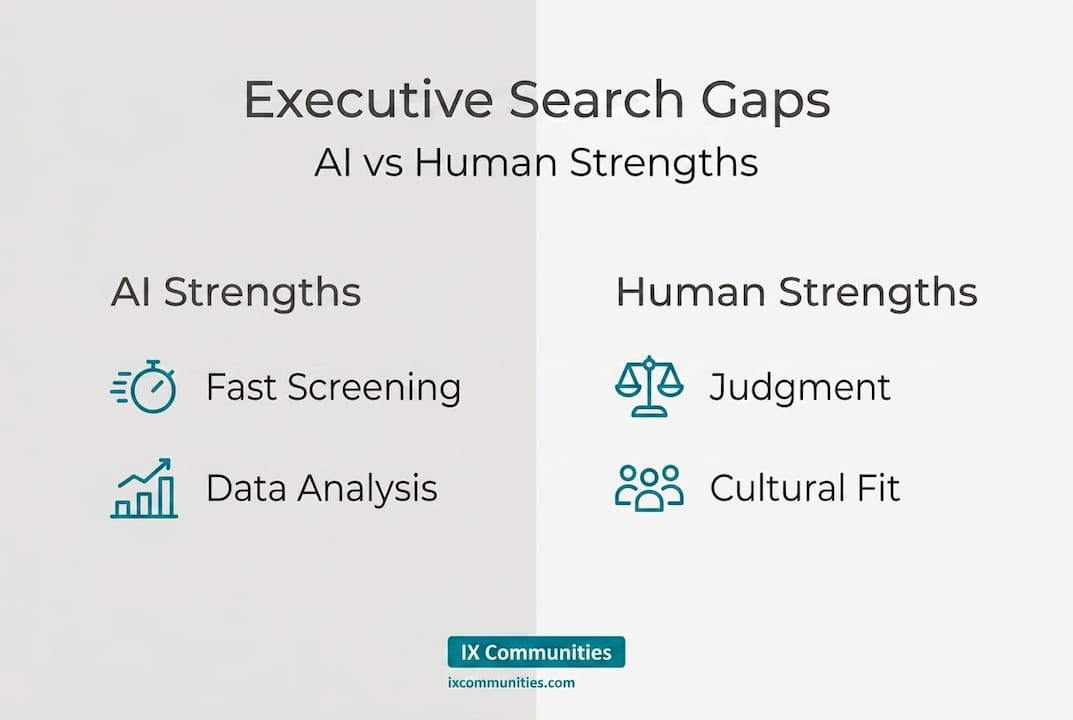
However, the AI in executive search finding is consistent: AI delivers time and efficiency gains in early-stage screening, but falls short on final decision-making. Once the process moves to evaluating leadership potential, organizational fit, and stakeholder alignment, human judgment is not optional.
Critical moments where human discretion must lead:
- Final shortlist selection, where judgment about fit and leadership character matters most
- Reference conversations that reveal candid context about performance
- Offer negotiation, which requires reading candidate motivation and priorities
- Onboarding design, which depends on understanding how the individual leads and learns
Tracking AI adoption trends across peer organizations can help calibrate where AI is adding genuine value versus where it is creating false confidence. Drawing on network insights on AI from experienced talent leaders provides a practical check on vendor claims.
Pro Tip: Use AI to surface a broad, data-rich candidate pool in the early stages. Apply rigorous human review for final shortlist decisions and every stage that follows.
Why the 'AI will revolutionize executive search' narrative misses the point
The dominant narrative positions AI as a transformative force that will soon close every gap in executive recruiting. That framing is not accurate, and acting on it carries real risk.
The most effective organizations are not asking whether AI will replace human judgment in executive search. They are identifying precisely where AI creates speed and reach, and where human expertise creates quality and accountability. Those are different contributions. Treating them as interchangeable is where costly hiring mistakes begin.
As research on the human factor in executive recruiting makes clear, executive search is fundamentally about trust, judgment, and relationships as much as data. Those elements are not formulaic. They are not automatable. And organizations that surrender them to the algorithm are not gaining an edge. They are giving one up.
The competitive advantage in executive search belongs to organizations that use AI for what it does well and protect the space where human expertise is irreplaceable. That means rethinking AI boundaries with clear protocols, not just deploying the latest tool.
Connect with experts shaping the future of executive recruiting
For leaders working to build a more rigorous, effective approach to executive recruiting, IXCommunities provides the resources, peer insights, and benchmarking tools to support that work.
Through industry benchmarks, members can assess where their AI integration practices stand relative to peer organizations. The peer mentoring program connects talent leaders with experienced practitioners who have navigated the same AI and executive search challenges. For recruiting professionals, the recruiter mentorship program offers structured guidance for building a high-trust, high-performance hiring practice. These are practical resources for leaders who want to move beyond vendor claims and into applied knowledge.
Frequently asked questions
Can AI fully replace human judgment in executive recruiting?
No, AI cannot replicate the nuanced judgment and contextual decision-making of experienced executive recruiters. Specifically, AI lacks the ability to evaluate intangible leadership qualities and complex fit factors that determine executive success.
How does AI introduce bias in executive hiring?
AI can reinforce historical biases if its training data mirrors past demographic trends among executives. Research confirms that bias in historical data results in AI recommending less diverse candidate pools for senior roles.
What are the best uses of AI in executive recruiting?
AI is best suited to high-volume sourcing, initial screening, and data-driven pattern recognition across large candidate pools. Research shows that AI speeds up sourcing and screening but still requires human discretion for executive appointments.
How can companies minimize AI risk in executive search?
Organizations should pair AI tools with structured human review at every consequential decision point and conduct regular algorithm audits. Combining AI with human oversight and bias checks consistently produces more equitable and effective outcomes.
Is there a community for sharing AI recruiting best practices?
Yes, peer mentoring programs and professional communities like IXCommunities offer structured environments where talent leaders can share strategies, benchmark practices, and refine their approach to AI integration in recruiting.