

Nearly 87% of companies now report using AI in recruiting, yet most talent leaders privately acknowledge the gap between vendor promises and day-to-day outcomes. The excitement around AI in executive search is real, but so is the confusion. Which tools are peers actually deploying? Where are the measurable gains, and where does AI consistently fall short in senior hiring? This article separates benchmark data from noise, profiles how leading firms are integrating advanced platforms, and gives talent acquisition leaders a grounded view of where AI investment genuinely pays off in 2026.
Table of Contents
- Where AI delivers real value in executive search
- AI in action: How leading firms use advanced tools
- Adoption at scale: Industry-wide benchmarks and current maturity
- Caveats, risks, and the human edge in executive hiring
- Why the future of executive search is hybrid—Here's what most leaders get wrong
- Accelerate your executive search transformation with proven solutions
- Frequently asked questions
Key Takeaways
| Point | Details |
|---|---|
| AI delivers speed and accuracy | AI has slashed search and administrative time in executive recruiting, especially for candidate sourcing and market mapping. |
| Most adoption remains basic | While adoption is widespread, most firms still operate at low maturity with hybrid systems outperforming full automation. |
| Human judgment is essential | For leadership fit and strategic alignment, human insight remains irreplaceable alongside AI tools. |
| Risks require vigilance | Bias, over-reliance, and readiness gaps can undermine AI’s benefits without careful oversight. |
| Winners blend tech and people | The best-performing teams use AI for workflow bottlenecks but preserve high-level judgment for executive appointments. |
Where AI delivers real value in executive search
AI now demonstrably improves several stages of executive search. The strongest returns appear in candidate sourcing, initial screening, market mapping, and administrative task automation. These are high-volume, repeatable activities where AI's speed and pattern-recognition capabilities outperform manual workflows.
The numbers are significant. AI delivers 30 to 66% reductions in time-to-interview and admin workload, according to data from Korn Ferry, Nexus, and Savannah MapX. Korn Ferry specifically recorded a 66% decline in time-to-interview after integrating AI-assisted sourcing and screening into its executive search workflows. Those are not marginal improvements. They represent hours recovered per search that can be redirected toward deeper candidate engagement and client advisory work.
| Workflow area | Before AI integration | After AI integration |
|---|---|---|
| Time-to-interview | 18 to 24 days | 8 to 12 days |
| Admin hours per search | 20 to 30 hours | 8 to 12 hours |
| Market mapping accuracy | Manual, inconsistent | Systematic, real-time |
| Candidate pipeline volume | Limited by researcher capacity | Scaled 3 to 5x |
Platforms like Savannah MapX are showing how AI-powered market mapping generates real-time talent intelligence that was previously impossible at scale. Instead of a researcher manually tracking career moves across 200 targets, AI tools continuously monitor movement, surface emerging candidates, and flag gaps in the pipeline.
Key areas where AI adds measurable value:
- Sourcing: Broader reach, faster identification of passive candidates
- Screening: Consistent application of criteria across large candidate sets
- Market mapping: Real-time tracking of talent pools and career movements
- Administrative automation: Scheduling, reporting, status updates, and documentation
Review Execsmart case studies to see how organizations have structured these workflows in practice, and compare your current state against benchmarks for AI adoption across your peer group.
Pro Tip: Prioritize AI deployment at the specific workflow bottleneck costing your team the most time. A single high-friction step, such as initial market mapping, often delivers more ROI than broad tool rollout across every stage.
AI in action: How leading firms use advanced tools
Korn Ferry and Heidrick & Struggles represent two of the clearest examples of how top-tier firms integrate AI into talent intelligence and simulations at the senior-executive level. Both firms have moved beyond basic resume screening to deploy AI in leadership evaluation, behavioral assessment, and immersive simulation environments.
Korn Ferry's platform layers AI against decades of executive performance data to generate predictive assessments of candidate leadership potential. The system does not simply match keywords; it identifies patterns associated with executive success in specific organizational contexts. Heidrick & Struggles' Heidrick Immersive platform uses AI-driven simulation to evaluate candidates against real-world leadership scenarios, adding behavioral data that traditional interviews cannot capture.
| Platform capability | Korn Ferry | Heidrick & Struggles | General AI tools |
|---|---|---|---|
| Talent sourcing | Advanced | Advanced | Standard |
| Leadership assessment | Predictive AI models | Simulation-based | Limited |
| Behavioral evaluation | Data-driven scoring | Immersive scenarios | Minimal |
| Market intelligence | Real-time mapping | Targeted | Basic |
"The role of the consultant is not diminished by AI. It is elevated. AI handles what scales. Humans provide what cannot be replicated: judgment, trust, and context." This captures the operating philosophy now guiding most sophisticated executive search practices.
Organizations integrating AI integration for C-suite hiring are learning that the highest-value applications sit at the intersection of data richness and human interpretation. AI surfaces the signal; experienced search professionals decide what the signal means for a specific client, culture, and leadership mandate.
Notable capabilities now available in leading platforms:
- Automated shortlisting with configurable criteria weighting
- AI-generated candidate summaries for panel review
- Continuous pipeline monitoring between active searches
- Structured interview guide generation based on role-specific competencies
Use leadership assessment benchmarks to understand which assessment approaches are gaining traction among peers, and explore Execsmart AI assessment tools for practical implementation guidance.
Adoption at scale: Industry-wide benchmarks and current maturity
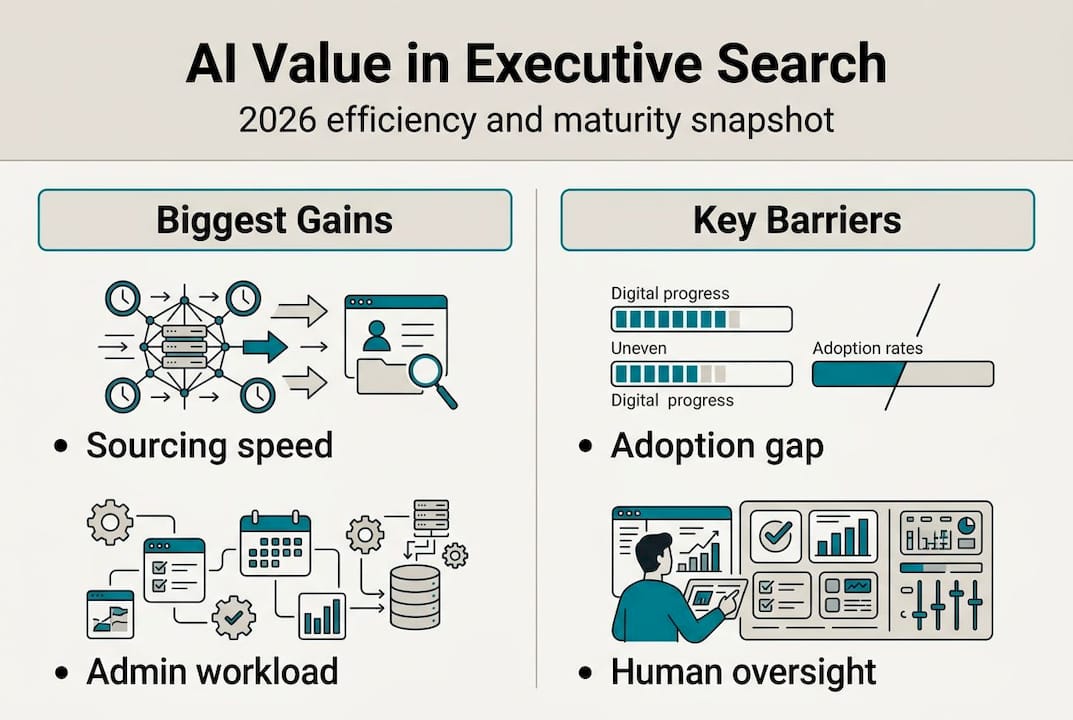
The adoption numbers signal broad movement, but the maturity picture is more nuanced. 87% AI usage in recruiting is confirmed by Disher Talent and supported by DemandSage and Korn Ferry data, with 84% of talent leaders planning further deployment in 2026. That is near-universal adoption at the surface level.

But maturity tells a different story. Most organizations are still applying AI to basic tasks: resume parsing, job description writing, and initial screening filters. Only a fraction have progressed to predictive analytics, leadership evaluation, or integrated talent intelligence platforms.
A critical data point: only 11% of executives feel prepared to lead in an AI-driven environment. That gap between tool adoption and leadership readiness is the defining challenge for talent acquisition functions in 2026.
| Organization size | AI adoption rate | Efficiency gain reported | Maturity level |
|---|---|---|---|
| Large enterprise (10,000+) | 92% | 40 to 60% | Moderate |
| Mid-market (1,000 to 9,999) | 85% | 25 to 45% | Early to moderate |
| Smaller corporate (under 1,000) | 70% | 15 to 30% | Early |
Review how peers at a similar scale are approaching adoption through executive search industry adoption insights and community benchmarking resources.
Steps for advancing from basic to mature AI use in executive search:
- Audit current workflows to identify where AI is already present and where manual steps dominate
- Establish baseline KPIs for time-to-hire, sourcing reach, and candidate quality before expanding tools
- Pilot AI in one high-volume workflow before broader rollout
- Train recruiters and search professionals on interpreting AI-generated outputs, not just using the tools
- Review outcomes quarterly against peer benchmarks to calibrate pace of expansion
Caveats, risks, and the human edge in executive hiring
AI's measurable gains in speed and volume do not translate uniformly to executive search outcomes. AI struggles with nuanced leadership fit; assessing whether a candidate has the judgment, cultural alignment, and interpersonal influence required at the C-suite level remains beyond what current tools handle reliably. Harvard Business Review's 2026 analysis concluded that hybrid human-AI approaches are necessary precisely because the highest-stakes dimensions of senior hiring resist algorithmic resolution.
Common risks that talent acquisition leaders report:
- Algorithmic bias: AI trained on historical data can perpetuate patterns that limit diversity
- Over-reliance on screening scores: High AI scores do not guarantee executive performance
- Loss of candidate experience: Automated interactions at the senior level can damage employer brand
- Misalignment with organizational culture: AI cannot assess the informal, contextual elements that define leadership fit
- Skill atrophy: Search professionals who defer too much to AI outputs may lose critical assessment capabilities over time
Understand the bias and readiness concerns shaping current AI governance discussions across the industry.
"AI in executive search works best when it extends human capability rather than replacing it. The firms getting results are those where technology amplifies the judgment of experienced search professionals, not those treating AI as a substitute for that judgment."
Connect with peers navigating these challenges through peer mentoring on AI pitfalls, where talent leaders share real-world experiences managing the human-AI balance in senior hiring.
Pro Tip: Assign a senior search professional to review every AI-generated shortlist before it reaches the client. This single step reduces bias risk and maintains quality control without sacrificing the time savings AI provides.
Why the future of executive search is hybrid—Here's what most leaders get wrong
Most conversations about AI in executive search focus on the tools. The harder question is organizational: who owns AI output quality, how do you calibrate human oversight, and where does your team's judgment actually add irreplaceable value?
Top performers see 40 to 90% efficiency gains, yet only 1 in 10 executives feel AI-ready. That gap is not a technology problem. It is a capability and governance problem.
The leaders winning in this environment are not those with the most sophisticated AI stack. They are those who have deliberately decided where human judgment is non-negotiable and structured their teams accordingly. They use AI to handle sourcing velocity and administrative load. They protect human time for candidate relationship development, final assessment, and client advisory work.
The practical step most teams overlook is a structured audit of their current human-AI balance. Where are your people spending time on tasks AI could handle? Where is AI currently making calls your team should be making?
Pro Tip: Audit your team's weekly activities against the AI capability list in this article. Any task appearing in the AI-strength column that your team still handles manually is an efficiency opportunity. Any task in the human-judgment column currently delegated to AI output is a quality risk.
Access membership community insights to benchmark your current hybrid model against peers at a comparable scale and organizational maturity.
Accelerate your executive search transformation with proven solutions
The evidence is clear: executive search functions that benchmark rigorously and build structured AI integration frameworks consistently outperform those that adopt tools reactively. For talent acquisition leaders managing global teams, the next step is connecting with peers who have navigated the same decisions.
IX Communities provides the tools, peer mentoring, and curated research that talent leaders need to move from early AI adoption to mature, measurable performance. Explore benchmark surveys to understand where your organization stands relative to the industry, and review membership opportunities to access the full range of community resources built specifically for senior talent and recruiting leaders.
Frequently asked questions
What areas of executive search benefit most from AI?
AI offers the greatest value in sourcing, screening, and market mapping by improving speed and accuracy across talent acquisition workflows. Time-to-interview reductions of 30 to 66% are reported by organizations with structured AI integration in these areas.
Are most firms using AI for executive search in 2026?
Yes, 87% of companies report using AI in recruiting, but most organizations remain at an early maturity level with limited use cases beyond basic screening and sourcing.
What are the main limitations or risks of using AI in executive search?
AI struggles with leadership nuance, cultural fit assessment, and can reinforce existing bias when trained on historical hiring data without careful oversight and correction.
Is a fully automated hiring process effective for executive roles?
No. A hybrid approach combining AI efficiency for high-volume tasks with human judgment for final assessment and relationship development produces the best outcomes in senior hiring.
How can talent leaders start advancing AI maturity in executive search?
Begin by applying AI to repeatable, high-volume tasks, establish baseline KPIs, and maintain structured human oversight of all outputs. Thoughtful integration and benchmarking against peer organizations consistently produces better results than broad, unstructured tool adoption.