

Most large organizations have invested significantly in recruiter training over the past decade. Yet a striking gap persists: the majority of those programs still focus on execution tasks like sourcing, scheduling, and compliance checklists, while the talent market increasingly demands recruiters who can act as strategic advisors, interpret data, and work alongside AI tools with sound judgment. The result is a skills deficit that shows up in slower hiring, weaker stakeholder relationships, and missed opportunities to influence business outcomes. This guide addresses that gap directly, offering talent leaders a structured way to rethink, rebuild, and measure recruiter training for the environment ahead.
Table of Contents
- Why recruiter training must evolve: AI and market forces
- Strategic skills for future recruiters: Beyond basic sourcing
- Integrating AI into recruiter training: Risks, benefits, and frameworks
- Building and benchmarking recruiter training programs
- Our take: What most recruiter training misses in 2026
- Take your recruiter training further with IX Communities
- Frequently asked questions
Key Takeaways
| Point | Details |
|---|---|
| AI requires new recruiter skills | Recruiters must build strategic, legal, and ethical expertise as AI transforms their roles. |
| Research-backed training beats traditional DEI | Evidence-based frameworks are proven to deliver better outcomes than generic compliance modules. |
| Benchmarking ensures lasting impact | Measuring recruiter training with peer surveys and data leads to ongoing improvement and success. |
| Strategic advice is a must-have | Recruiters who advise business stakeholders add more value than those who simply source candidates. |
Why recruiter training must evolve: AI and market forces
The talent market is not the same environment recruiters trained for five years ago. Two converging forces are making that clear. First, the supply of entry-level candidates is shrinking. Gartner warns of entry-level decline pressuring HR departments to perform at a higher level with fewer traditional pipelines to draw from. Second, AI tools are reshaping what recruiters actually do each day, automating the transactional elements of the role and creating space for higher-value work.
Those shifts raise the baseline for what good recruiting looks like. Stakeholders inside large organizations now expect recruiters to interpret labor market data, advise on hiring strategy, and navigate complex workforce planning conversations. Sourcing a candidate is no longer the defining skill. The ability to advise a business unit leader on talent availability, compensation benchmarks, and hiring timeline trade-offs is.
The compliance training problem
Many organizations responded to these changes by layering more compliance and DEI training onto existing programs. The evidence for that approach is not encouraging. Generic DEI trainings are ineffective when compared to research-backed methods that target specific behavior change, accountability structures, and measurable outcomes. Organizations that continue to rely on annual checkbox-style modules are not building recruiter capability. They are satisfying an administrative requirement.
This is not an argument against inclusion or compliance. It is an argument for better design. Research-backed DEI frameworks produce stronger results because they are tied to real job scenarios, reinforced over time, and connected to performance expectations rather than treated as a standalone event.
"AI elevates recruiters to strategic roles but requires training on bias and legal risks. Generic DEI trainings are ineffective. Organizations that overlook research-backed methods are leaving recruiter capability on the table." (Source: HBR)
What this means for training leaders
The forces reshaping the talent market also reshape what training must accomplish. Consider how organizations approaching global hiring strategies for 2026 are recalibrating recruiter skills requirements to reflect local market nuance, regulatory complexity, and cross-functional advisory responsibilities. Training programs built around administrative competencies cannot meet those requirements.
Key forces reshaping recruiter training needs today:
- Shrinking entry-level talent pools increasing pressure on recruiter quality and strategy
- AI-driven automation replacing transactional sourcing tasks
- Stakeholder expectations shifting toward advisory and consultative recruiter roles
- Legal and ethical complexity around AI tools demanding new compliance knowledge
- Inadequate DEI training frameworks producing no measurable change in recruiter behavior
Strategic skills for future recruiters: Beyond basic sourcing
With these market forces in context, the question becomes specific: which skills actually differentiate a high-performing recruiter in a large organization? Members of peer networks have consistently reported that the shift from execution to strategic advising is the most difficult transition for recruiter teams to make. It requires a different set of capabilities, and those capabilities require intentional training investment.

The core skill categories
The following table outlines the skill areas that separate execution-focused recruiters from those operating at a strategic advisory level:
| Skill area | Execution-level recruiter | Strategic-level recruiter |
|---|---|---|
| Stakeholder engagement | Provides candidate updates | Advises on hiring strategy and workforce planning |
| Data use | Tracks pipeline metrics | Interprets labor market data for business decisions |
| DEI knowledge | Completes annual training | Applies research-backed frameworks to sourcing and assessment |
| AI literacy | Uses tools as directed | Evaluates AI output, flags bias, understands legal risk |
| Legal compliance | Follows EEOC basics | Applies NIST and EEOC standards to AI-assisted hiring |
The gap between those two columns is where recruiter training programs need to focus. AI elevates recruiters to strategic roles but also introduces training requirements for bias recognition, EEOC compliance, and NIST risk frameworks that most current programs do not address.
Building advisory competency
Strategic advising is a learnable skill, not a personality trait. Recruiters who understand how to frame a talent market briefing for a VP of Engineering, or how to present hiring timeline trade-offs with supporting data, create measurable value for their organizations. Training programs that develop those skills need to include scenario-based exercises, structured coaching conversations, and feedback from senior stakeholders.
The future skills every recruiter needs include stakeholder communication frameworks, structured interviewing competency, and the ability to translate AI-generated data into business language. These are not soft skills. They are technical communication skills tied to specific business outcomes.
Pro Tip: Build stakeholder advisory training into your recruiter onboarding program from day one, not as an advanced module for experienced staff. Recruiters who learn advisory habits early adapt faster and require less retraining later.
A structured development path
For teams building or rebuilding recruiter capability, a phased approach works better than trying to train everything at once. Here is a practical sequence:
- Assess current skill gaps against a defined strategic competency model.
- Build baseline AI literacy training covering how tools work, where bias enters, and what legal standards apply.
- Introduce stakeholder advisory frameworks with scenario-based practice and structured feedback.
- Add research-backed DEI modules tied to real sourcing and assessment processes.
- Implement ongoing benchmarking to track progress and identify persistent gaps.
This sequence works because it builds skills in the order recruiters will actually use them. Organizations building a recruiting function from the ground up or restructuring existing teams benefit from this phased model because it connects training investment to role clarity and business outcomes at each stage.
Integrating AI into recruiter training: Risks, benefits, and frameworks
AI tools are already embedded in recruiting workflows across most large organizations. The training question is no longer whether to train recruiters on AI. It is how to do that in a way that captures efficiency gains while managing the legal and ethical risks that come with AI-assisted hiring decisions.
Where AI adds value
AI tools can accelerate candidate screening, surface passive talent, generate first-draft job descriptions, and provide labor market data that would take a recruiter hours to compile manually. Those efficiency gains are real. They free up recruiter time for higher-value advisory work. But they also create a false sense of confidence if recruiters treat AI outputs as objective or final rather than as a starting point requiring human review.
The comparison below summarizes the core trade-offs talent leaders need to factor into training design:
| AI integration factor | Benefit | Risk if untrained |
|---|---|---|
| Resume screening automation | Faster initial candidate review | Algorithmic bias filtering out qualified candidates |
| Candidate sourcing tools | Expanded passive talent reach | Reinforcing historical hiring patterns |
| Interview scoring software | Consistent evaluation criteria | Legal exposure under EEOC guidelines |
| Compensation data analysis | Faster market benchmarking | Overreliance on potentially biased data sets |
| Job description generation | Reduced administrative burden | Unintentional exclusionary language |
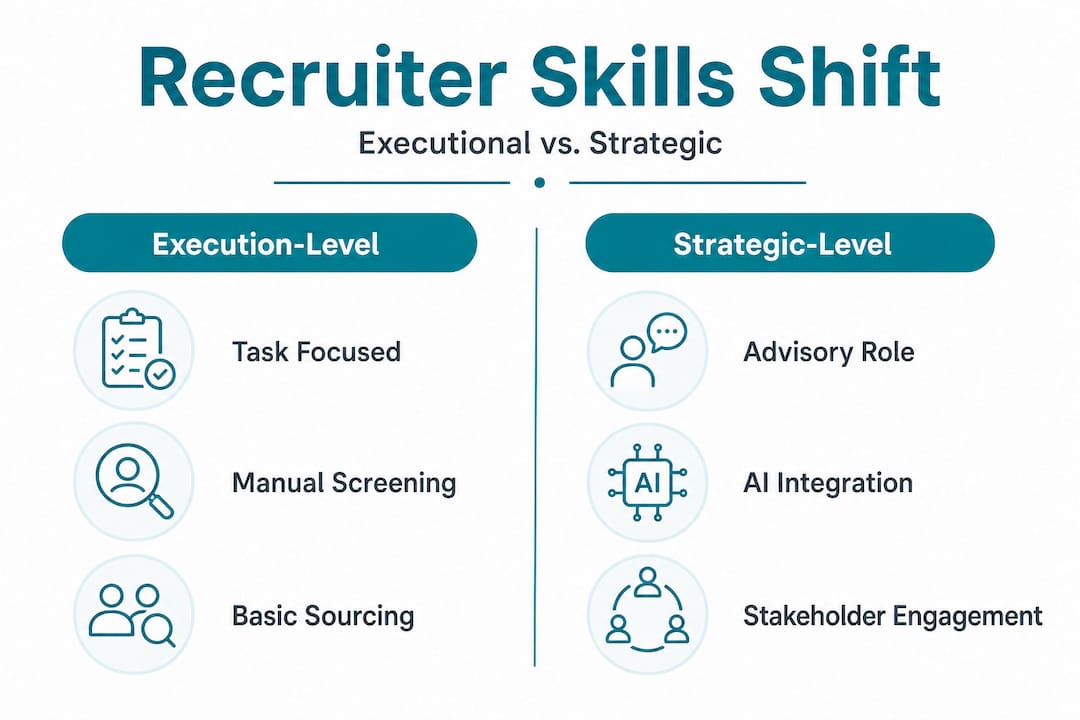
AI elevates recruiter roles but requires training on bias and legal risks. EEOC and NIST frameworks provide specific guidance on how AI tools must be evaluated for adverse impact and fairness. Recruiters who cannot articulate those standards create legal exposure for their organizations every time they use an AI tool in a selection decision.
Governance models that reduce risk
Effective AI governance in recruiting does not require a legal team in every hiring decision. It requires a clear framework that recruiters understand and can apply. Strong AI governance strategies for hiring typically include three elements: documented AI tool selection criteria, regular bias audits of AI-generated outputs, and recruiter training on how to challenge or override AI recommendations when warranted.
Organizations serious about AI transformation in recruiting are learning that the governance layer is as important as the tool selection itself. A recruiter using a well-governed AI framework will outperform one using a superior tool with no framework, because human judgment remains the final checkpoint in every hiring decision.
Pro Tip: Require recruiters to document at least one specific instance per quarter where they overrode or questioned an AI tool recommendation. This builds critical evaluation habits and creates an audit trail that supports EEOC compliance.
Training for candidate authenticity
One underaddressed area in AI training is how recruiters evaluate AI-driven candidate authenticity. As candidates use AI tools to prepare applications, resumes, and interview responses, recruiters need skills to distinguish genuine capability from AI-polished presentation. That distinction matters enormously for predicting actual job performance, and it requires structured training on interview design, behavioral questioning, and evaluation calibration.
Key training elements for AI-integrated recruiting programs:
- EEOC and NIST compliance modules specific to AI tool usage in hiring
- Bias recognition exercises using real AI-generated screening outputs
- Governance framework training covering documentation and audit requirements
- Candidate authenticity assessment skills for AI-influenced application environments
- Data interpretation skills for translating AI analytics into stakeholder-ready insights
Building and benchmarking recruiter training programs
Training design and program delivery matter, but neither produces lasting results without a measurement framework. Talent leaders who cannot demonstrate the impact of recruiter training on hiring quality, time to fill, or stakeholder satisfaction will struggle to protect and scale that investment over time.
Designing programs that work
Research is consistent on this point: generic DEI trainings are ineffective and the same principle extends to generic skills training of any kind. Effective recruiter development programs share several design characteristics. They are anchored to specific job scenarios rather than abstract principles. They include practice, feedback, and reinforcement over time rather than a single training event. They are tied to measurable performance outcomes rather than completion rates.
Here is a practical sequence for building a structured recruiter training program:
- Define the target competency model based on your organization's current and future recruiting needs.
- Conduct a baseline skills assessment to identify priority gaps across the team.
- Select research-backed training methods for each competency area, including structured role plays, case studies, and coached practice.
- Build in reinforcement touchpoints at 30, 60, and 90 days post-training.
- Establish benchmarking metrics tied to business outcomes, including hire quality, stakeholder satisfaction, and compliance audit results.
- Review and update the program on a defined cycle, at minimum annually, to incorporate new AI tool developments and market changes.
Measuring impact over time
The following table outlines practical benchmarking dimensions for recruiter training programs in large organizations:
| Benchmarking dimension | What to measure | Frequency |
|---|---|---|
| Hire quality | Hiring manager satisfaction scores, 90-day performance ratings | Per hire, quarterly summary |
| Compliance | EEOC audit results, AI bias review outcomes | Semi-annual |
| Stakeholder engagement | Recruiter advisory activity, business partner ratings | Quarterly |
| DEI progress | Pipeline diversity metrics, sourcing channel analysis | Quarterly |
| AI literacy | Assessment scores, governance documentation completion | Annual with spot checks |
Connecting training outcomes to these recruiting best practices benchmarks gives talent leaders the data they need to justify program investment, identify underperforming modules, and make iterative improvements with confidence rather than guesswork.
Our take: What most recruiter training misses in 2026
Most recruiter training programs are built around what is easy to measure, not what actually changes recruiter performance. Compliance completion rates are trackable. Strategic advising capability is harder to quantify. So organizations default to the former and wonder why recruiter effectiveness does not improve.
The real gap in recruiter training is not a skills curriculum problem. It is a design philosophy problem. Programs are still built around what recruiters need to know rather than what they need to be able to do in a real business conversation. That distinction matters enormously. A recruiter who can pass a compliance quiz is not necessarily a recruiter who can navigate a difficult conversation with a hiring manager about candidate quality versus hiring speed.
What talent leaders often overlook is that AI tools do not resolve this problem. They accelerate it. An AI tool can give a recruiter better data in less time. But if that recruiter lacks the advisory skills to translate that data into a credible business recommendation, the efficiency gain produces no strategic value. The organization has faster information and the same quality of conversation.
The other overlooked factor is accountability. Research consistently shows that generic DEI trainings are ineffective in part because they carry no accountability mechanisms. The same dynamic applies to strategic skills training. Recruiters who complete modules but face no expectation of behavior change will not change their behavior. Training design must include manager accountability, performance expectations, and regular review to produce results that persist beyond the training event itself.
The organizations getting this right are treating recruiter development as a continuous practice, not a periodic event. They are integrating coaching, peer learning, and structured benchmarking into the recruiter role itself rather than treating training as something separate from daily work.
Take your recruiter training further with IX Communities
Talent leaders who want to move from program design to measurable impact need more than a content library. They need access to peer benchmarks, structured mentorship, and a network of professionals solving the same challenges at comparable scale.
IX Communities, through ESIX and TLIX, provides exactly that environment. Members access peer mentorship programs built specifically for recruiter development, structured benchmarking tools that allow talent teams to compare training outcomes against peer organizations, and a leadership networking community where talent acquisition leaders share what is working, what is not, and where the field is heading. These resources are available in a secure, peer-driven environment designed for large corporate talent and recruiting departments.
Frequently asked questions
What are the top skills recruiters need for AI-driven roles?
Future recruiters need advanced advising, stakeholder management, bias mitigation training, and knowledge of EEOC/NIST legal standards, as AI elevates recruiters to strategic roles while also introducing new legal and ethical requirements.
How can talent leaders avoid ineffective recruiter training programs?
Replace generic DEI modules with evidence-backed frameworks and integrate real benchmarking tools for ongoing impact, since generic DEI trainings are ineffective at producing sustained behavior change.
What legal risks should recruiters be trained for in 2026?
Recruiters should focus on mitigating bias and understanding compliance standards from EEOC and NIST when using AI, as AI in hiring decisions carries specific legal exposure under existing federal guidelines.
How should recruiter training programs be benchmarked for effectiveness?
Talent leaders should use peer surveys, data-driven assessment models, and regular review cycles to benchmark recruiter training outcomes, moving beyond completion rates to actual performance and compliance metrics, consistent with evidence that generic training methods are ineffective without accountability structures.