

A single mis-hire at the executive level can cost an organization more than 213% of the role's annual salary, and the ripple effects on culture, strategy, and team morale compound that figure quickly. Yet most large corporations still rely on ad-hoc processes, outdated vendor relationships, or generalist HR teams to fill their most critical roles. Building a structured executive recruiting function addresses this gap directly. This guide walks through every major step: from defining objectives and choosing an operating model, to staffing your team, selecting technology, and measuring results over time.
Table of Contents
- Laying the foundation: Defining your executive recruiting objectives
- Designing your executive recruiting model: In-house, outsourced, or hybrid?
- Building the team: Key roles, skills, and structure
- Equipping for success: Tools, technology, and recruiting processes
- Scaling and refining: Measuring success and continuous improvement
- Why most executive recruiting functions stall—and how to avoid it
- Take your executive recruiting to the next level
- Frequently asked questions
Key Takeaways
| Point | Details |
|---|---|
| Align recruiting with strategy | Connect your executive recruiting objectives to company goals for maximum impact. |
| Choose the right recruiting model | In-house, agency, or hybrid models all offer unique advantages for executive recruitment. |
| Build a diverse recruiting team | A cross-functional team structure ensures effective and unbiased hiring. |
| Leverage technology and process | The right tools and processes streamline executive recruiting and improve candidate experience. |
| Embrace continuous improvement | Monitor results, gather feedback, and evolve your executive recruiting function over time. |
Laying the foundation: Defining your executive recruiting objectives
The first step is to clarify your objectives. Without a clear purpose, even a well-staffed recruiting function will produce inconsistent results. Strong executive recruiting begins with understanding why the function exists and what it is accountable for delivering.
Start by identifying the business drivers behind your executive hiring needs. Are you entering new markets? Replacing retiring leadership? Building capabilities for a product pivot? Each scenario calls for a different profile of talent and a different level of urgency. Linking recruiting strategies with business objectives ensures stronger buy-in and more impactful results.
Next, define the scope of the function. Will it cover all VP-level and above roles across all business units? Or will it focus on specific functions like technology, finance, or operations? Clarity here prevents scope creep and helps you allocate resources effectively. You can also use C-suite recruiting strategies to calibrate scope against industry norms.
Once scope is defined, set measurable outcomes:
- Time to fill: Target a specific number of days for executive roles from requisition to accepted offer
- Diversity representation: Set baseline and improvement goals for underrepresented groups at the leadership level
- Quality of hire: Define what success looks like at 90 days, 6 months, and 12 months post-hire
- Retention rate: Track two-year retention for executive hires as a lagging indicator of fit
Stakeholder alignment is critical at this stage. The executive recruiting function will need support from the CHRO, CFO, and line-of-business leaders to access resources and move fast when needed. Review benchmarking best practices to understand how peer organizations set their targets, and revisit defining talent leadership to ensure your function's mandate reflects a modern talent strategy.
Pro Tip: Conduct structured interviews with 5 to 7 internal stakeholders before finalizing your objectives. These conversations frequently surface hidden talent pain points, such as recurring failures in a specific function or geographic expansion plans not yet reflected in the talent plan.
Designing your executive recruiting model: In-house, outsourced, or hybrid?
With a clear purpose in place, it is time to think about the operating model that will deliver those results. The three primary options each carry distinct tradeoffs.

| Model | Cost | Control | Speed | Scalability |
|---|---|---|---|---|
| In-house | High fixed cost | Full | Moderate | Limited |
| Agency/retained search | Variable, often high per-search | Low | Fast for niche | High |
| Hybrid | Moderate | Shared | Fast | High |
As each recruiting model has benefits and tradeoffs in speed, cost, and candidate quality, the right choice depends on your hiring volume, budget structure, and how quickly your leadership needs shift.
To choose and implement the right model, follow these steps:
- Audit current state: Document how executive hires have been made in the past three years, including sources, timelines, costs, and outcomes.
- Map future hiring volume: Project leadership needs over 12 to 24 months across all business units.
- Evaluate budget constraints: Determine whether your organization can sustain a full internal team or needs the cost flexibility of external partners.
- Assess internal capability: Review existing recruiting staff skills before assuming they can support executive-level search without development.
- Pilot and refine: Launch your chosen model for one to two searches, then adjust based on results before full rollout.
Use evaluating recruitment tools to assess technology fit for each model, and connect with peer mentorship in recruiting to learn how comparable organizations have navigated this decision.
Pro Tip: Hybrid models are especially effective during growth transitions. They give you internal ownership of the candidate relationship while allowing external specialists to handle sourcing in markets or functions where your team lacks networks.
Building the team: Key roles, skills, and structure
Once your recruiting model is selected, you will need to staff your function with the right mix of skills and roles. Executive search is a specialized discipline, and general recruiting skills do not automatically transfer.
The core roles in a high-functioning executive recruiting team include:
- Lead executive recruiter: Manages full search lifecycle, owns stakeholder relationships, and serves as the primary advisor to the hiring executive
- Research analyst: Builds market maps, identifies passive candidates, and tracks competitor talent movements
- Recruiting coordinator: Manages logistics, scheduling, and candidate experience throughout the process
- Diversity champion: Ensures sourcing strategies actively reach underrepresented talent pools and that assessment processes reduce bias
Hard skills for this team include executive market mapping, behavioral assessment design, offer negotiation, and data analysis. Soft skills matter just as much: discretion, executive presence, and the ability to advise C-suite leaders without losing credibility.
| Role | Reports to | Key output |
|---|---|---|
| Lead executive recruiter | CHRO or VP Talent Acquisition | Filled roles, stakeholder satisfaction |
| Research analyst | Lead executive recruiter | Candidate slates, market intelligence |
| Recruiting coordinator | Lead executive recruiter | Process efficiency, candidate experience |
| Diversity champion | CHRO or DE&I lead | Diverse slates, bias-reduced processes |
A multidisciplinary team is essential for effective, diverse executive hiring. Organizations that build cross-functional recruiting teams consistently outperform those relying on a single recruiter model.
Gaining access to recruiting expertise through professional communities can accelerate team development significantly, particularly in organizations building this function for the first time. Consider how boosting team performance principles apply directly to the recruiting team itself.
Equipping for success: Tools, technology, and recruiting processes
With the right team in place, effective technology and process are necessary to operate at scale and quality. A well-configured tech stack removes friction, improves data visibility, and creates a consistent candidate experience.
Core tools for executive recruiting include:
- Applicant tracking system (ATS): Centralizes candidate records, tracks search progress, and supports compliance documentation
- Executive sourcing platforms: LinkedIn Talent Solutions, BoardEx, and similar platforms help identify and engage passive candidates at senior levels
- Assessment software: Structured behavioral and cognitive assessments reduce subjectivity in final-stage evaluation
- Search dashboards: Real-time reporting tools that track KPIs across active searches and rolling 12-month performance
- Candidate relationship management (CRM): Maintains engagement with silver-medal candidates and long-term executive prospects
Investing in the right technological stack supports both efficiency and candidate experience, two factors that directly affect offer acceptance rates at the executive level.
Process flows matter as much as tools. Define clear stages: intake meeting with the hiring leader, sourcing and market mapping, candidate review, structured interview scheduling, reference and background verification, and onboarding handoff. Document each stage with accountable owners and expected timelines. Use exec search insights from peer organizations to validate your process design against real-world benchmarks. Also consider optimizing LinkedIn for recruitment as part of your sourcing strategy.
Pro Tip: Automate your KPI tracking from day one. Set up dashboards that pull live data on time-to-slate, candidate drop-off rates, and offer acceptance. Manual tracking creates gaps that make it impossible to improve.
Scaling and refining: Measuring success and continuous improvement
Maintaining a high-performing executive recruiting function means establishing a strong feedback and improvement cycle. Results without review lead to stagnation.
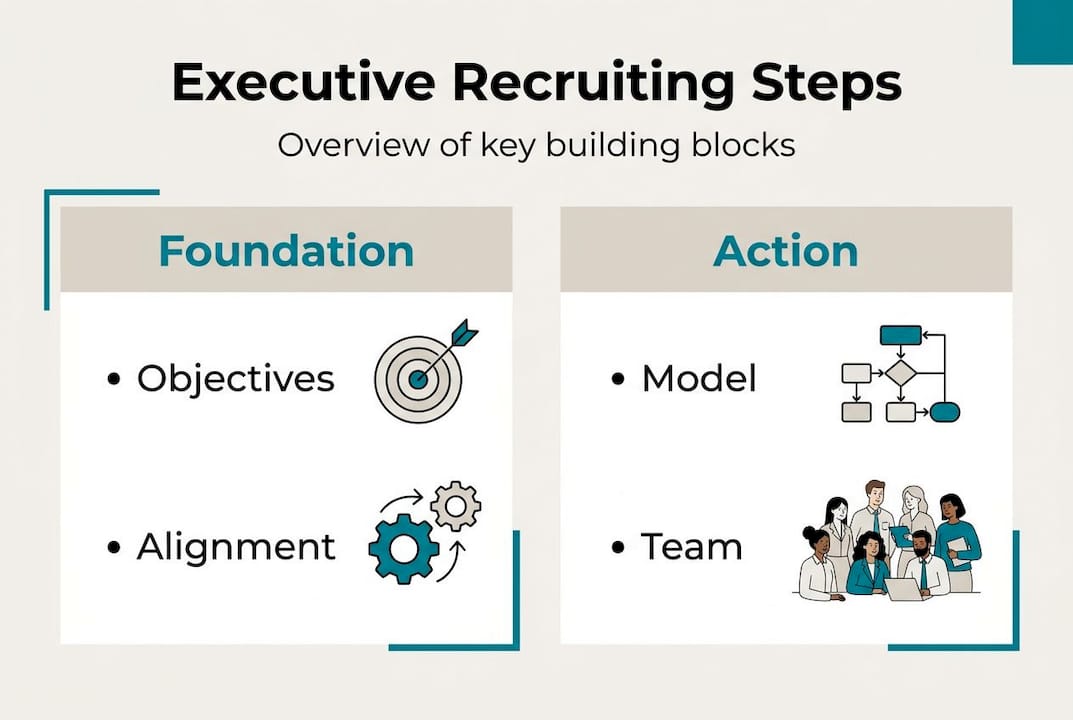
Organizations with formal benchmarking practices see up to 25% faster executive fills compared to those without structured measurement. That figure reflects the operational lift that comes from knowing where your process slows down and acting on it.
Follow these steps to build your improvement cycle:
- Define your KPI set: Time to fill, diversity of final slates, quality of hire at 12 months, and cost per hire are the foundational metrics.
- Collect stakeholder feedback: Survey hiring leaders and candidates after each search. Ask specific questions about communication, speed, and candidate quality.
- Review results quarterly: Hold a structured review with your recruiting team and HR leadership to assess performance against targets.
- Benchmark externally: Use executive recruiting benchmarks to compare your metrics against peer organizations in your industry and size tier.
- Update processes based on findings: Document changes, communicate them to the team, and measure the impact in the following quarter.
- Track year-over-year trends: Single-quarter data points can mislead. Multi-year trend analysis reveals whether your function is genuinely improving.
Understanding talent pipeline benefits also informs how your improvement cycle should factor in proactive leadership development, not just reactive search.
Why most executive recruiting functions stall—and how to avoid it
The mechanics described above are well understood by experienced talent leaders. The harder question is why so many functions, built with good intentions and solid resources, lose momentum within 18 to 24 months.
The most common cause is process drift. A recruiting function launches with clear standards, then gradually adapts those standards under pressure from urgent hires, budget cuts, or stakeholder impatience. Over time, informal workarounds replace formal process, and data quality degrades. Without data, it becomes impossible to defend the function's value or identify where it is underperforming.
A second cause is technology underutilization. Most organizations invest in the right tools and then use 30 to 40 percent of their functionality. Teams revert to familiar workflows and the investment yields little return. Discipline in tool adoption is as important as the tool selection itself.
The strongest executive recruiting functions treat their own processes as a subject of ongoing inquiry. They test new sourcing channels, run structured retrospectives after difficult searches, and actively seek deeper exec search insights from peer networks. The principle is straightforward: continuous evolution, not just best practices, determines top performance.
Take your executive recruiting to the next level
Building and sustaining a high-performing executive recruiting function requires more than a good framework. It requires access to current benchmarks, peer knowledge, and proven tools calibrated for large corporate environments.
IX Communities provides talent acquisition leaders with exactly that. Through start benchmarking today, you can compare your executive recruiting metrics against a global peer set and identify specific gaps. IX Communities Membership connects your team to a secure, trusted network of talent leadership professionals across industries. And the peer mentorship program gives your recruiters direct access to experienced practitioners who have navigated the same challenges you are facing now.
Frequently asked questions
What is an executive recruiting function?
An executive recruiting function is an organized approach or team dedicated to sourcing, assessing, and hiring senior-level leaders within an organization. A specialized function streamlines high-level talent acquisition by standardizing process, accountability, and measurement across all executive searches.
How do I choose between in-house and agency recruiting for executives?
Consider your organization's need for direct control, speed, and candidate quality. Each recruiting model has benefits and tradeoffs, and hybrid arrangements can offer both the flexibility of external partners and the ownership of an internal team.
Which metrics are most important for executive recruiting?
Track time-to-fill, candidate diversity, quality of hire, and leadership retention rates to optimize your recruiting strategy. Regular benchmarking against peer organizations provides the external context needed to interpret these metrics accurately.
What technologies do top executive recruiting teams use?
Leading teams use applicant tracking systems, AI sourcing tools, candidate relationship management platforms, and integrated assessment software. The right technological stack supports both operational efficiency and a strong candidate experience at the senior level.
How can I ensure my executive recruiting function continually improves?
Implement regular feedback cycles, conduct benchmarking, and update processes based on results and stakeholder input. Improved hiring outcomes follow directly from structured, recurring measurement and willingness to act on what the data shows.