

Many multinational companies are expanding internationally at a pace that their leadership pipelines cannot support. Global expansion is moving faster than leadership readiness, and that gap is generating measurable risk for large organizations. This article addresses four critical dimensions of leadership hiring that talent acquisition leaders must act on now: the widening readiness gap, the downstream effects of cutting entry-level hires, the importance of cultural fluency in markets like China, and the practical integration of human judgment with AI in hiring design. Each section offers concrete actions and benchmarked insights.
Table of Contents
- The leadership hiring dilemma: Global expansion vs. readiness
- Entry-level hiring reductions: Long-term leadership crisis
- Cultural fluency and localization: The China case study
- Designing for human-AI collaboration in leadership roles
- The uncomfortable truth: What global companies get wrong about leadership hiring
- Build future-ready leadership: Programs and resources
- Frequently asked questions
Key Takeaways
| Point | Details |
|---|---|
| Global expansion risks | Rapid growth outpaces leadership readiness, creating talent shortages. |
| Entry-level cuts weaken pipelines | Reducing entry-level hires undermines future leadership development. |
| Cultural fluency drives success | Locally informed leadership hiring is crucial for cross-border markets. |
| Human-AI collaboration is essential | Integrating AI with human insight delivers more effective leadership selection. |
The leadership hiring dilemma: Global expansion vs. readiness
Large multinational companies are opening offices, acquiring regional firms, and entering new markets at a rate not seen in over a decade. But the supply of leaders prepared to operate across borders, manage diverse teams, and navigate regulatory complexity is not keeping pace. The result is a structural leadership gap that is growing faster than most talent teams recognize.
Consider the numbers. International hiring has risen 50% in recent years, but leadership readiness scores in the same organizations are declining. This is not a talent shortage in the traditional sense. There are candidates. The issue is that organizations are promoting or importing leaders who lack the specific skills needed to succeed in cross-border environments.
"Leadership readiness is not just about competency. It is about whether a leader can operate effectively in an environment they have not experienced before." This distinction matters significantly when you are placing leaders in markets with different regulatory frameworks, labor norms, and cultural expectations.
The risks of unreadiness are not abstract. When a leader fails in a new market, the organization incurs direct costs including severance, re-hiring, and project delays. It also incurs indirect costs: damaged relationships with local partners, employee turnover in the affected region, and reputational harm in the local talent market.
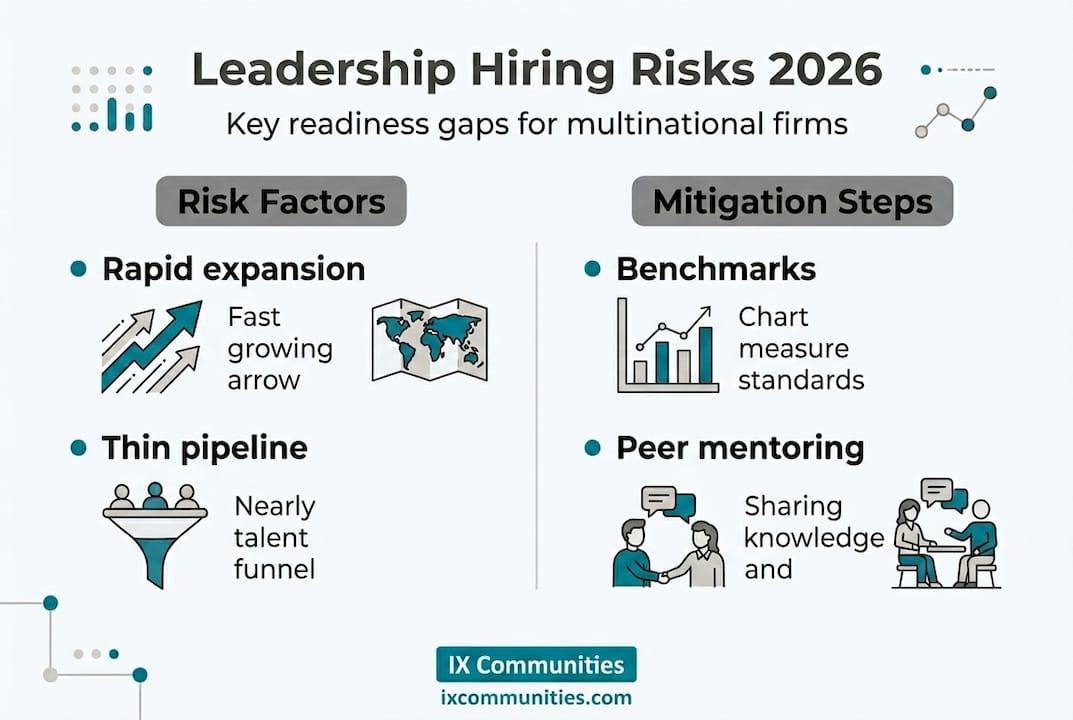
Here is a snapshot of where global companies currently stand on leadership readiness versus expansion pace:
| Dimension | Current state | Risk level |
|---|---|---|
| International hiring volume | Up 50% over 3 years | High |
| Leadership readiness scores | Declining in 6 of 10 regions | Critical |
| Cross-cultural training programs | Offered in fewer than 40% of MNCs | High |
| Succession planning for global roles | Formalized in fewer than 30% of firms | Very high |
| Pipeline development time | Average 5 to 7 years per leader | Moderate |
Talent acquisition leaders should benchmark leadership hiring practices against peers to identify where their organization sits in this landscape. Organizations that have invested in proactive leadership processes are better positioned to fill cross-border roles with prepared candidates rather than reactive placements.
The critical insight here is that global expansion does not create a readiness gap on its own. It is the absence of a long-term leadership development strategy, maintained consistently over years, that creates the gap. Companies that invest in guest speaker insights and peer learning opportunities are building awareness of this issue earlier in their planning cycles.
Entry-level hiring reductions: Long-term leadership crisis
When economic pressure builds, entry-level hiring is often the first budget line cut. This decision looks financially sensible in the short term. The long-term consequences are more serious than most executives account for.
A 37% reduction in entry-level hiring creates compounding gaps in the leadership pipeline. Entry-level roles are where future leaders learn the organization's culture, build cross-functional relationships, and develop foundational skills. When those classes shrink or disappear, the bench that would have produced managers and directors five to eight years later becomes thin. Organizations then face a choice: promote underprepared internal candidates or pay premium rates for external leadership talent.

The comparison below illustrates this dynamic clearly:
| Factor | Companies maintaining entry-level hiring | Companies reducing entry-level hiring |
|---|---|---|
| Internal promotion rate (5 yr) | 65% | 38% |
| External leadership hiring cost | Lower, stable | Higher, increasing |
| Cultural continuity in leadership | Strong | Fragmented |
| Time-to-productivity for new leaders | Shorter | Longer |
| Employee engagement scores | Higher | Lower |
To address this proactively, talent acquisition leaders should take a structured approach to protecting and developing entry-level talent even when headcount budgets are constrained.
- Audit the pipeline. Map every leadership role in the organization five to eight years out and identify which entry-level cohorts would logically feed those positions.
- Protect high-potential cohorts. Even when cutting overall volume, retain the top-performing subset of entry-level candidates who show cross-functional and adaptive capability.
- Build structured rotation programs. Give entry-level hires exposure across functions and geographies early. This accelerates leadership readiness significantly.
- Formalize mentorship. Assign senior leaders to entry-level cohorts with specific development targets. Document progress on a quarterly basis.
- Track pipeline health metrics. Monitor the ratio of internal candidates to open leadership roles. A declining ratio is an early warning sign.
Pro Tip: Structured peer mentorship for recruiters and talent acquisition teams is one of the most cost-effective ways to build institutional knowledge about pipeline health. When recruiters share what they are seeing across organizations, patterns emerge faster. Access expert hiring strategies from practitioners who have managed these transitions at scale.
The core issue is straightforward. Organizations that cut entry-level hiring in 2022 and 2023 are already beginning to see the consequences in their 2025 and 2026 leadership succession reports. The math is not complicated, but the decision to reverse the trend requires both conviction and a clear financial case made to senior leadership.
Cultural fluency and localization: The China case study
China is the most frequently cited example of global leadership hiring failure among large multinationals. The pattern is consistent and well-documented. A company entering or expanding in China promotes or relocates a leader who has performed well in other markets. That leader brings a standardized management approach, applies it to a local team, and struggles to gain traction. Business results fall short. The leader exits within 18 months.
The problem is not the leader's technical competence. The problem is the absence of cultural fluency, which includes an understanding of local business norms, communication hierarchies, regulatory relationships, and market-specific customer behavior.
MNCs in China regularly fail when they default to "safe," non-localized leadership hires. A "safe" hire, in this context, means a known quantity from another market who fits the organization's standard leader profile. In China, that profile rarely aligns with what is needed to build teams, manage government relationships, or read competitive dynamics effectively.
"Cultural fluency is not a soft skill. It is an operational requirement for leaders managing in markets where trust, hierarchy, and relationship-building follow fundamentally different rules."
What does a localized leadership hiring strategy actually look like in practice? Here are the critical components:
- Prioritize bilingual and bicultural candidates. Leaders who have lived and worked in the target market for extended periods bring insight that cannot be replicated through training programs alone.
- Assess market knowledge explicitly. Include scenario-based questions in the selection process that test familiarity with local regulatory processes, negotiation norms, and team management expectations.
- Involve local HR and business leads in the selection decision. A hiring panel in headquarters cannot fully evaluate cultural fit for a role in Shenzhen or Shanghai.
- Set a realistic integration timeline. Even highly capable leaders need 90 to 180 days to build the relationships needed to operate effectively in a new market.
- Build in structured mentorship with a local guide. This can be an internal peer or an external advisor with deep market experience.
Pro Tip: Talent acquisition leaders building international talent strategies should treat cultural fluency as a scored competency in leadership assessments, not a discussion point at the end of a panel interview. Leadership networking with peers in similar markets accelerates the identification of what "good" looks like in localized leadership hiring.
The China example applies broadly. The same principles hold in Brazil, Saudi Arabia, India, and Southeast Asia. The organizations that succeed in these markets share one common characteristic: they invest time in understanding the leadership requirements of each market before filling the role.
Designing for human-AI collaboration in leadership roles
AI-assisted hiring tools are now embedded in most large corporate talent acquisition functions. Resume screening, skills matching, interview scheduling, and candidate scoring are increasingly automated. This creates efficiency. It also creates new risks in leadership hiring specifically.
Human-AI collaboration needs thoughtful design in leadership hiring, and cultural fluency remains a dimension that AI systems routinely underweight. Leadership roles involve judgment, relationship management, and contextual decision-making. These are areas where algorithmic scoring can be misleading if not calibrated carefully.
Here is a practical framework for integrating AI and human judgment in leadership hiring:
- Use AI for initial screening only. Allow AI tools to filter candidates based on verifiable criteria: experience, education, geographic background, and language skills. Do not use AI scoring as a ranking mechanism for leadership finalists.
- Apply human panels to all leadership shortlists. Final selection for leadership roles must involve structured human evaluation, including behavioral interviews and reference checks.
- Audit AI outputs for cultural bias. Many AI hiring tools are trained on historical data that reflects existing leadership demographics. This can disadvantage candidates from markets where leadership looks different. Audit outputs quarterly.
- Design role profiles with AI in mind. When writing job requirements, distinguish between criteria that AI can assess accurately and criteria that require human evaluation. List them separately to guide your process.
- Build a feedback loop. Track the performance outcomes of leaders hired with AI-assisted screening versus those hired without. Use that data to recalibrate the AI tool's role in your process.
| Hiring stage | AI role | Human role |
|---|---|---|
| Application screening | Primary | Review exceptions |
| Skills assessment | Scoring support | Validate for senior roles |
| Cultural fluency evaluation | Not recommended | Required |
| Final selection | Not applicable | Panel decision |
| Offer and negotiation | Scheduling only | Full ownership |
| Post-hire performance review | Data aggregation | Interpretation and action |
Pro Tip: Talent teams using peer mentoring for talent leaders report faster identification of AI tool limitations. Peer benchmarking through technology for talent teams provides a structured way to evaluate which AI tools are performing effectively across similar organizations.
The fundamental principle here is that AI tools are designed to optimize for patterns in historical data. Leadership hiring for global roles often requires finding candidates who break those patterns in productive ways. That requires human judgment that no algorithm can replicate yet.
The uncomfortable truth: What global companies get wrong about leadership hiring
Most organizations approach leadership hiring as a response to a vacancy. A senior role opens. The search begins. Candidates are evaluated against the profile of the person who just left. This approach has a structural flaw that most talent leaders recognize but few organizations fix.
The leader who left was hired for a different version of the company. The role has changed. The market has changed. The team has changed. Hiring a similar profile into an evolved role sets the new leader up for the same friction the previous leader experienced.
Cutting entry-level positions compounds this problem significantly. When the pipeline is thin, hiring teams default to external searches, which default to known profiles. "Safe" hires in markets like China fail not because they are bad leaders, but because they are being evaluated against criteria that do not reflect the actual demands of the role.
The missed opportunity in human-AI hybrid strategies is also significant. Most organizations use AI to make existing processes faster. The more productive application is to use AI to identify patterns that human evaluators miss, such as non-linear career paths, underrepresented markets of origin, or cross-industry experience that correlates with leadership success in specific contexts.
What should proactive firms do differently? First, redefine leadership profiles based on where the organization is going, not where it has been. Second, protect entry-level hiring as a strategic investment, not a cost center. Third, treat cultural fluency as a scored requirement for any cross-border leadership role. Fourth, design AI's role in leadership hiring deliberately rather than defaulting to vendor recommendations.
Organizations investing in mentoring best practices and drawing on expert perspectives on hiring are building the institutional knowledge needed to avoid these structural mistakes. The firms that get this right will build leadership benches that are genuinely prepared for the next five years of global growth.
Build future-ready leadership: Programs and resources
Translating these strategies into organizational practice requires access to the right tools, peer networks, and benchmarked data.
ESIX, TLIX, and IXCommunities provide corporate talent acquisition and HR leadership teams with the resources needed to move from reactive to proactive leadership hiring. Members access leadership hiring benchmarks drawn from peer organizations at comparable scale, giving decision-makers a factual basis for building the case for pipeline investment. The peer mentoring for talent leaders program connects practitioners managing similar challenges across different industries and geographies. For talent acquisition teams specifically, recruiter mentorship programs support the development of sourcing and assessment capabilities that align with global leadership requirements. These resources are designed for large corporate environments where the stakes of leadership hiring decisions are significant and the need for peer-validated approaches is clear.
Frequently asked questions
What is the biggest risk in global leadership hiring?
The speed of global expansion outpacing leadership readiness is the top risk for multinational companies. Organizations scaling internationally without a parallel investment in leadership development face structural gaps that are costly to close after the fact.
How does cutting entry-level hires affect future leaders?
A 37% reduction in entry-level hiring creates direct gaps in the leadership pipeline by removing the candidates who would have become managers and directors over the following five to eight years. This forces organizations into expensive external leadership searches later.
Why does cultural fluency matter for leadership hires in China?
MNCs operating in China that rely on "safe," non-localized hires consistently underperform compared to those that prioritize leaders with genuine market knowledge and cultural fluency. Cultural understanding directly affects team management, partner relationships, and business results.
How can companies combine AI with human judgment in leadership hiring?
By designing roles with clear boundaries for what AI assesses and what human panels evaluate, organizations avoid bias and ensure that leadership decisions reflect the full complexity of the role. AI tools should support screening, not final selection.