

Executive recruiting has long been considered a relationship-driven discipline where personal networks and seasoned intuition drove outcomes. That view is now outdated. AI tools and advanced data analytics are reshaping how large corporations identify, assess, and land senior talent, and the recruiters who thrive will be those who build the right technical and strategic competencies before the market leaves them behind. This article covers the essential future skills, practical frameworks, and development strategies that talent acquisition leaders need to prepare their executive recruiting teams right now.
Table of Contents
- Why executive recruiting is changing
- Core skill sets for future-ready executive recruiters
- Balancing AI capabilities and human judgment in executive search
- Strategies for developing future skills in your recruiting team
- The uncomfortable truth about future recruiting skills
- Upgrade your recruiting team with IX Communities
- Frequently asked questions
Key Takeaways
| Point | Details |
|---|---|
| AI is driving change | Executive recruiting is being transformed by AI and data analytics for faster, more diverse hires. |
| Future skills are dynamic | Recruiters must combine technical, ethical, and interpersonal skills to stay relevant and effective. |
| Human judgment still matters | Technology supports process, but complex executive hires need nuanced, human decision-making. |
| Continuous upskilling is vital | Peer mentoring, benchmarking, and ongoing learning help teams keep pace with change. |
Why executive recruiting is changing
The pace of technology adoption inside talent functions at large corporations has accelerated significantly. AI is no longer a pilot program or a future investment; it is a present operational reality. The data backs this up clearly.
"AI adoption in Fortune 500 recruiting has produced measurable gains in efficiency: Unilever achieved a 90% reduction in time-to-hire and a 16% increase in diversity, while IBM recorded a 30% efficiency gain and a 60% reduction in time-to-fill."
Those are not marginal improvements. They represent fundamental shifts in how work gets done inside talent acquisition departments. Organizations that track and act on benchmark survey insights consistently report faster adaptation to these shifts than those operating without peer data.
The drivers behind these changes fall into three categories:
- AI integration at scale: Intelligent screening, predictive assessments, and automated scheduling are now standard at leading firms, freeing recruiters to focus on higher-value interactions.
- Demand for data-driven decisions: Boards and executive leadership teams expect recruiting functions to present measurable outcomes, not just anecdotal successes.
- Evolving recruiter roles: The skill profile of a high-performing executive recruiter now includes data literacy, ethical AI oversight, and the ability to synthesize market intelligence into actionable narratives.
Staying current with Execsmart tech trends and tapping into the executive search exchange community both provide structured ways for talent leaders to monitor these shifts and respond proactively.
The role is changing. The question is whether your team is changing with it.
Core skill sets for future-ready executive recruiters
Understanding that change is happening is one thing. Knowing exactly which skills to prioritize is another. The following five competency areas represent the clearest path forward for executive recruiting teams at large corporations.
1. Data analytics proficiency and interpretation
Recruiters no longer need to rely solely on hiring managers for candidate assessments. Access to labor market data, internal pipeline metrics, and predictive modeling tools means the best recruiters can build their own analysis. More importantly, they can synthesize mass data sets into clear narratives that support executive decision-making.

This is a critical point. The skill is not just reading a dashboard; it is translating complex data into concise business intelligence that a CFO or board chair can act on. A recruiter who can walk into a leadership team meeting with a structured market analysis and a prioritized talent pool recommendation is a strategic asset.
2. Ethical AI governance and bias mitigation
As AI governance becomes a compliance concern in executive search, recruiters must understand both the promise and the risk of automated screening. AI tools can reduce unconscious bias when configured correctly, but they can also encode existing organizational biases if left unsupervised.
Executive recruiters need working knowledge of how their AI tools make decisions, what data they were trained on, and where human review must be applied. This is not a technology team responsibility; it belongs inside the talent function.
3. Hybrid interviewing skills
Structured AI-assisted assessments work well for initial screening. But executive placements require judgment on factors that no algorithm fully captures: organizational politics, cultural dynamics, long-term leadership trajectory. Future-ready recruiters blend AI-generated candidate data with rigorous human evaluation techniques.
4. Advanced stakeholder management
Senior hires involve more decision-makers, longer timelines, and higher stakes than other recruiting categories. Recruiters who can manage complex internal stakeholder dynamics while maintaining candidate engagement will close more placements and maintain better relationships with hiring managers.
5. Continuous learning and adaptability
The tools available to executive recruiters in 2026 will not be the same tools available in 2028. The skill of continuous learning, specifically the ability to adopt new platforms quickly and share institutional knowledge across teams, is itself a core competency.
The executive search community provides a structured environment where practitioners can exchange knowledge on all five of these skill areas in real time, with peers who face the same challenges.
Comparison: Traditional vs. future-ready executive recruiter skill profiles
| Skill area | Traditional recruiter | Future-ready recruiter |
|---|---|---|
| Candidate sourcing | Network and referrals | AI-assisted search and market mapping |
| Assessment | Intuition and interviews | Structured data plus human evaluation |
| Reporting | Activity metrics | Outcome data and predictive analytics |
| Bias management | Informal awareness | Systematic AI governance protocols |
| Learning model | Annual training | Continuous, peer-driven education |
| Stakeholder engagement | Relationship-based | Data-informed and structured |
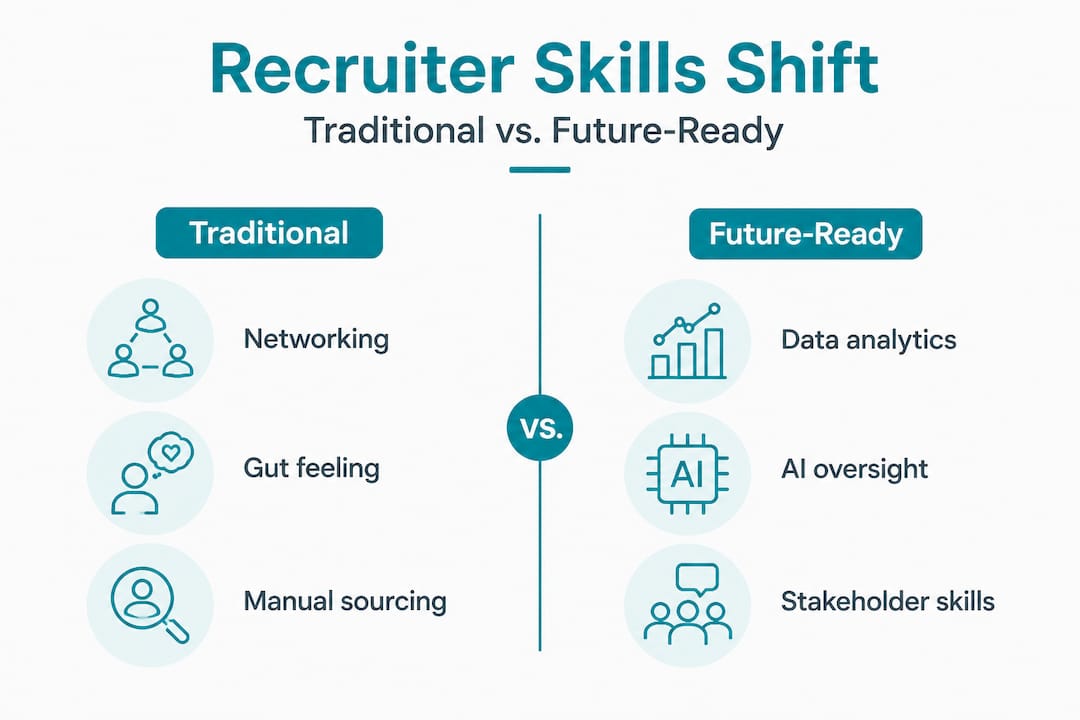
Pro Tip: When assessing your team's current skill profile, map each recruiter against these six dimensions. Gaps in the "reporting" and "bias management" rows tend to be the most common and have the most significant impact on executive search quality.
Balancing AI capabilities and human judgment in executive search
The debate about whether AI will replace executive recruiters misses the point. The more useful question is: how do you build a workflow that uses AI for what it does well and reserves human judgment for what it does best?
AI handles data digestion efficiently. It can scan thousands of professional profiles, rank candidates against structured criteria, flag potential red flags based on historical data, and schedule assessments without manual effort. What it cannot do is read the room during a final-round conversation, assess whether a candidate's leadership style fits a board that just navigated a merger, or determine whether a senior hire will thrive inside a particular organizational culture.
Recommended AI and human task allocation for executive search:
| Task | AI role | Human role |
|---|---|---|
| Initial candidate sourcing | Primary driver | Review and approve criteria |
| Resume and profile screening | Automated ranking | Final review and exception handling |
| Diversity pipeline monitoring | Real-time tracking | Strategy and intervention decisions |
| Interview scheduling | Fully automated | Relationship management with candidates |
| Cultural and political fit assessment | Data input only | Primary evaluator |
| Compliance and bias auditing | Flagging and reporting | Decision and corrective action |
The key protocols for responsible AI usage in executive recruiting include:
- Establish regular audits of AI screening outputs to identify patterns that may signal bias
- Define clear escalation points where human judgment must override AI recommendations
- Document the rationale for AI configuration choices to support compliance and legal review
- Involve diverse reviewers in evaluating AI outputs, particularly for senior roles
These protocols align directly with leadership hiring best practices that experienced talent leaders have developed over years of navigating high-stakes placements.
Handling bias mitigation in executive search also requires connecting to resources beyond your own organization. The diversity strategy exchange provides access to peer-tested frameworks that large corporations have used to address bias in both the AI configuration and the human evaluation stages of executive hiring.
Pro Tip: Before deploying any AI screening tool for executive-level roles, run a parallel test. Use both AI ranking and manual recruiter review on the same candidate pool for four to six weeks. Compare results and document where the tools diverged and why. This builds internal confidence and surfaces configuration issues early.
Building individual recruiter capability around AI oversight also benefits from structured peer mentoring for recruiters, where practitioners share firsthand experience with AI tool performance and governance challenges.
Strategies for developing future skills in your recruiting team
Knowing which skills matter is only half the work. The other half is building a team development strategy that actually delivers those skills at scale. Talent acquisition leaders at large corporations have several proven options.
-
Implement structured peer mentoring programs. Pairing less experienced recruiters with senior practitioners who have navigated AI adoption and skills-based hiring builds competency faster than formal training alone. The peer mentorship for recruiters program provides a structured framework for this type of knowledge transfer.
-
Use benchmarking surveys to identify skill gaps. Internal assessments can only tell you so much. Benchmarking against peer organizations reveals where your team's capabilities fall relative to industry standards. This data should inform your annual training and development priorities directly.
-
Invest in data literacy training. This is the skill gap most talent functions underestimate. Recruiters who can interpret and present market data confidently will take on more strategic roles inside their organizations. Online courses, internal analytics workshops, and mentorship from data teams inside your organization all contribute to closing this gap.
-
Build a collaborative team culture that supports rapid adaptation. Recruiters who feel safe sharing what is not working with AI tools or skills-based hiring approaches adapt faster as a team. Create regular forums for internal knowledge sharing, including structured retrospectives after complex executive placements.
-
Prioritize skills-based hiring internally. As organizations shift toward skills-based hiring for their own workforces, recruiting teams should model the same approach. Build internal networks that identify recruiters with adjacent skills, such as data analysis, project management, or organizational psychology, who can grow into broader roles.
The results at Fortune 500 companies that committed to both AI adoption and recruiter upskilling simultaneously show the two are mutually reinforcing. Teams that understand their tools perform better with them.
Accessing community membership through IX Communities provides talent leaders with a secure environment to benchmark their team development strategies against those of peers at organizations facing similar scale and complexity.
The following development priorities are worth tracking as part of a formal team skills roadmap:
- Data analytics fluency for sourcing and market mapping
- AI governance and compliance knowledge
- Structured interviewing and assessment certification
- Stakeholder communication and executive presence coaching
- Skills-based hiring methodology training
The uncomfortable truth about future recruiting skills
Most conversation about future skills in executive recruiting focuses on technology: which AI platforms to adopt, how to build data dashboards, what certifications to pursue. That focus is not wrong, but it is incomplete.
The recruiters who will define excellence in executive search over the next five years are not necessarily the ones with the most technical training. They are the ones who can navigate ambiguity with confidence, adapt their process when a situation does not fit the standard framework, and question entrenched practices that no longer serve the organization.
Checklist-based approaches to executive recruiting were always a limitation. AI amplifies that limitation. When a recruiter relies on a structured scoring model to make a final recommendation on a CEO placement, and the top-scoring candidate is the wrong fit for a board in transition, the checklist fails the organization. Human judgment, built on experience and informed by peer knowledge, is what catches those cases.
Skill versatility matters more than technical mastery in this environment. A recruiter who can move between a data analysis session, a difficult stakeholder conversation, and a nuanced candidate debrief without losing effectiveness is more valuable than one who has deep expertise in a single area. The future of executive recruiting rewards range.
The executive search insights available through peer exchange communities reflect this reality. Practitioners who participate in structured knowledge-sharing consistently cite the exposure to diverse approaches, not technical training, as the factor that most improved their performance in complex placements.
Future-ready recruiters also actively question their own processes. They ask whether their AI configuration is actually producing better candidates or just faster ones. They ask whether their skills-based hiring criteria are reflecting genuine organizational needs or historical preferences dressed up in new language. That kind of critical self-examination is not a technical skill. It is a professional discipline.
Upgrade your recruiting team with IX Communities
Talent acquisition leaders who are ready to move from awareness to action have a clear starting point through IX Communities.
IX Communities operates the preeminent peer networking and benchmarking groups for talent leadership professionals worldwide. Through programs like the peer mentoring program, practitioners gain structured access to peers who have navigated AI adoption, skills-based hiring transitions, and executive search complexity at scale. Membership for recruiters opens access to secure forums, expert-led events, and a library of practical resources designed specifically for large corporate talent functions. Skill benchmarking surveys provide the data needed to prioritize team development investments with confidence. These are not general HR resources; they are built for the specific challenges that talent leaders at large corporations face when preparing executive recruiting teams for the future.
Frequently asked questions
What is the most important skill for executive recruiters in 2026?
Combining data analytics with ethical, human judgment is the critical skill set, particularly as AI governance and compliance in executive search become more complex and regulated.
How has AI impacted diversity hiring in executive search?
AI tools helped Unilever increase diversity by 16% at the executive level while also cutting time-to-hire by 90%, demonstrating that speed and inclusion improvements can happen simultaneously.
What are proven ways to develop future recruiter skills internally?
Peer mentoring, skills benchmarking against industry peers, and structured data literacy training are the most effective internal development strategies for executive recruiting teams at large corporations.
Can AI replace human judgment in executive placements?
No. AI effectively supports data analysis and initial screening, but complex executive roles involving cultural fit, organizational politics, and leadership dynamics require human judgment that current AI tools cannot replicate.