

Leadership hiring mistakes are expensive. Research estimates the cost of a failed executive hire at up to 213% of salary, factoring in severance, lost productivity, and the disruption that ripples through teams. Yet many large organizations continue to approach leadership hiring without a structured method for identifying what works, replicating it, or measuring outcomes consistently. Siloed recruiting teams, informal institutional knowledge, and inconsistent evaluation methods make it difficult to surface truly effective practices. This guide outlines a practical, step-by-step approach to identifying, benchmarking, and elevating leadership hiring best practices across your organization.
Table of Contents
- Pinpoint your starting point: The importance of internal benchmarking
- Standardize the process: Tools and frameworks for consistency
- Upgrade your evaluation: Advanced assessments for leadership roles
- Drive alignment: Engaging stakeholders and surfacing true requirements
- A smarter way forward: What most organizations miss in leadership hiring
- Continue your journey: Benchmark, connect, and learn alongside peers
- Frequently asked questions
Key Takeaways
| Point | Details |
|---|---|
| Internal benchmarking focus | Comparing hiring results across teams reveals hidden organizational best practices. |
| Standardized processes | Using structured tools like needs analysis and scorecards ensures consistent, high-quality leadership hires. |
| Advanced assessments | Behavioral interviews, psychometrics, and simulations boost objectivity and reduce hiring bias. |
| Stakeholder alignment | Clear needs analysis and success profiles prevent misalignment in leadership expectations. |
| Broaden your benchmarking | Combine internal, competitive, and functional insights for breakthrough leadership hiring improvements. |
Pinpoint your starting point: The importance of internal benchmarking
Before your organization can improve leadership hiring, it needs a clear picture of current performance. Most talent acquisition leaders know their overall metrics, but very few have done a rigorous side-by-side comparison of how leadership hiring outcomes differ across divisions, geographies, or functions. That comparison is where insight lives.
Internal benchmarking means systematically comparing leadership hiring metrics across departments, regions, or time periods to identify high-performing practices already operating inside your organization. It is not just about finding weaknesses. It is equally about locating pockets of excellence that can be scaled.
Core metrics to collect and compare:
- Time-to-fill: How many days does each division take to fill a director-level or above role?
- Quality of hire: At 12 months, how do hiring managers rate the performance of new leaders?
- Retention rate: What percentage of leadership hires are still in role at 18 and 36 months?
- Offer acceptance rate: Are candidates accepting offers or declining late in the process?
- Diversity ratios: What is the demographic composition of leadership hire pipelines versus final hires?
These metrics, when viewed collectively across units, reveal patterns that would otherwise remain hidden. A division with a 90-day average time-to-fill but a 90% retention rate at 24 months is doing something worth understanding. A region with fast fills and high early attrition may be cutting corners in evaluation.
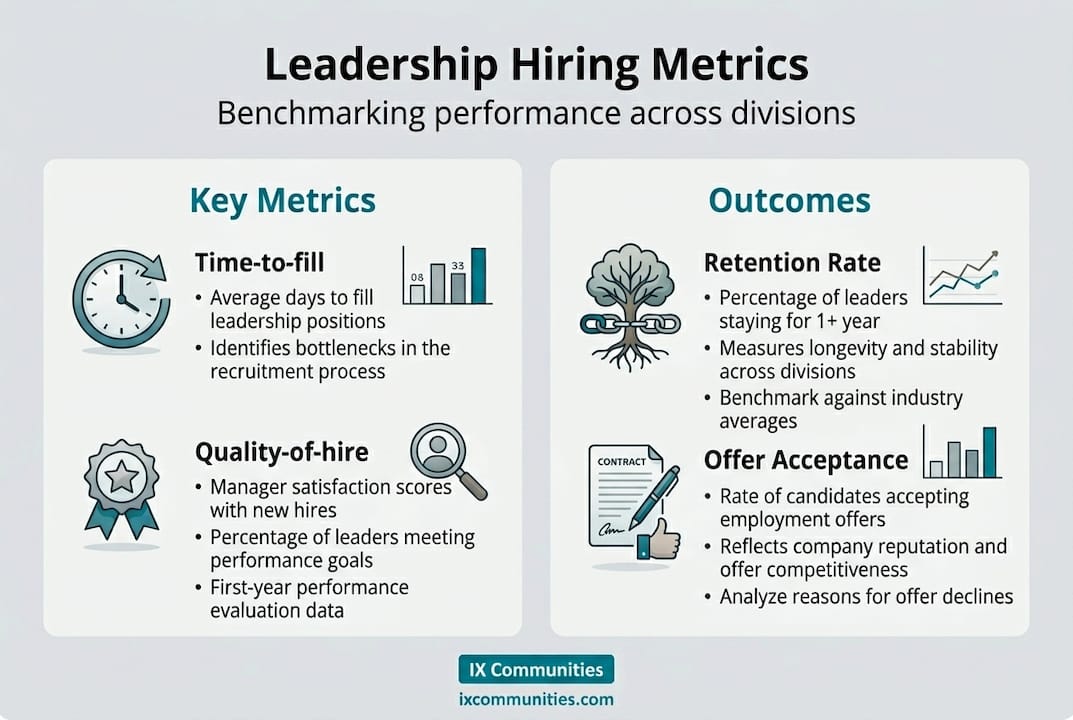
Example comparison: Leadership hiring metrics across three divisions
| Metric | Division A | Division B | Division C |
|---|---|---|---|
| Avg. time-to-fill (days) | 62 | 89 | 74 |
| Quality of hire score (1-10) | 7.4 | 8.9 | 7.1 |
| Retention at 24 months | 68% | 91% | 72% |
| Offer acceptance rate | 74% | 88% | 71% |
| Pipeline diversity ratio | 32% | 49% | 38% |
Division B stands out across nearly every measure. Internal benchmarking through peer recruitment benchmarks would prompt a direct conversation: What is Division B doing differently in how it structures searches, engages candidates, or evaluates finalists?
Interpretation is as important as data collection. Look for clusters of related metrics. Strong quality-of-hire scores combined with high retention often signal rigorous competency-based evaluation. Rapid fills paired with poor retention often point to insufficient due diligence. Programs like mentor-led benchmarking can help talent leaders develop the analytical lens needed to read these patterns accurately.
Pro Tip: Start your internal benchmarking initiative with one business unit or region before attempting organization-wide rollout. A focused pilot produces cleaner data, generates buy-in from stakeholders, and surfaces practical issues before they become systemic.
Standardize the process: Tools and frameworks for consistency
Once you understand where your organization performs well and where it does not, the next step is building structured processes that make strong outcomes repeatable. Variability is the enemy of quality in leadership hiring. When each hiring manager or business unit designs its own process, results depend too much on individual judgment, relationships, or instinct.
Structured leadership hiring processes, including needs analysis, role clarity checklists, competency scorecards, and behavioral interviews, are proven to reduce variability and support better decisions at each stage. Amazon offers a well-documented example. When Amazon developed its "Bar Raiser" program, it started with a simple but powerful premise: no single hiring manager should have final say. Designated Bar Raisers, trained and objective evaluators from outside the hiring team, brought structured criteria and a shared standard to every leadership evaluation. The result was a consistent, repeatable hiring bar that scaled across one of the world's largest and most complex organizations. The lesson is not to copy Amazon's model directly, but to recognize that consistent tools, applied rigorously, are what protect organizations from recurring mis-hires.
Key tools to standardize leadership hiring:
| Tool | Purpose | Owner | Primary benefit |
|---|---|---|---|
| Needs analysis template | Defines business context for the role | HRBP + hiring manager | Prevents scope creep |
| Role clarity checklist | Confirms accountabilities and success criteria | Talent acquisition lead | Aligns expectations early |
| Competency scorecard | Standardizes candidate evaluation criteria | Interviewer panel | Reduces bias and subjectivity |
| Behavioral interview guide | Structures questions around demonstrated behaviors | All interviewers | Improves prediction accuracy |
| Debrief facilitation guide | Structures post-interview discussion | Talent acquisition lead | Surfaces disagreement transparently |
How to adopt standardized tools in your organization:
- Audit existing tools. Determine which divisions already use structured scorecards or interview guides and which do not.
- Select or build a core template set. Work with HRBP partners and legal to develop a consistent base set of tools that can be customized by function or level.
- Train every interviewer, not just recruiters. Effectiveness depends on consistent application. Untrained panelists using a structured guide still produce inconsistent results.
- Integrate tools into your ATS workflow. When structured documents are embedded in the process itself, they are more likely to be used.
- Review and improve tools quarterly. Flag cases where scorecards did not predict performance and adjust criteria accordingly.
The value of behavioral interviews for executives extends beyond individual assessment. When every interviewer uses the same behavioral framework, debriefs become more productive. Disagreements surface around evidence rather than impressions. Using competency scorecards also creates an audit trail that supports diversity goals and helps organizations respond to internal challenges about selection decisions.
Pro Tip: Apply a phase-gate checklist at each major stage of a leadership search, intake, slate approval, interview panel, and final selection. Each gate forces a check that role requirements have not drifted from original criteria.
Upgrade your evaluation: Advanced assessments for leadership roles
Standard hiring processes create a floor. Advanced assessment methods raise the ceiling. For roles with significant organizational impact, a structured interview alone is not sufficient to evaluate readiness, decision-making quality, or leadership style under pressure.

Best-practice executive assessments combine multiple methods, including behavioral interviews, psychometric tests, 360-degree feedback from prior organizations, and leadership simulations, to build an objective, multi-dimensional picture of each candidate.
Advanced assessment types for leadership hiring:
- Psychometric assessments: Standardized tools that measure personality traits, cognitive ability, or leadership style. Examples include Hogan, SHL, or custom organizational culture fit instruments. These provide data points that interviewers cannot easily gather through conversation alone.
- Leadership simulations: Candidates work through a realistic business scenario, such as a restructuring decision or a communications crisis, and assessors evaluate their thinking process, communication style, and judgment in real time.
- 360-degree reference reviews: Rather than the standard two or three calls, structured 360 processes collect input from multiple perspectives including direct reports, peers, and managers. These reviews are framed around competencies rather than general impressions.
- Case-based interviews: Candidates respond to strategic business problems relevant to the role. These are especially useful for functions like finance, operations, or strategy, where analytical rigor is a core requirement.
- Values alignment interviews: A structured interview format focused on organizational values and culture. Assessors evaluate not just whether a candidate shares values but whether they have demonstrated them in prior decisions and behaviors.
Research consistently shows that organizations using multiple structured assessment methods make significantly better leadership hiring decisions than those relying on unstructured interviews. Studies on structured selection indicate that combining cognitive ability tests with structured behavioral interviews raises predictive validity substantially compared to either method alone.
Organizations that adopt advanced executive interview strategies also report fewer mis-hires at the director and VP level, where the cost of failure is highest. The secondary benefit is equally important: structured assessments generate documentation that supports diversity and inclusion goals. When decisions are grounded in scored evidence, bias is easier to identify and address. Reading leadership assessment techniques developed by practitioners in the field provides a useful starting point for organizations looking to upgrade their approach.
Drive alignment: Engaging stakeholders and surfacing true requirements
Even the most rigorous assessment process will fail if the organization does not agree on what it is looking for before the search begins. Misaligned stakeholder expectations are among the most common reasons leadership searches stall, extend, or result in hires who are rejected within the first year.
Early stakeholder alignment, built around thorough needs analysis and clearly defined success profiles, is what separates searches that close well from those that drag on. The needs analysis asks fundamental questions: Why is this role open? What did the prior leader do well? What business outcomes must the new leader achieve in the first 90, 180, and 365 days? What organizational dynamics will this leader need to navigate?
"Most leadership searches fail not because the talent pool is thin, but because the organization never reached internal consensus on what success looks like. Competing stakeholder agendas, unclear priorities, and shifting requirements create a moving target that no candidate can reliably hit." This pattern, documented across executive search engagements, points to process failure, not talent scarcity.
How to facilitate effective stakeholder alignment:
- Schedule a structured intake session before sourcing begins. Include the hiring manager, HR business partner, and at least two key internal stakeholders who will work closely with the new leader.
- Use a written needs analysis template to guide the session. This forces specificity and prevents the meeting from staying at a high level of abstraction.
- Distinguish must-have criteria from nice-to-have preferences. A common practice is to categorize each requirement as essential (role cannot succeed without it), preferred (adds value but not required), or disqualifying (presence of this would make hire unsuitable).
- Draft a written success profile and circulate it to all stakeholders. Require written sign-off before sourcing begins.
- Revisit the profile at the finalist stage to confirm criteria have not shifted without documentation.
The discipline of aligning stakeholders in recruitment also reduces the risk of competing agendas surfacing late in a search, when they are most disruptive. Talent acquisition leaders who facilitate this process effectively earn the trust of business partners and position their function as a strategic contributor rather than a transactional service.
A smarter way forward: What most organizations miss in leadership hiring
Internal benchmarking is valuable. Standardized tools add consistency. Advanced assessments raise predictive accuracy. But there is a limitation that many organizations do not address directly: relying too heavily on internal comparisons creates a closed feedback loop.
When an organization benchmarks only against itself, it risks normalizing its own constraints. A division that outperforms its peers internally may still lag significantly behind external market standards. This is where combined benchmarking strategies, including competitive, functional, and cross-industry comparisons, provide exponential gains that internal data alone cannot deliver.
The second blind spot involves how organizations define leadership "fit." Many hiring committees evaluate candidates against a cultural profile shaped by who has succeeded historically. This approach reinforces existing patterns. It can inadvertently filter out candidates who could have driven needed transformation because they did not match a legacy archetype. A more productive frame is "culture add": assessing candidates against stated organizational values and future strategy, not past executive profiles.
Internal promotions carry a similar risk. They preserve institutional knowledge and signal career development opportunity. But organizations that promote primarily from within over long periods may find their leadership teams increasingly homogenous in thinking, approach, and experience. Balancing internal promotions with strategic external hires, particularly for roles requiring change leadership or digital capability, produces more resilient leadership teams over time.
The most effective leadership hiring programs treat benchmarking as a continuous, multi-source practice rather than a periodic internal exercise. Combining internal metrics with peer community data and external research produces the clearest picture of where genuine improvement is possible.
Continue your journey: Benchmark, connect, and learn alongside peers
The practices covered in this guide, internal benchmarking, standardized tools, advanced assessments, and stakeholder alignment, are most effective when supported by ongoing peer exchange and external data.
ESIX, TLIX, and IXCommunities provide talent acquisition and HR leaders at large organizations with access to real-world leadership hiring benchmarks, secure peer networking, and structured knowledge exchange. Whether you are looking to validate your internal metrics against market data, learn from peers who have solved similar challenges, or access tools developed by practitioners, the community offers a direct path from this guide to applied action. Explore peer mentoring for talent leaders or review membership for ongoing insight to identify the right point of engagement for your organization.
Frequently asked questions
What are the most effective metrics for benchmarking leadership hiring?
Key metrics include time-to-fill, quality of hire, retention at 12 to 36 months, offer acceptance rate, and diversity ratios across pipeline and final hires. Comparing these metrics across departments surfaces both gaps and high-performing practices worth replicating.
How can we balance internal promotions with bringing in external leadership?
Internal promotions preserve institutional knowledge and support retention, while external hires introduce fresh perspectives and capabilities that internal pipelines may not offer. Balancing both approaches based on role requirements and organizational needs produces stronger leadership teams than defaulting to either strategy alone.
What structured tools help improve the consistency of leadership hires?
Needs analysis templates, role clarity checklists, competency scorecards, and behavioral interview guides form the core toolkit. Standardizing these tools across divisions reduces variability and creates a consistent evaluation standard that supports better decisions at every stage.
How do we ensure stakeholder alignment when defining leadership roles?
Begin with a structured intake session using a written needs analysis template, then produce and circulate a formal success profile for stakeholder sign-off before sourcing begins. Early alignment on requirements eliminates the most common cause of search failure: shifting criteria that no candidate can reliably meet.