

AI in executive search is simultaneously delivering faster results and deterring top candidates, often at the same time. 50% of applicants drop out when facing asynchronous AI-driven interview stages, particularly women and senior professionals. Yet the same technology can reduce bias in initial scoring and surface candidates that human reviewers overlook. For talent acquisition leaders navigating this contradiction, separating fact from assumption is not optional. The evidence points in multiple directions at once, and that complexity is exactly what this article addresses. What follows is a grounded look at where AI genuinely adds value, where it introduces new risk, and what responsible adoption looks like in corporate executive hiring.
Table of Contents
- How AI is reshaping executive search processes
- AI strengths: Where automation outperforms human recruiters
- Persistent and new challenges: AI bias, fairness, and trust
- Impact on candidate experience and organizational trust
- Our perspective: What talent leaders should really take away about AI in executive search
- Connect and learn: Executive search resources and peer support
- Frequently asked questions
Key Takeaways
| Point | Details |
|---|---|
| AI speeds up hiring | AI-driven processes can reduce executive search time by up to 40 percent but require strategic oversight. |
| Bias is not eliminated | AI can reinforce or introduce new types of bias, so ongoing governance is essential. |
| Candidate trust matters | Automated stages can deter top applicants and erode trust, particularly for diverse or senior talent. |
| Human-AI balance | Optimal executive search blends AI efficiency with transparent, accountable human decisions. |
How AI is reshaping executive search processes
Executive search has traditionally relied on professional networks, consultant judgment, and relationship capital. AI is shifting that model in measurable ways. Sourcing, screening, scheduling, and assessment scoring are all being automated to varying degrees, and the effects on speed and scale are real.
AI adoption in executive search now reaches 67%, with firms reporting 40% faster placements through automated shortlisting and scheduling tools. That is a significant operational shift, particularly for large corporate organizations managing high volumes of senior-level searches simultaneously.
Here is how AI is being applied across the executive search pipeline:
- Sourcing: AI tools scan professional databases and passive candidate networks far beyond what a human researcher can cover in the same timeframe.
- Resume ranking: Algorithms score and sort candidates against defined role criteria, reducing manual review time.
- Interview scheduling: Automated coordination eliminates back-and-forth between candidates and search teams.
- Assessment scoring: AI evaluates recorded video interviews, psychometric responses, and competency assessments using pattern recognition.
Stat: AI-assisted processes can reduce time-to-hire by 40%, according to current adoption data from executive search firms.
The practical benefit is list narrowing at scale. A search that previously required weeks of manual review can now produce a shortlist in days. However, executive recruiters' strategies note a consistent pattern: AI systems optimized for speed tend to favor candidates with conventional career paths. Non-traditional profiles and high-potential candidates without expected credentials are frequently filtered out before a human reviewer ever sees them.
The operational efficiency is real. So is the risk of narrowing the candidate pool in ways that are not visible until later in the process. Understanding both is essential before expanding AI use in your search practice.
AI strengths: Where automation outperforms human recruiters
Given the evolution of process, it is important to examine where machines are demonstrably better than people. The evidence here is more specific than most practitioners expect.
Research on AI assessment tools shows that AI scores women and minorities higher and predicts employment outcomes better than human reviewers, who exhibit measurable subjective cognitive bias in the same evaluations. This finding runs counter to the common concern that AI universally disadvantages underrepresented candidates. In structured assessment contexts, the opposite can be true.
The distinction matters because human reviewers are not neutral. Affinity bias, proximity bias, and anchoring on prestigious institutions are well-documented patterns in executive hiring. AI, when trained on outcome-linked data rather than historical hiring decisions, can sidestep some of these tendencies.

The table below compares human and AI performance across three core dimensions in executive assessment:
| Dimension | Human reviewers | AI assessment tools |
|---|---|---|
| Bias reduction | Inconsistent, prone to affinity/proximity bias | Reduces some biases when trained on outcome data |
| Speed and scale | Limited by time and cognitive load | Processes thousands of candidates consistently |
| Predictive accuracy | Varies by interviewer experience | Higher prediction rates in structured evaluations |
For AI transformation in executive search, the most effective use case is using AI as a second-look tool: running candidates through AI assessment after an initial human review, specifically to surface profiles the human process may have deprioritized.
Pro Tip: Do not use AI as the sole decision engine at any executive search stage. Deploy it as a structured check on your human reviewers, particularly for identifying overlooked candidates who match outcome-linked criteria rather than conventional signals.
For talent leaders focused on talent attraction strategies, this reframing shifts AI from a replacement for judgment to a calibration tool for it.
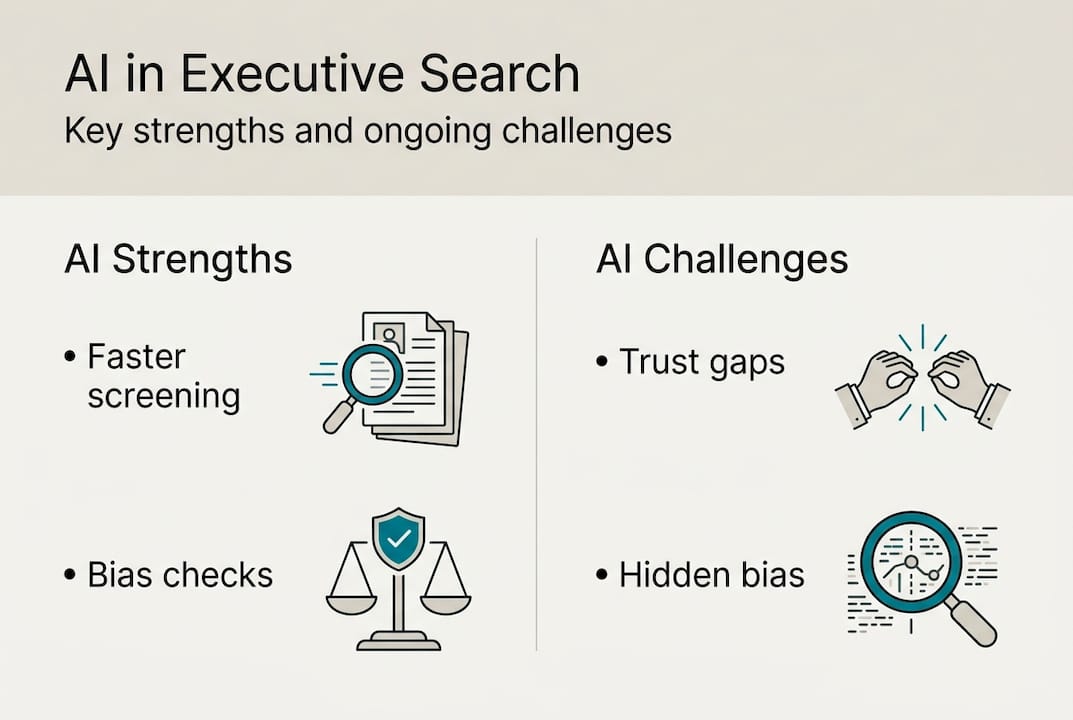
Persistent and new challenges: AI bias, fairness, and trust
The benefits matter, but so do the pitfalls. What gets missed, or introduced, when tech replaces instinct?
AI does not eliminate bias. It redistributes it. Research on algorithmic hiring documents that AI biases persist in specific and sometimes unexpected forms. Ordinal bias, the tendency to favor candidates appearing first in ranked lists, is one example. Proxy discrimination, where AI uses variables like zip code, university name, or employment gap length as stand-ins for protected characteristics, is another.
"AI cannot eliminate bias. It requires ongoing oversight and better training data to avoid encoding the same patterns it was meant to correct."
The table below illustrates how human and AI bias cases compare in executive search contexts:
| Bias type | Human hiring | AI-driven hiring |
|---|---|---|
| Affinity bias | High, favors familiar profiles | Lower in structured assessments |
| Ordinal (list position) bias | Moderate | High, favors first-ranked candidates |
| Proxy discrimination | Implicit, harder to detect | Embedded in model features if unaudited |
| Training data bias | Not applicable | High risk if historical data reflects past inequities |
The limitations of AI in hiring are most acute when systems are deployed without governance structures to catch these patterns.
For talent leaders focused on governance for AI in hiring, here are four concrete steps to reduce AI-related risk:
- Audit AI outputs regularly for demographic patterns across shortlists and rejection rates.
- Review training data to confirm it is based on performance outcomes, not past hiring decisions.
- Implement diverse evaluation panels at every human checkpoint following AI screening.
- Document override decisions when human reviewers adjust AI rankings, and track those patterns over time.
Talent leader insights on AI consistently emphasize that governance is not a one-time setup. It requires ongoing review as models are updated and search criteria evolve.
Impact on candidate experience and organizational trust
Bias is not the only concern. Candidate buy-in and impressions are also changing the rules of executive hiring.
The data on asynchronous AI interviews is direct: a 50%+ drop in applicants occurs when candidates encounter fully automated interview stages. Women and professionals from underrepresented groups are disproportionately likely to withdraw. Engineers and senior technical leaders are particularly likely to mistrust these processes, citing concerns about how their data is used and who reviews it.
At the executive level, where passive candidates often have multiple options and limited tolerance for impersonal processes, this dropout rate carries material consequences. AI amplifies historical biases and erodes candidate trust, particularly in high-stakes, high-visibility roles where candidates expect a different level of engagement.
The loss of personal interaction is not just a perception problem. It affects which candidates stay in the process and, by extension, who gets hired. Hard-to-reach executive talent, individuals who are not actively searching and are evaluating the quality of the organization through every interaction, will disengage faster from automated pipelines.
Pro Tip: Use digital tools for efficiency in logistics and data collection, but ensure a credible human interaction occurs before or during every significant decision stage. Transparency about how AI is used in the process reduces dropout among senior candidates.
Four ways to rebuild candidate trust in AI-assisted executive search:
- Clear communication: Inform candidates upfront about which process stages are AI-assisted and why.
- Transparent criteria: Share the competencies and outcomes being evaluated, not just the format.
- Responsive feedback: Provide timely, direct communication at each stage, even when automated tools are involved.
- Human checkpoints: Ensure at least one meaningful human interaction occurs before any shortlisting decision is finalized.
For guidance on executive candidate experience, maintaining trust through process transparency is a documented competitive differentiator in tight executive talent markets. Applying modern HR strategy means treating candidate experience as a strategic outcome, not an afterthought.
Our perspective: What talent leaders should really take away about AI in executive search
The most important shift in thinking is this: AI does not fix broken hiring processes. It makes them more visible.
When AI surfaces a biased shortlist, that bias existed before. The algorithm just made it measurable. That is actually useful, but only if talent leaders treat it as a signal to examine the underlying criteria, not a reason to override the system and move on. The risk is not that AI introduces bias into otherwise fair processes. The risk is that it scales whatever was already there.
The future of executive search is not AI versus human judgment. It is about building governance structures where talent leaders use peer advice and auditing as standard practice. Both AI outputs and human overrides need to be tracked, reviewed, and explained.
The contrarian takeaway: stop optimizing for bias-free AI. That goal is not achievable in the near term. Instead, optimize for more consistent human judgment, with AI as a tool that makes inconsistencies visible and correctable. That is a goal organizations can act on today.
Pro Tip: Rethink your governance model to focus on auditing both AI outputs and human overrides equally. Neither should be treated as automatically correct.
Connect and learn: Executive search resources and peer support
Actionable insights are most valuable when paired with ongoing learning and peer connection. Navigating AI transformation in executive search requires access to current benchmarks, tested practices, and a community of peers working through the same decisions.
IX Communities offers AI benchmarking for talent teams to help you understand how your organization's AI use compares to large corporate peers. The peer mentorship program connects talent acquisition leaders with experienced practitioners who have navigated AI adoption in executive search. Membership for talent leaders provides access to secure, structured forums where benchmarking data, governance frameworks, and candidate experience strategies are shared among professionals at your level.
Frequently asked questions
Does AI remove all human bias from executive search?
AI can reduce some biases, such as affinity and proximity bias, but often introduces new ones like ordinal bias and proxy discrimination. Ongoing oversight, diverse training data, and persistent AI biases require active governance to mitigate.
Why do asynchronous AI interviews lead to fewer applicants?
More than half of candidates drop out when facing fully automated interview stages, particularly women and senior professionals, primarily due to concerns about transparency and data use.
How should talent acquisition leaders balance AI and human judgment?
Use AI for efficient data processing and shortlisting, but maintain transparent human checkpoints at every significant decision stage. Balance is required to prevent over-reliance from undermining strategic and fairness goals.
What are the risks of relying completely on AI for executive hiring?
Complete reliance amplifies historical biases embedded in training data and erodes candidate trust, particularly among senior executives and engineers who evaluate the hiring process itself as a signal of organizational quality.