

AI is no longer a tool reserved for high-volume, entry-level hiring. At the executive level, AI reduces time-to-fill by 40 to 50%, and in-house talent leaders who dismiss this shift are already falling behind. The organizations moving fastest are not just adopting AI for efficiency. They are using it to expand candidate networks, sharpen shortlists, and free up human capital for the work that actually requires judgment. This guide covers what AI changes in executive search, where its limits are, and how in-house teams can build a model that uses both well.
Table of Contents
- How AI is powering modern executive search
- What AI misses: The limits of automation in executive search
- The irreplaceable roles of humans in the AI era
- Bringing it together: How in-house leaders can harness AI without losing the human edge
- The uncomfortable truth: Why AI is not a magic bullet for executive hiring
- Connect with peers and unlock smarter executive search
- Frequently asked questions
Key Takeaways
| Point | Details |
|---|---|
| AI revolutionizes sourcing | AI now automates sourcing, screening, and outreach—reducing executive search cycles by up to half. |
| Automation has real limits | AI alone cannot assess cultural fit, nuance, or build the trust needed for top executive hires. |
| Bias management is crucial | Unchecked AI can amplify hiring biases, so in-house leaders must pair technology with oversight. |
| Human expertise still matters | Relationship-building, negotiation, and reference checks remain essential human roles in executive search. |
| Blend for best results | Combining AI efficiency and human insight delivers the most effective executive hiring strategies. |
How AI is powering modern executive search
With the scale of change set, let's break down how AI actually operates in executive search today.
AI has moved well beyond resume parsing. Today's tools handle sourcing, screening, market mapping, and candidate outreach with a level of speed and scale that no human team can match alone. AI automates sourcing and handles 80% of repetitive tasks in executive search, cutting time-to-fill by 40 to 50%. That is not a marginal improvement. It is a structural shift in how executive talent pipelines are built.

The core value proposition is reach and speed. AI-powered sourcing tools can scan professional networks, public databases, and proprietary talent pools simultaneously, generating candidate lists that would take a human researcher weeks to compile. Natural language processing (NLP) screens profiles against nuanced role criteria, not just keyword matches. Automated outreach sequences can contact hundreds of potential candidates while tracking engagement data in real time.
Here is a snapshot of where AI delivers the most measurable impact in executive search:
| AI Function | Traditional Approach | AI-Powered Approach |
|---|---|---|
| Candidate sourcing | Manual network searches | Automated multi-platform scans |
| Profile screening | Recruiter review | NLP-based criteria matching |
| Market mapping | Research analyst hours | Real-time data aggregation |
| Outreach sequencing | Individual emails | Automated, personalized cadences |
| Shortlist creation | Days to weeks | Hours to days |
Key capabilities that in-house teams are using right now include:
- 10x network expansion through AI-driven sourcing across platforms
- Automated screening that filters thousands of profiles against specific competency frameworks
- Predictive analytics that score candidates based on career trajectory and role alignment
- Market intelligence that benchmarks compensation and availability in real time
Organizations that have adopted AI in consulting and talent functions report that the technology is most effective when it handles the mechanics of search, freeing senior recruiters to focus on assessment and relationship management. For in-house teams tracking executive search benchmarks, the data consistently shows that AI-assisted searches outperform fully manual processes on speed and initial candidate quality. The question is not whether to use AI. It is how to use it without losing what makes in-house teams effective.
Teams looking for exec search insights from peers already navigating this shift will find that the most common lesson is the same: AI is a force multiplier, not a replacement.
What AI misses: The limits of automation in executive search
While the upside is significant, understanding AI's true limitations is critical for balanced decision making.
AI performs well when the inputs are clean, the patterns are consistent, and the criteria are quantifiable. Executive search rarely offers all three. The higher the role, the more the decision depends on factors that resist measurement, and that is where automation starts to break down.
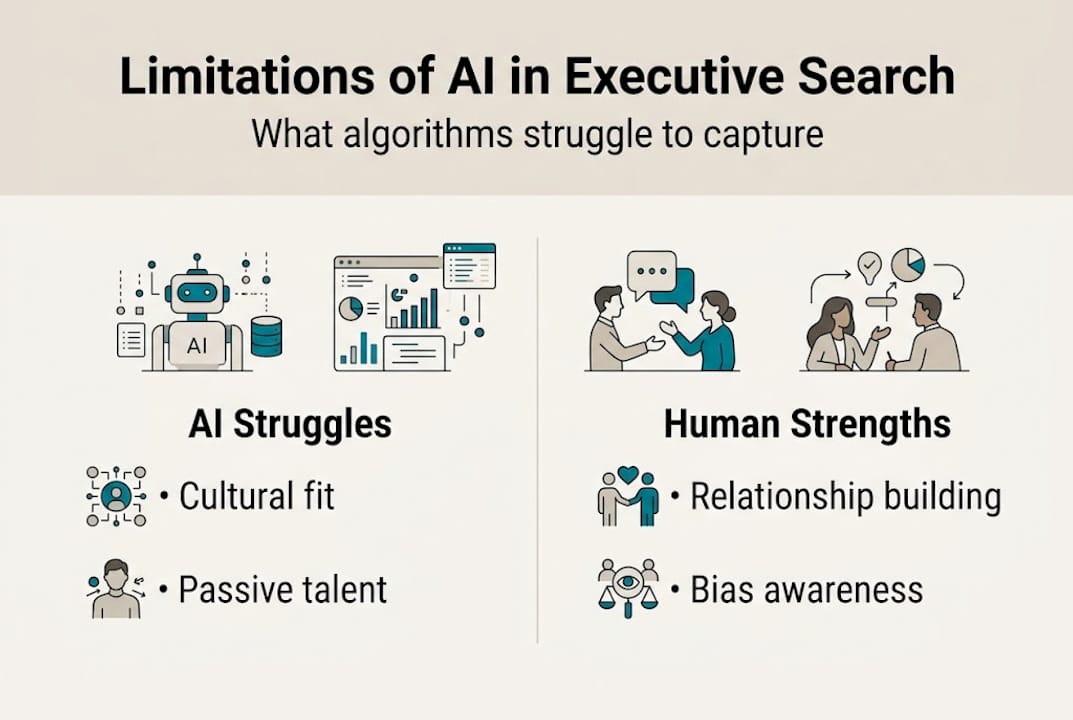
One of the most documented risks is bias amplification. AI amplifies bias and produces false positives when trained on flawed historical hiring data. If past executive hires skewed toward a particular background, geography, or career path, the model will replicate that pattern at scale. The result is a shortlist that looks efficient but is structurally limited.
Passive candidates present a different problem. Most senior executives are not actively searching. They are reachable only through trusted relationships and well-timed, personalized conversations. Automated outreach sequences, no matter how well crafted, rarely move this audience. A generic message from an AI-driven platform signals low priority to a candidate who receives multiple approaches per week.
Cultural fit is another area where automation falls short. Evaluating whether a candidate will thrive in a specific organizational environment requires contextual knowledge that no algorithm currently holds. It requires conversations, observation, and judgment built over time.
Here is a direct comparison of where AI performs well versus where it struggles:
| Search Activity | AI Effectiveness | Human Effectiveness |
|---|---|---|
| Sourcing at scale | High | Moderate |
| Profile screening | High | Moderate |
| Passive candidate engagement | Low | High |
| Cultural fit assessment | Low | High |
| Reference checks | Very low | High |
| Offer negotiation | Very low | High |
Additional risk areas for in-house teams to monitor:
- Over-reliance on AI shortlists without human review can damage candidate experience
- Automated outreach at scale can harm employer brand if messaging feels impersonal
- False confidence in AI-generated matches may lead to skipped validation steps
"The risks are not theoretical. Teams that automate too aggressively in executive search often discover the gaps only after a failed hire or a damaged relationship with a high-value candidate."
In-house leaders exploring AI search benefits and challenges through peer communities consistently flag candidate experience as the area most at risk when automation is applied without guardrails. Reviewing your AI stack against these known limitations is a practical first step. Understanding C-suite recruiter strategies that balance automation with personal engagement provides useful reference points for where the line should be drawn.
The irreplaceable roles of humans in the AI era
This brings us to what machines can't do, and why in-house HR expertise matters more than ever.
AI acts as a force multiplier for sourcing mechanics and NLP screening, but it cannot replicate relationship-building, reference checks, or navigating offer dynamics. These are not soft capabilities. They are the activities that determine whether an executive search ends with a successful placement or a withdrawn offer.
Here are the critical touchpoints where human involvement is non-negotiable:
- Cultural fit evaluation. Assessing alignment between a candidate's values, leadership style, and organizational culture requires direct interaction and contextual judgment.
- Reference checks. Meaningful reference conversations depend on trust, professional credibility, and the ability to read between the lines of what is and is not said.
- Candidate relationship management. Senior candidates expect to be engaged as individuals, not processed as data points. Sustained, personal engagement is what keeps them in a process.
- Offer negotiation. Executive-level offers involve compensation structures, equity, relocation, and role scope. Navigating these conversations requires experience and interpersonal skill.
- Stakeholder alignment. Bringing hiring managers, boards, and business leaders to consensus on a final candidate is a political and relational process that AI cannot facilitate.
In-house teams that invest in these human capabilities alongside AI tools create a genuine competitive advantage. Peer learning through recruiter mentorship programs and talent leader mentoring accelerates the development of these skills in ways that technology cannot replicate.
Pro Tip: Map your current executive search workflow and identify which steps are relationship-dependent. Protect those steps from automation pressure, even when efficiency gains look attractive on paper.
Effective talent acquisition strategies in 2026 treat human judgment not as a fallback when AI fails, but as a deliberate design choice in the search architecture.
Bringing it together: How in-house leaders can harness AI without losing the human edge
So how can in-house teams act on these insights and future-proof their executive hiring?
The answer is not to choose between AI and human-led search. It is to build a model where each handles what it does best. AI automates sourcing and repetitive tasks, but humans are needed for offer dynamics and culture fit. That division of labor is the foundation of a functional hybrid model.
Here is a practical sequence for in-house teams building or refining that model:
- Audit your current workflow. Identify which steps in your executive search process are time-intensive but low-judgment. These are your best automation targets.
- Select tools with transparency. Choose AI platforms that explain how they rank and filter candidates. Black-box scoring creates risk, especially in executive hiring.
- Train your team on AI limitations. Recruiters who understand where AI fails are better positioned to catch errors before they affect outcomes.
- Define human-only checkpoints. Specify which stages require human review regardless of AI output. Document these as policy, not just practice.
- Pilot and measure. Run a hybrid search alongside a traditional search and compare results on time-to-fill, shortlist quality, candidate satisfaction, and offer acceptance rate.
- Iterate based on data. Use talent leader network benchmarks to calibrate your model against what peers are seeing in similar organizations.
Pro Tip: Candidate satisfaction scores are one of the most underused metrics in executive search. Collect them systematically and use them to identify where automation may be eroding the experience.
Leaders looking for structured guidance on this transition will find the AI guide for C-suite a useful reference for framing the organizational case for hybrid search models.
The uncomfortable truth: Why AI is not a magic bullet for executive hiring
Let's be candid about what most miss when trying to automate executive search.
AI can dramatically improve process efficiency. It can surface candidates faster, reduce administrative burden, and generate data that improves decision quality. These are real benefits, and organizations that ignore them will fall behind those that do not.
But efficiency is not the same as effectiveness. At the executive level, the most consequential hires are made through trust, not technology. A senior leader considering a career move is not responding to the best algorithm. They are responding to a person they respect, a conversation that felt genuine, and an opportunity that was presented with context and care.
The teams that over-automate executive search often discover this the hard way. They build fast, clean processes that produce shortlists no one is excited about. The real risk is not that AI will replace human recruiters. It is that organizations will mistake process speed for search quality and optimize for the wrong outcome.
True innovation in executive search is about integrating technology and human expertise with intention, not defaulting to automation because it is available.
Connect with peers and unlock smarter executive search
For those ready to future-proof their hiring, here is how to stay ahead.
IXCommunities, ESIX, and TLIX provide talent leaders at large organizations with a secure environment to share practices, benchmark performance, and learn from peers navigating the same AI-driven shifts in executive search.
Through the peer mentoring program, members gain direct access to experienced talent leaders who have built and refined hybrid search models. The membership community offers benchmarking data, working groups, and peer discussions focused on AI adoption in talent functions. For teams evaluating or deploying AI sourcing tools, the Execsmart platform provides practical resources aligned to real executive search workflows. These are not generic resources. They are built for the specific challenges that in-house talent leaders face at scale.
Frequently asked questions
How much faster can AI make executive searches?
AI reduces time-to-fill for executive searches by 40 to 50%, primarily by automating sourcing, screening, and outreach tasks that previously required significant manual effort.
Does using AI increase the risk of bias in executive hiring?
Yes. Without proper oversight, AI amplifies bias and produces false positive matches when the underlying training data reflects historical hiring patterns that lack diversity or breadth.
Can AI find passive executive candidates well?
AI struggles significantly with passive executives. Passive execs often ignore automated outreach, and building the relationships needed for senior-level engagement requires human initiative and credibility.
What executive search activities cannot be automated?
Building trust, evaluating cultural fit, conducting reference checks, and managing complex offer negotiations all require human expertise that AI cannot replicate at the executive level.
How should in-house teams start integrating AI into executive search?
Begin by automating routine sourcing and screening tasks, then establish clear human-only checkpoints for candidate evaluation, cultural assessment, and final decision making to maintain search quality.