

Recruiting is not just about filling empty seats. The organizations that consistently attract and retain top talent treat recruiting as a core business function, not an administrative afterthought. Strategic recruitment connects talent acquisition directly to business goals, ensuring every hire moves the company forward. This guide breaks down the recruiting best practices that talent acquisition leaders at mid to large organizations can put to work immediately, from workforce planning and candidate experience to data-driven decision-making and continuous benchmarking.
Table of Contents
- Defining recruiting best practices in 2026
- Strategic workforce planning and business alignment
- Candidate experience as a differentiator
- Leveraging data and technology in recruiting
- Continuous improvement and benchmarking
- Beyond the checklist: Why culture and collaboration matter most
- Unlock recruiting excellence with IX Communities
- Frequently asked questions
Key Takeaways
| Point | Details |
|---|---|
| Strategy alignment | Recruiting should align closely with overall business goals for maximum impact. |
| Workforce planning | Proactive planning helps anticipate and address organizational talent needs efficiently. |
| Candidate experience | Excellent candidate journeys improve hiring results and strengthen employer brand. |
| Data-driven improvement | Use technology and analytics to drive smarter hiring and continuous process optimization. |
| Continuous benchmarking | Regularly compare recruiting outcomes with industry peers to stay competitive. |
Defining recruiting best practices in 2026
With recruiting rightly reframed as a strategic function, it is crucial to understand what "best practices" really mean in today's landscape. The term gets thrown around loosely, but for talent leaders, it has a precise meaning: recruiting best practices are evidence-based actions that produce consistent, high-quality hiring results at scale.
The definition has shifted significantly over the past decade. Early recruiting models were transactional. Post a job, screen resumes, extend an offer. That approach worked when talent was plentiful and competition was low. Neither condition holds today.
Modern best practices are built on three pillars:
- Business alignment: Recruiting goals mirror organizational priorities, not just open headcount.
- Data-driven decisions: Every major choice, from sourcing channels to offer strategy, is informed by measurable outcomes.
- Proactive workforce planning: Talent pipelines are built before roles open, not after.
The evolution matters because it changes how talent acquisition teams are structured, funded, and measured. A team still operating on a purely reactive model is not practicing best-in-class recruiting, regardless of how fast they fill roles.
"Align recruitment strategy with business goals and conduct workforce planning to anticipate needs." This is the foundation every high-performing TA function builds on.
For TA leaders looking to assess where their organization stands, benchmarking recruiting practices against peer organizations is one of the most effective ways to identify gaps and prioritize improvements. Peer data cuts through internal bias and shows you exactly where your process outperforms the market and where it falls short.
Leaders who want to go deeper on methodology can explore expert recruiting strategies developed by practitioners who have built and scaled TA functions inside large enterprises. Theory only goes so far. Practitioner knowledge is where real change happens.
Strategic workforce planning and business alignment
Once we understand the new definition of best practices, the logical first step is making recruiting a partner to business strategy. Workforce planning is not a planning department exercise. It is the foundation of recruiting effectiveness.
TA leaders who forecast hiring needs proactively, rather than reacting to sudden vacancies, consistently outperform their peers on time-to-fill, quality-of-hire, and hiring manager satisfaction. The difference is structural.
Here is a practical three-step process for building a workforce planning capability:
- Analyze business needs. Partner with finance, operations, and business unit leaders to understand growth plans, attrition projections, and skill gaps over the next 12 to 24 months.
- Forecast talent demand. Translate business plans into specific role types, volumes, and timelines. Build scenario models for high-growth and conservative growth paths.
- Build recruiting pipelines. Develop talent communities and sourcing relationships before roles open. When a position is approved, your pipeline should already be warm.
| Workforce planning maturity | Reactive model | Proactive model |
|---|---|---|
| Trigger for recruiting | Role opens | Business plan cycle |
| Pipeline status | Built from scratch | Pre-built and warm |
| Time-to-fill | Longer, unpredictable | Shorter, consistent |
| Hiring manager experience | Frustrated by delays | Confident in TA partnership |
| Quality-of-hire | Variable | Consistently higher |
The workforce planning insights shared across peer networks consistently show that organizations with mature planning functions hire faster and spend less per hire. The investment in planning pays back quickly.
Pro Tip: If you are just starting to build a workforce planning function, begin with your top five highest-volume or highest-impact role families. Nail the process there before scaling it enterprise-wide. For exec-level recruiting expertise on structuring TA for strategic impact, dedicated resources exist to help senior leaders make that transition.
Candidate experience as a differentiator
Workforce planning aligns recruitment to business, but bringing top talent in requires winning them over with a strong candidate experience. Every interaction a candidate has with your organization, from the first job posting they read to their first day of work, shapes their decision to join and their willingness to recommend you to others.

The gap between traditional and best-in-class candidate experiences is wider than most organizations realize.
| Experience element | Traditional approach | Best-in-class approach |
|---|---|---|
| Application process | Long, generic forms | Streamlined, mobile-friendly |
| Communication | Infrequent, templated | Timely, personalized updates |
| Interview process | Inconsistent, uncoordinated | Structured, respectful of time |
| Feedback | Rarely provided | Prompt and constructive |
| Offer stage | Slow, transactional | Fast, personalized, compelling |
Three practices separate good from great candidate experience:
- Personalized communication: Candidates want to feel seen, not processed. Use their name, reference the specific role, and acknowledge their background in every touchpoint.
- Swift feedback loops: Silence is the fastest way to lose a top candidate to a competitor. Set internal SLAs for feedback and hold to them.
- Radical transparency: Tell candidates what to expect at every stage. Uncertainty creates anxiety and drives drop-off.
Modern recruiting emphasizes partnership with business leaders, data-driven decisions, and proactive workforce planning, and candidate experience sits at the intersection of all three. A poor experience signals organizational dysfunction to the very people you most want to attract.
Pro Tip: Survey candidates at every stage of your process, including those who declined offers or dropped out. Their feedback is more valuable than the feedback from people who said yes. Explore talent attraction strategies and diversity best practices to build an experience that resonates across all candidate segments.
Leveraging data and technology in recruiting
Delivering a first-rate candidate experience is vital, but scaling excellence requires the smart integration of data and technology. High-performing TA functions do not just use technology. They use it intentionally, with clear metrics tied to business outcomes.
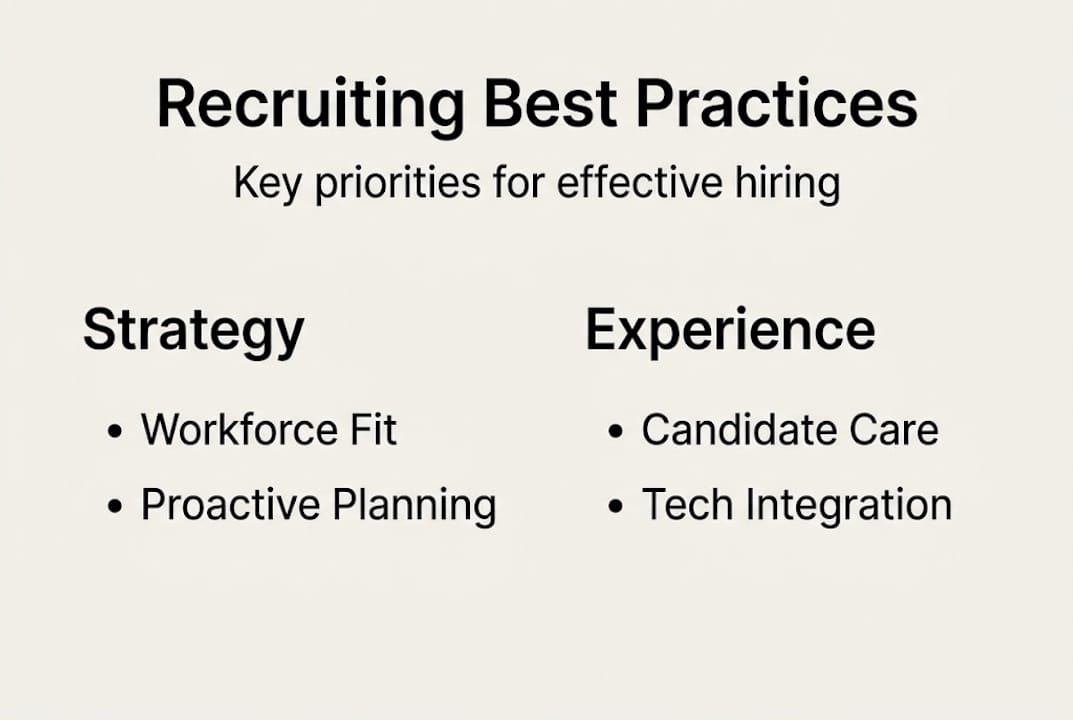
The core technology stack for modern recruiting typically includes an applicant tracking system (ATS) for pipeline management, AI-powered sourcing tools for identifying passive candidates, and analytics platforms for measuring performance across the full hiring funnel.
Key metrics every TA leader should monitor:
- Time-to-fill: How long from role approval to accepted offer. Benchmark this by role family and level.
- Quality-of-hire: A composite score using new hire performance ratings, retention at 12 months, and hiring manager satisfaction.
- Source effectiveness: Which channels produce the highest-quality candidates, not just the highest volume.
- Diversity ratios: Representation at each stage of the funnel, from application to offer to hire.
- Offer acceptance rate: A leading indicator of candidate experience and compensation competitiveness.
Data-driven decisions are now essential to recruiting effectiveness. Organizations that track and act on recruiting analytics consistently outperform those that rely on intuition alone.
The risk with technology is over-reliance. AI tools can introduce bias if not audited regularly. ATS configurations can create friction that drives candidates away. The technology tools for recruiting that work best are those evaluated and refined continuously, not deployed and forgotten. Peer benchmarking on technology adoption helps TA leaders understand what the market is actually using versus what vendors are selling.
Continuous improvement and benchmarking
To keep pace with changing expectations and evolving business needs, successful organizations treat recruiting as a process of continuous improvement. Best practices are not static. What worked in 2022 may actively hurt you in 2026.
Organizations that conduct regular performance reviews and adjust strategies based on data consistently outperform those that set a process once and leave it unchanged. The cadence matters as much as the content.
Here is a three-step recruiting effectiveness review process you can run quarterly:
- Gather data. Pull your core metrics: time-to-fill, quality-of-hire, offer acceptance rate, source mix, and diversity funnel data. Make sure the data is clean and comparable period over period.
- Compare to benchmarks. Internal trends tell you whether you are improving. External benchmarks tell you whether your improvement is fast enough. Use benchmark surveys from peer organizations to contextualize your performance.
- Iterate the process. Identify the one or two highest-impact changes you can make in the next 90 days. Implement, measure, and repeat.
Statistic callout: Organizations that benchmark recruiting performance against external peers and act on those findings reduce average time-to-fill by up to 20% within two review cycles. The compounding effect of small, consistent improvements is significant over 12 to 24 months.
The discipline of continuous improvement also builds credibility with business leaders. When TA can show quarter-over-quarter progress on metrics that matter to the business, the function earns a seat at the strategic table rather than being treated as a support service.
Beyond the checklist: Why culture and collaboration matter most
While continuous improvement and benchmarking are critical, the highest-performing companies take things a step further. They do not treat recruiting best practices as a checklist. They embed them into how the organization thinks about people.
Every process improvement we have seen succeed long-term shares one common factor: it was owned by both TA and the business, not just the recruiting team. When hiring managers understand why structured interviews matter, they conduct them better. When finance understands the cost of a bad hire, they fund recruiting properly. Collaboration turns best practices into habits.
The uncomfortable truth is that many organizations invest in the right tools and frameworks but see limited results because the culture does not support them. A recruiter who surfaces great data gets ignored if their business partner does not value it. A candidate experience initiative stalls if hiring managers will not commit to feedback SLAs.
Peer mentoring for TA leaders is one of the most underutilized levers for building this kind of culture. Learning from peers who have navigated the same organizational dynamics, not just consultants with frameworks, accelerates real change.
Unlock recruiting excellence with IX Communities
For TA leaders ready to put these best practices into action, additional resources and expert support can make the difference between incremental progress and transformational results.
IX Communities gives talent acquisition leaders access to the benchmarks, peer networks, and expert knowledge needed to lead recruiting at the highest level. From benchmark surveys that show exactly how your metrics compare to peer organizations, to recruiter mentorship programs that develop your team's capabilities, the platform is built for leaders who take recruiting seriously. IX Communities Membership connects you with the people and data that turn best practices into competitive advantage.
Frequently asked questions
What are considered recruiting best practices in 2026?
Recruiting best practices include aligning recruitment with business strategy, proactive workforce planning, delivering an excellent candidate experience, leveraging technology, and continuously benchmarking against peers. The most effective organizations treat all five as interconnected, not independent initiatives.
Why is workforce planning important for recruiting?
Workforce planning ensures talent acquisition aligns with business growth, helping organizations forecast hiring needs and reduce costly vacancies. It shifts TA from reactive to proactive, which consistently improves both speed and quality of hire.
How does candidate experience impact hiring results?
A great candidate experience increases offer acceptance rates and strengthens employer brand, while a poor experience drives top talent directly to competitors. Modern recruiting treats every candidate touchpoint as an opportunity to differentiate your organization.
How can technology improve recruiting outcomes?
Technology streamlines sourcing, assessment, and communication, while data-driven decisions help teams improve speed and quality of hire. The key is using technology intentionally, with clear metrics, rather than adopting tools for their own sake.