

Many talent acquisition leaders treat their candidate databases as talent communities, but these two things are fundamentally different. A database stores names. A community builds relationships. As competition for skilled professionals intensifies, organizations that rely solely on reactive job postings are consistently losing top candidates to employers who have already established ongoing connections with them. This guide explains what talent communities actually are, how they differ from talent pools and pipelines, when to build one, and how to keep it functioning as a genuine recruitment asset rather than a forgotten list of contacts.
Table of Contents
- Defining talent communities: What sets them apart
- Benefits of talent communities for modern recruitment
- When and why to build a talent community
- Best practices for engaging and growing your talent community
- Why talent communities aren't a silver bullet (and what most leaders miss))
- Take your talent community strategy to the next level
- Frequently asked questions
Key Takeaways
| Point | Details |
|---|---|
| Talent communities defined | They are ongoing, opt-in groups focused on engagement and mutual value, not just static lists of candidates. |
| Strategic recruitment edge | Well-run communities shorten time-to-hire, increase candidate quality, and support employer brand building. |
| Timing is crucial | Build a community when there is frequent hiring, brand investment, or competitive talent needs. |
| Engagement is key | Sustained, two-way interaction and regular measurement prevent your community from becoming a data graveyard. |
Defining talent communities: What sets them apart
The term "talent community" is used loosely, which creates confusion. Before building one, it is important to understand exactly what it is.
Talent communities are groups of individuals who have expressed interest in an organization and opt to stay connected for future opportunities, even without immediate roles available. The key phrase here is "opt to stay connected." Membership is voluntary. Candidates choose to be part of the community because they see value in the relationship, not just in a specific job opening.
This is what separates a talent community from a talent pool or pipeline:
- Talent pool: A static collection of candidate profiles, often sourced from past applications or resume databases. Communication is minimal and typically one-directional.
- Talent pipeline: A structured sequence of candidates mapped to specific future roles. More targeted than a pool, but still largely passive.
- Talent community: An active, two-way relationship where candidates receive ongoing value (career content, events, industry news) and the organization gains sustained visibility and trust.
| Feature | Talent pool | Talent pipeline | Talent community |
|---|---|---|---|
| Candidate opt-in | Rarely explicit | Sometimes | Always explicit |
| Communication style | One-way, occasional | Role-specific outreach | Two-way, ongoing |
| Engagement frequency | Low | Moderate | High |
| Relationship depth | Transactional | Moderate | Relational |
| Data freshness | Often outdated | Moderate | Regularly updated |
"They differ from talent pools or pipelines: communities emphasize two-way engagement, relationship-building, and ongoing value provision (e.g., newsletters, events), while pools are more static databases of candidates."
This distinction matters operationally. A proactive recruitment approach requires infrastructure that supports continuous communication, not just periodic outreach when a vacancy opens. Organizations that invest in proactive talent engagement build a measurable advantage in candidate responsiveness and hiring speed.
Benefits of talent communities for modern recruitment
Talent communities deliver value across multiple dimensions of the recruitment function. Understanding each benefit helps talent leaders make the case internally for the investment required.
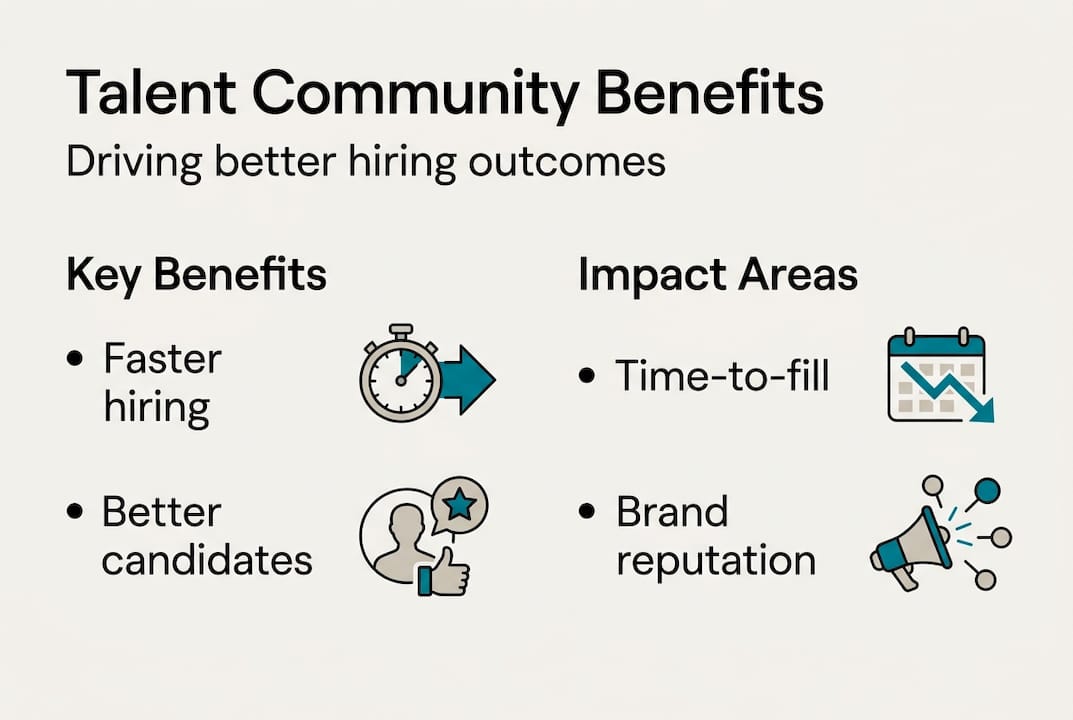
Shorter time-to-hire. When a role opens, a well-maintained community gives recruiters immediate access to pre-qualified, already-interested candidates. There is no need to start sourcing from scratch. This alone can cut weeks from a typical hiring cycle.

Higher candidate quality. Community members self-select based on genuine interest in the organization. They have read your content, attended your events, and engaged with your brand. That prior relationship produces better cultural alignment and more informed candidates at the interview stage.
Stronger employer brand. Every newsletter, webinar, or career resource you share reinforces your organization's reputation as a place worth working. Candidates who are not yet ready to move will remember your brand when they are.
Reduced dependency on job boards. Reactive postings are expensive and often produce high-volume, low-quality applicant pools. A functioning talent community reduces that dependency significantly.
However, there is a critical caveat. Communities feed pipelines and work well in competitive markets, but only when engagement metrics are actively monitored. Without measurement, communities become "data graveyards," full of contacts who stopped paying attention months ago.
| Benefit | Impact area | Measurement indicator |
|---|---|---|
| Faster hiring | Time-to-fill | Days from open to offer |
| Better candidates | Quality of hire | Interview-to-offer ratio |
| Brand visibility | Employer brand | Content engagement rate |
| Cost reduction | Recruitment spend | Cost per hire |
Pro Tip: Set a quarterly review of your community's tracking engagement metrics such as email open rates, event RSVPs, and reply rates. If any metric drops below your baseline for two consecutive quarters, it is time to refresh your content strategy or re-permission your list.
Organizations that adopt proactive recruitment strategies consistently outperform those that rely on reactive hiring, particularly in sectors where specialized talent is scarce.
When and why to build a talent community
Not every organization needs a talent community immediately, but certain conditions make building one a clear priority.
Common triggers for building a talent community:
- You consistently hire for the same roles and spend significant time re-sourcing the same candidate profiles each cycle.
- Your hiring cycles are longer than your competitors', and passive talent is accepting other offers before you reach them.
- You are investing in employer brand initiatives and need a channel to convert that brand awareness into candidate relationships.
- You operate in a high-growth phase where future hiring volume is predictable but timing is uncertain.
- You are losing strong candidates who were not ready to move at the time of your outreach, with no structured way to stay in touch.
If three or more of these apply to your organization, the business case for a talent community is strong.
Signs it is the right time to start:
- Hiring managers regularly report that great candidates "got away"
- Your applicant tracking system contains thousands of past applicants with no follow-up plan
- Your recruitment marketing produces interest but no structured pipeline
- Passive talent outreach yields low response rates because candidates do not recognize your brand
Talent communities are proactive, not reactive, and work best when engagement is measurable from the start. This means defining your audience, establishing a clear value proposition for members, and creating a program calendar before launch.
Pro Tip: Start small. Launch with one audience segment, such as software engineers or finance professionals, and build your engagement model before scaling. Use keeping communities active resources to maintain momentum after the initial launch energy fades.
Once your community is live, use structured tools to measure community engagement and adjust your approach based on real data, not assumptions.
Best practices for engaging and growing your talent community
Building a talent community is the first step. Keeping it active is the ongoing work that determines whether it becomes a recruitment asset or an unused database.
Communities emphasize two-way engagement, relationship-building, and ongoing value provision through tools like newsletters and events. That principle should guide every engagement decision.
Content and engagement tactics that work:
- Monthly newsletters with industry news, career development content, and company updates (not just job postings)
- Virtual or in-person events such as panels, Q&A sessions with hiring managers, or skill-building workshops
- Career resources including resume tips, interview guides, and role-specific development content
- Personalized outreach when a relevant role opens, referencing the candidate's prior engagement with the community
- Surveys and polls to gather member feedback and demonstrate that their input shapes the community experience
Segmentation is essential. A community of 5,000 contacts should not receive identical communications. Segment by function, seniority level, geographic preference, or engagement history. Personalized content consistently outperforms generic broadcasts in open rates and response rates.
"The most engaged talent communities are built on a simple principle: members receive more value than they are asked to give. When that balance tips, disengagement follows quickly."
Avoid these common pitfalls:
- Sending communications only when you have open roles
- Ignoring member feedback or survey responses
- Failing to refresh content regularly, leading to declining open rates
- Not having a clear value proposition that members understand from day one
Explore community-building programs designed for talent leaders, and draw on expert-led engagement ideas to keep your approach current and effective.
Pro Tip: Assign a dedicated owner to your talent community, even if it is a part-time responsibility. Communities without an accountable owner drift toward inactivity within six months of launch.
Why talent communities aren't a silver bullet (and what most leaders miss)
Most organizations that struggle with talent communities make the same mistake: they build the infrastructure and assume the work is done. They collect opt-ins, send a few newsletters, and then gradually reduce activity as other priorities take over. Within a year, the community is technically alive but functionally inactive.
The uncomfortable truth is that a talent community requires the same consistent investment as any other marketing channel. It needs a content calendar, an engagement owner, defined KPIs, and a feedback loop. Organizations that treat it as a one-time project rather than an ongoing program will see diminishing returns.
There is also a measurement gap. Many leaders track community size (number of members) but not community health (active engagement rate). A community of 10,000 with a 5% engagement rate is less valuable than a community of 2,000 with a 40% engagement rate. Communities feed pipelines only when members are actually paying attention.
The fix is straightforward: build a system for fostering ongoing interaction with defined touchpoints, measurable outcomes, and a regular cadence of two-way communication. Treat engagement as a metric that requires the same rigor as time-to-fill or cost-per-hire.
Take your talent community strategy to the next level
Building and sustaining a talent community requires the right tools, benchmarks, and peer insights to get it right. IX Communities provides talent acquisition leaders with direct access to resources that support every stage of community development.
Through IX Communities Membership, you gain access to a secure peer network where talent leaders share what is working, what is not, and how to measure it. Use Community Connection to engage directly with peers facing the same challenges. And leverage Benchmark Surveys to compare your community engagement metrics against industry peers and identify exactly where to focus your efforts.
Frequently asked questions
What is the difference between a talent community and a talent pool?
A talent community is an engaged group with ongoing two-way engagement and relationship-building, while a talent pool is a static database of candidates with minimal interaction.
How do you measure engagement in a talent community?
Track newsletter open rates, event attendance, and direct reply rates. These engagement metrics reveal whether your community is active or drifting toward inactivity.
When should an organization create a talent community?
Build one when you hire frequently for key roles, want to nurture passive talent, or need a competitive edge. Talent communities work best when engagement is measurable from the outset.
What are common pitfalls of running a talent community?
Inactive engagement, lack of fresh content, and not tracking activity are the most frequent mistakes. Failing to avoid data graveyards requires consistent measurement and regular content refreshes.