

Siloed HR functions are not a minor inconvenience. When recruiting and talent management operate as separate units, organizations face measurable consequences: skills gaps widen, quality-of-hire drops, and costly hire-fire cycles repeat. The integrated talent management model shows that connecting recruiting to performance reviews, succession planning, and workforce development through shared data and "one HR" partnerships is the foundation for sustainable organizational performance. Every recruiter has the potential to act as a talent advisor, bringing people analytics and AI-driven insights to decisions that once relied on instinct alone. This article outlines how large organizations can build that connectivity with precision.
Table of Contents
- Understanding the talent management and recruiting connection
- Building synergy: Shared pipelines, metrics, and cross-functional syncs
- AI and analytics: The transformative enabler
- Strategic workforce planning: Bridging internal mobility and external acquisition
- Benchmarking and evolving outcomes: What good connectivity delivers
- A new perspective: Why most organizations miss the mark on synergy
- Connect and evolve: Take action with peer-driven solutions
- Frequently asked questions
Key Takeaways
| Point | Details |
|---|---|
| Unified data drives synergy | Connecting recruiting and talent management through shared data and systems enables strategic impact. |
| AI transforms workflows | AI and analytics automate matching, streamline hiring, and deliver real-time insights for both functions. |
| Strategic planning prevents churn | Strategic workforce planning bridges internal and external talent solutions, reducing inefficient hiring cycles. |
| Benchmarks reveal success | Metrics like time-to-fill and cost-per-hire show measurable gains when functions are connected. |
| Collaboration is key | Cross-functional syncs and shared KPIs drive continuous improvement and retention. |
Understanding the talent management and recruiting connection
Recruiting and talent management are not separate stages in a process. They are interdependent functions that share data, metrics, and strategic priorities. The challenge in most large organizations is that the operating models, technology systems, and reporting structures reinforce separation rather than integration.
The integrated talent management operating model connects recruiting to broader HR functions by mapping data flows across performance reviews, succession planning, and learning and development. This mapping creates a "one HR" partnership model where talent acquisition leaders and talent management teams share accountability for outcomes, not just processes. Following recruiting best practices that emphasize this integration significantly reduces the frequency of reactive hiring.
The core data flows in an integrated model look like this:
| Data type | Source function | Receiving function | Business impact |
|---|---|---|---|
| Skills profiles | Talent management | Recruiting | Targeted sourcing |
| Performance ratings | Performance reviews | Succession planning | Internal mobility |
| Attrition signals | HR analytics | Workforce planning | Proactive backfill |
| Onboarding completion | Recruiting/L&D | Talent management | Development alignment |
| Promotion readiness | Talent management | Recruiting | Build vs. buy decisions |
When these flows are formalized and automated, both functions gain a shared view of the talent landscape. This is critical for organizations operating across multiple geographies or business units, where executive team structures can vary significantly.
Key priorities for establishing this connection include:
- Defining shared KPIs that span both functions, such as first-year retention and internal promotion rates alongside time-to-fill
- Mapping skills shortages identified in performance reviews directly to sourcing strategies
- Creating joint ownership of workforce planning outputs rather than treating them as HR deliverables handed off between teams
- Establishing data standards so that skills taxonomies, role definitions, and competency frameworks are consistent across systems
Organizations that prioritize this integration early reduce their exposure to critical skills shortages, which have become one of the most costly risks for large employers. The complexity of managing these data flows at scale makes technology governance a non-negotiable part of the operating model.
Building synergy: Shared pipelines, metrics, and cross-functional syncs
With a clear understanding of the core connection, organizations can now focus on building synergy through deliberate operational practices. Synergy does not happen automatically when systems are integrated. It requires process design, shared accountability, and regular cross-functional communication.
Talent acquisition practices that achieve measurable synergy share several characteristics: pipeline mapping tied to specific roles and growth scenarios, cross-functional syncs for shared ownership, and unified metrics like time-to-fill and quality-of-hire. Integrated ATS and CRM systems provide real-time tracking, and co-created employer branding ensures that the talent value proposition reflects the full employee experience, not just the hiring process.
Here are five operational steps to build this synergy:
- Map talent pipelines to role categories. Segment pipelines by criticality, time-to-fill risk, and growth trajectory. This makes it easier to prioritize sourcing investments and internal development simultaneously.
- Establish regular cross-functional syncs. Monthly or bi-weekly meetings between recruiting leads and talent management partners create shared ownership of workforce outcomes. These should not be status updates; they should be data-driven planning sessions.
- Align on unified metrics. Track executive recruiting metrics that span both functions. Quality-of-hire, 90-day performance ratings, and retention at 12 months are more informative than time-to-fill alone.
- Integrate ATS and CRM data. Real-time visibility into requisition status, candidate pipeline health, and offer outcomes enables faster decisions and more accurate workforce forecasts.
- Co-create employer branding content. When recruiting and talent management teams collaborate on messaging, the result reflects authentic career development opportunities, which directly improves candidate quality and offer acceptance rates.
"Synergy between talent acquisition and talent management is not a technology problem. It is an ownership problem. When both functions share accountability for outcomes, integration follows naturally."
Pro Tip: Use recruitment benchmarks from peer organizations at similar scale to calibrate your shared metrics. Internal benchmarks alone can create blind spots about what "good" actually looks like.
The most effective organizations treat this cross-functional work as a core operating rhythm, not an annual planning exercise. Consistent, structured collaboration between recruiting and talent management is what separates organizations that respond to talent gaps from those that prevent them.
AI and analytics: The transformative enabler
Building synergy is now possible at scale because AI and advanced analytics have changed what is operationally feasible. Talent leaders who treat AI as a point solution for sourcing are leaving significant value on the table. The more powerful application is using AI to create a continuous, real-time connection between talent data across the full employment lifecycle.

AI workforce agility platforms like Eightfold enable skills-focused approaches that include standardized workflows, real-time requisition feedback, activation of latent talent pools, and TA dashboards for workforce planning. These capabilities directly address the data fragmentation that makes manual integration so difficult.
The performance impact of AI on recruiting outcomes is well documented. AI recruitment outcomes research shows a 54% pass rate to final interview for AI-assisted processes compared to 34% for resume-based screening. That is a 20 percentage point improvement. The same research found 44% fewer human interviews required and 17 percentage points higher job placement rates at five months. These are not incremental gains. They represent a fundamental shift in recruiting efficiency and quality.
Key applications of AI across the talent management and recruiting connection include:
- Skills inference engines that translate job history and performance data into standardized skills profiles, enabling both internal mobility matching and external sourcing
- Predictive attrition modeling that signals flight risk before a resignation occurs, giving talent management and recruiting time to plan proactively
- Workflow automation that handles scheduling, status updates, and compliance documentation, freeing recruiters to focus on advisory and relationship work
- Real-time dashboards that connect requisition status with workforce planning data, giving talent leaders a single view of supply and demand
For talent leaders who want to understand the full picture, AI in executive search involves important considerations beyond efficiency metrics. Governance of AI outputs, bias auditing, and human oversight are not optional. Every AI tool applied to hiring decisions requires a documented governance framework that includes regular audits of outcomes by demographic group, role type, and business unit.
Pro Tip: Before deploying an AI recruiting tool, define what "quality-of-hire" means in measurable terms for your organization. If you cannot measure the outcome, you cannot evaluate whether the AI is improving it. The future recruiter skills landscape increasingly includes data literacy as a core competency, and AI transforming executive search is an ongoing process, not a one-time implementation.
Strategic workforce planning: Bridging internal mobility and external acquisition
With AI changing what is operationally feasible, strategic workforce planning becomes the mechanism that aligns talent management and recruiting with long-term business goals. Strategic workforce planning (SWP) is not a forecast document produced by HR. It is a cross-functional discipline that links HR, operations, and finance in a shared view of talent supply and demand.
Strategic workforce planning anticipates three to five year talent gaps, weighs internal reskilling against external hiring, and reduces the hire-fire cycles that inflate costs and damage employer brand. When this planning process is integrated with talent management and recruiting data, organizations can make earlier and more accurate decisions about where to build capability internally versus where to acquire it externally.
Recruitment and L&D collaboration identifies skills gaps early, integrates career development into recruitment messaging, co-designs onboarding with learning milestones, and promotes internal mobility supported by upskilling. This collaboration directly reduces first-year attrition and improves the accuracy of hiring decisions.
Practical steps for embedding SWP into the recruiting and talent management connection:
- Align SWP timelines with business planning cycles. Workforce plans that are disconnected from budget and strategy cycles lose influence quickly.
- Build internal mobility pathways before opening external requisitions. This requires a current, accurate skills inventory maintained by talent management and accessible to recruiting.
- Embed career development language in job descriptions and candidate conversations. When recruiters articulate genuine development opportunities, candidate quality and offer acceptance improve.
- Use analytics to track mobility outcomes. Monitor promotion rates, lateral move success, and retention for internally sourced fills versus external hires to calibrate your build-versus-buy strategy.
"Organizations that connect SWP directly to recruiting pipelines reduce their dependency on reactive hiring and build a more predictable talent supply chain."
The executive recruiting function guide outlines how to structure the recruiting team to support this level of strategic integration. The key is ensuring that recruiters have the data access, skills, and organizational mandate to act as workforce planning partners rather than requisition processors.
Benchmarking and evolving outcomes: What good connectivity delivers
If strategic planning sets the foundation, outcomes data shows whether the integration is working. Benchmarks provide the reference points that allow talent leaders to assess performance objectively and set realistic improvement targets.
Current recruiting benchmarks show a median time-to-fill of 45 days overall, with technology roles at 42 days and retail at 35 days. Cost-per-hire for non-executive roles averages $1,200, rising to $1,800 in technology and $10,625 for executive positions. Offer acceptance rates average 84%, and the typical recruiter carries a load of approximately 20 requisitions at any given time.
These benchmarks create a baseline, but the real value of integration shows up in outcomes that go beyond speed and cost:
- First-year retention rates for hires sourced through integrated pipelines are consistently higher when talent management is involved in the hiring process
- Internal promotion rates improve when recruiting and talent management share skills data and development tracking
- Quality-of-hire scores at 90 days and 12 months provide the most reliable signal of whether integration is generating better decisions
- Offer acceptance rates above 84% typically reflect stronger employer brand alignment, which is a direct output of co-created talent management and recruiting messaging
- Reduced time-to-productivity when onboarding is co-designed by recruiting and learning and development teams
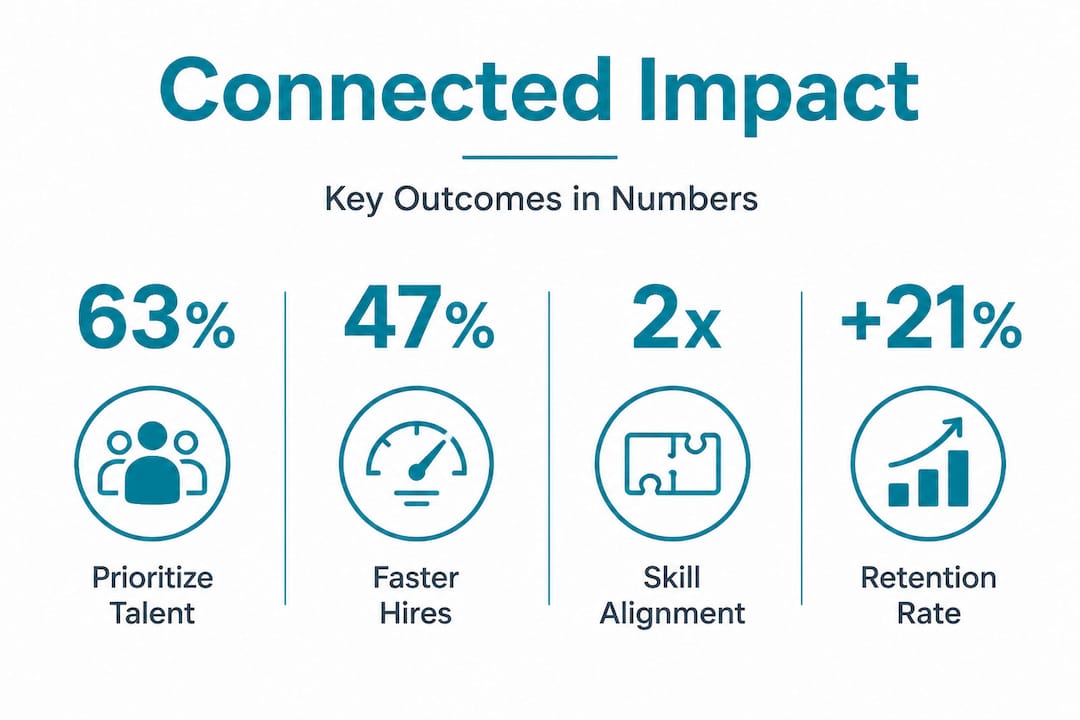
A SHRM survey of 1,268 HR professionals found that 63% prioritize critical talent sourcing strategy, and that "Talent Architects," organizations that apply skills-first recruitment, strategic partnerships, and technology leverage, consistently achieve lower turnover and better candidate fit than organizations using traditional models.
Pro Tip: Access talent benchmarks from peer organizations to understand where your current performance stands relative to comparable enterprises. Self-assessed targets without external reference points often underestimate what high-performing organizations achieve.
A new perspective: Why most organizations miss the mark on synergy
Organizations invest in integration technology and still fail to achieve meaningful connectivity. The reason is rarely technical. It is structural and behavioral.
Siloed operations persist because performance management for recruiting teams is still primarily measured on speed and volume metrics. Quality-of-hire and retention outcomes are tracked by talent management but rarely reported back to recruiting in a way that changes sourcing or selection behavior. This creates a functional disconnect that no software platform can resolve on its own.
The hidden pitfall in cross-functional sync programs is that they often become coordination meetings rather than decision-making forums. Without shared data and shared accountability, these sessions produce action items that neither team has the mandate or information to execute effectively. AI recruiting limitations are compounded when the underlying data shared between functions is inconsistent or incomplete.
Unified technology governance is not a technology decision. It is a leadership decision. Talent leaders need to define what data each function owns, what data is shared, and how discrepancies are resolved. Without this governance structure, AI tools will amplify existing fragmentation rather than address it.
The actionable moves that distinguish leaders who achieve genuine connectivity from those who do not include formalizing shared outcome metrics in both functions' performance goals, creating joint ownership of the workforce planning process, and treating AI changes in executive search as an ongoing governance responsibility rather than a deployment event. The organizations that get this right are not necessarily the ones with the most advanced technology. They are the ones with the clearest operating model.
Connect and evolve: Take action with peer-driven solutions
Talent leaders who are serious about building lasting connectivity between recruiting and talent management benefit significantly from peer exchange and shared benchmarking data. Understanding what integration looks like in practice, across organizations of comparable scale and complexity, accelerates both strategy and execution.
IXCommunities provides a secure environment where talent and recruiting leaders share real-world outcomes, benchmark performance, and exchange solutions to the exact challenges covered in this article. Through peer-driven connections, members access practical frameworks and data that are not available in public research. Survey insights from member organizations provide current, peer-validated benchmarks for metrics including time-to-fill, cost-per-hire, quality-of-hire, and internal mobility rates. The talent leaders exchange brings together senior professionals who are navigating the same integration challenges, providing a forum for structured learning and direct peer input.
Frequently asked questions
What are the key metrics for measuring recruiting and talent management connectivity?
Shared KPIs like time-to-fill, quality-of-hire, integrated ATS/CRM tracking, first-year retention, and internal promotion rates are the most reliable indicators of synergy between recruiting and talent management.
How does AI improve outcomes in recruiting and talent management?
AI platforms enable skills-focused workforce agility, real-time requisition feedback, and workflow automation that collectively improve hiring speed, candidate quality, and the accuracy of workforce planning decisions.
What is strategic workforce planning's role in bridging recruiting and talent management?
Strategic workforce planning anticipates three to five year talent gaps, weighs internal reskilling against external hiring, and links HR, operations, and finance to reduce inefficient and reactive hiring cycles.
How can organizations reduce the risks of siloed recruiting and talent management?
The integrated talent management model fosters "one HR" partnerships, shared data standards, and cross-functional accountability structures that directly address the risks created by siloed operations, including skills shortages and poor quality-of-hire.
What are the financial benefits of integrated talent management and recruiting?
Organizations using skills-first recruitment strategies and strategic talent partnerships consistently achieve lower turnover, higher offer acceptance rates, improved quality-of-hire, and measurable reductions in cost-per-hire compared to organizations using siloed models.