

Most executives assume their recruiting team structure is solid because it worked well five years ago. That assumption is becoming increasingly costly. Fortune 500 companies are rapidly moving away from purely centralized or purely decentralized models, replacing them with flexible hybrid structures that can scale, adapt, and respond to shifting business priorities. For heads of talent acquisition and executive recruiting at mid to large corporations, understanding these structural shifts is not optional. This article covers leadership roles, team composition ratios, operating models, and real-world examples that inform stronger internal capability building.
Table of Contents
- Key leadership roles and reporting structures
- Core team composition and specialized roles
- Centralized, decentralized, and hybrid operating models
- Real-world examples and best practices
- What most companies miss about structuring executive recruiting teams
- Connect with industry leaders and advance your recruiting team
- Frequently asked questions
Key Takeaways
| Point | Details |
|---|---|
| Leadership matters | High-performing recruiting teams are led by specialized executives who report to senior leadership for strategic alignment. |
| Optimal team mix | Effective teams balance recruiters, sourcers, and coordinators, using ratios and role clarity to drive results. |
| Hybrid models are rising | Most Fortune 500 companies now combine centralized and decentralized functions for agility and local expertise. |
| Real-world proof | Companies like Intel showcase proactive pipelining and internal mobility as best practices for future-ready teams. |
Key leadership roles and reporting structures
High-performing executive recruiting teams are built on clearly defined leadership roles. Without the right structure at the top, even well-resourced teams struggle to deliver consistent results for senior-level hiring. The foundation starts with role clarity and accountable reporting lines.
Leading companies structure executive recruiting teams with dedicated leadership roles such as Head of Executive Recruiting and Senior Director of Talent Acquisition, often reporting to a Global Head of Talent or directly to the CHRO. This reporting chain matters significantly. When executive recruiting sits close to the CHRO, the function gains visibility, budget authority, and the strategic credibility needed to influence board-level hiring decisions.
Consider a company like a large global consumer goods organization. The Head of Executive Recruiting reports to the Global Talent VP, who in turn reports to the CHRO. That chain ensures executive search priorities align directly with business strategy rather than operating as a transactional function buried in HR operations.
Key responsibilities in senior executive recruiting leadership roles typically include:
- Setting the strategic direction for all VP-level and above hiring
- Building and maintaining relationships with business unit leaders and the board
- Overseeing recruiter development and performance standards
- Managing external search firm partnerships and cost controls
- Driving proactive pipelining for critical and succession-linked roles
- Reporting talent metrics to senior stakeholders, including time-to-fill and quality-of-hire
Strong executive recruiting leadership also requires the Senior Director layer to bridge the gap between strategic intent and day-to-day execution. Senior Directors typically manage team leads, coordinate cross-functional searches, and ensure consistency in candidate experience and process quality across geographies.
A practical example of a reporting chain at a mid-size Fortune 500 company:
- CHRO
- Global Head of Talent Acquisition
- Head of Executive Recruiting
- Senior Director of Executive Recruiting
- Executive Recruiters and Sourcers
One often-overlooked element is the value of peer mentorship roles within this structure. Pairing senior recruiters with high-potential team members accelerates capability development and builds internal bench strength, reducing dependency on external hires for recruiting leadership positions.
Stat callout: Organizations with clearly defined recruiting leadership hierarchies report faster fill times for VP-level roles and stronger alignment between talent strategy and business outcomes.
The clearest indicator of a structurally sound executive recruiting team is not how many people it has, but whether accountability is clearly mapped at every level of the hierarchy.
Core team composition and specialized roles
With leadership in place, the next essential component is building out the team itself. Let's examine how leading companies organize specialized roles for maximum effectiveness.
A well-structured executive recruiting team is not just a collection of recruiters. It requires a deliberate mix of roles, each contributing to a distinct part of the hiring workflow. Talent acquisition team structure research shows that teams include specialized roles including recruiters, sourcers at a 1:3 ratio to recruiters, and coordinators, with executive recruiters handling full-cycle recruiting for senior roles.

That 1:3 sourcer-to-recruiter ratio is not arbitrary. For executive-level searches, sourcing is a highly intensive activity. Identifying passive candidates at the VP, SVP, and C-suite level requires deep market research, relationship building, and discretion. Having one sourcer support three recruiters allows each recruiter to maintain active searches and candidate relationships without sacrificing pipeline quality.
A typical team structure for an executive recruiting function at a large corporation looks like this:
| Role | Primary Function | Typical Ratio |
|---|---|---|
| Executive Recruiter | Full-cycle search, stakeholder management | 1 per 3-5 active roles |
| Sourcer | Candidate identification, research, outreach | 1 per 3 recruiters |
| Recruiting Coordinator | Scheduling, logistics, candidate experience | 1 per 4-5 recruiters |
| Recruiting Operations Lead | Data, tools, process improvement | 1 per team or function |
| Team Lead / Manager | Performance oversight, cross-team coordination | 1 per 5-8 staff |
This model scales well. A team of 15 people might include 6 recruiters, 2 sourcers, 3 coordinators, 1 operations lead, 1 team lead, and 1 head of function. The key is not hitting exact numbers but rather ensuring each workflow layer has dedicated capacity.
Pro Tip: When evaluating your team's current composition, map every open role to a workflow stage rather than a job title. If multiple stages are covered by one person, you have identified a scaling risk before it becomes a hiring problem.
Executive recruiters in this model handle the full cycle. They manage intake meetings with senior business leaders, develop search strategies, conduct candidate assessments, manage offer negotiations, and oversee onboarding transitions. This is distinct from general recruiter roles, which may focus on volume or mid-level hiring.
Benefits of specialized role allocation in executive recruiting:
- Sourcers develop deep market expertise without being pulled into administrative tasks
- Coordinators create consistent candidate experiences that protect employer brand at the senior level
- Recruiters can focus on relationship quality and judgment-intensive work
- Operations leads drive data integrity, which improves forecasting and reporting
Leveraging modern talent acquisition tools within this structure helps teams track pipeline health, measure recruiter productivity, and surface data that supports better staffing decisions. Teams that invest in benchmarking team structures against peer organizations can identify gaps and validate whether their current composition reflects market norms or lags behind.
Centralized, decentralized, and hybrid operating models
Understanding roles is crucial, but how teams operate may be even more important. Let's dissect the ways companies are structuring their exec recruiting functions across centralized, decentralized, and hybrid models.
Defining the three models:
A centralized model places all executive recruiting activity under one team, usually at the corporate level. A decentralized model distributes recruiting responsibility across individual business units or geographies. A hybrid model combines both, typically maintaining central functions for sourcing, operations, and standards, while embedding recruiters within business units.
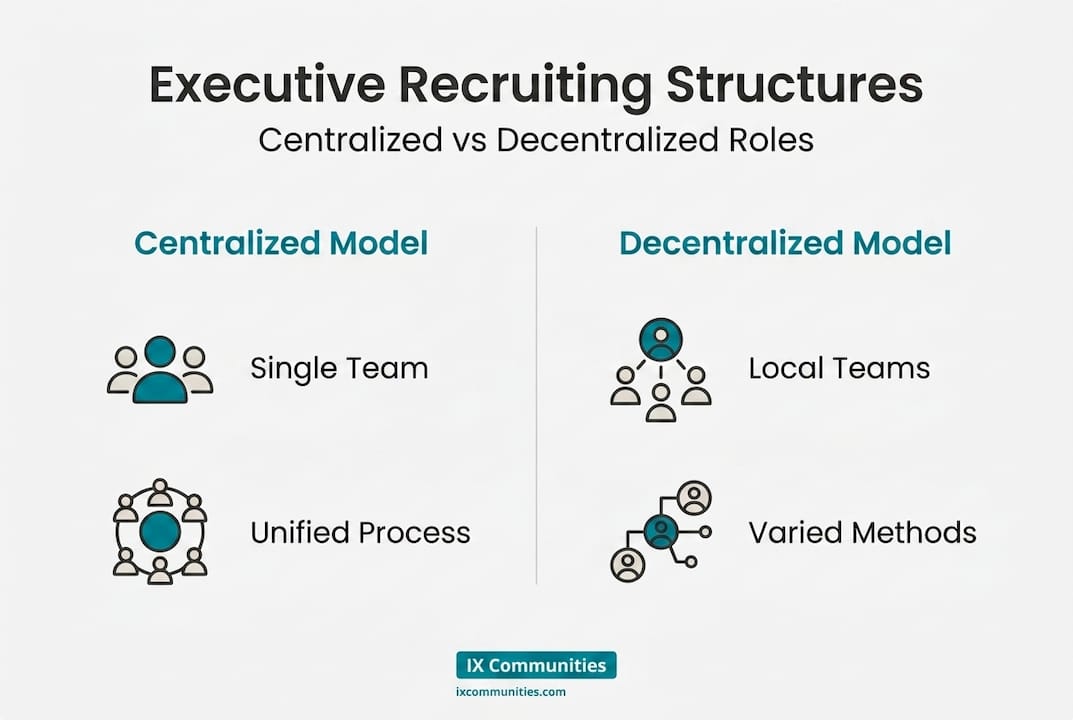
Hybrid centralized-decentralized models are common in Fortune 500 organizations, combining central operations and sourcing with embedded recruiters within individual business units. This approach has become the dominant model for a practical reason: it balances consistency with responsiveness.
| Model | Strengths | Weaknesses |
|---|---|---|
| Centralized | Consistent process, unified data, lower cost | Slower response to business unit needs |
| Decentralized | Deep business alignment, faster local decisions | Inconsistent standards, duplicated effort |
| Hybrid | Best of both, scalable, adaptable | Requires strong governance to avoid confusion |
Steps to select the right model for your organization:
- Assess the complexity of your business units. If they operate in very different markets or talent pools, embedded recruiters provide meaningful local advantage.
- Evaluate your current data and reporting capabilities. Centralized operations functions work best when a strong technology foundation supports them.
- Review your team's headcount and budget against hiring volume. Hybrid models require clear handoff points to avoid redundancy.
- Survey your business unit leaders on their current satisfaction with executive recruiting service levels. Feedback here often reveals structural gaps.
- Pilot the hybrid approach in one region or business unit before scaling across the organization.
Pro Tip: The most common failure in hybrid model transitions is unclear ownership. Define in writing which team owns which roles, at what level, and at what point in the process. Ambiguity at the transition from central to embedded creates delays, candidate confusion, and stakeholder frustration.
Exploring recruiting model trends through peer-reviewed resources and practitioner-authored materials helps teams assess which structural evolutions are gaining traction in comparable organizations. The hybrid model is not a new idea, but how companies implement governance, handoffs, and accountability within it continues to evolve.
Real-world examples and best practices
Theory only gets you so far. Let's look at how companies like Intel turn structure into results and which best practices you can adopt right away.
Intel provides a well-documented example of a structured, purpose-built executive recruiting function. The Intel Executive Search Team operates with dedicated sourcing professionals, executive recruiters, and coordinators working together in a coordinated workflow. Proactive pipelining is a core operating principle, meaning the team maintains active talent maps and candidate relationships before roles are formally opened. This reduces time-to-fill significantly for critical leadership roles. Additionally, Intel integrates internal mobility support directly into its executive search function, meaning the team actively considers internal candidates alongside external ones for senior positions.
"Proactive pipelining and internal mobility integration are not supplementary activities for high-performing executive recruiting teams. They are core functions that define team value."
This is a model worth studying. The discipline of maintaining active pipelines for anticipated roles, rather than reacting to vacancies, requires process investment upfront but delivers measurable returns in speed, quality, and cost.
Best practices drawn from leading executive recruiting teams:
- Proactive pipelining: Maintain candidate lists for the top 10 to 15 critical roles before those roles open, using ongoing market mapping and relationship management.
- Internal mobility integration: Partner with HR business partners and L&D teams to surface internal candidates at the start of every executive search, not as an afterthought.
- Structured intake processes: Use a documented intake meeting format for every VP-level and above search, capturing role scope, success criteria, cultural fit dimensions, and interview panel composition.
- Candidate experience standards: Assign coordinators to every executive-level search to ensure consistent, high-quality communication throughout the process.
- Data-driven reporting: Track and report on time-to-offer, source of hire, offer acceptance rates, and pipeline diversity metrics on a regular cadence to stakeholders.
- Recruiter specialization: Where possible, align recruiters to specific business units or functional areas so they build domain knowledge and stakeholder trust over time.
Integrating internal mobility support into executive recruiting also strengthens retention outcomes. When senior employees see a defined pathway to advancement through the company's own talent processes, engagement improves. Teams that combine external search with internal mobility generate better overall talent outcomes at the senior level.
For talent acquisition leaders looking to accelerate capability building, membership in practitioner communities provides access to documented case studies, peer benchmarking, and direct knowledge exchange with peers at organizations facing comparable challenges.
Actionable steps to integrate these lessons into your own team:
- Audit your current team structure against the role composition framework outlined above.
- Identify gaps in the sourcer-to-recruiter ratio and coordinator coverage.
- Evaluate your operating model against the centralized, decentralized, and hybrid framework.
- Document current pipelining activity and compare it against proactive pipelining standards.
- Schedule a review session with business unit leaders to assess alignment between recruiting capacity and anticipated leadership hiring needs over the next 12 to 24 months.
What most companies miss about structuring executive recruiting teams
Most structural discussions in executive recruiting focus on org charts and headcount ratios. These matter, but they address only part of the challenge. The organizations that consistently outperform in executive hiring have invested equally in the soft infrastructure: recruiter business acumen, stakeholder partnership skills, and the ability to advise rather than just execute.
Many companies replicate a structure that worked elsewhere without examining whether their own business context, culture, and growth trajectory support it. They add sourcers to fix pipeline problems, when the real gap is recruiter credibility with senior business leaders.
The perspective from practitioners in peer network communities consistently surfaces the same pattern: teams that invest in helping their recruiters understand the business, not just the hiring process, build lasting strategic value. Structure enables, but it does not substitute for the consultant-level capabilities that make an executive recruiter genuinely effective.
Future-proofing a recruiting team is not primarily a technology question. It is a capability question. The teams that will perform best over the next decade are those that prioritize internal development, business partnership, and proactive talent intelligence over structural complexity.
Connect with industry leaders and advance your recruiting team
If you're ready to apply these strategies and connect with peers innovating in executive recruiting, the resources below are a direct starting point.
ESIX, TLIX, and IXCommunities provide talent acquisition leaders with structured access to peer exchange, benchmarking data, and practitioner-developed frameworks. Whether your priority is refining your team's composition, evaluating a model transition, or building internal capability, these platforms connect you with the people and data most relevant to your work. Explore peer mentoring for talent leaders, access talent network membership, or benchmark your recruiting team against verified data from comparable organizations.
Frequently asked questions
What is the ideal ratio of sourcers to recruiters in executive recruiting?
The recommended ratio is approximately 1 sourcer for every 3 recruiters, ensuring sufficient pipeline capacity for senior-level sourcing and recruiting without overstaffing the function.
How do Fortune 500 companies structure executive recruiting teams?
Most use hybrid operating models that combine centralized operations and sourcing with recruiters embedded within individual business units, balancing consistency and business responsiveness.
What is the role of coordinators in executive recruiting teams?
Coordinators manage scheduling, candidate communications, and logistics throughout the full-cycle recruiting process, enabling executive recruiters to concentrate on sourcing, assessment, and stakeholder management.
How do leading companies support internal mobility for executive roles?
Companies like Intel build dedicated executive recruiting teams that proactively pipeline internal candidates and coordinate with HR partners to facilitate movement across business units for senior leadership roles.