

Most enterprise hiring teams are operating with more technology than they can effectively manage. The average large recruiting department runs on 15 to 20 separate tools, yet high-performing teams achieve a 22% reduction in time-to-hire specifically by consolidating to fewer, better-utilized platforms. This guide breaks down how the most effective talent acquisition leaders approach technology evaluation and selection, what criteria they prioritize, and which common mistakes are quietly draining productivity from teams that believe more tools means more capability.
Table of Contents
- The shift: From tool overload to streamlined selection
- Key criteria leaders use for selecting hiring technology
- Best practices: Consolidating your hiring tech stack
- Measuring the impact of your hiring technology decisions
- A practical perspective: What most leaders miss about hiring tech selection
- Need help streamlining your hiring technology?
- Frequently asked questions
Key Takeaways
| Point | Details |
|---|---|
| Limit tool overload | High-performing talent teams streamline hiring by reducing the number of technologies they use. |
| Focus on consolidation | Consolidating to a system-of-record platform can cut time-to-hire by over 20 percent. |
| Use clear criteria | Smart leaders evaluate tech based on integration, impact, and sustainability rather than just features. |
| Measure for impact | Track clear KPIs to ensure your hiring technology is improving outcomes and delivering ROI. |
The shift: From tool overload to streamlined selection
Technology sprawl in talent acquisition rarely happens by design. It accumulates gradually. A new sourcing platform gets added to address a short-term gap. An analytics tool comes in after a compliance review. A scheduling solution arrives when the recruiting team grows. Each decision seems reasonable in isolation, but the combined result is a fragmented ecosystem where data lives in silos, recruiters toggle between screens all day, and IT manages an increasingly complex web of integrations.
This pattern is well documented across enterprise recruiting functions. Most large organizations maintain between 15 and 20 active hiring tools at any given time. The list typically includes an applicant tracking system, a candidate relationship management tool, job distribution platforms, interview scheduling software, background screening vendors, assessment providers, video interviewing tools, and several reporting or analytics dashboards. When you add niche sourcing tools and AI-powered screening layers, the count climbs further.
| Tool category | Typical enterprise count | High-performer count |
|---|---|---|
| Core ATS or CRM | 1 to 2 | 1 |
| Sourcing and outreach | 3 to 5 | 1 to 2 |
| Assessment and screening | 2 to 4 | 1 |
| Analytics and reporting | 2 to 3 | Embedded in ATS |
| Scheduling and coordination | 1 to 2 | Integrated |
| Total estimate | 15 to 20+ | 5 to 7 |
The data is clear. High-performing teams limit tool count and consolidate to a system-of-record to reduce time-to-hire by 22%. That is not a marginal gain. That is a measurable operational advantage achieved through restraint, not expansion.
"Fewer tools, used well, outperform a large stack used poorly. The highest-performing recruiting teams succeed by mastering depth over breadth in their technology choices."
The risks of tool overload are frequently underestimated. Leaders often focus on what each tool can do, not what the full stack costs the organization to maintain and use. The most overlooked risks include:
- Recruiter cognitive load: Switching between platforms reduces focus and increases error rates.
- Data fragmentation: When candidate data lives in five places, reporting becomes unreliable.
- Integration failures: More connections between systems mean more points of potential breakdown.
- Training overhead: Each new tool requires onboarding time, documentation, and ongoing support.
- License waste: Studies consistently show that a significant portion of software licenses across enterprise teams go underutilized.
Leaders who have worked through this at enterprise scale recognize the pattern quickly. The goal is not to eliminate all specialized tools but to be intentional about each one. Every platform in the stack should justify its presence through measurable utilization and clear impact on a defined outcome.
Key criteria leaders use for selecting hiring technology
Once a team recognizes the problem of tool sprawl, the next challenge is building a structured approach to evaluating and selecting technology. Most underperforming teams make selection decisions reactively, based on vendor demos, peer recommendations without context, or short-term pressure to solve a specific problem. High-performing leaders use a different process.

The evaluation process typically begins with a clear definition of the problem being solved. Leaders ask what specific outcome is not being achieved, whether that is faster time-to-fill for critical roles, better candidate experience scores, or more accurate hiring data. From that starting point, they assess whether an existing tool in the stack can be configured to solve the problem before considering any new addition.
When a new platform is genuinely needed, the shortlisting process centers on four criteria:
- Integration capability: Can this tool connect directly to the existing system-of-record without requiring a custom middleware build? Native integrations are strongly preferred over API-based workarounds.
- Compliance and security: Does the platform meet the organization's data privacy requirements, including regional regulations such as GDPR or state-level U.S. employment law requirements?
- Scalability: Can the tool handle volume fluctuations, support multiple business units, and accommodate geographic expansion without requiring a separate license tier?
- Vendor support model: What does implementation look like, and what is the escalation path when issues arise? Vendor responsiveness is often overlooked until something goes wrong.
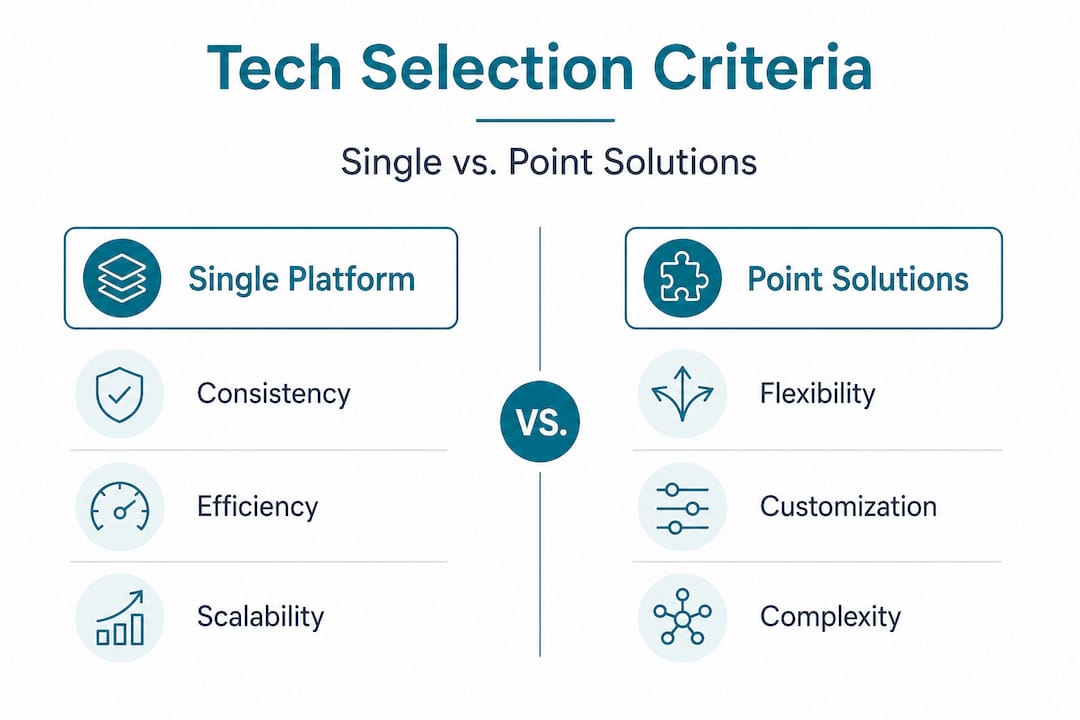
| Factor | Single platform approach | Multiple point solutions |
|---|---|---|
| Data consistency | High | Variable |
| Integration complexity | Low | High |
| Recruiter training time | Shorter | Longer per added tool |
| Reporting accuracy | Consolidated | Requires aggregation |
| Long-term cost | Predictable | Often escalates |
| Time-to-hire impact | 22% improvement possible | Inconsistent |
Leaders who want objective data on how their evaluation process compares to peers across the industry can access benchmarks for hiring tech evaluation that provide direct comparisons without vendor bias. Similarly, a structured technology stack reference can help map current tools against what high-performing organizations in similar industries are using.
Pro Tip: Beware hidden costs in over-customization. When a platform requires extensive custom development to meet your process requirements, that is often a signal the process itself needs review. Simpler configurations almost always drive faster ROI and fewer long-term maintenance problems.
The systematic evaluation process works best when it includes a formal scoring matrix. Each candidate platform is rated across the four criteria above, plus any organization-specific requirements such as language support, mobile functionality, or HRIS integration depth. Decisions made through a scoring process are easier to document, easier to defend to stakeholders, and more likely to hold up over time.
Best practices: Consolidating your hiring tech stack
Selecting better technology is only part of the challenge. The operational work of consolidating an existing stack is where many well-intentioned strategies stall. Consolidation is not simply a matter of turning off tools. It requires a clear sequence, active stakeholder management, and realistic timelines.
Systems-of-record offer a specific efficiency advantage that is worth understanding clearly. A true system-of-record is the authoritative source of candidate data throughout the hiring lifecycle. When all activity, notes, communications, and decisions flow through a single platform, reporting becomes accurate, audits become manageable, and recruiter workflows become predictable. The 22% time-to-hire reduction associated with high-performing teams is directly tied to this consolidation principle.
A stepwise consolidation strategy looks like this:
- Audit current usage: Before removing any tool, document actual utilization rates. Many tools believed to be essential turn out to have low active user counts.
- Identify redundancy: Map overlapping capabilities across tools. It is common to find three platforms performing variations of the same function.
- Define the system-of-record: Establish which platform will serve as the primary data hub before beginning any decommissioning work.
- Sequence decommissioning carefully: Retire tools in order of lowest utilization and fewest dependencies, not alphabetically or by contract end date.
- Communicate changes to recruiters: Give the team advance notice and clear timelines. Surprise tool removals create resistance that slows adoption of the replacement workflow.
"The consolidation phase is where many talent teams lose momentum. The technical work is often straightforward. The harder work is managing expectations and keeping the team focused on the end goal."
The most common pitfalls during consolidation are avoidable with preparation. Data migration errors occur when teams underestimate how much candidate history needs to move between systems. Integration gaps appear when the new system-of-record lacks a native connection that the legacy tool provided. And adoption failure happens when end users were not involved in the evaluation process and feel the change was imposed on them.
Case studies from hiring leaders who have completed large-scale consolidations consistently show that the organizations with the smoothest transitions invested heavily in recruiter input during platform selection. The teams that struggled the most made decisions centrally and communicated them late.
Executive search practices add a further layer of complexity, since those workflows often rely on relationship management capabilities that differ from high-volume recruiting tools. When consolidating across both executive and operational hiring functions, leaders should evaluate whether one platform can genuinely serve both or whether a minimal two-platform architecture is more realistic.
Pro Tip: Involve end users early to avoid adoption failure. Recruiters who participate in the evaluation process are significantly more likely to embrace the final selection, even when the chosen platform is not their personal preference.
Measuring the impact of your hiring technology decisions
Technology decisions in talent acquisition are only as good as the outcomes they produce. Without a measurement framework in place before implementation begins, it is difficult to determine whether a new platform or consolidation effort actually improved performance or simply changed which problems the team is dealing with.
The most important KPIs for evaluating hiring technology impact are:
- Time-to-hire: Measured from job requisition approval to accepted offer. This is the most direct indicator of process efficiency.
- Cost-per-hire: Includes direct costs like job board spend and vendor fees, as well as indirect costs like recruiter time per role.
- User adoption rate: What percentage of the recruiting team is actively using the platform's core features within 90 days of implementation?
- Candidate experience score: Gathered through post-application or post-interview surveys, this metric reflects how the technology affects the candidate's perception of the organization.
- Data accuracy rate: How often does reporting data match manually verified records? Low accuracy signals data hygiene problems tied to the tech stack.
| Metric | Pre-consolidation baseline | Post-consolidation target | Review interval |
|---|---|---|---|
| Time-to-hire | Establish from last 12 months | Reduce by 15 to 22% | Monthly |
| Cost-per-hire | Current all-in average | Reduce by 10 to 15% | Quarterly |
| User adoption | Tool utilization audit | 80%+ active use within 90 days | Monthly for first 6 months |
| Candidate experience | Existing NPS or satisfaction score | Maintain or improve | Bi-monthly |
| Reporting accuracy | Spot-check baseline | 95%+ match rate | Quarterly |
Setting up ongoing assessment cycles is as important as the initial measurement. Point-in-time reviews miss trends. A monthly review of time-to-hire and adoption metrics, combined with a quarterly review of cost and accuracy data, gives leaders the visibility to catch problems early before they escalate into full-scale issues.
Leaders who maintain active membership in peer communities have access to continuously updated hiring technology benchmarks, which makes it significantly easier to contextualize internal metrics against industry performance rather than evaluating performance in isolation.
Pro Tip: Review metrics quarterly to spot early signs of diminishing returns. A platform that delivers strong results in year one may plateau by year two if adoption has not deepened or if the vendor has not kept pace with product development.
A practical perspective: What most leaders miss about hiring tech selection
The conventional approach to hiring technology selection focuses heavily on features. Vendor demo cycles are designed to showcase capabilities, and procurement conversations quickly become comparisons of feature lists. This is understandable but ultimately leads many teams toward the wrong decisions.
The leaders who consistently build effective hiring tech stacks are not chasing the most feature-rich platforms. They are investing in clarity of process. A well-defined recruiting workflow operated on a limited, well-integrated tech stack will outperform a sophisticated multi-tool ecosystem where process discipline is weak. The technology is only as effective as the process it supports.
There is a related pattern worth noting. Organizations that are tempted by every new AI-powered tool, every next-generation sourcing platform, and every emerging scheduling innovation often find themselves cycling through technology without achieving sustained improvement. Technology FOMO (fear of missing out) is a real operational risk. The teams that resist it and instead focus on mastering the tools they already have tend to produce better outcomes over time.
The diversity of perspectives in the selection process also matters more than most leaders acknowledge. When technology decisions are made by a small group of senior stakeholders without recruiter input, without hiring manager input, and without any representation from the candidate experience side, the selected platform often optimizes for the wrong variables. Broader input, including voices from diverse hiring strategy perspectives, produces selections that hold up better under real-world operating conditions.
The practical lesson is straightforward. Restraint, process clarity, and inclusive decision-making are the real drivers of effective hiring technology selection. Features matter, but they matter far less than most teams assume.
Need help streamlining your hiring technology?
For talent acquisition leaders ready to move from tool overload to a more focused, high-performing tech stack, IX Communities offers direct access to resources built specifically for this challenge.
Through peer mentoring for talent leaders, members connect with experienced practitioners who have navigated consolidation projects, platform selections, and organizational change management in large enterprise environments. The community also supports data-driven decisions through benchmark surveys that reveal how your current stack compares to high-performing teams across industries. And for practical guidance on which tools top organizations are actually using, the technology stack reference tool provides a structured starting point for any evaluation process. These resources are designed to give talent leaders clear, peer-validated guidance rather than vendor-driven perspectives.
Frequently asked questions
What is the optimal number of hiring tech tools for an enterprise team?
Top-performing teams typically operate with well under 20 tools, prioritizing high utilization and consolidation over breadth. Benchmark data shows that consolidating to a system-of-record model correlates directly with a 22% reduction in time-to-hire.
What KPIs should leaders track when adopting new hiring technology?
The core KPIs are time-to-hire, cost-per-hire, user adoption rates, and candidate satisfaction scores. High-performing teams track these consistently and review them on defined cycles rather than ad hoc.
How often should hiring technology stacks be reviewed or updated?
Technology stacks should be formally reviewed at least once per year and immediately following any significant organizational change, such as a merger, major headcount shift, or new compliance requirement.
Why are systems-of-record preferred by high-performing hiring teams?
Systems-of-record consolidate candidate data into a single authoritative source, which reduces reporting errors, simplifies recruiter workflows, and supports measurable outcomes. Consolidation to a system-of-record is directly associated with a 22% improvement in time-to-hire among top-performing teams.