

Technology alone is not reshaping talent acquisition at large corporations. The most significant shifts in 2026 combine strategic thinking, skills-based frameworks, people-centered leadership, and data fluency in ways that many organizations are still underestimating. As recruitment models are rethought across industries, talent acquisition leaders need more than awareness of buzzwords. They need practical frameworks, reliable benchmarks, and peer knowledge to turn emerging trends into real organizational results. This guide outlines what is actually driving change, and what actions matter most right now.
Table of Contents
- The evolving landscape of talent acquisition
- How technology is transforming recruitment processes
- DEI, skills-based hiring, and the new workforce priorities
- Remote, hybrid, and return-to-office: Navigating shifting work models
- Measuring success: The new KPIs and analytics in talent acquisition
- Our take: Why real advantage comes from people, not just platforms
- Unlock peer insights and tools for your acquisition team
- Frequently asked questions
Key Takeaways
| Point | Details |
|---|---|
| Human-centered leadership | Leaders must balance innovative technology with strong people and collaboration skills to thrive. |
| Data-driven decision-making | Analytics and benchmarking transform recruitment success by offering clear, actionable metrics. |
| DEI and skills focus | Emphasizing diversity and skill-based hiring opens new talent pools and improves organizational outcomes. |
| Adapting to work models | Remote and hybrid trends require flexible recruitment strategies to attract and retain top talent. |
The evolving landscape of talent acquisition
Not every trend deserves equal attention. Some shifts are genuinely business-critical. Others generate noise without delivering results. Separating the two is one of the most important skills a talent acquisition leader can develop in 2026.
The most consequential shifts currently affecting large organizations include:
- Skills-based hiring replacing degree requirements as the primary filter for many roles
- Hybrid workforce models becoming a permanent feature of workforce planning, not a temporary adjustment
- Employer brand functioning as a competitive differentiator that directly affects offer acceptance rates
- DEI integration moving from standalone programs to core hiring architecture
- AI-assisted sourcing and screening compressing time-to-fill and improving candidate matching at scale
The forces behind these shifts are interconnected. Technology acceleration is changing the speed at which roles evolve, making static job descriptions less reliable. Demographic changes are tightening certain talent pools while diversifying others. Competitive pressures mean top candidates have more choices and shorter decision windows. And rising DEI expectations from candidates, investors, and regulators are pushing organizations to redesign their processes rather than layer programs on top of existing systems.
| Trend | Cited by leading firms | Current status |
|---|---|---|
| Skills-based hiring | High | Scaling rapidly |
| AI-assisted screening | High | Widely adopted |
| Employer brand investment | High | Increasing |
| Degree requirement removal | Moderate | Growing |
| Predictive analytics for hiring | Moderate | Early adoption |
| Gig/contract workforce integration | Low to moderate | Stalled in many sectors |
"Recent years have seen a fundamental rethinking of recruitment models, leadership expectations, and talent pools for corporations," with leading organizations moving faster and more deliberately than their peers on each of these dimensions.
Using talent acquisition benchmarking data helps leaders identify which of these trends their peer organizations are actually implementing versus which ones are being discussed but not yet acted upon. That distinction is operationally important.
How technology is transforming recruitment processes
Technology is not just an efficiency tool. When implemented with clear purpose, it changes what is possible at every stage of the hiring process. The key is understanding where technology solves real problems and where it creates new ones.
Choosing hiring technology well requires leaders to map their current process pain points before evaluating platforms. Organizations that skip this step often purchase tools that duplicate existing capabilities or create integration problems across their HR systems.

Traditional vs. AI-driven recruitment: a direct comparison
| Stage | Traditional approach | AI-driven approach |
|---|---|---|
| Sourcing | Manual searches, job boards | Automated matching, talent pool mining |
| Screening | Resume review by recruiter | AI scoring against skills profiles |
| Outreach | Templated emails, phone calls | Personalized automated sequences |
| Scheduling | Back-and-forth coordination | AI scheduling assistants |
| Assessment | Structured interviews only | Video analysis, skills testing |
| Decision-making | Interviewer consensus | Data-supported scoring with human review |
The ROI from technology adoption is real but context-dependent. A large financial services organization that implemented AI-assisted screening for high-volume roles reported a 40% reduction in time-to-screen and a measurable improvement in hiring manager satisfaction scores after six months. The differentiator was not the tool itself but the process redesign that happened alongside it.
Here are five steps to adopt and scale new recruitment technologies effectively:
- Audit your current process for specific bottlenecks before selecting any tool
- Define success metrics in advance so you can evaluate impact objectively
- Pilot with a single team or role type before enterprise rollout
- Train recruiters on how to use the tool, not just how to operate it
- Review outputs regularly to catch bias, errors, or gaps in the system's recommendations
Pro Tip: The most common mistake in recruitment technology adoption is buying a platform to solve a strategy problem. If your hiring process lacks clear criteria or stakeholder alignment, technology will scale those problems, not fix them. Address process design first.
Using AI tools for recruiters effectively also requires ongoing skill development. A tool is only as useful as the recruiter who interprets its outputs and acts on them with judgment.
DEI, skills-based hiring, and the new workforce priorities
The relationship between DEI and skills-based hiring is more direct than it may appear. When organizations remove unnecessary degree requirements and assess candidates on demonstrated competencies instead, they naturally access broader and more diverse talent pools. This is not coincidental. It is the intended design.
Modern recruitment methods at leading corporations now treat DEI not as a separate initiative but as a quality control mechanism for the hiring process. Biased sourcing, narrow job descriptions, and inconsistent interview standards all reduce the quality of hire, not just the diversity of the candidate pool.
Key strategies used by leading companies in this space include:
- Replacing degree requirements with skills assessments for roles where education is not a genuine predictor of success
- Standardizing interview scorecards to reduce evaluator subjectivity
- Tracking sourcing channel diversity to identify where pools are narrowing
- Setting representation goals at the pipeline stage, not just at the hire stage
- Training hiring managers on structured interview techniques and implicit bias patterns
- Partnering with community colleges, coding bootcamps, and workforce development programs to access non-traditional talent
A notable data point: According to research across Fortune 500 hiring practices, more than 60% of organizations now list skills competency as their primary hiring filter for technical roles, up from fewer than 30% five years ago. This shift reflects both talent availability pressures and the growing recognition that degrees do not predict job performance as reliably as demonstrated skills.
Pro Tip: Capturing DEI metrics meaningfully means going beyond representation counts at the hire stage. Track where diverse candidates drop out of your funnel, which hiring managers have lower offer acceptance rates among diverse candidates, and how representation at the offer stage compares to the sourcing stage. These data points reveal where process redesign is needed.
Understanding which skills recruiters need to assess competencies accurately is equally important. The shift to skills-based hiring places new demands on recruiting teams themselves.
Remote, hybrid, and return-to-office: Navigating shifting work models
Work model decisions are now a direct input to talent acquisition strategy. Return-to-office policies are reshaping not just where people work but which candidates accept offers, which leaders can be recruited, and how competitive your employer value proposition is in specific markets.
The impact of work models on talent acquisition shows up in measurable ways:
- Candidate pool size: Remote and hybrid roles attract significantly more applicants than fully in-person roles in most corporate job categories
- Offer acceptance rates: Candidates at the mid to senior level increasingly factor flexibility into final decisions, often ahead of compensation adjustments
- Geographic reach: Hybrid and remote policies allow organizations to recruit in secondary markets where competition for talent is lower
- Employer brand perception: Return-to-office mandates without clear rationale are frequently cited in negative employer reviews on platforms like Glassdoor and LinkedIn
- Leadership hiring complexity: Senior executives have stronger preferences and more negotiating leverage on work location terms
"Remote and hybrid work trends are fundamentally altering talent acquisition and leadership hiring," requiring organizations to recalibrate their entire sourcing and offer strategy rather than treating location flexibility as a simple yes-or-no benefit.
One instructive case: a large technology company that shifted to a hybrid-first policy in 2023 expecting productivity gains instead found that its recruiter pipeline quality improved significantly. With a 30% wider geographic sourcing range, the company accessed talent markets it had previously overlooked and reduced average time-to-fill for technical leadership roles by three weeks. The unintended consequence was a meaningful improvement in new hire retention at the 12-month mark.
The challenge for talent acquisition leaders is not choosing between models but designing recruiting processes that are consistent regardless of which model a given business unit uses. Alignment between your employer brand message and your actual offer terms is where leadership hiring strategies succeed or fail.
Measuring success: The new KPIs and analytics in talent acquisition
Measurement frameworks are changing. The metrics that drove decisions five years ago are no longer sufficient. Leaders now need a more complete view of recruiting performance that connects hiring activity to business outcomes.
The metrics that matter most in 2026 include both process indicators and outcome indicators:
| Metric | Definition | Why it matters |
|---|---|---|
| Time-to-fill | Days from req open to offer accepted | Tracks process efficiency and candidate experience |
| Quality-of-hire | Performance and retention of new hires | Links recruiting to business outcomes |
| Candidate experience score | Survey-based satisfaction rating | Reflects brand impact and process design |
| Diversity at pipeline stages | Representation at each funnel stage | Reveals where drop-off occurs |
| Offer acceptance rate | Percentage of offers accepted | Indicates competitiveness of the offer package |
| Recruiter capacity ratio | Open reqs per recruiter | Tracks operational sustainability |
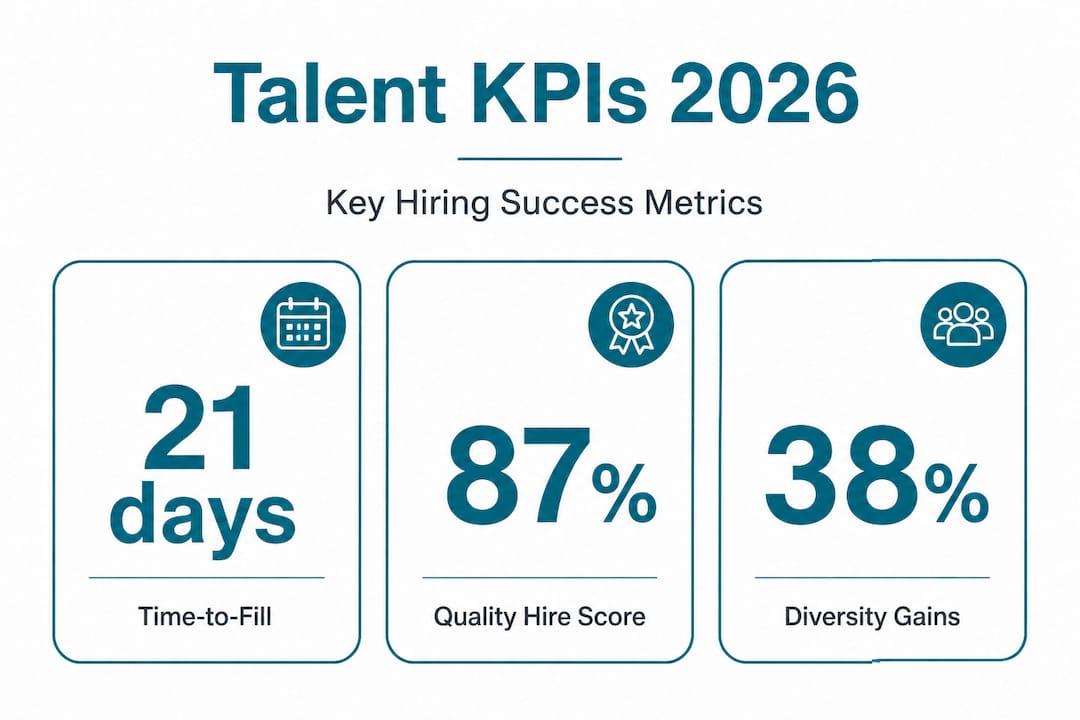
Benchmarking and analytics allow talent acquisition teams to move from internal comparisons to peer-informed standards. Knowing your time-to-fill is 45 days means less without knowing whether your peer organizations are averaging 35 or 55.
To put advanced analytics into practice with existing HR systems, follow these steps:
- Identify your current data sources including ATS, HRIS, and survey tools and assess their integration compatibility
- Define two to three priority metrics that align directly with business goals for the current year
- Establish a baseline using at least 12 months of historical data before making comparisons
- Build a reporting cadence that delivers insights to hiring managers and business leaders, not just HR
- Review and recalibrate metrics annually as business priorities and workforce conditions change
Using analytics for recruiter training is an underused application. Performance data at the individual recruiter level, including offer conversion rates, hiring manager satisfaction, and pipeline diversity, can identify where skill gaps exist and where coaching will have the most impact.
Our take: Why real advantage comes from people, not just platforms
The trend toward technology investment in talent acquisition is justified. AI tools, analytics platforms, and automation are producing real results for organizations that implement them thoughtfully. But there is a pattern worth naming: organizations that invest heavily in platforms while underinvesting in recruiter capability and peer learning consistently see smaller returns than those that develop both simultaneously.
The common mistake is believing that a new ATS or AI screening tool will compensate for gaps in recruiter skill, hiring manager alignment, or organizational clarity about what good talent looks like. Tools surface information. People interpret it, apply judgment, and build the relationships that convert candidates into hires and hires into contributors.
Talent networking strategies have long been cited as a differentiator in competitive talent markets. The leaders who consistently outperform on quality of hire are those with strong peer networks, access to real-time benchmarking data, and a culture of continuous learning within their recruiting teams.
Consider this pattern observed across peer communities: recruiting leaders who participate in structured peer exchange programs identify emerging problems earlier, adopt effective practices faster, and build more credible business cases for resourcing than those who rely primarily on vendor-provided insights or generic industry reports.
Pro Tip: To build more strategic hiring conversations across your organization, establish a monthly cross-functional calibration session between recruiting, HR business partners, and key business leaders. Align on what "quality of hire" means for each role family and review new hire performance data together. This practice alone often surfaces misalignment that no technology tool would catch.
The connection between talent management and recruiting is also frequently underutilized. When recruiting leaders have access to internal mobility data, performance trends, and succession gaps, their external sourcing strategies become significantly more targeted and effective.
Platforms provide capability. People provide direction. The organizations that lead on talent acquisition in 2026 will be those that invest in both with equal seriousness.
Unlock peer insights and tools for your acquisition team
Talent acquisition leaders at large corporations face challenges that generic industry resources do not fully address. The scale, complexity, and competitive pressures of enterprise recruiting require peer-informed perspective, not just vendor content.
IX Communities, through ESIX and TLIX, provides a secure environment where corporate talent and recruiting leaders share real data, exchange practices, and benchmark performance against peers. Whether you are navigating AI adoption, rethinking your skills-based hiring model, or building the business case for increased recruiting investment, peer mentoring for TA leaders and real-time benchmarking data provide resources that are specific to your context. Explore IX Communities membership to connect with a network of peers who are navigating the same challenges and building the same capabilities your team needs.
Frequently asked questions
What are the most critical talent acquisition KPIs in 2026?
Key KPIs include time-to-fill, quality-of-hire, candidate experience scores, and diversity metrics at each pipeline stage. Benchmarking and analytics enable organizations to measure these against peer standards rather than internal baselines alone.
How are remote and hybrid work models affecting recruitment strategies?
They have expanded candidate pools geographically and transformed how senior leaders are recruited, but also introduced new challenges in maintaining culture consistency. Return-to-office policies now directly influence offer acceptance rates at every level.
Why is skills-based hiring growing in popularity?
Skills-based hiring allows organizations to access wider talent pools and aligns hiring criteria more directly with actual job performance. Recruiting best practices increasingly reflect this shift as a quality and diversity improvement tool simultaneously.
How can talent acquisition leaders stay ahead of emerging trends?
Combining technology adoption with peer learning, structured benchmarking, and data-driven strategy creates the clearest path to sustained advantage. As executive search approaches change across the industry, leaders with strong peer networks identify and respond to shifts faster than those relying on vendor-sourced insight alone.