

Executive search is changing faster than most organizations are prepared for. The frameworks that guided leadership hiring five years ago are no longer aligned with what top candidates expect, what boards demand, or what competitive organizations deliver. In 2026, the gap between organizations that have updated their search practices and those that have not is measurable in both time-to-fill and quality of hire. This article outlines the specific shifts senior talent acquisition leaders are making, from technology adoption to diversity mandates to peer benchmarking, and what those changes mean for your organization's talent strategy going forward.
Table of Contents
- Shifts in the executive talent landscape
- New technologies redefining executive recruitment
- Elevating diversity and inclusion as a core mandate
- Performance benchmarking and peer-driven innovation
- Why incremental tweaks won't keep you competitive
- Connect, benchmark, and lead with IX Communities
- Frequently asked questions
Key Takeaways
| Point | Details |
|---|---|
| Candidate priorities shift | Flexibility, culture, and purpose have overtaken compensation in executive decisions. |
| AI transforms recruitment | Digital tools and AI are now vital for efficient, targeted executive searches. |
| Diversity built into process | Top teams set diversity benchmarks for every search stage, not just the end result. |
| Benchmarking drives innovation | Continuous peer and data benchmarking sets leading teams apart in 2026. |
Shifts in the executive talent landscape
The forces reshaping executive search in 2026 are not subtle. They reflect fundamental changes in what leaders want from their careers, what organizations need from their executives, and how the global talent pool is structured.
Remote and hybrid leadership models have permanently altered the candidate pool. Organizations are no longer limited to geographic proximity when sourcing executive talent, but that also means they are competing globally for the same candidates. A chief operating officer in Austin is now a viable candidate for a role based in Amsterdam, and vice versa. This expansion creates opportunity, but it also raises the bar for how compelling your organization's value proposition must be.
Executive search trends show that candidate priorities have shifted significantly since 2020, with increased emphasis on flexibility, purpose, and culture. That shift is not a preference. It is a filter. Candidates at the executive level are declining offers that do not align with these expectations, regardless of compensation.
Top 5 candidate priorities: 2026 vs. 2023
| Priority | 2023 ranking | 2026 ranking |
|---|---|---|
| Organizational culture fit | 3 | 1 |
| Flexibility and hybrid options | 5 | 2 |
| Purpose and mission alignment | 4 | 3 |
| Compensation and total rewards | 1 | 4 |
| Career development pathways | 2 | 5 |
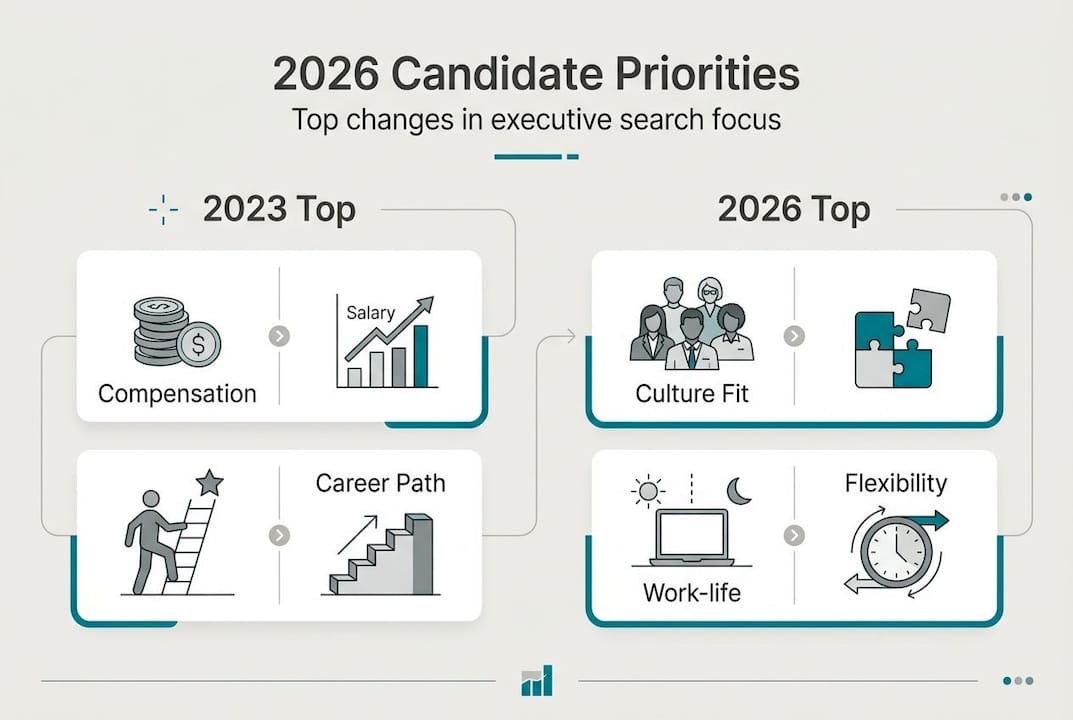
The table above reflects a clear pattern. Compensation, once the dominant factor, has dropped to fourth. Culture and flexibility now lead. This is not a temporary trend. It represents a structural shift in how senior talent evaluates opportunity.
Leading search teams are responding by:
- Rewriting position briefs to lead with culture and mission rather than scope and title
- Building candidate experience protocols that reflect the organization's stated values
- Integrating cultural assessment earlier in the search process, not just at final interview
- Expanding sourcing geography to reflect the reality of hybrid and remote executive roles
Diversity, inclusion, and cultural fit have also moved from aspirational goals to operational requirements. Boards and executive committees are holding search teams accountable for diverse slates, not just diverse hires. The distinction matters. A diverse slate that consistently produces non-diverse placements signals a process problem, not a pipeline problem.
New technologies redefining executive recruitment
The adoption of technology in executive search has accelerated sharply. What was experimental three years ago is now standard practice at leading organizations.

Top executive search firms now use AI-powered platforms for enhanced candidate sourcing and faster shortlist generation. The impact is significant. Searches that previously took 90 days to reach a qualified shortlist are now completing that stage in under 45 days at organizations using AI-assisted sourcing tools.
Traditional vs. AI-driven executive search: Key process differences
| Search stage | Traditional approach | AI-driven approach |
|---|---|---|
| Candidate sourcing | Manual database searches, referrals | Automated multi-source scanning |
| Shortlist generation | Recruiter judgment and experience | Data-scored candidate ranking |
| Assessment | Unstructured interviews, references | Video assessment, behavioral analytics |
| Bias mitigation | Inconsistent, interviewer-dependent | Structured prompts, blind review options |
| Reporting | Manual tracking, periodic updates | Real-time dashboards, predictive analytics |
Beyond sourcing, video assessment platforms now allow structured evaluation of executive candidates at scale. These tools capture behavioral signals that unstructured interviews miss, and they create a consistent record for panel review. Advanced people analytics platforms are also being used to model leadership fit against organizational performance data, moving assessment beyond gut instinct.
Key innovations currently in use at leading search operations include:
- AI sourcing tools that scan public professional networks, proprietary databases, and internal talent pools simultaneously
- Video assessment platforms with structured question sets and automated behavioral scoring
- People analytics tools that map candidate profiles against team composition and performance outcomes
- Applicant tracking integrations that provide real-time visibility into search progress
Organizations exploring modern search technology should also evaluate AI and data tools for search carefully for bias and regulatory compliance before deployment.
Pro Tip: When vetting AI sourcing tools, request documentation on how the algorithm was trained and what steps the vendor takes to audit for demographic bias. This protects your organization legally and ensures the tool supports, rather than undermines, your diversity goals.
Elevating diversity and inclusion as a core mandate
Diversity in executive search has moved beyond reporting. In 2026, it is embedded in process design, not added at the end.
Diversity targets are now set at each search stage, not just at final slate presentation. That means search teams are accountable for diverse representation at the long list, the short list, and the interview panel, not just the offer stage. This structural change is producing more consistent outcomes than end-stage diversity requirements ever did.
Leading organizations are taking the following actions to embed diversity throughout the search process:
- Setting explicit diversity criteria at the long list stage, before any screening occurs
- Using structured interview guides to reduce evaluator bias during candidate assessment
- Auditing job descriptions for exclusionary language before posting or sharing with search firms
- Requiring diverse interview panels for all final-stage executive candidates
- Tracking diversity metrics at each search stage and reporting them to leadership
- Partnering with improving diversity in searches networks to access broader candidate pools
"Diversity is baked into process, not an afterthought." This principle, increasingly common among top-performing search teams, reflects a shift from compliance thinking to design thinking.
Organizations with access to diversity strategy resources are better positioned to move from surface-level metrics to genuine inclusion outcomes. The difference shows up in retention. Executives who join organizations where the culture genuinely reflects stated values stay longer and perform better.
Pro Tip: Track candidate withdrawal rates by demographic group. If certain groups are withdrawing at higher rates during the process, that signals a candidate experience problem, not a pipeline problem. Fix the process before expanding sourcing.
For teams building internal capability, peer mentorship for diversity programs offer structured learning from practitioners who have navigated these challenges at comparable organizations.
Performance benchmarking and peer-driven innovation
The organizations advancing fastest in executive search are not operating in isolation. They are benchmarking continuously and learning from peers who face the same challenges at scale.
Benchmarking programs and information exchanges now drive ongoing refinement and innovation in executive search practices. The value is not just in knowing where you stand. It is in understanding what the top quartile is doing differently and applying those practices before they become standard.
Executive search KPI comparison: 2025 vs. 2026
| KPI | 2025 average | 2026 top quartile |
|---|---|---|
| Time to shortlist (days) | 52 | 38 |
| Diverse slate compliance rate | 64% | 89% |
| Offer acceptance rate | 71% | 84% |
| First-year retention rate | 76% | 91% |
| Search cost per placement | $48,000 | $39,500 |
The gap between average and top-quartile performance is significant across every metric. Organizations that benchmark regularly are consistently closing that gap faster than those that do not.
Steps to leverage peer input for innovation in executive search:
- Identify the two or three KPIs where your team's performance lags the benchmark most significantly
- Connect with peer organizations through structured information exchanges to understand their process differences
- Pilot one or two process changes based on peer input before full implementation
- Re-measure against the benchmark after 90 days to assess impact
- Share your findings back with the peer network to contribute to collective improvement
Access to benchmarking executive search data and expert case studies accelerates this cycle. Organizations that treat benchmarking as a continuous practice, rather than an annual exercise, maintain a structural advantage in search quality and efficiency.
Why incremental tweaks won't keep you competitive
There is a pattern visible across the organizations that are falling behind in executive search. They are making adjustments. They are updating job descriptions, adding a diversity question to interview guides, or piloting one AI tool. These are not transformations. They are incremental changes applied to processes that need fundamental redesign.
The organizations leading in 2026 made deliberate decisions to rebuild their search practices from the ground up. They did not add diversity to an existing process. They redesigned the process with diversity as a structural requirement. They did not bolt AI onto a manual workflow. They replaced the workflow.
The outcomes are not marginal. The KPI data shows double-digit improvements in offer acceptance, retention, and cost efficiency among organizations that committed to genuine transformation. Incremental adjustments produce incremental results.
Rethinking diversity strategy is one area where this distinction is especially clear. Organizations that treat diversity as a compliance requirement produce compliant outcomes. Organizations that treat it as a design principle produce competitive ones. The difference in leadership quality, team cohesion, and long-term retention is measurable.
The question for senior talent leaders is not whether change is needed. The data makes that clear. The question is whether your organization is willing to make the changes that actually move the needle, or whether it will continue optimizing a process that is no longer fit for purpose.
Connect, benchmark, and lead with IX Communities
Senior talent leaders who want to act on these changes have a direct path forward through IX Communities. The peer networks, benchmarking data, and structured information exchanges available through ESIX, TLIX, and IXCommunities are built specifically for large corporate talent and recruiting departments navigating exactly these challenges.
Access in-depth benchmarking data to measure your team's performance against the top quartile. Connect with peers through mentoring for talent leaders programs that offer structured learning from practitioners at comparable organizations. Explore membership benefits to understand how IX Communities supports ongoing innovation in executive search practice. The resources are available. The peer network is active. The next step is yours.
Frequently asked questions
What are the top priorities for executive candidates in 2026?
Flexibility, culture, and purpose now lead executive candidates' priorities in 2026, with compensation ranking fourth. Development opportunities and career pathways round out the top five.
How is AI impacting executive search processes now?
AI platforms are now standard for sourcing and assessing top executive talent, reducing time to shortlist by up to 50% at leading organizations while improving candidate scoring consistency.
How do leading teams ensure executive search diversity?
They embed diversity goals at every stage of the search process, from long list through offer, with stage-specific targets and structured reporting accountability.
Why is benchmarking increasingly important in executive search?
Ongoing benchmarking enables leaders to compare performance with peers, identify process gaps, and adopt best practices before they become standard across the industry.