

Return-to-office mandates were expected to restore collaboration and reinforce company culture. What many organizations did not anticipate was the toll these policies would take on leadership retention and recruitment. 42% of employers with RTO mandates reported higher-than-normal turnover, and 29% found it harder to recruit qualified employees. For talent acquisition leaders at large organizations, this is not a peripheral trend. It is a direct challenge to hiring strategy, leadership pipeline strength, and workforce diversity goals.
Table of Contents
- The shifting landscape: RTO mandates and leadership turnover
- Why flexibility is now 'compensation': Candidate expectations for executive roles
- Unequal impacts: How strict RTO undermines diversity and advancement
- Data-driven approaches: Measuring and adapting RTO's impact on hiring
- Why the conventional wisdom on RTO and leadership hiring is outdated
- Supporting leaders through smarter RTO transition
- Frequently asked questions
Key Takeaways
| Point | Details |
|---|---|
| RTO mandates hurt retention | Strict return-to-office policies are linked to higher leadership turnover and harder recruiting. |
| Flexibility equals compensation | Executive candidates increasingly view hybrid and remote work as part of total compensation. |
| Diversity risks rise | Rigid RTO guidelines disproportionately harm the retention and advancement of women and minority leaders. |
| Smart leaders track outcomes | Measuring metrics like time-to-hire and turnover helps adapt RTO practices and protect leadership pipelines. |
| Adapting means competing | Organizations that iterate on policy are better positioned to attract and keep high-impact leadership talent. |
The shifting landscape: RTO mandates and leadership turnover
The return-to-office conversation has moved well past debate. Many large organizations have now implemented formal RTO policies, requiring three to five days per week of in-office attendance for leadership and non-leadership roles alike. The data emerging from these decisions is worth close attention.
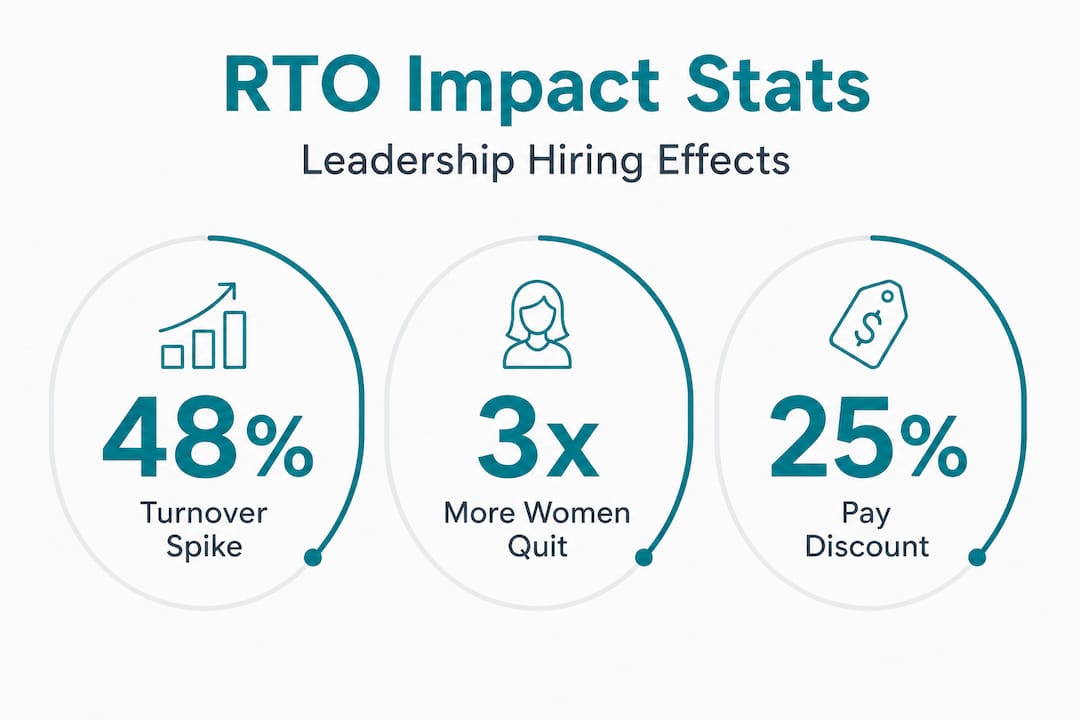
Higher turnover after RTO mandates affects nearly half of all employers who have adopted strict in-office requirements. For recruitment teams, this creates a compounding problem. Losing experienced leaders means longer vacancy periods, more costly searches, and reduced institutional knowledge. At the same time, the candidate market for senior roles is increasingly resistant to rigid location requirements.
Recruiting senior talent under strict RTO conditions presents distinct challenges. Experienced executives and senior managers have often built careers around geographic mobility and flexible working arrangements. Many have accepted roles with organizations that actively promoted flexibility as part of the offer. Asking those individuals to reverse course mid-career, or requiring that new hires commit to daily office attendance, narrows the candidate pool considerably.
The financial implications are significant. Leadership roles typically carry replacement costs of 50 to 200 percent of annual salary when accounting for recruiting fees, onboarding time, and lost productivity. When RTO policies accelerate turnover at the director, VP, or C-suite level, those costs accumulate quickly. Tracking specific metrics helps talent leaders quantify what is happening and justify policy adjustments.
| Metric | RTO impact observed | Recommended tracking frequency |
|---|---|---|
| Time-to-fill (senior roles) | Increased 15 to 30% in many organizations | Monthly |
| Offer acceptance rate | Declined where RTO is strict | Per hire cohort |
| Leadership voluntary turnover | Elevated above pre-RTO baseline | Quarterly |
| Candidate pool size | Reduced for in-office-only roles | Per open requisition |
Talent leaders who apply leadership best practices to RTO challenges are also drawing on leadership strategies for growth to assess how policy decisions interact with broader organizational goals. Treating RTO as an isolated operational decision, rather than a talent strategy variable, is where many organizations go wrong.
Why flexibility is now 'compensation': Candidate expectations for executive roles
Flexibility has shifted from a workplace perk to a core element of total compensation. This is not a sentiment-based observation. It is backed by measurable behavior in the talent market. When candidates weigh two offers, they apply real dollar values to the presence or absence of remote and hybrid options.
Tech workers accepted a ~25% pay discount for remote or hybrid roles over fully in-person positions. This finding from UCLA Anderson Review is not a niche data point. It reflects how meaningfully flexibility factors into a candidate's decision to accept, negotiate, or decline an offer. For executive roles, where total compensation packages can reach seven figures, a 25 percent discount represents a substantial financial concession candidates are willing to make for schedule autonomy.
This market reality requires a recalibration of how talent leaders structure competitive offers. Compensation benchmarking can no longer focus solely on base salary and equity. It must factor in the implicit value of location flexibility, schedule control, and remote access to collaboration tools.
Here is a practical framework for assessing offer competitiveness in an RTO environment:
- Identify the flexibility tier of the role. Fully in-office, hybrid with defined in-office days, or primarily remote each represent distinct market positions.
- Benchmark base salary separately from flexibility value. A fully in-office role may need to compensate 15 to 25 percent higher than a comparable hybrid role to attract the same caliber of candidate.
- Assess the candidate's career stage and discipline. Senior leaders in functions like finance, legal, and operations may have different flexibility expectations than those in technology, marketing, or people functions.
- Evaluate organizational culture signals. Candidates research a company's stated and actual flexibility norms before applying. Misalignment between messaging and practice damages employer brand credibility.
- Compare against competitor offers in the same geography and function. Flexibility vs. salary data varies meaningfully by market, making location-specific benchmarks essential.
Pro Tip: Use benchmark compensation data from peer networks to understand what flexibility configurations comparable organizations are offering for senior roles. Anecdotal comparisons are not sufficient for accurate positioning.
| Offer configuration | Candidate premium required | Typical acceptance rate impact |
|---|---|---|
| Fully in-office, 5 days/week | High premium needed | Acceptance rate declines 10 to 20% |
| Hybrid, 2 to 3 days in-office | Moderate alignment with market | Acceptance rate stable |
| Primarily remote with quarterly travel | Below-market salary often accepted | Acceptance rate increases |
Access to membership for HR best practices through professional peer communities allows talent teams to validate these patterns against what peers at comparable organizations are observing in real time.
Unequal impacts: How strict RTO undermines diversity and advancement
The diversity consequences of rigid RTO policies are among the most significant and least discussed aspects of this issue. Strict return-to-office requirements do not affect all employee groups equally. The data shows clear patterns of disproportionate impact on women, caregivers, employees with disabilities, and workers from lower-income backgrounds.
RTO strictness intensifies workplace inequalities and can measurably lower retention rates for women in particular. Research published in the Industrial and Organizational Psychology journal found that the structural demands created by in-office requirements fall harder on groups that carry disproportionate caregiving responsibilities or face greater commuting barriers. This is not a minor variance. It is a systematic pattern.

The magnitude of this effect becomes clear in behavioral data. Women are nearly three times as likely to quit when RTO mandates are imposed, compared to their male counterparts. For organizations that have invested significantly in building leadership diversity pipelines, a strict RTO policy can dismantle years of progress within a short period.
Key diversity-related effects of strict RTO policies include:
- Caregiver attrition. Women and single parents with primary caregiving responsibilities face structural conflicts between rigid office schedules and family logistics. Many opt to leave rather than manage the added burden.
- Geographic exclusion. Underrepresented candidates are more likely to live farther from corporate headquarters due to housing costs. In-office requirements raise commuting costs and time demands disproportionately.
- Proximity bias. Leaders who are physically present in the office gain more visibility with senior decision-makers. Remote employees, who are more likely to be women or caregivers, miss out on informal sponsorship opportunities that drive advancement.
- Access to high-visibility projects. In-office workers are more frequently selected for stretch assignments and cross-functional projects, accelerating their paths to leadership roles.
"Return-to-office mandates create structural barriers that are not neutral in their impact. They concentrate opportunity among those who face the fewest external constraints, which tends to reinforce existing demographic imbalances in leadership."
Proximity bias in hybrid teams is a documented phenomenon that affects how performance is perceived, how credit is assigned, and who gets sponsored for leadership roles. Talent acquisition and HR leaders who do not actively measure and counteract this bias will find their diversity gains eroding in direct correlation with RTO strictness.
Pro Tip: Use peer mentorship and proximity bias programs to build structured visibility pathways for remote and hybrid employees, ensuring advancement opportunities do not default to those who happen to be physically present. Complementary peer programs for diversity support leaders in building equitable frameworks that function across work models.
Data-driven approaches: Measuring and adapting RTO's impact on hiring
Understanding the problem is only useful if organizations act on what they learn. The most effective talent leaders treat RTO policy as a variable to measure and adjust, not a permanent fixture to defend. This requires building a consistent measurement framework around leadership hiring and retention.
Organizations should measure recruiting, retention, productivity, and time-to-hire by department and adjust policy based on observed results. This approach moves RTO decisions out of the realm of intuition and into the domain of evidence-based management.
A practical approach to RTO impact measurement involves four steps:
- Establish a pre-RTO baseline. Before policy changes take effect, document turnover rates, time-to-fill, offer acceptance rates, and diversity ratios for leadership roles. This baseline is the reference point for all future comparisons.
- Segment data by department, role type, and location. Aggregate numbers can obscure important variation. A technology department may show dramatically different RTO sensitivity than a finance or legal group. Senior roles may respond differently than mid-level management.
- Track leading indicators, not just lagging ones. Voluntary resignations and failed offers are lagging indicators. Application volume, candidate drop-off rates, and employee engagement scores give earlier signals of RTO policy friction.
- Review and iterate on a defined schedule. Quarterly reviews tied to benchmarking post-RTO data allow organizations to course-correct before problems become entrenched.
| Data point | Why it matters for RTO assessment | Review cadence |
|---|---|---|
| Leadership offer acceptance rate | Direct signal of candidate response to RTO terms | Per hiring cohort |
| Voluntary turnover by location | Identifies offices where RTO is driving exits | Quarterly |
| Diversity ratio at director level and above | Tracks RTO's cumulative diversity impact | Semi-annually |
| Time-to-fill for senior roles | Measures recruiting efficiency under RTO conditions | Monthly |
| Employee engagement scores | Early indicator of dissatisfaction before voluntary exit | Quarterly |
Pro Tip: Segment your metrics not only by department and role level, but also by commute distance categories. Employees who commute over 45 minutes each way show measurably higher attrition in strict RTO environments. This segmentation often reveals which locations carry the most RTO-related risk for your leadership pipeline.
Reviewing metrics for performance and connecting them to RTO policy outcomes creates a feedback loop that supports better decision-making over time. Organizations that adopt this approach consistently outperform those that set RTO policy once and treat it as fixed.
Why the conventional wisdom on RTO and leadership hiring is outdated
The assumption that in-person presence correlates with stronger performance and deeper organizational loyalty has not held up under scrutiny. Yet many organizations continue to use it as the default justification for strict RTO mandates. This is a significant strategic error, and it costs organizations real talent.
The evidence points in a different direction. Flexibility correlates with higher reported loyalty, broader candidate access, and stronger retention among experienced leaders. The organizations applying rigid in-office requirements are frequently those losing the most senior talent to competitors with more adaptive policies. The old logic assumed that if you could see someone working, they were working better. That assumption does not account for the ways high-performing leaders actually operate.
Diversity and advancement are more threatened by inflexible policies than by distributed work models. The path to a more representative leadership team requires removing structural barriers, not adding new ones. Strict RTO is a structural barrier for a predictable set of employees. Organizations that recognize this are adjusting policy accordingly, not because of social pressure, but because retaining and promoting diverse leaders has measurable business value.
The most forward-thinking talent leaders are treating RTO as a variable in an ongoing experiment, not a statement of organizational values. They test configurations, measure outcomes, and adjust based on what the data shows. This is consistent with how leadership network perspectives from peer communities frame the issue. Rigid policy is not a sign of strong leadership culture. Adaptive policy, grounded in evidence, is.
Investment in leadership development insights also points toward this conclusion. Organizations that invest in developing leaders do not rely on physical presence to signal engagement. They build systems, frameworks, and cultures that produce results regardless of where people sit.
Supporting leaders through smarter RTO transition
Navigating RTO-driven changes in leadership hiring requires more than internal analysis. Access to peer-level insights, validated benchmarks, and structured diversity frameworks accelerates adaptation and reduces the risk of reactive decision-making.

ESIX, TLIX, and IXCommunities provide talent acquisition and HR leaders with the tools needed to manage these challenges effectively. Through peer mentoring for leaders, talent professionals can connect with peers navigating the same RTO pressures and share what is and is not working across organizations of similar scale. Access to leadership hiring benchmarks allows teams to validate whether their offer competitiveness, turnover rates, and diversity metrics align with or diverge from peer organizations. For teams focused on equity and representation, diversity strategy support through dedicated peer communities provides frameworks that hold up under evolving policy conditions.
Frequently asked questions
How are return-to-office policies affecting executive candidate pools?
Strict RTO mandates narrow candidate pools by eliminating leaders who prioritize schedule flexibility, and companies report significantly longer hiring timelines as a result.
What metrics should HR track to assess RTO impact on leadership hiring?
Track voluntary turnover, offer acceptance rates, time-to-fill, and leadership diversity ratios by location and department. Adjusting RTO policy based on these observed results is more effective than relying on fixed assumptions.
Does RTO policy have a measurable impact on leadership diversity?
Yes. Strict RTO intensifies inequalities for women and underrepresented groups, and women are nearly three times more likely to exit an organization when mandates are imposed.
Are remote and hybrid work still important for attracting top leadership talent?
Flexibility remains a decisive factor for many executive candidates. Tech workers accepted ~25% lower pay to secure remote or hybrid arrangements, indicating that flexibility carries substantial market value.