

Automation promised to fix executive recruiting. Faster screening, broader sourcing, reduced administrative burden. Many organizations invested heavily in these capabilities, only to find that the quality of senior hires did not improve at the same rate. The reason is straightforward: process efficiency and hiring intelligence are not the same thing. AI can create failure modes including incomplete market sampling, black-box scoring, bias amplification, and overreliance on historical patterns unless datasets and governance are strong and humans retain accountability. The shift now underway in leading talent functions is from automating tasks to building genuine intelligence capacity.
Table of Contents
- From process automation to intelligence-driven executive recruiting
- How talent intelligence transforms executive search
- AI's limits and the case for human judgment
- Building an intelligence-driven recruiting function: Next steps
- What most leaders miss about the intelligence revolution
- Accelerate your intelligence-driven recruiting journey
- Frequently asked questions
Key Takeaways
| Point | Details |
|---|---|
| Intelligence over automation | True executive recruiting success now depends on strategic data use and context, not just efficient processes. |
| AI limits require oversight | Human expertise must complement AI to avoid failures from bias and incomplete analysis. |
| Action: Build talent intelligence | Organizations should focus on acquiring actionable insights, building strong governance, and upskilling recruiters. |
| Frameworks drive change | Successful change comes from structured, piloted approaches blending analytics and human judgment. |
From process automation to intelligence-driven executive recruiting
Process automation in recruiting was designed to solve a volume problem. It streamlined resume parsing, interview scheduling, and candidate tracking. For high-volume hiring, these gains are real and measurable. For executive recruiting, however, the calculus is different. The stakes are higher, the candidate pool is smaller, and the variables that determine success in a senior role are far more contextual.
The core limitation of pure automation is that it optimizes for what can be measured easily. It favors candidates who match historical patterns, use the right keywords, and appear in the right databases. What it cannot do is assess whether a candidate's leadership style fits a company's current strategic inflection point, or whether their network and influence are suited to the specific market challenge the organization faces.
AI sourcing tools often use partial datasets, produce overconfident but incomplete results, and cannot replace expert judgment for executive roles. This is not a reason to abandon technology. It is a reason to reframe how technology is used.
Intelligence-driven recruiting changes the model. Instead of using technology to replace judgment, it uses data, analytics, and structured insight to sharpen judgment. The recruiter becomes an analyst as much as a relationship manager. Decisions are informed by market mapping, competitive talent intelligence, and predictive modeling, but they are still made by people with context.
| Dimension | Process automation | Intelligence-driven recruiting |
|---|---|---|
| Primary goal | Task efficiency | Decision quality |
| Data use | Structured, historical | Structured and unstructured, real-time |
| Human role | Reduced through automation | Elevated through interpretation |
| Candidate evaluation | Keyword and criteria matching | Contextual fit and predictive assessment |
| Risk profile | Bias amplification, incomplete sampling | Managed through governance and oversight |
| Outcome focus | Speed and volume | Strategic hire quality |
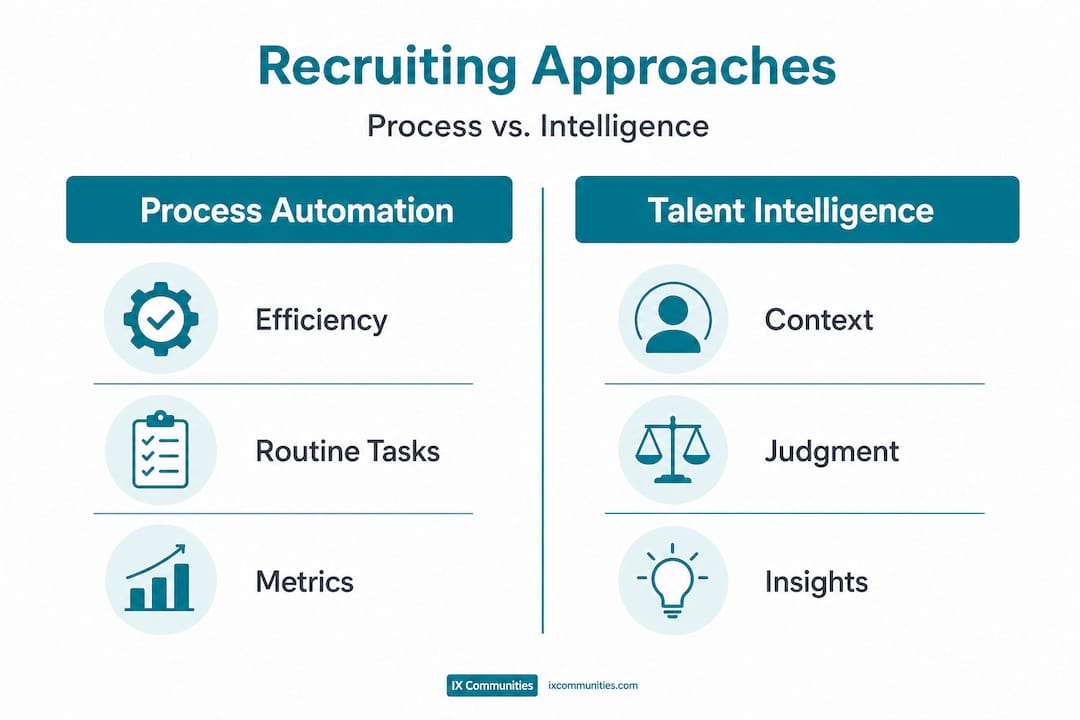
The distinction matters because executive hiring failures are rarely about process. They are about context misjudgment: placing the right person in the wrong moment, or missing a candidate because they did not surface in standard pipelines. Understanding what's changing with executive search is the first step toward building a function that addresses this gap. The broader AI transformation in executive search is creating both new risks and new capabilities that talent leaders need to navigate carefully.
How talent intelligence transforms executive search
Talent intelligence is not a single tool or platform. It is a practice. It involves systematically gathering, analyzing, and applying data about the talent market to improve recruiting decisions. For executive search, this means going beyond what candidates say about themselves and building a richer picture of who is available, where they are, and what they are likely to do next.

In practical terms, talent intelligence involves three core capabilities. First, market mapping: identifying the full population of candidates who could plausibly fill a role, including those who are not actively looking. Second, competitive intelligence: understanding where top talent is moving, which organizations are gaining or losing senior leaders, and what compensation and career factors are driving those movements. Third, predictive modeling: using available data to assess which candidates are most likely to succeed in a specific organizational context.
Here is how these capabilities apply in real executive search scenarios:
Mapping hidden talent pools. A company searching for a Chief Revenue Officer in a specialized industry may find that the obvious candidates, those with the right title at competitor firms, are either unavailable or not the strongest fit. Talent intelligence allows the search team to identify adjacent talent: leaders from related industries who have demonstrated the same core competencies in different contexts. This requires both data access and the analytical skill to interpret what the data means.
Scenario-based candidate assessment. Rather than evaluating candidates against a static job description, intelligence-driven teams use scenario modeling to assess how a candidate's profile aligns with the specific challenges the organization will face over the next 18 to 36 months. This might involve analyzing a candidate's track record during periods of organizational change, or assessing their network's relevance to a new market the company is entering.
Real-time labor market signals. Talent intelligence platforms can track signals such as executive departures, funding announcements, and organizational restructuring at competitor firms. These signals create recruiting opportunities that would not appear in traditional sourcing.
| Intelligence source | Application in executive search |
|---|---|
| Labor market data | Identify supply and demand for specific executive profiles |
| Competitor talent movement | Surface passive candidates and anticipate availability |
| Compensation benchmarking | Structure competitive offers with precision |
| Predictive tenure modeling | Assess long-term fit and retention risk |
| Network analysis | Evaluate candidate influence and relationship capital |
The benefits of this approach compared to traditional sourcing are significant:
- Access to candidates who are not visible in standard databases
- More accurate assessment of cultural and strategic fit
- Reduced time-to-shortlist for senior roles
- Better alignment between candidate profile and organizational need
- Lower risk of costly executive mis-hires
AI cannot replace expert judgment when data is conflicting or incomplete, which is common in executive search. Understanding overlooked AI factors in executive search helps teams avoid the trap of over-indexing on what the data shows while ignoring what it cannot capture. The most effective teams use intelligence to frame the search and human judgment to close it. Staying current on executive search leadership changes in 2026 is equally important for understanding how the profession itself is evolving.
AI's limits and the case for human judgment
The enthusiasm around AI in recruiting is understandable. The tools are improving rapidly, and the efficiency gains in certain areas are real. But for executive recruiting specifically, the risks of over-automation are significant and worth examining directly.
The most common failure modes fall into three categories. First, incomplete market sampling: AI tools can only surface candidates from the data they have access to. If a candidate is not well represented in the underlying dataset, they will not appear in results, regardless of their actual suitability. Second, bias amplification: when AI systems are trained on historical hiring data, they can encode and reinforce the biases present in past decisions. For executive roles, this can systematically exclude candidates from underrepresented groups who would otherwise be strong fits. Third, overconfidence in scoring: automated scoring systems can assign high confidence ratings to candidates who match historical patterns, even when those patterns are not predictive of success in the current organizational context.
"Hiring failures can occur from black-box scoring, bias amplification, and partial or incomplete datasets unless humans retain oversight." Harvard Business Review, 2026
The solution is not to remove AI from the process. It is to ensure that human accountability is built into every decision point. Here are the best practices that leading talent functions are applying:
- Define the decision rights clearly. Specify which decisions AI can inform and which decisions require human sign-off. For executive roles, final shortlist decisions should always involve human review.
- Audit AI outputs regularly. Review the candidates that AI tools are surfacing and those they are not. Look for patterns that suggest incomplete sampling or bias.
- Maintain diverse review panels. Ensure that the humans reviewing AI-generated candidate pools bring different perspectives and can identify gaps in the data.
- Document the rationale for decisions. When a candidate is advanced or rejected, record the reasoning. This creates accountability and supports continuous improvement.
- Invest in data quality. The quality of AI outputs is directly tied to the quality of the underlying data. Organizations that invest in clean, current, and representative data get better results.
Pro Tip: Always pair predictive analytics with expert panel reviews for executive roles. Analytics can surface the right candidates, but a structured panel review ensures that contextual factors, organizational culture, and strategic timing are factored into the final decision.
Understanding the gaps and limitations of AI recruiting is essential before scaling any AI-driven approach. Equally important is building AI governance in hiring frameworks that keep humans accountable at every critical decision point. When choosing hiring technology, the governance model should be evaluated alongside the tool's capabilities.
Building an intelligence-driven recruiting function: Next steps
Shifting from process automation to intelligence-driven recruiting requires deliberate investment in people, data, and governance. It is not a technology purchase. It is an organizational capability build. Here are the critical building blocks:
- Data acquisition strategy. Identify which talent intelligence sources are most relevant to your executive hiring needs. This includes both proprietary data from your own hiring history and third-party market intelligence.
- Governance framework. Establish clear policies for how AI tools are used, how outputs are reviewed, and who holds accountability for final decisions. This framework should be reviewed and updated as tools evolve.
- Recruiter upskilling. Executive recruiters need new skills to operate in an intelligence-driven model. This includes data literacy, analytical thinking, and the ability to interpret market intelligence in the context of organizational strategy.
- Intelligence platforms. Evaluate platforms that provide real-time labor market data, competitive talent movement tracking, and predictive modeling capabilities. Prioritize platforms that allow human interpretation rather than fully automated decision-making.
- Cross-functional collaboration. Intelligence-driven recruiting works best when talent acquisition, HR, and business leaders collaborate on defining what success looks like for each executive role. This alignment ensures that the intelligence gathered is relevant to actual organizational needs.
The human and machine collaboration model is central to this approach. Machines augment the recruiter's ability to see the full market and identify patterns. Humans interpret what those patterns mean in context and make the final judgment calls. Neither works as well without the other.
Organizations must build strong datasets and governance before scaling AI-driven approaches. Investing in future recruiter skills and AI tools and recruiter training are two of the most direct ways to build this capacity inside your organization.
Pro Tip: Start with pilot projects that involve talent acquisition, HR, and business leaders together. Pilots allow you to test intelligence-driven approaches on a contained scope, identify gaps in data or process, and build internal confidence before scaling.
What most leaders miss about the intelligence revolution
Most organizations approaching intelligence-driven recruiting focus first on technology selection. They evaluate platforms, compare features, and make purchasing decisions. What they underestimate is the cultural and capability shift required to actually use intelligence well.
Technology is not the differentiator. Two organizations can use the same talent intelligence platform and get dramatically different results. The difference comes from how their teams interpret the data, what questions they ask of it, and how effectively they integrate intelligence into decision-making conversations with business leaders.
The organizations that are winning in executive recruiting are not necessarily those with the most advanced tools. They are the ones that have built a culture of evidence-based decision-making, where recruiters are expected to bring market data into conversations with hiring managers, where assumptions about candidate availability are tested against actual market intelligence, and where the quality of a hire is evaluated against the intelligence that informed it.
Another common gap is the failure to blend structured and unstructured intelligence. Structured intelligence comes from data platforms: labor market analytics, compensation benchmarks, tenure modeling. Unstructured intelligence comes from relationships, conversations, and qualitative assessment of a candidate's reputation and influence. The most effective executive search functions treat both as essential inputs.
The practical lesson here is to build capability before scaling technology. Invest in training your recruiters to think analytically. Build internal processes for reviewing and acting on market intelligence. Establish governance before you need it. Then, when you scale your technology investment, you have the organizational capacity to use it effectively. Reviewing AI transformation realities with your team is a useful starting point for grounding these conversations in what is actually happening in the market.
Accelerate your intelligence-driven recruiting journey
Talent leaders navigating this shift do not need to figure it out alone. The frameworks, benchmarks, and peer insights that accelerate this transition are available through structured communities designed specifically for this purpose.
IX Communities, through ESIX and TLIX, provides talent acquisition and HR leaders at large organizations with access to curated intelligence, peer benchmarking, and collaborative learning in a secure environment. Members gain access to industry benchmark surveys that provide real data on how peer organizations are structuring their intelligence-driven recruiting functions. The talent leaders peer mentoring program connects senior practitioners who are navigating the same transition, offering practical guidance grounded in real organizational experience. For leaders ready to engage more fully, community membership provides ongoing access to resources, events, and a network of peers who are building the same capabilities.
Frequently asked questions
What is intelligence-driven executive recruiting?
It is a strategy where hiring decisions rely on advanced data analysis, market insights, and structured human judgment rather than automated processes alone. Intelligence-driven recruiting merges data insights with strategic talent context to improve the quality of senior hires.
How does AI help and hurt executive recruiting?
AI helps identify patterns and expands the speed and reach of sourcing, but it can increase bias or miss critical judgment calls when oversight is weak. AI in hiring has sometimes produced worse outcomes precisely because organizations deployed it without adequate governance or human accountability.
What risks come with relying on AI in executive search?
Common risks include incomplete market sampling, amplified bias from historical data, and overconfidence in automated scoring when humans are not actively reviewing outputs. AI can create failure modes unless datasets are strong and humans retain accountability throughout the process.
How can organizations get started with intelligence-driven approaches?
Begin with pilot projects that bring together talent acquisition, HR, and business leaders, invest in recruiter upskilling, and establish strong data governance before scaling. Building strong datasets and governance is the foundation that makes all other intelligence-driven capabilities possible.