

Executive talent groups deliver measurable advantage for corporate talent and recruiting leaders through three mechanisms: access to candid peer feedback, structured benchmarking data, and compounding leadership development. If you lead a talent acquisition, executive recruiting, or diversity recruiting function at a mid to large company, joining a curated peer group is one of the highest-return professional investments available to you.
- Trusted candid feedback: Peers with no political stake in your organization give direct input that internal colleagues rarely can.
- Benchmarking and external perspective: Structured surveys and cohort data let you compare time-to-fill, quality-of-hire, and technology adoption against peers at comparable organizations.
- Leadership development that compounds: According to research cited by 6S Advisory, members of structured peer advisory groups grew revenue over three times faster than non-members and achieved higher profitability (22.5% vs 10.3%). Separately, 67% reported avoiding a major business mistake and 79% made more confident decisions.
Table of Contents
- What are executive talent groups and who should join them?
- What concrete benefits do executive talent groups deliver?
- How do executive talent groups operate?
- How do you measure membership value and ROI?
- How do you evaluate and choose the right executive talent group?
- What do memberships cost and when will you see results?
- When is a peer group not the right fit?
- How Ixcommunities (ESIX / TLIX) delivers what talent leaders need
- What outcomes do members report?
- Common pitfalls in executive talent groups and how to avoid them
- Key Takeaways
- The case for committing, not just exploring
- Ixcommunities membership: your next step
- Useful sources and further reading
What are executive talent groups and who should join them?
Executive talent groups are structured peer forums where senior talent and recruiting leaders meet regularly to share challenges, review benchmarking data, and hold each other accountable. They are not networking events or trade associations. The formats vary: small cohorts of 6–16 members meeting monthly, roundtable discussions organized by function or company size, and benchmarking survey programs that aggregate anonymized data across member organizations.
The changing role of exec recruiting leaders makes these groups increasingly relevant. The typical candidate for membership meets most of these criteria:
- Head of Talent Acquisition, Chief Talent Officer, or Chief People Officer at a company with a dedicated recruiting function
- Head of executive recruiting or diversity recruiting with a team of two or more
- Responsible for hiring strategy, not just execution
- Employed at a mid to large company (typically 1,000+ employees)
- Willing to commit to monthly meetings and confidentiality standards
Membership expectations are straightforward: monthly meetings of 2–3 hours, preparation between sessions, and a signed confidentiality agreement. Peer mix matters. The most productive groups keep members at comparable seniority levels and avoid placing direct competitors in the same cohort.
What concrete benefits do executive talent groups deliver?
The core value comes from five outcomes, each tied to a KPI your function already tracks.
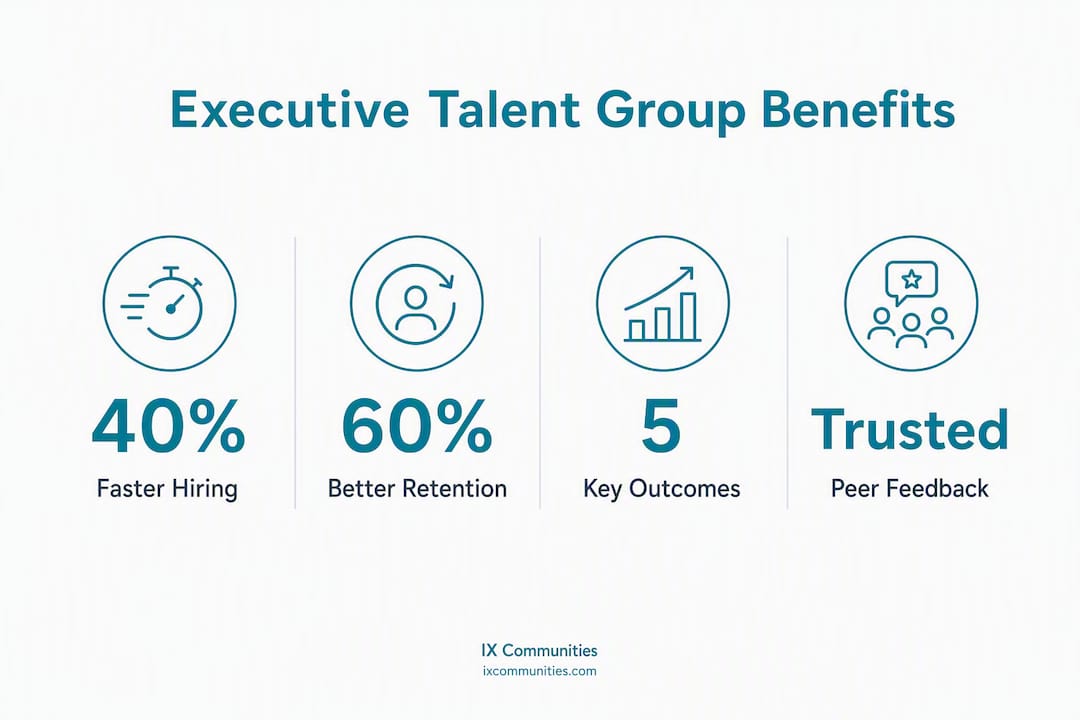
Candid feedback without political risk. As Alisa Cohn writes in Forbes, the core differentiator of peer groups is a trusted environment where leaders can drop political personas and receive honest input without vested agendas. For a Head of TA navigating a board-level hiring decision, that kind of feedback is not available internally.
Benchmarking and data. Peer groups that run structured surveys give members access to aggregated data on time-to-fill, cost-per-hire, and technology adoption. This serves as the evidence base for budget conversations with the CFO and for validating or challenging your current executive search and talent management approach.
External thinking partner. Anthony Mayo at Harvard Business School describes professional networks as external thinking partners that challenge mental models before high-stakes decisions. For a talent leader evaluating a new ATS or restructuring an executive search process, that external perspective reduces the risk of expensive errors.
Leadership development. The Center for Creative Leadership notes that relying on formal hierarchies is insufficient in complex organizations; peer networks help leaders identify hidden champions and subcultures that org charts miss.
Accountability. Peer accountability increases follow-through on commitments. When you state a goal in front of peers who will ask about it next month, completion rates improve.
How do executive talent groups operate?
Most groups follow a structure built around four elements: a small forum, a defined cadence, confidentiality standards, and facilitation.
- Forum size: 6–16 members, small enough for genuine trust, large enough for diverse perspectives.
- Meeting cadence: Monthly sessions of 2–3 hours, either in person or virtual, with a structured agenda.
- Benchmarking surveys: Periodic data collection that members contribute to and receive back as anonymized reports.
- One-to-one mentorship: Some programs pair members with a more experienced peer for direct coaching between group sessions.
Governance matters as much as format. Well-run groups require clearly defined structure: confidentiality standards, a code of conduct, accountability mechanisms, and curated membership. Groups without these elements tend to drift toward surface-level conversation.
Facilitation models vary. Some groups are peer-led; others use a professional facilitator to keep sessions focused and prevent dominant voices from crowding out quieter members. Between-meeting peer contact, where members proactively reach out when a relevant challenge appears, is where much of the highest-value advice actually happens.

Pro Tip: Ask any group you are evaluating how they handle between-meeting contact. High-retention groups have a clear norm for peer outreach outside formal sessions.
How do you measure membership value and ROI?
Track these metrics before joining and review them at 6 and 12 months.
| KPI | Baseline measurement | Review cadence |
|---|---|---|
| Time-to-fill (executive roles) | Current average in days | Quarterly |
| Quality-of-hire | Manager satisfaction score at 90 days | Quarterly |
| Leadership decision speed | Time from brief to shortlist | Quarterly |
| TA leader retention | Annual turnover rate | Annually |
| Strategic hires completed | Count of C-1 and above placements | Annually |
At 6 months, look for qualitative signals: are you applying peer input to live decisions? At 12 months, expect measurable movement in at least two of the KPIs above. The talent intelligence tools available through structured membership programs can accelerate baseline data collection.
The compounding effect is the most undervalued part. Research from Deliberate Directions notes that the biggest ROI comes from consistently better decisions over years, not from immediate tactical fixes. New members often expect quick wins; the durable value is a better decision framework.
How do you evaluate and choose the right executive talent group?
Use this checklist when shortlisting options:
- Peer mix matches your seniority level and company size
- Confidentiality agreement is explicit and enforced
- Benchmarking data is proprietary and anonymized
- Facilitator has demonstrated experience with talent or HR functions
- Group can show evidence of member retention and outcomes
- No direct competitors placed in your cohort
Questions to ask during vetting:
- What is the average tenure of current members?
- How is membership curated — who decides who joins?
- What confidentiality standards govern sessions and survey data?
- How are benchmarking reports structured and distributed?
- What is the facilitator's background in talent acquisition or executive recruiting?
- How do you handle a member who is not contributing?
- Can I speak with two current members before committing?
- What does onboarding look like for a new member?
- Are there add-on options for coaching or training?
- What is the cancellation or exit policy?
Red flags: vague confidentiality language, no evidence of benchmarking data, high member churn, and a peer mix that skews toward small companies or non-comparable roles.
Pro Tip: Request a trial session or observer access before signing an annual membership. Any group confident in its value will accommodate a short pilot.
What do memberships cost and when will you see results?
Pricing structures vary by program type. Most follow one of three models: annual membership fee per leader, per-seat pricing with add-ons for benchmarking reports or coaching, or bundled access to multiple communities under one subscription.
| Timeline | What to expect |
|---|---|
| 0–3 months | Onboarding, peer relationship building, baseline benchmarking data |
| 3–6 months | First peer input applied to a live decision; initial benchmarking comparison |
| 6–12 months | Measurable movement in 1–2 KPIs; stronger peer accountability norms |
| 12–24 months | Compounding decision quality; network becomes a standing resource |
Time commitment runs roughly 3–5 hours per month including meeting preparation and between-session peer contact. Budget that time explicitly when making the case to your organization.
The growth of corporate executive search teams in 2026 means more TA leaders are competing for the same peer insights. Early membership in a high-quality group creates a durable information advantage.
When is a peer group not the right fit?
A peer group is a long-term investment. It is not the right tool for every situation.
| Situation | Better option |
|---|---|
| Immediate tactical need (e.g., urgent search process fix) | Executive coaching or targeted training |
| Internal alignment problem | Internal advisory board or facilitated workshop |
| Technology evaluation only | Vendor benchmarking service or analyst report |
| Individual skill gap | Structured training course |
| Long-term decision quality and network | Peer group membership |
Executive coaching is the most effective complement to peer group membership. The ICF reports that coaching drives productivity and profitability gains; paired with peer accountability, results compound. For talent leaders who need both immediate skill development and long-term peer support, combining a coaching engagement with group membership is the highest-return combination.
Professional services training can address specific advisory and business development skill gaps that peer groups surface but do not directly teach.
How Ixcommunities (ESIX / TLIX) delivers what talent leaders need
Ixcommunities operates ESIX and TLIX, the preeminent peer networking and benchmarking communities for corporate talent acquisition, executive recruiting, and diversity recruiting leaders. The offering maps directly to the evaluation checklist above.
- Curated peer cohorts: Membership is limited to heads of TA, executive recruiting, and diversity recruiting at mid to large companies. No independent recruiters, no small-business owners.
- Proprietary benchmarking reports: Members access anonymized benchmark surveys covering time-to-fill, quality-of-hire, and technology adoption.
- Recruiter mentorship programs: ESIX pairs members with experienced peers for structured one-to-one development.
- Technology benchmarking tools: The technology stack reference tool lets members compare their TA tech investments against peer organizations.
- Expert guest speakers and training courses: Sessions with practitioners, not generalists.
Onboarding for a new corporate member follows a defined sequence:
- Membership application and peer-fit review
- Cohort placement based on role, company size, and function
- Orientation session with facilitator and existing members
- Access to benchmarking survey baseline and prior reports
- First full group session within 30 days of joining
What outcomes do members report?
Member outcomes from Ixcommunities communities consistently reflect the patterns the research predicts. Heads of TA report applying peer benchmarking data directly to budget presentations, using cohort time-to-fill comparisons to justify additional headcount, and drawing on peer input when evaluating new ATS platforms. Diversity recruiting leads describe using the community to pressure-test inclusion metrics against peer organizations before presenting to the board.
The talent communities research supporting these outcomes shows that structured community participation improves recruitment results across multiple dimensions, not just one. Members who engage consistently, including between-meeting peer contact, report the strongest outcomes.
Common pitfalls in executive talent groups and how to avoid them
The most common failure mode is passive membership. Leaders who attend sessions but do not share real challenges get surface-level value. The groups that produce the outcomes described above require vulnerability: bringing actual problems, not polished updates.
A second pitfall is mismatched peer mix. If the group skews toward companies significantly smaller or larger than yours, the benchmarking data loses relevance and the peer input loses applicability. Vet the peer mix before joining.
A third issue is expecting immediate ROI. As the research from Deliberate Directions makes clear, the compounding decision-quality benefit takes 12–24 months to fully materialize. Leaders who evaluate membership at the 90-day mark and find no tactical fix often leave before the durable value arrives.
Finally, groups without enforced confidentiality norms deteriorate quickly. Members stop sharing real challenges when they are not confident the information stays in the room. Confirm the confidentiality standard is explicit, not implied.
Key Takeaways
Executive talent groups deliver their highest value through compounding decision quality over 12–24 months, not through immediate tactical fixes.
| Point | Details |
|---|---|
| Join if you lead a TA or recruiting function | Heads of TA, CTOs, and executive recruiting leads at mid to large companies are the right fit. |
| Track 2–3 KPIs from day one | Time-to-fill, quality-of-hire, and decision speed give you a measurable baseline for ROI. |
| Vet peer mix and confidentiality first | A mismatched cohort or weak confidentiality standard undermines the core value of membership. |
| Combine coaching with peer membership | Pairing executive coaching with group participation compounds results beyond either alone. |
| Ixcommunities (ESIX / TLIX) | Offers curated cohorts, proprietary benchmarking reports, and mentorship programs built for corporate talent leaders. |
The case for committing, not just exploring
Most talent leaders who evaluate peer groups spend too long in evaluation mode. They attend a session, find it useful, and then wait for a better moment to commit. The problem is that the compounding value described throughout this article does not start until you are fully in: sharing real challenges, contributing to benchmarking surveys, and building the peer relationships that produce between-meeting advice.
The research is consistent. Structured peer advisory members make more confident decisions, avoid costly mistakes, and build networks that function as standing resources for years. The question for a talent leader is not whether the category delivers value. It is whether the specific group you join has the peer mix, governance, and benchmarking depth to deliver it for your function.
Evaluate on those criteria. Request a trial session. Check the peer mix. Then commit.
Ixcommunities membership: your next step
Ixcommunities gives corporate talent and recruiting leaders direct access to the peer benchmarking data, curated cohorts, and mentorship programs that produce the outcomes described in this article — without the vague networking of a trade association or the cost of a retained advisory firm.
The ESIX and TLIX communities are built exclusively for heads of TA, executive recruiting, and diversity recruiting at mid to large companies. Membership includes proprietary benchmarking reports, recruiter mentorship, technology benchmarking tools, and expert speaker sessions. Request a benchmarking sample or book a membership call through the ESIX recruiter mentorship programs page, or review full membership options to find the right fit for your function.
Useful sources and further reading
- How Leaders Create and Use Networks — Harvard Business Review: foundational framework for operational, personal, and strategic networking in leadership roles.
- Importance of Networking in Leadership — Harvard Business School Online: Anthony Mayo on professional networks as external thinking partners.
- Networks and Leadership — Center for Creative Leadership: why formal hierarchies are insufficient and how networks surface hidden champions.
- Strength In Numbers: How CEO Networks Drive Success — Forbes / Alisa Cohn: trusted environment and candid feedback as the core differentiator of peer groups.
- The Data-Backed ROI of Peer Groups + Coaching — 6S Advisory: revenue growth, profitability, decision confidence, and mistake-avoidance statistics from peer group research.
- Why Smart Executives Join Peer Groups — Deliberate Directions: compounding ROI, accountability mechanisms, and structural requirements for effective groups.
- Executive Peer Advisory Groups — Academic study: forum structure, confidentiality norms, and member outcomes across YPO, Vistage, and EO.
- Strategic Leadership from the Social Network Perspective — Springer Nature: empirical research on network structures and superior organizational performance.
- Ixcommunities — Brand home: peer networking and benchmarking communities for corporate talent and recruiting leaders.