

Corporate executive search teams are defined as dedicated internal functions responsible for identifying, engaging, and hiring senior leaders at the VP level and above. These teams are expanding rapidly in 2026, driven by leadership pipeline erosion, the demand for AI-era executives, and the behavioral reality that top candidates are almost never actively looking. At the same time, external search firms are consolidating, moving upstream toward specialized, retained models. The balance of power in senior hiring is shifting inward, and HR leaders who understand why are better positioned to act on it.
Why corporate executive search teams are growing
The executive search sector is not growing because companies are hiring more people. It is growing because senior hiring has become structurally harder. Fee revenue in executive search grew 11% year over year in 2026 to $6.69 billion, with 94% of firms expecting continued growth. That level of sustained expansion signals a structural shift, not a temporary market cycle.
Several forces are converging to drive this growth:
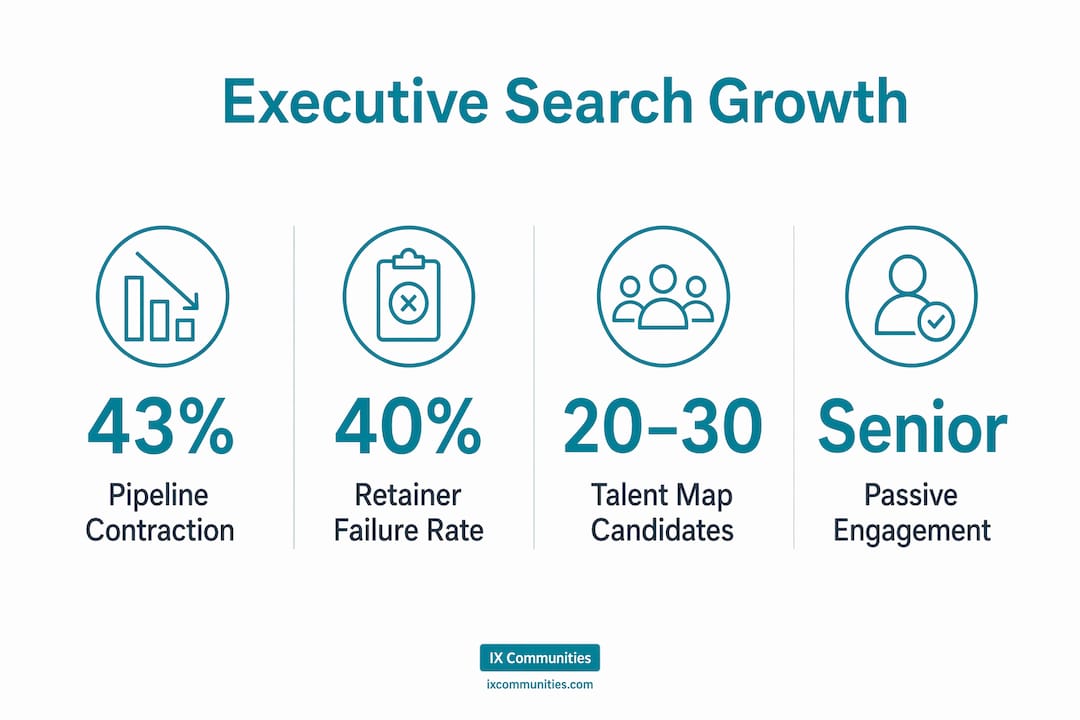
- Pipeline erosion. The mid-career leadership pipeline contracted by 43% between 2022 and 2025. Fewer mid-level managers survived the hiring contractions of that period, which means fewer internal promotion candidates exist today for VP and C-suite roles.
- AI transformation demands. Boards are seeking executives with demonstrated experience deploying AI at scale. That profile is rare, which makes search harder and longer.
- Earlier external searches. External CEO hires in S&P 500 companies nearly doubled in one year, rising from 18% to 33%, as internal succession gaps forced boards to look outside earlier and more often.
- Higher cost of mis-hires. A failed C-suite hire costs an organization an estimated 213% of the executive's annual salary when accounting for severance, lost productivity, and re-hiring costs.
- Role complexity. Senior roles now carry broader mandates, cross-functional accountability, and greater board visibility than they did five years ago.
| Driver | Impact on internal search teams |
|---|---|
| Pipeline contraction (43%) | Forces external sourcing for roles previously filled internally |
| External CEO hires up (18% to 33%) | Increases volume and urgency of senior searches |
| AI-era executive demand | Requires specialized market intelligence and niche sourcing |
| Sector revenue growth (11%) | Validates sustained investment in internal search capability |
How does candidate behavior shape executive talent acquisition?

The most important fact about senior executive candidates is that they are not browsing job boards. Top senior candidates are almost never actively looking. They are performing in their current roles, and they respond only to credible, relationship-based outreach. This single behavioral reality explains much of the growth of executive search as a dedicated function.
Cold outreach from contingency recruiters has low conversion rates at the senior level. A VP or Chief Revenue Officer who receives a generic LinkedIn message from an unknown recruiter will not respond. The same executive will take a call from someone who has tracked their career for 18 months and can speak specifically to why this role is a fit. That kind of engagement requires time, continuity, and organizational commitment.
Retained and committed search models exist precisely because of this dynamic. Retained search works through front-loaded rigor and relationship credibility. The recruiter is paid to focus exclusively on one search, which signals seriousness to passive candidates. Internal teams that operate on a retained model carry the same credibility, with the added advantage of representing the employer brand directly.
Internal teams also manage confidentiality more effectively. A board-level succession search cannot be broadcast across multiple contingency firms. Internal teams control the information flow, manage stakeholder sensitivities, and translate board requirements into a search strategy without the coordination risk that comes from using multiple external parties.
Pro Tip: When engaging passive senior candidates, the first contact should reference a specific career milestone or published insight from that individual. Generic outreach at the executive level signals that the recruiter has not done the work.
What are strategic retained search models, and how do internal teams use them?
The traditional model of executive search is episodic. A role opens, a search begins, a hire is made, and the relationship ends. Strategic Research Retainers represent a different approach. They operate continuously, maintaining live market intelligence on target candidate pools so that when a role opens, the groundwork is already done.
Here is how a Strategic Research Retainer engagement typically progresses:
- Market mapping begins immediately. The team identifies target organizations and builds a candidate universe before any specific role is open.
- Target lists are delivered within five business days. Speed at this stage reflects the depth of pre-existing market knowledge.
- First candidates are presented within four business days of role confirmation. This is possible because relationship development precedes the formal search.
- Hiring decisions occur within 27 days. That timeline compares favorably to the 12–16 week window that a well-managed CEO search typically requires.
The contrast with contingency search is significant. Contingency models prioritize volume. Firms submit as many candidates as possible and earn a fee only on placement. That incentive structure does not favor depth of engagement or candidate quality at the senior level. Strategic Research Retainers, by contrast, prioritize continuous talent intelligence, maintaining relationships with candidates who are not yet ready to move but will be within 12–24 months.
| Model | Approach | Best for |
|---|---|---|
| Contingency search | Volume-based, fee on placement | Mid-level, active candidates |
| Retained search | Exclusive, front-loaded engagement | Senior roles, passive candidates |
| Strategic Research Retainer | Continuous intelligence, pre-built pipelines | C-suite, board-level, succession planning |
Pro Tip: Internal teams that maintain a live talent map of 20–30 senior candidates per critical role category can cut time to first presentation by more than half compared to starting a search from scratch.
How are success metrics evolving for internal executive search teams?
Traditional executive search metrics are built around time-to-fill. That metric is misleading at the senior level because it includes factors outside the recruiter's control, including candidate decision timelines, board scheduling conflicts, and offer negotiation delays. Internal executive search teams are shifting to metrics that reflect controllable process stages.
The most useful metric is time to candidate presentation. This measures how quickly the team can surface a qualified, engaged candidate after a role is confirmed. It reflects the quality of pre-existing market intelligence and the depth of candidate relationships. A team that presents a strong candidate within five business days is demonstrating a fundamentally different capability than one that takes six weeks.
Other metrics gaining traction among internal teams include:
- Candidate engagement rate. What percentage of contacted candidates agree to an initial conversation?
- Slate quality score. How many presented candidates advance past the first interview?
- Offer acceptance rate. Are candidates who reach the offer stage accepting? Low acceptance rates signal misalignment in role positioning or compensation benchmarking.
Approximately 40% of traditional retained searches fail to place a candidate. That failure rate reflects misaligned incentives and poor process design, not market scarcity. Internal teams that track process-level metrics rather than outcome-only metrics identify breakdowns earlier and correct them faster.
Internal teams also serve a governance function. They act as liaisons between boards and hiring processes, translating board-level requirements into executable search strategies. That role requires credibility, discretion, and deep knowledge of the organization's strategic direction.
What does this trend mean for your talent acquisition strategy?
The growth of internal executive search capability is not a reason to eliminate external search firm relationships. It is a reason to restructure them. Internal teams handle continuous market intelligence, candidate relationship development, and stakeholder management. External boutique firms with deep sector expertise handle searches that require geographic reach or specialized networks the internal team does not yet have.
The organizations building the strongest executive talent acquisition functions in 2026 are doing several things consistently:
- Investing in continuous talent mapping. They maintain live candidate databases for critical role categories, updated quarterly.
- Building internal recruiter expertise. They develop internal search capabilities through structured training, peer mentorship, and benchmarking against peer organizations.
- Using AI-enabled data tools. They apply technology to identify career trajectory signals, compensation benchmarks, and organizational movement patterns among target candidates.
- Collaborating selectively with external boutiques. They engage specialized firms for specific searches rather than outsourcing entire functions.
- Measuring what they can control. They track time to candidate presentation, engagement rates, and slate quality rather than time-to-fill alone.
The shift from contingency to retained models reflects a broader recognition that senior hiring requires commitment, not volume. Organizations that treat executive search as a continuous function rather than a reactive one will build faster, deeper candidate pipelines and make better hires.
Pro Tip: Pair your internal executive search team with external talent data on succession decisions. Internal knowledge of culture and strategy combined with external market intelligence produces stronger candidate slates than either source alone.
Key takeaways
Internal executive search teams are growing because senior hiring has become too complex, too specialized, and too strategically consequential to manage through episodic, volume-based approaches.
| Point | Details |
|---|---|
| Pipeline erosion is structural | A 43% contraction in mid-career leaders forces companies to source externally for roles once filled internally. |
| Passive candidates require relationship-based outreach | Senior executives respond to credible, sustained engagement, not cold outreach from unknown recruiters. |
| Strategic Research Retainers accelerate hiring | Continuous market intelligence enables candidate presentation within four business days of role confirmation. |
| Metrics must reflect controllable stages | Time to candidate presentation is more useful than time-to-fill for measuring internal team performance. |
| Internal and external search are complementary | Internal teams handle intelligence and relationships; specialized boutiques handle searches requiring niche networks. |
What I have observed about this shift
The growth of internal executive search teams is not simply a cost-reduction play. I have seen organizations frame it that way initially, and they consistently underinvest in the function as a result. The teams that perform well are the ones whose leadership treats executive search as a strategic intelligence operation, not a transactional hiring service.
The consolidation happening among external search firms tells the same story from the other direction. Boutique firms with deep sector expertise are gaining influence. Generalist firms that relied on volume and broad mandates are under pressure. The market is rewarding specialization and depth at every level.
What concerns me most is the metric problem. Too many internal teams are still being evaluated on time-to-fill for senior roles. That metric creates the wrong incentives. It pushes teams toward speed over quality and discourages the relationship-building work that actually produces better candidates. The organizations that have moved to time-to-candidate-presentation as their primary metric report meaningfully better outcomes, and the logic is straightforward. You control your process. You do not control how long a candidate takes to resign from their current employer.
The strategic retained model is the clearest best practice I have seen for internal teams operating at scale. It requires organizational commitment and patience in the early stages, but the payoff in candidate quality and search speed is substantial. The teams doing this well are also the ones most actively benchmarking against peers, sharing what works, and learning from organizations that have already built this capability.
— Simon
How Ixcommunities supports internal executive search teams

Ixcommunities operates ESIX, TLIX, and IXCommunities as the preeminent peer networking and benchmarking groups for talent leadership professionals worldwide. For HR leaders and corporate executives building or scaling internal executive search capabilities, Ixcommunities provides a secure environment to share practices, benchmark performance, and access structured learning. The ESIX Recruiter Peer Mentorship Program connects internal search professionals with experienced peers who have navigated the same challenges. The Talent Leaders Peer Mentoring Program supports senior talent acquisition leaders in building the strategic capabilities this market demands. Explore Ixcommunities membership to access the full suite of resources, events, and benchmarking tools.
FAQ
Why are internal executive search teams growing in 2026?
Internal executive search teams are growing because senior hiring has become more complex, with a 43% contraction in the mid-career leadership pipeline and rising demand for AI-era executives. Companies need dedicated, continuous search capabilities rather than episodic external engagements.
What is a Strategic Research Retainer in executive search?
A Strategic Research Retainer is a continuous executive talent intelligence model where a search team maintains live candidate relationships before roles open, enabling candidate presentation within four business days of role confirmation.
How do internal executive search teams measure success?
Internal teams are shifting from time-to-fill to time-to-candidate-presentation, a metric that reflects controllable process stages rather than external factors like candidate decision timelines or board scheduling.
Why are external executive search firms consolidating?
External firms are consolidating because the market is rewarding specialization and depth. Boutique firms with sector-specific expertise are gaining influence, while generalist firms that relied on volume are under competitive pressure.
How should companies balance internal and external executive search?
Internal teams should handle continuous talent mapping and candidate relationship development, while specialized external boutiques should be engaged selectively for searches requiring geographic reach or niche networks the internal team does not yet cover.