

Talent acquisition leaders at large organizations are under pressure to fill senior roles faster, with tighter budgets and fewer dedicated resources. Doing more with less in executive recruiting does not mean working harder or pushing more candidates through the pipeline. It means eliminating the process failures that drain time and create rework: unclear mandates, misaligned stakeholders, and manual coordination that could be automated. This guide covers practical, evidence-backed executive recruiting strategies to reduce hiring costs, shorten time-to-fill, and improve decision quality without adding headcount.
Table of Contents
- Why more hiring effort alone no longer works in executive recruiting
- Fixing intake and alignment early to reduce bottlenecks and candidate drop-off
- Leveraging automation and AI to boost productivity without extra headcount
- Reducing true cost per hire through audit, automation, and smarter screening
- Streamlining the interview process to speed decisions and improve quality
- Why focusing on internal alignment beats chasing volume in doing more with less
- Build executive recruiting efficiency with IX Communities support
- Frequently asked questions
Key Takeaways
| Point | Details |
|---|---|
| Early alignment matters | Clarifying success criteria and interview roles upfront prevents costly delays and candidate drop-off later. |
| Automation boosts output | Targeting repetitive workflows for automation can more than double recruiter productivity. |
| Audit costs thoroughly | Understanding your true cost per hire across all activities helps identify effective reduction strategies. |
| Structured interviews speed decisions | Consistent questions and scoring reduce debate and selection errors. |
| Candidate experience impacts success | Faster scheduling and clear communication reduce drop-offs and improve offer acceptance. |
Why more hiring effort alone no longer works in executive recruiting
A common assumption is that executive search slows down because recruiters are not surfacing enough candidates. The data points elsewhere. Speed failures in executive searches often stem from evolving success criteria and unclear decision authority, not sourcing volume. Adding more outreach or widening applicant pools does not fix debates over what the role requires or who has authority to make the final call.
Executive searches now routinely run four to six months, largely because approval chains are longer and alignment conversations happen too late. By the time a strong candidate is in the final round, hiring teams sometimes realize they are evaluating the wrong profile entirely. That kind of rework is costly in recruiter time, leadership bandwidth, and candidate goodwill.
Common sources of inefficiency that volume alone cannot solve:
- Evolving role requirements after sourcing has already begun
- Multiple stakeholders with conflicting views on must-have criteria
- No documented decision-making authority for offer approval
- Unclear timelines communicated to candidates, causing drop-off
- Interview panels assembled without clear evaluation ownership
The shift in streamlining executive search is from access to alignment. Getting 50 candidates in front of a hiring committee is far less valuable than entering that process with documented criteria everyone has agreed to in advance.
Fixing intake and alignment early to reduce bottlenecks and candidate drop-off
Early process discipline is the single highest-return investment in efficient talent acquisition. High-performing TA teams verify candidate eligibility early and hold a 30-minute kickoff meeting with hiring stakeholders to align on must-haves, timelines, and interview ownership before launching searches. That brief investment prevents weeks of rework later.
A structured intake process does not need to be elaborate. Four steps cover the fundamentals:
- Confirm eligibility requirements before screening begins, including location, clearances, compensation range, and any non-negotiables that would end a candidacy late in the process.
- Run a structured kickoff with the hiring manager and any interview panel members to document must-have criteria, nice-to-haves, and deal-breakers. Assign interview ownership so each evaluator knows what they are assessing.
- Document agreed criteria in a shared scorecard that all evaluators reference throughout the process. This prevents late-stage debates.
- Set and communicate a timeline to candidates upfront. Candidates who understand the process are less likely to drop off or accept competing offers during evaluation.
Structured interviews and alignment with stakeholders also reduce the legal and quality risks of inconsistent evaluation. When all interviewers assess the same criteria using the same rubric, the hiring decision is faster and more defensible.
Pro Tip: Send a one-page intake summary to all stakeholders after the kickoff meeting. Ask them to confirm the documented criteria in writing. That step alone reduces revisits to the mandate by a significant margin.
Leveraging automation and AI to boost productivity without extra headcount
Automation's real value in executive recruiting is not replacing judgment. It is eliminating the coordination tasks that consume recruiter time without requiring human expertise. Teams can see up to 2.4x productivity gains by automating repeatable workflows while recruiters focus on strategic evaluation.

Statistic: Automated scheduling confirms interviews 26% faster than manual methods, reducing median scheduling time from 5 to 3.7 hours per interview round. Across a six-round executive search, that adds up to a full day of recovered recruiter time per search.
Practical automation applications in executive recruiting:
- Interview scheduling: Calendar tools with automated availability matching eliminate the back-and-forth coordination common in senior-level search.
- Candidate communications: Automated status updates at defined process milestones reduce candidate anxiety and drop-off without requiring recruiter intervention at each step.
- Resume screening support: AI tools can surface patterns and flag alignment with documented criteria, though recruiters should validate outputs before acting on them.
- Data routing: Automated handoffs between ATS stages reduce the manual data entry that often delays candidate progression.
Automation in executive recruiting works best when intake is clean. Automation can eliminate repeated coordination overhead while humans maintain control over mandate, compensation, and cultural fit decisions. The boundary matters: automate coordination, not judgment.
AI transforming executive search is accelerating in practical applications, including generating first-draft interview guides from documented role criteria, summarizing candidate profiles for panel review, and producing calibrated shortlists for recruiter validation.
Reducing true cost per hire through audit, automation, and smarter screening
Before cutting any recruiting spend, audit your full cost per hire first, including recruiter time, interview time, job ads, agencies, assessments, and background checks. Most organizations undercount internal time costs, which means they optimize the visible spend while the largest cost drivers remain invisible.
| Cost driver | Common mistake | Better approach |
|---|---|---|
| Sourcing channels | Paying for channels that produce low-quality volume | Audit conversion rates by source; cut underperformers |
| Agency fees | Defaulting to retained search for all roles | Reserve agencies for roles where internal sourcing is limited |
| Interview time | Excessive rounds without defined decision criteria | Reduce rounds; require scorecards before advancing candidates |
| Screening time | Reviewing unqualified candidates late in process | Add eligibility verification at intake stage |
| Candidate drop-off | Slow communication allowing candidates to accept elsewhere | Automate status updates and set clear decision deadlines |
Re-activating candidates already in your ATS is one of the most underused budget-friendly recruiting methods available. Silver-medal candidates from prior searches, internal referrals, and past applicants who were not selected for timing reasons are often ready for reconsideration with no new sourcing cost.
Key steps to lower cost per hire without reducing quality:
- Clarify intake with documented must-haves, nice-to-haves, and approved sourcing channels
- Use AI resume screening to reduce first-pass review time, with recruiter validation on all outputs
- Re-activate qualified candidates from your existing ATS before opening new sourcing spend
- Cut interview rounds where multiple rounds assess overlapping competencies
- Monitor candidate drop-off by stage and investigate communication gaps when drop-off spikes
Pro Tip: Calculate the true internal cost of a single extended search by estimating recruiter hours, hiring manager interview time, and panel time at fully-loaded hourly rates. For most large organizations, one slow executive search costs more internally than a mid-tier agency retainer.
Streamlining the interview process to speed decisions and improve quality
The interview process is where most executive searches lose speed and quality simultaneously. Building structured interview question sets and rubrics takes two to four hours per role family and rolls out in two to three months, improving hiring quality and reducing turnover by enabling calibrated scoring across evaluators.
A phased implementation approach:
- Define role families and group related positions that share core competency requirements.
- Build question banks for each competency, with scoring guidance that defines what a strong, average, and weak response looks like.
- Assign interview ownership so each panel member evaluates a distinct set of competencies rather than all evaluating everything.
- Run calibration sessions before each search launches so all interviewers apply the rubric consistently.
- Set decision deadlines post-interview so candidates are not waiting in ambiguity while interviewers coordinate feedback.
Scheduling is a major bottleneck; multi-interviewer panels increase delays, but expanding and training interviewer pools creates scheduling flexibility. Organizations that train a wider group of senior leaders as calibrated interviewers reduce dependency on specific individuals whose calendars create delays.
| Interview approach | Time to decision | Candidate drop-off risk | Hiring quality |
|---|---|---|---|
| Unstructured, ad hoc panels | Slow | High | Inconsistent |
| Structured, scored by competency | Faster | Lower | Consistent |
| Calibrated interviewers with scorecards | Fastest | Lowest | Highest |
Structured interview practices reduce the post-interview debate that often delays decisions. When every evaluator submits a completed scorecard, the debrief moves from open-ended discussion to comparing documented assessments. That shift alone can cut decision time by days.
Pro Tip: Track "pass-through rate" by interview stage. If a high percentage of candidates stall or drop out after the first panel, the issue is likely communication speed or candidate experience rather than candidate quality.
Why focusing on internal alignment beats chasing volume in doing more with less
There is a persistent belief in executive recruiting that the solution to a stalled search is more candidates. More pipeline, more sourcing channels, more outreach. That belief is usually wrong, and acting on it makes searches longer, not shorter.
Separating decision-making from coordination through anchored scorecards and pre-alignment avoids repeated stakeholder relitigation, a major cause of delays in leadership search. The rework happens when stakeholders who were not aligned at intake relitigate the mandate after reviewing candidates. More candidates do not resolve that disagreement. They amplify it.
The organizations achieving genuine recruitment optimization are not the ones adding tools or outsourcing more. They are the ones investing in process discipline before the search begins. That means documented criteria, assigned decision authority, and committed timelines from hiring managers.
Cutting recruiter admin without fixing upstream intake and spec quality usually backfires. Automation accelerates wrong conversations if the mandate is not clear. A recruiter who automates the scheduling and communication layer on top of a poorly specified search will move through the wrong candidates faster. That is not efficiency. It is accelerated waste.
The practical implication is that recruiters should position themselves as facilitators of decisions, not organizers of debates. The recruiter's job is to surface aligned candidates and move the hiring team toward a decision. That requires pre-wired criteria, not improvised evaluation. Internal alignment over volume is the discipline that makes everything else in this guide work.
Build executive recruiting efficiency with IX Communities support
The strategies in this article represent best practices in executive staffing that leading talent teams are applying today. Putting them into practice requires more than information. It requires access to peers who have navigated the same challenges at comparable organizations.

IX Communities provides talent leaders peer mentoring and recruiter peer mentorship programs where senior recruiting professionals benchmark practices, share process improvements, and learn from peers managing similar constraints. Members gain direct access to structured discussions on automation adoption, intake design, and interview process improvement within a secure, non-competitive environment. If your organization is working to close the gap between current recruiting efficiency and what is possible, IX Communities membership connects you with the knowledge and peer support to move faster.
Frequently asked questions
What does 'doing more with less' mean in executive recruiting?
It means increasing recruitment output and quality without adding headcount or budget by improving process alignment, automating repetitive tasks, and reducing administrative delays. Teams can achieve up to 2.4x productivity gains by automating repeatable workflows while recruiters concentrate on strategic evaluation.
How can automation realistically speed up executive recruiting?
Automation accelerates tasks like interview scheduling, candidate communication, and resume screening, saving hours per candidate and enabling recruiters to focus on judgment-based tasks. Automated scheduling reduces median scheduling time from 5 to 3.7 hours, a 26% improvement over manual methods.
Why is internal alignment emphasized more than sourcing volume in executive recruiting?
Unclear success criteria and evolving mandates cause delays and candidate drop-offs, so clear intake and stakeholder agreement improve quality and speed more than adding more applicants. Speed failures in leadership searches most often trace back to unclear decision authority rather than a lack of sourcing volume.
What are some quick wins to reduce cost per hire without hurting quality?
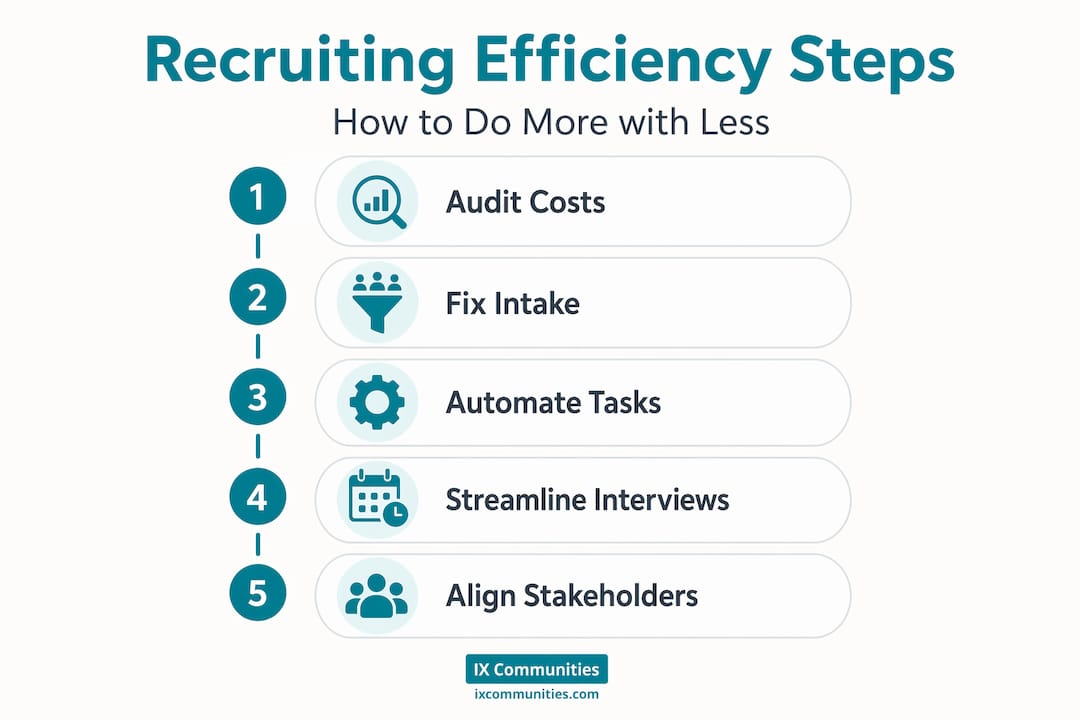
Audit the true hiring costs including internal time, improve job intake and screening criteria, automate resume screening while keeping recruiters in control, re-use ATS candidates, and reduce interview waste and drop-offs. The five most effective steps include auditing costs, improving intake, automating screening, rediscovering ATS candidates, and reducing interview waste.
How do structured interviews improve executive recruiting efficiency?
Structured interviews use pre-set questions and scoring rubrics to reduce post-interview debate, speed decision-making, and improve calibration between evaluators. Structured interview formats improve ratings by 25% at six months and reduce turnover by selecting better-fit candidates from the start.