

Not long ago, retaining an executive search firm for any senior-level hire felt like the only responsible option. That assumption is shifting. Major corporations are now handling a growing share of executive recruiting internally, and the change is not simply about cost. It reflects a broader realignment of tools, team capabilities, and expectations around what external partners should actually deliver. This article examines the core reasons for that shift, how technology is accelerating it, where external search firms still add clear value, and what rigor internal teams must maintain to produce outcomes that match or exceed traditional search standards.
Table of Contents
- Why companies are reducing reliance on search firms
- How AI and internal tools reshape executive search
- Selective partnership: When and why companies still use search firms
- What companies now expect from search partners
- A fresh perspective: Why "less search firm" doesn't mean less rigor
- Explore peer-driven solutions for modern TA leaders
- Frequently asked questions
Key Takeaways
| Point | Details |
|---|---|
| Internal recruiting rises | Companies are moving executive search tasks in-house to save money and boost control. |
| AI transforms efficiency | AI and sourcing tools enable faster candidate finding and reduce reliance on external search. |
| Selective use of partners | External partners are now chosen for specialist expertise and market intelligence. |
| Evolving partner expectations | Buyers want leadership advisory and consulting, not just candidate delivery. |
| Process rigor matters most | Replicating disciplined search-firm practices internally is essential for high-quality executive hires. |
Why companies are reducing reliance on search firms
The decline in search firm usage is real, though it is not uniform across all industries or company sizes. Several forces are converging at once, and understanding them separately helps talent leaders respond with precision rather than reaction.
Cost pressure is the most visible factor. Budget scrutiny has intensified at most large organizations, and executive search fees are often the first line item reviewed when TA leaders are asked to cut spend. Retained search fees typically run 25% to 33% of a placed executive's first-year compensation. For a Vice President earning $350,000 annually, that equals a fee between $87,500 and $115,500 per placement. When internal teams are capable of filling comparable roles, that number is hard to justify.
The strategic shift toward in-house capability is equally important. Companies are increasingly handling more executive and senior-role recruiting in-house, or through flexible models such as RPO and embedded recruiting support. This is not a reactive cost cut. Many organizations have invested deliberately in building internal executive recruiting functions over the past several years, and those investments are now producing returns.
Market expectations have also changed. Hiring managers and boards are less patient with slow timelines, limited transparency, and generic candidate pools. Internal teams, operating with direct access to company stakeholders and real-time data, can often respond faster and with more context than an outside firm working through an intermediary layer.
Key drivers reshaping how companies approach external search spend:
- Rising cost-per-hire scrutiny from finance and the C-suite
- Internal TA teams equipped with sourcing and research tools that previously required outside specialists
- Demand for faster time-to-fill on senior roles
- Expectation that recruiting partners function as strategic advisors, not just candidate submitters
- Growth of flexible models like RPO and embedded talent support that sit between fully internal and fully outsourced
"The shift away from traditional retained search is not about eliminating external expertise. It is about recalibrating where that expertise adds genuine value versus where internal capability is now sufficient."
Understanding these drivers sets the foundation for the next question: what specific technologies are enabling internal teams to perform at this elevated level?
How AI and internal tools reshape executive search
Technology is the clearest accelerant behind internal TA teams taking on work that once required an external search firm. Artificial intelligence, in particular, has compressed the time and effort involved in early-stage research and candidate identification, which are tasks that historically justified a significant portion of search firm fees.

Bullhorn's 2026 Industry Trends Report documents that AI and internal sourcing tools reduce the cost and effort of early-stage research and candidate search, directly changing what buyers consider "premium" value from external firms. When a tool can generate a qualified candidate list in hours rather than days, the argument for paying a firm to do the same work weakens considerably.
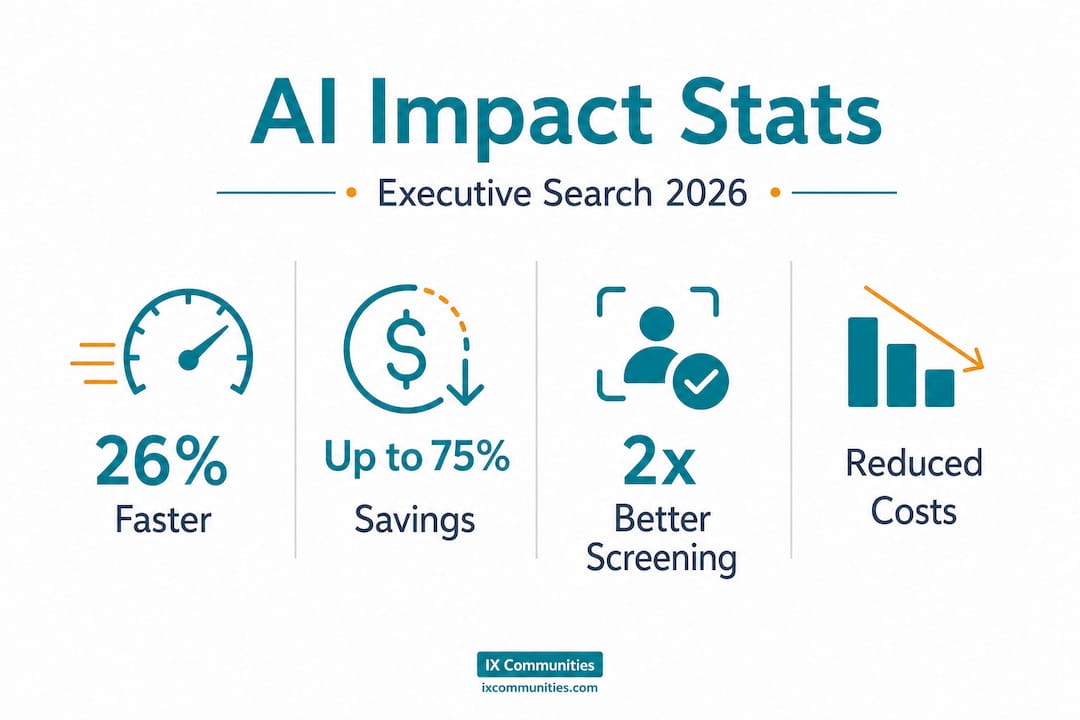
Quantified efficiency gains are substantial. Recruiters report that AI reduces time on searching and screening by 26% to 75%, depending on role complexity and the tools deployed. For an executive recruiter managing five to ten open roles simultaneously, that time savings is the equivalent of adding capacity without adding headcount.
The table below illustrates how AI-powered tools compare to traditional search firm processes on key dimensions:
| Activity | Traditional search firm | AI-assisted internal team |
|---|---|---|
| Initial candidate research | 1 to 2 weeks | 1 to 3 days |
| Long-list generation | 2 to 3 weeks | 3 to 7 days |
| Initial screening and qualification | 1 to 2 weeks | 3 to 5 days |
| Market mapping | 3 to 4 weeks | 1 to 2 weeks |
| Stakeholder reporting | Periodic updates | Real-time dashboards |
These are not hypothetical numbers. Internal TA teams at large technology, financial services, and healthcare organizations have reported compressed timelines matching this range after deploying AI-assisted sourcing and screening platforms.
The impact on budget allocation is direct. When internal teams handle early research, long-list creation, and initial candidate screening, the cost per executive hire drops significantly. That freed budget can be redirected toward assessment tools, onboarding support, or compensation data subscriptions, all of which strengthen the overall hiring process.
Pro Tip: Before measuring the ROI of AI tools in executive recruiting, establish a clear baseline of your current average time-to-fill and cost-per-hire for senior roles. Without that baseline, you cannot demonstrate the value of the investment to finance or the C-suite.
For talent leaders evaluating AI trends in executive search, the key question is not whether AI will change the function. It already has. The question is whether your internal processes are structured to capture the full efficiency gain or whether the tools are running ahead of your workflows. It is also worth examining AI pitfalls in recruiting and the real limitations of AI before making large platform commitments.
Selective partnership: When and why companies still use search firms
Reducing search firm dependency does not mean eliminating external partners. The most effective talent acquisition strategies in 2026 involve selective, deliberate engagement with outside firms for specific types of situations where internal capability or bandwidth has clear limits.
A well-documented pattern shows that internal teams run search-like processes for the majority of executive roles, while external partners are used as niche specialists or for market intelligence rather than end-to-end execution. This is not a compromise. It is a more efficient allocation of resources.
The move away from broad search firm dependency is less about reducing executive search overall and more about shifting toward flexible involvement, including boutique specialist firms, RPO models, and embedded recruiting support. The specific model chosen depends on timeline, role complexity, internal bandwidth, and available expertise.
The following table compares engagement models available to TA leaders today:
| Model | Best for | Cost structure | Control level |
|---|---|---|---|
| Retained search firm | Strategic, high-stakes executive roles | 25% to 33% of first-year comp | Low to medium |
| Boutique specialist firm | Niche functional or industry expertise | Retained or contingent | Medium |
| RPO provider | High-volume or program-based needs | Per-hire or monthly fee | Medium to high |
| Embedded recruiter | Surge capacity, short-term projects | Daily or monthly rate | High |
| Fully internal team | Standard to mid-level executive roles | Fixed headcount cost | Full |
Criteria for deciding when to engage an external partner:
- The role requires deep expertise in a functional area or industry where internal network coverage is limited.
- The timeline is compressed and internal bandwidth is insufficient to run a rigorous search process.
- The role is highly confidential and requires arms-length candidate contact.
- The organization is entering a new market or geography where internal market knowledge is thin.
- The board or C-suite requires an external validation component as part of governance.
Building a capable internal recruiting function does not mean replacing every external engagement. It means having the clarity to choose external partners intentionally rather than by default. That distinction matters both for budget efficiency and for outcome quality.
What companies now expect from search partners
When organizations do engage search firms in 2026, the scope of expected deliverables has expanded well beyond a candidate slate. Firms that position themselves purely as candidate finders are losing ground to those that offer broader advisory capability.
When companies retain search firms, expectations have shifted toward broader leadership advisory deliverables. Firms that cannot expand their scope beyond candidate delivery are losing share to more consultative competitors.
What talent leaders now expect from search partners:
- Compensation and market benchmarking provided at the start of the engagement, not after a candidate declines an offer
- DEI advisory support, including sourcing strategy and candidate slate composition guidance
- Onboarding consultation covering the first 90 to 180 days and alignment with stakeholder expectations
- Market intelligence on competitor talent movements, compensation shifts, and availability of specific profiles
- Candidate experience management, particularly for senior executives who expect personalized, high-quality interaction throughout the process
- Stakeholder alignment facilitation, helping internal hiring committees reach consensus on role criteria and decision-making process
This expanded set of expectations reflects a broader truth: the value of an external search partner is no longer primarily access to candidates. Internal teams and AI tools have narrowed that access gap considerably. What external firms now offer that is genuinely differentiated is advisory depth, market context, and the experience to guide organizations through high-stakes decisions.
Pro Tip: When evaluating a search firm for a senior engagement, ask for examples of advisory deliverables they have provided beyond candidate slates. If a firm cannot produce clear examples of market intelligence reports, DEI sourcing strategies, or onboarding consultation, treat that as a signal about their value add.
Evolving leadership search trends reinforce this direction. The firms gaining traction are those that have invested in research infrastructure, advisory talent, and data capabilities rather than those relying on a large database of names and a strong network alone. For TA leaders who want to understand how talent management and executive search are converging, the trajectory is consistent: the boundary between search and strategic workforce planning is blurring, and the best external partners are operating on both sides of that line.
A fresh perspective: Why "less search firm" doesn't mean less rigor
There is a risk embedded in the trend described throughout this article. When companies shift executive search work from external firms to internal teams, there is a tendency to assume the process can be lighter because it is faster and cheaper. That assumption leads to poor outcomes.
Search firms built their value proposition partly on process discipline: structured intake meetings, documented role requirements, consistent evaluation criteria, regular stakeholder updates, and rigorous reference processes. These practices were not arbitrary overhead. They were the mechanisms that produced reliable hiring outcomes. Streamlining executive search for speed is a legitimate goal. Removing rigor in the name of speed is a different decision, and a costly one.
Internal teams that reduce search firm usage without replicating search-grade process discipline tend to see a specific set of failure patterns: stakeholder misalignment on role requirements that surfaces late in the process, candidate evaluations that rely too heavily on interviews without structured assessment, and reference checks that are treated as formalities rather than substantive data sources.
The organizations that have successfully brought executive search in-house are those that invested in building the internal infrastructure that mirrors search firm standards. That includes calibration frameworks, evaluation scorecards, documented offer processes, and regular post-hire reviews that feed back into process improvement.
Dashboards and metrics matter here. Tracking offer acceptance rates, time-to-productivity, and 12-month retention for executive hires gives TA leaders the data needed to assess whether internal process quality is meeting the standard. Without that measurement, cost savings can mask quality erosion until a failed hire makes it undeniable.
Building an executive recruiting function that performs consistently requires the same elements that made search firms effective, combined with the speed and contextual advantage that internal teams naturally hold. The goal is not to replicate a search firm inside the company. It is to capture the best of both models and apply them with the discipline that executive-level hiring demands.
Explore peer-driven solutions for modern TA leaders
The strategic decisions described in this article involve complexity that benefits from shared experience and benchmarking data. For talent acquisition leaders navigating the balance between internal capability and external partnership, peer-driven programs provide practical support that generic consulting cannot replicate.

ESIX, TLIX, and IXCommunities connect TA leaders at large corporations to benchmark against peers, access structured learning, and engage in confidential discussion on exactly these challenges. Through peer mentoring for talent leaders, members work directly with experienced counterparts who have navigated similar decisions around search firm strategy, internal team building, and technology adoption. Benchmark surveys provide the quantitative data needed to make informed decisions on spend allocation, team structure, and sourcing model selection. If you are ready to apply what you have learned here, joining IXCommunities is a concrete next step toward building a more effective, informed recruiting organization.
Frequently asked questions
Are companies replacing search firms with internal teams or just reducing external spend?
Most companies are shifting only part of search firm work in-house, focusing on early-stage research and execution while retaining external partners for niche expertise and high-stakes strategic roles.
How much time does AI save in executive recruiting?
Recruiters report that AI-driven tools reduce time spent on searching and screening candidates by 26% to 75%, depending on role complexity and platform capabilities.
When should companies still use a search firm?
Search firms deliver the most value for strategic, high-stakes roles where misalignment consequences are significant, where deep market expertise is required, or where internal bandwidth is insufficient to run a rigorous process.
What risks do companies face in handling executive search fully in-house?
The primary risk is loss of process discipline, particularly in candidate evaluation and stakeholder alignment. Internal teams must replicate search-firm-level rigor in process consistency and executive-grade assessment to sustain quality outcomes.
Are search firms disappearing from the market?
No. Search firms are adapting by specializing and expanding into advisory services. While demand for traditional retained search execution is shifting, firms that offer strategic advisory, DEI consultation, and market intelligence continue to grow.