

Only 14% of organizations execute succession planning effectively, despite 86% acknowledging it as a business-critical priority. That gap is not a planning problem. It is a structural one. When executive search operates as a standalone, transactional function disconnected from talent management and succession, organizations keep relearning the same expensive lessons. The convergence of these two disciplines is changing that, and the most forward-thinking HR leaders are already breaking the silos.
Table of Contents
-
The integration imperative: Aligning talent management and search
-
Governance matters: Search models, incentives, and succession risk
-
Advanced application: Market mapping, succession stress-tests, edge cases
-
Perspective: Why integration is harder than it looks—and how to do it well
-
Connect, benchmark, and lead through peer-powered integration
Key Takeaways
| Point | Details |
|---|---|
| Integration closes leadership gaps | Combining executive search with talent management helps organizations anticipate and fill future leadership needs effectively. |
| Succession requires a flywheel approach | Treating search as a recurring intelligence process builds deeper leadership pipelines and organizational learning. |
| Alignment and governance matter | Strategic alignment and suitable governance ensure integration creates real, not just perceived, succession value. |
| Stress-test for true readiness | Use executive search to calibrate internal leaders’ capabilities against the market for unbiased readiness assessments. |
| Peer learning accelerates progress | Connecting with other HR leaders via peer mentoring and benchmarking fosters best practice adoption and leadership impact. |
The old model: Executive search as a one-off solution
Legacy executive search was built around urgency. A seat opened, a search firm was engaged, a hire was made, and the process ended. There was no feedback loop, no integration with internal talent pipelines, and no systematic learning carried forward to succession planning.
The consequences are measurable. Organizations relying on reactive search miss the organizational intelligence that each search generates. They also lose time. The average time-to-fill for a C-suite role can exceed six months, and without a pre-built pipeline, every vacancy becomes a business continuity risk.
| Traditional search model | Integrated enterprise search model |
|---|---|
| Triggered by vacancy | Triggered by strategy |
| Siloed from HR/talent teams | Embedded in talent management cycle |
| Ends at placement | Continues through onboarding and development |
| No pipeline benefit | Builds ongoing external talent map |
| Reactive to role requirements | Proactive on capability horizon |
The core limitation is clear: executive search is increasingly being treated as an ongoing capability inside the organization rather than a series of emergencies. Organizations that still treat it as a transactional placement function are leaving both talent intelligence and succession readiness on the table.
Key shortcomings of the legacy model include:
-
No structured handoff of search insights to internal development teams
-
Missed benchmarking data on external talent relative to internal successors
-
Reactive role definitions that do not reflect future business needs
-
No accountability for post-placement performance or succession contribution
The integration imperative: Aligning talent management and search
To move from reactive to proactive, organizations are fundamentally realigning how they connect internal executive search capabilities to their ongoing leadership development.
The starting point is a shared language between HR, business leaders, and search partners. Aligning leadership requirements with the search’s success profile means external search outcomes can directly inform internal leadership development and bench readiness. Without this alignment, search results and talent reviews operate in parallel but never intersect.
A practical integration workflow follows four steps:
-
Define forward-looking leadership requirements jointly with business and HR leaders, not just role replacements but capability horizons for the next three to five years.
-
Build a shared success profile that the search team uses externally and the talent team uses to assess internal successors.
-
Capture market intelligence from every search, including candidate profiles, compensation benchmarks, and capability gaps, and route it back to succession planning.
-
Review integration metrics quarterly, tracking how search outcomes contribute to succession readiness scores and internal promotion rates.
Understanding how talent management and recruiting connect for impact is foundational to this workflow. Organizations that have built this connection report measurably stronger bench depth within 18 to 24 months.
| Integration metric | What it measures |
|---|---|
| Succession readiness rate | % of critical roles with a ready-now internal candidate |
| Search-to-succession conversion | % of search insights applied to internal development plans |
| Time-to-ready | Months to bring internal successor to readiness |
| External benchmark alignment | How internal candidates compare to external market |
For organizations building this capability from the ground up, building an executive recruiting function step by step is a practical place to start before attempting full integration.
From emergency hiring to the leadership flywheel
Having outlined how integration is achieved, let’s look at why the new model generates enduring strategic value, not just faster replacements.

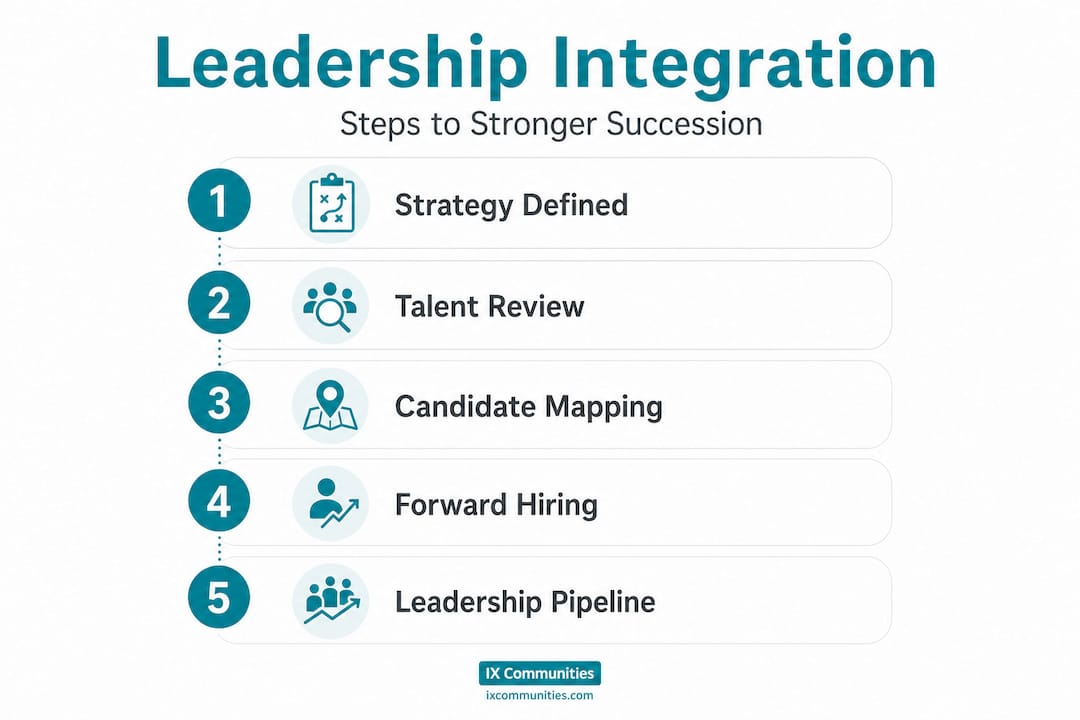
Executive search increasingly functions as a continuing intelligence-and-capability loop that supports leadership development and succession planning. Each completed search adds to the organization’s understanding of what great leadership looks like in a given function, market, or growth stage.
The flywheel works as follows:
-
Placement generates intelligence. Every search surfaces data on market talent, compensation, and capability trends.
-
Intelligence informs development. That data feeds back into coaching, mentoring, and development plans for internal successors.
-
Development strengthens the bench. Stronger internal candidates reduce dependency on reactive external search.
-
A stronger bench accelerates future searches. When internal candidates are genuinely ready, external searches can be more targeted and faster.
“Integrating executive search with talent management reflects a move toward forward-hiring and market mapping informed by people analytics and predictive insight.”
This shift is significant. Forward-hiring means defining the leadership capabilities the business will need in two to four years and beginning to identify and develop those profiles now, both internally and externally. It is the difference between building a pipeline and filling a hole.
Organizations that have adopted streamlined executive search practices report that the flywheel effect reduces average time-to-fill for repeat searches in the same function by as much as 30%. More importantly, they report higher post-placement performance scores because the success profile has been refined through prior search cycles.
The broader impact on executive search leadership in 2026 is a shift in how search partners are evaluated. The question is no longer only “Did you fill the role?” It is “What did we learn, and how does that strengthen our succession bench?”
Governance matters: Search models, incentives, and succession risk
Even with integration, your governance and incentive structures can make or break the real impact.
Retained versus contingency executive search models are not neutral containers. Misaligned incentives can create an illusion of rigor without the underlying assessment substance needed for succession-grade decisions. A contingency model, where fees are paid only on placement, creates pressure to close quickly rather than assess thoroughly.
| Search model | Incentive structure | Succession suitability |
|---|---|---|
| Retained | Fee paid in stages; completion focus | High: supports thorough assessment |
| Contingency | Fee paid on placement only | Lower: speed over depth |
| Embedded/RPO | Fixed or project-based | High: aligned with talent strategy |
Governance structures that support integration include:
-
A defined stakeholder group that includes HR, the business leader, and the search partner in every stage-gate review
-
Objective, pre-agreed assessment criteria tied to the shared success profile
-
A formal handoff process that routes search intelligence to the talent management team post-placement
Pro Tip: Treat the choice of search model as a strategic governance decision, not a procurement one. The model you select signals to your organization how seriously you treat succession-grade rigor.
Organizations seeking to benchmark their current governance practices can review leadership hiring best practices and access leadership benchmarking data to calibrate against peer organizations.
Advanced application: Market mapping, succession stress-tests, edge cases
The biggest payoffs come when integration helps organizations navigate gray areas in leadership succession.
The most common edge case: internal successors whose readiness is genuinely uncertain. The instinct is often to either promote and hope, or bypass internally and go straight to external search. Neither is optimal. Executive search should complement, not replace, succession development by using search to stress-test and calibrate internal readiness against external market benchmarks and role requirements.
A structured approach to stress-testing looks like this:
-
Identify the internal successor pool for a critical role and document current readiness assessments.
-
Run a parallel market map to understand what external candidates at the same level look like in terms of capability, experience, and leadership style.
-
Compare profiles objectively using the shared success profile as the evaluation framework.
-
Use the gap analysis to prioritize development actions for internal candidates or to define the precise profile for an external search.
-
Document findings and route them into the next talent review cycle.
This process does not undermine internal candidates. It strengthens the organization’s confidence in its succession decisions and provides a defensible, data-informed rationale for the board and senior leadership.
Pro Tip: Use market mapping as a risk management tool, not just a search preparation step. A current external talent map for your top five critical roles gives you a realistic picture of how quickly you could respond to an unexpected vacancy.
Organizations exploring how AI in executive search is reshaping market mapping will find that predictive analytics now make it possible to identify potential successors and external candidates well before a vacancy is anticipated.
Perspective: Why integration is harder than it looks—and how to do it well
The frameworks above are sound. The reality of execution is more complicated.
Many organizations attempt integration by adding a search partner to their talent review process or sharing a succession chart with their search firm. That is not integration. Real integration requires new accountability structures, shared metrics, and a willingness to let search intelligence challenge internal assumptions about who is ready and for what.
The most common failure mode is that hiring remains reactive and workforce planning lacks a long-range skill horizon. Adding a search partner to a reactive process does not make it strategic. It just adds cost.
What experienced HR leaders have learned is that integration requires embedding HR into how the business defines future success and risk, not merely adding a search partner to the process. That means HR leaders need a seat at the table when business strategy is set, not after. It means succession planning is reviewed in the context of the business plan, not as a separate HR exercise.
The organizations that get this right share three characteristics. First, they define leadership requirements from business strategy, not from job descriptions. Second, they use integrated talent management and recruiting as a continuous process, not an annual event. Third, they hold both HR and business leaders accountable for succession outcomes, not just HR.
Integration is not a plugin. It is a operating model shift. Organizations that treat it as a project will see short-term improvement. Organizations that treat it as a permanent change in how they make leadership decisions will build a lasting competitive advantage in talent.
Connect, benchmark, and lead through peer-powered integration
For executives seeking to accelerate their integration or benchmark with peers, community resources make the difference.
ESIX, TLIX, and IXCommunities provide senior talent and recruiting leaders with secure, peer-based environments to share practices, benchmark outcomes, and access current research on executive search and succession integration. Whether you are stress-testing your governance model or building your first integrated workflow, the peer mentoring program for talent leaders connects you with practitioners who have navigated the same challenges. Access leadership benchmark surveys to see how your succession readiness and search integration metrics compare to peer organizations. IX Communities membership provides the tools, data, and network to move from frameworks to results.
Frequently asked questions
What is the main benefit of integrating executive search and talent management?
Integration creates a continuous leadership pipeline that strengthens succession planning and builds sustainable bench depth. Executive search functions as a capability loop feeding leadership development rather than operating as a standalone transaction.
How does forward-hiring differ from traditional executive search?
Forward-hiring uses data and predictive analytics to anticipate future leadership gaps before vacancies occur. Forward-hiring and market mapping use people analytics to identify and prepare for future leadership needs rather than reacting to open roles.
What is a leadership flywheel in executive search?
It is an ongoing process where each executive search generates intelligence that feeds back into leadership development and succession planning. The flywheel model strengthens leadership playbooks and improves succession outcomes over successive search cycles.
Why do succession planning efforts often fail?
Most organizations recognize the value of succession planning but do not execute it with sufficient rigor or integration. Only 14% of organizations execute succession planning effectively despite 86% recognizing its importance, largely because planning remains disconnected from search and development.
How do organizations stress-test internal successors with executive search?
Organizations run parallel market maps to compare internal candidates against external talent benchmarks using a shared success profile. Executive search calibrates internal readiness against external benchmarks and role requirements to provide objective succession decisions.