

An executive search that drags on for six months doesn't just delay a hire. It stalls strategic initiatives, strains teams, and signals organizational dysfunction to the very candidates you're trying to attract. For large organizations, a slow or mismanaged search process compounds quickly, burning recruiter bandwidth, exhausting stakeholder patience, and risking the loss of top-tier candidates to faster-moving competitors. The good news is that most delays are preventable. Retention can increase 20-30% with structured post-hire planning, and the same discipline applied earlier in the process pays equally large dividends. This guide walks you through each phase of a streamlined executive search, from preparation through onboarding.
Table of Contents
- Understanding the executive search bottlenecks
- Preparation: Laying the groundwork for a streamlined search
- Execution: Streamlining interview and selection steps
- Verification: Ensuring success with onboarding and metrics
- Rethinking speed: What most executive search guides overlook
- Next steps: Empower your executive search process
- Frequently asked questions
Key Takeaways
| Point | Details |
|---|---|
| Eliminate process bottlenecks | Identify and resolve delays at every stage to accelerate executive hiring. |
| Prioritize strategic fit | Use tailored interviews and expert panels to align candidates with organizational needs. |
| Leverage onboarding plans | Adopt 30-60-90 day programs and mentorship to improve retention of executive hires. |
| Adopt technology solutions | Implement digital tools for tracking and feedback to drive efficient, data-driven search. |
Understanding the executive search bottlenecks
Before you can fix a slow process, you need to know exactly where it breaks down. Most executive search delays don't come from a shortage of qualified candidates. They come from internal dysfunction that compounds at every stage.
The most common recruitment bottlenecks in large organizations include:
- Misaligned role requirements: When hiring managers, HR leaders, and business unit heads each have a different picture of the ideal candidate, the search never gains traction.
- Slow stakeholder response: Interview scheduling, feedback collection, and offer approvals all stall when decision-makers are disengaged or overloaded.
- Cumbersome evaluation stages: Too many interview rounds, redundant assessments, and unclear scoring criteria turn a manageable process into an endurance test for candidates.
- Lack of process ownership: Without a single accountable leader driving the search, handoffs between teams create gaps and delays.
These bottlenecks matter beyond internal frustration. Candidates at the executive level are evaluating your organization just as critically as you are evaluating them. A drawn-out, disorganized process signals poor leadership culture, and your best prospects will quietly withdraw.
Applying executive search best practices means treating the candidate experience as a reflection of your brand. Expert panelists and company-specific tasks reveal strategic fit far more reliably than generic competency interviews, but only when the process is structured enough to deploy them effectively.
Here's how a streamlined approach compares to a traditional one:
| Factor | Traditional search | Streamlined search |
|---|---|---|
| Role definition | Evolves throughout the process | Locked in before launch |
| Stakeholder alignment | Ongoing negotiation | Pre-agreed criteria |
| Interview stages | 5 or more rounds | 3 focused rounds |
| Feedback turnaround | Days to weeks | 24 to 48 hours |
| Candidate experience | Inconsistent | Structured and deliberate |
| Time to offer | 90 to 180 days | 45 to 75 days |
The gap is significant. Streamlined processes don't cut corners. They eliminate waste.
Preparation: Laying the groundwork for a streamlined search
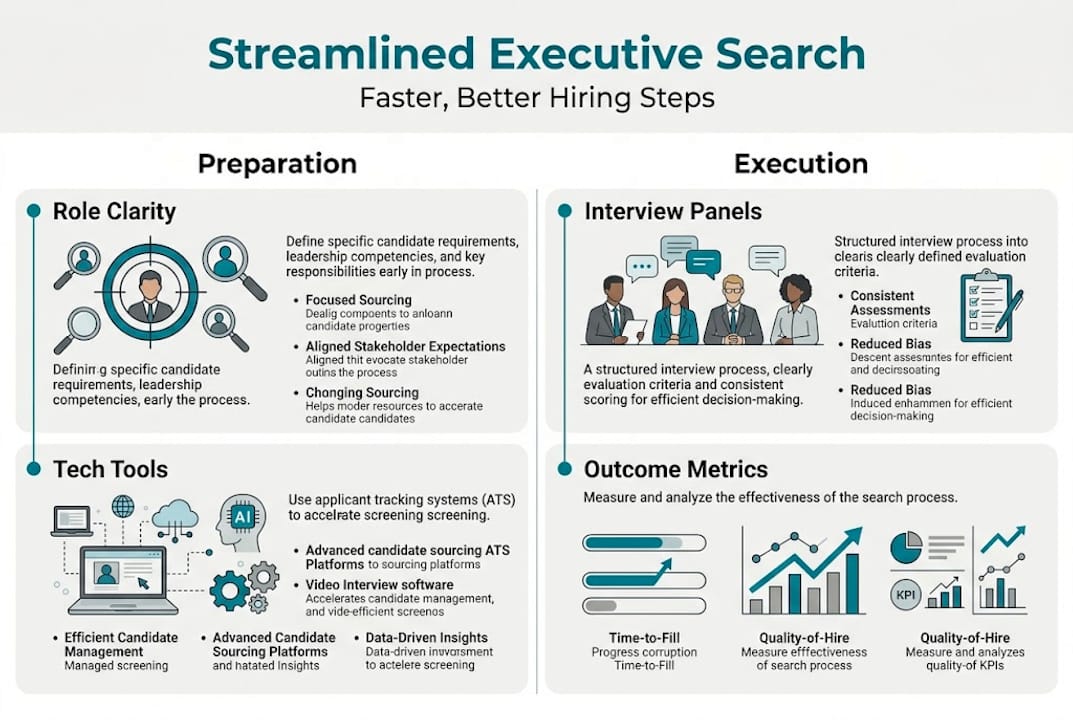
Once you know where bottlenecks happen, preparation is where you can make the biggest difference up front. The organizations that move fastest on executive hires are almost always the ones that did the most work before the search launched.
Here are the foundational steps to build that advantage:
- Define the role with precision. Document not just responsibilities, but the outcomes the executive must deliver in the first 12 months. Vague job descriptions produce vague candidate pools.
- Align stakeholders before the search opens. Get hiring committee members to agree on must-have versus nice-to-have criteria in writing. This prevents scope creep mid-search.
- Select your technology stack early. Choose platforms for candidate tracking, interview scheduling, and evaluation scoring before the first resume arrives.
- Create a realistic job preview. Be transparent with candidates about organizational challenges, culture, and expectations. This self-selects for fit and reduces late-stage withdrawals.
- Assign clear process ownership. One person drives the timeline, owns stakeholder communication, and escalates delays. Without this, accountability diffuses.
Tailoring interviews with case studies and company-specific tasks is most effective when those materials are built during preparation, not improvised during the search.
Here's a quick reference for tools and who should own them:
| Tool category | Recommended for | Primary owner |
|---|---|---|
| ATS/candidate tracking | All searches | Talent acquisition lead |
| Scheduling automation | Panel interviews | Recruiter or coordinator |
| Evaluation scorecards | Structured assessment | Hiring committee |
| Benchmarking platform | Role scoping and comp | HR leadership |
| Digital search platform | Sourcing and vetting | Executive search partner |
The Execsmart digital platform and a well-configured recruitment tech stack give large organizations the infrastructure to move with speed and consistency.

Pro Tip: Run a 90-minute stakeholder workshop before launching the search. Use it to align on the candidate profile, agree on evaluation criteria, and assign committee roles. This single meeting can eliminate weeks of back-and-forth once candidates enter the pipeline.
Execution: Streamlining interview and selection steps
A strong foundation lets you execute quickly. Now, let's streamline interviews and evaluation to avoid costly delays.
The interview stage is where most executive searches lose momentum. Too many rounds, too little structure, and too few clear decision points turn a promising pipeline into a candidate dropout problem. Here's how to run it tighter:
- Use structured panel interviews. Assign specific competency areas to each panelist. Avoid redundant questions across rounds. Every conversation should surface new information.
- Deploy case studies and role-specific tasks. These create a realistic preview of the work while giving your team concrete evidence of strategic thinking.
- Set a three-round maximum. First round for cultural and leadership fit, second for functional depth, third for executive team alignment. More rounds rarely add more clarity.
- Require feedback within 24 hours. Build this into your process agreement with all panelists before the search begins. Late feedback stalls offers and loses candidates.
- Use digital evaluation tools. Centralized scoring platforms let committee members submit assessments asynchronously, eliminating scheduling delays for debrief meetings.
Engaging expert panelists during executive interviews ensures precise assessment for niche roles where internal evaluators may lack the technical depth to judge candidate quality accurately.
Pro Tip: For highly specialized roles, consider inviting guest experts to sit on your interview panel. A seasoned peer from your industry brings credibility to the evaluation and often surfaces questions your internal team wouldn't think to ask.
Critical step: Before the first interview, hold a 30-minute interviewer alignment session. Confirm scoring criteria, assign question ownership, and establish the feedback deadline. This single touchpoint prevents the most common execution failures: inconsistent evaluation and delayed decisions.
Building relationships through recruiter peer mentorship also gives your team access to proven interview frameworks that have been tested across large organizations in similar searches.
Verification: Ensuring success with onboarding and metrics
With your executive hired, it's vital not to lose steam in the final stretch. Here's how to deliver on placement success.
Many organizations treat the signed offer letter as the finish line. It isn't. Research shows that post-hire 30-60-90 day plans can boost retention by 20 to 30%. Yet most large organizations hand off a new executive to a generic onboarding program and hope for the best. That gap between search success and integration success is where executive churn originates.
Here are the post-hire strategies that actually protect your investment:
- Build a 30-60-90 day onboarding plan with specific milestones tied to the role's success criteria. Don't leave this to the executive's direct manager alone.
- Schedule structured check-ins at the 30, 60, and 90-day marks with both HR leadership and the executive's direct supervisor.
- Facilitate early stakeholder introductions across business units, not just the immediate team. Executives who build broad internal relationships in the first 90 days integrate faster.
- Address cultural nuances proactively. Brief the new executive on informal power structures, communication norms, and organizational dynamics that don't appear in the org chart.
- Gather feedback from the executive. Ask them what's working and what's creating friction. This signals investment in their success and surfaces integration risks early.
Pro Tip: Assign a peer mentor from within your senior leadership team for the first 90 days. This is not a buddy program. It's a structured relationship with a defined purpose: accelerating the new executive's understanding of how decisions actually get made in your organization. Explore onboarding mentorship programs for frameworks that work at scale.
Measuring the success of your search doesn't end at placement either. Use measuring search outcomes benchmarking data to track time-to-productivity, 12-month retention rates, and hiring manager satisfaction scores. These metrics close the feedback loop and sharpen your next search.
Rethinking speed: What most executive search guides overlook
Most guides on executive search efficiency treat speed as the primary goal. Get to offer faster. Reduce time-to-fill. Compress the process. That framing misses something important.
Speed without strategic rigor produces fast bad hires. And a bad executive hire in a large organization doesn't just cost the replacement fee. It costs 12 to 18 months of organizational momentum, team stability, and stakeholder trust. We've seen organizations run textbook-efficient searches and still lose the executive within 18 months because onboarding was an afterthought.
The real opportunity isn't just in compressing the search timeline. It's in building a process that is simultaneously faster and more thorough where it counts. That means front-loading the hard conversations about role scope and success criteria, using expert evaluation at the interview stage, and treating executive onboarding best practices as a continuation of the search, not a separate HR function.
The organizations that retain great executives long-term aren't necessarily the ones with the fastest searches. They're the ones that stay invested in the executive's success well past day one. That's the discipline most efficiency guides never mention.
Next steps: Empower your executive search process
Ready to apply these strategies? The frameworks in this guide are most powerful when backed by real peer intelligence and purpose-built tools.
Explore Execsmart solutions to bring digital precision to your sourcing and candidate management workflow. Use executive search benchmarks to measure your process against what leading organizations are actually doing, not just industry averages. And if you're building a team that can sustain search excellence over time, peer mentoring resources connect your recruiters and HR leaders with experienced professionals who have solved the same challenges. ESIX, TLIX, and IXCommunities exist precisely for this: giving talent leaders a secure, trusted environment to benchmark, share, and grow.
Frequently asked questions
What are the first steps to streamlining an executive search process?
Start with role clarity, stakeholder alignment, and predefined evaluation criteria to prevent mid-process delays. Case studies in interviews test for strategic fit from the very beginning of the evaluation stage.
How do expert panelists improve executive hiring?
They bring industry-specific depth that internal evaluators often lack, making assessment both more accurate and more credible. Expert panelists for niche roles enhance evaluation accuracy and reduce the risk of a costly misfit.
What post-hire strategies help retain new executives?
A structured 30-60-90 day onboarding plan paired with peer mentorship creates the integration support executives need to succeed. 30-60-90 day plans are proven to boost retention by 20 to 30%.
How can digital tools speed up the search process?
Platforms for centralized candidate tracking and automated scheduling reduce administrative drag and keep the process moving between stages. They also create a consistent record that helps hiring committees make faster, better-informed decisions.