

Executive hiring has always demanded rigor, but why executive hiring is getting more complex today goes well beyond a shortage of qualified names. The real challenge sits beneath the surface: volatile global markets are compressing decision timelines, senior candidates are more risk-averse than at any point in recent memory, and hybrid work has rewritten the competency map for leadership roles. Understanding each of these layers is not optional for talent acquisition professionals. It is the difference between a hire that holds and one that costs your organization 14 times the executive's base salary before anyone admits it failed.
Table of Contents
- Key takeaways
- Why executive hiring is getting more complex
- Evolving candidate expectations
- Hybrid work and leadership complexity
- Structural shifts in executive search
- Practical strategies for talent acquisition leaders
- My perspective on the mindset shift required
- Connect with peers navigating the same challenges
- FAQ
Key takeaways
| Point | Details |
|---|---|
| Complexity is layered | Global volatility, candidate risk aversion, and hybrid work each add distinct pressure to executive hiring. |
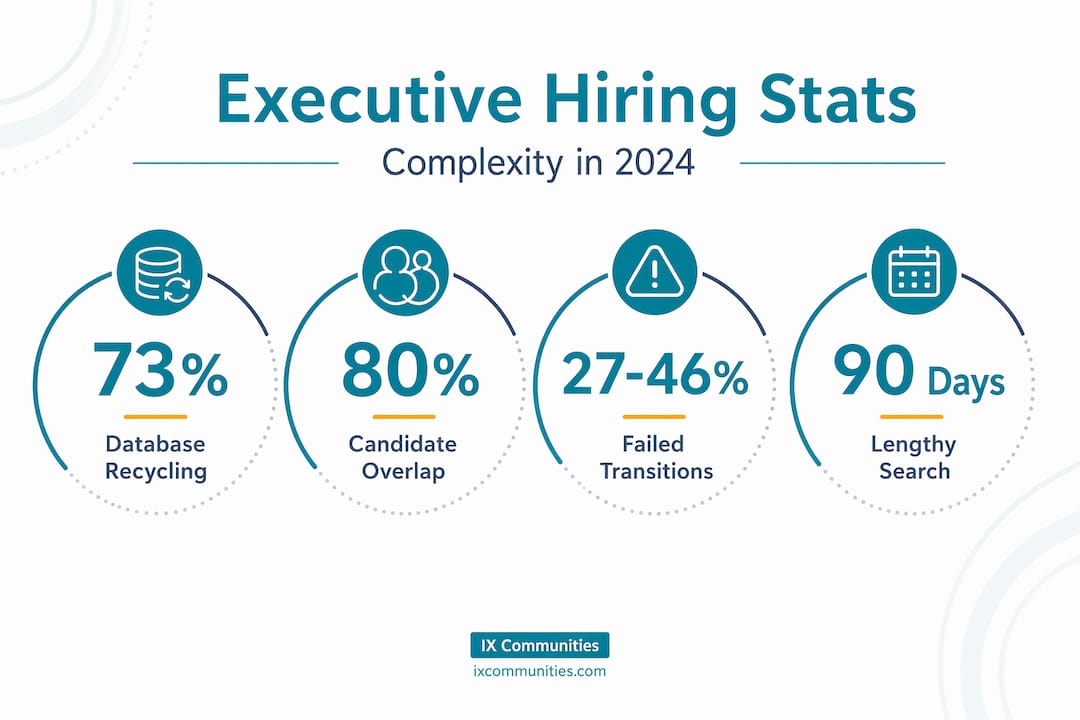
| Failure rates are high | Between 27% and 46% of executive transitions fail within 24 months, making diagnostic rigor non-negotiable. |
| Passive talent is shrinking | Only 11% of presented candidates are not actively job-seeking, limiting the depth of traditional candidate pools. |
| Search models are changing | Intelligence-led, data-driven approaches are replacing retrospective credential reviews in modern executive search. |
| Onboarding is part of the hire | Leadership transition success depends on structured onboarding, not just selecting the right candidate. |
Why executive hiring is getting more complex
The factors affecting executive hiring have multiplied. Economic uncertainty is the first pressure point. When boards cannot predict revenue trajectories 12 months out, senior hiring decisions get frozen or scaled back. The result is an irregular supply of active executive candidates and an equally irregular demand signal from hiring organizations, which makes forward planning difficult for any talent acquisition team.
Geopolitical forces add a second layer. Candidate willingness to relocate across borders has dropped noticeably. Cross-border executive moves that were routine five years ago now require significantly more negotiation around tax implications, family considerations, and political stability. This narrows the effective talent pool for global mandates in ways that raw database counts do not reveal.
There is also a structural mismatch in the executive talent market that often goes unexamined. Some sectors are experiencing senior layoffs at scale while others face genuine shortages. Technology and finance have both produced waves of displaced executives in the same period that healthcare, infrastructure, and climate-focused industries are struggling to find qualified leadership. The aggregated numbers look balanced. The reality for any specific search is often not.
- Longer search timelines. Executives spend 6 to 12 months securing new leadership roles, driven by AI screening volume and increased organizational caution.
- Crisis leadership evaluation. Organizations now assess candidates' records through specific disruption cycles, not just their tenure length.
- Sector-specific supply gaps. Leadership pools for emerging sectors like climate finance and digital infrastructure remain thin despite elevated compensation.
- Frozen mandates. Economic uncertainty creates stop-start search cycles that damage candidate engagement and extend time-to-fill significantly.
- Relocation resistance. Geopolitical and personal factors reduce candidate mobility, limiting geographic search scope.
Pro Tip: When a search timeline extends past 90 days, revisit the role specification first. Overly prescriptive requirements are the most common hidden reason for prolonged searches in volatile markets.
Evolving candidate expectations
Senior candidates have changed. The complexities of hiring executives today include a behavioral dimension that many talent acquisition teams are underprepared for. High-performing executives who are technically available are making far more careful decisions about where they move. The emotional cost of a wrong career decision, magnified by economic instability, means that candidates at the senior level are applying a level of scrutiny to prospective employers that mirrors the organization's own due diligence process.
Top executives stressed from geopolitical and economic uncertainty demonstrate greater risk aversion, and this changes how they respond to outreach. Generic LinkedIn messages and templated recruiter communications get ignored at higher rates than ever. The reason is straightforward: AI-driven outreach overloads passive candidates, and automated, non-relationship-based contact has trained senior leaders to default to non-response.
There are four specific behaviors that talent acquisition leaders should recognize in today's senior candidate market:
- Delayed engagement. Qualified candidates take significantly longer to respond to initial outreach because they are filtering volume aggressively.
- Deeper organizational scrutiny. Candidates research board composition, financial stability, and leadership team tenure before agreeing to an exploratory conversation.
- Compensation recalibration. Beyond base salary, candidates now weigh equity structures, severance terms, and role security explicitly.
- Narrative demands. Candidates want a clear story about why this role exists and where it leads. Vague succession language or ambiguous reporting structures are disqualifying.
"The organizations winning top executive talent in 2026 are not the ones with the highest compensation packages. They are the ones that communicate clearly, move deliberately, and treat the candidate's decision process with the same respect they expect from their own due diligence."
Trust is now the primary currency in executive engagement. Talent acquisition professionals who approach senior candidates with transparency about role challenges, organizational context, and realistic success criteria consistently outperform those who lead with title and compensation.
Hybrid work and leadership complexity
Modern executive hiring issues increasingly involve a dimension that barely registered five years ago: how a leader will operate in a hybrid or distributed environment. This is not simply about whether a role allows remote work. It is about whether a candidate's leadership style, communication approach, and team-building methods translate effectively when half the team is never in the same room.
The competency requirements for executive roles have genuinely changed. Digital fluency is now a baseline expectation, not a differentiator. The ability to build trust and culture across distributed teams is a distinct skill that many experienced executives have not yet developed. An executive who built a high-performing team in a fully co-located environment may struggle significantly in a hybrid context, and prior remote experience is not always predictive of success in a new organizational culture.
- Cultural fit is a measurable risk. Organizations that rely on informal office interaction to reinforce culture face specific leadership challenges when that mechanism is no longer available.
- Onboarding failure rates increase. Leadership transition success rates drop when onboarding programs are not redesigned for hybrid environments.
- Assessment gaps persist. Standard interview formats do not expose how candidates actually operate when managing distributed accountability.
- Prior success does not transfer. Executive success is rarely portable due to varying organizational contexts, and hybrid environments amplify this problem.
Pro Tip: Add a structured scenario exercise to your executive assessment process that requires candidates to describe how they have managed accountability, conflict, and cultural reinforcement in a distributed setting. Self-reported answers reveal as much as the content itself.
Structural shifts in executive search
Why hiring top executives is difficult also has a structural explanation: the tools and models used to conduct searches have not kept pace with the complexity of the roles themselves. Traditional retained and contingent search models are evolving toward continuous intelligence and research-led approaches. The retrospective, credential-focused evaluation that defined executive search for decades is increasingly inadequate.

The data problems in executive search are more significant than most in-house teams realize.
| Traditional Search Model | Intelligence-Led Search Model |
|---|---|
| Pulls from existing candidate databases | Conducts forward-looking market mapping |
| Evaluates credentials and career history | Assesses cognitive diversity and problem-solving fit |
| Focuses on industry background match | Prioritizes contextual fit and leadership adaptability |
| Reactive to role specifications | Proactive talent intelligence before mandates open |
| Relies on repeat candidates from shared networks | Sources from passive markets not visible in shared databases |
The database recycling problem is particularly acute. 73% of candidates are registered with five or more firms, and 80% of executives appear repeatedly in shortlists. When multiple search partners are drawing from overlapping pools, the apparent breadth of a search is illusory. You may be reviewing the same 40 names under four different retainers.
Boards are also raising the specificity bar. The shift toward specific problem-solver roles means that cognitive diversity and scenario-specific capability are now evaluated as hard risk factors. Hiring for a "Pivot CEO" mandate or a transformation-specific CFO requires a fundamentally different assessment architecture than a like-for-like replacement search.
Pro Tip: Before commissioning an external search, ask each firm to demonstrate the overlap percentage between their candidate database and those of two other firms you are considering. The answer will tell you more about their market access than any pitch deck.
The move from process to intelligence in executive recruiting reflects a genuine maturation of the function. The firms and in-house teams that will lead are those that build ongoing talent intelligence capabilities rather than reactive search cycles.
Practical strategies for talent acquisition leaders
The executive search process complications described above are not abstract. Each one has a practical response that talent acquisition leaders can apply now.
- Start with a diagnostic, not a job description. Before writing a specification, map the specific capability gaps the organization needs to close. Generic experience requirements attract generic candidates. Define the three or four problems the incoming executive must solve in the first 18 months.
- Separate speed from urgency. Leadership roles requiring faster outcomes under tighter budgets create pressure to compress timelines. Recognize that speed to offer and speed to success are not the same thing. A compressed process that produces the wrong hire costs far more than an additional four weeks of assessment.
- Use technology for intelligence, not volume. AI tools have real gaps in assessing leadership and should be applied to market mapping and data aggregation. Reserve human judgment for evaluation, engagement, and candidate decision support.
- Build candidate trust before you need it. Engage potential candidates through authentic, specific outreach well before a role opens. Trust built over 6 months does not need to be rebuilt when urgency arrives.
- Redesign onboarding as a hiring deliverable. 40 to 60% of executive hires fail to meet expectations within 18 months. A structured 90-day integration plan, agreed before the executive starts, is one of the highest-return investments in the entire hiring cycle.
- Assess contextual fit explicitly. Organizational context factors such as ownership structure, internal power dynamics, and board expectations are frequently overlooked in formal evaluation criteria. Build them into your assessment process deliberately.
Pro Tip: The most revealing question you can ask a finalist candidate is: "Describe a situation where your leadership approach did not work and what the specific organizational conditions were that contributed to that." The quality of self-awareness in the answer is more predictive of success than almost any credential.
My perspective on the mindset shift required
I have watched talent acquisition teams default to credential matching when the actual problem is contextual. A candidate with an impressive track record at a publicly traded company may be completely unprepared for the governance dynamics of a founder-led private firm. That mismatch does not show up in a resume screen. It surfaces six months into the role, and by then the cost is already significant.
What I have learned from working in executive recruiting environments is that the organizations getting this right are the ones treating each search as a diagnostic problem, not a fulfillment exercise. They start with the organizational context, map the specific capability gaps, and then evaluate candidates against that precise picture. They are not asking "who is impressive?" They are asking "who will succeed here, with this board, in this market, at this moment?"
The standard interview process fails to reveal leadership behavior under real organizational constraints. Most executives can present well. What assessment rarely surfaces is how a candidate navigates conflicting priorities, scarce resources, and internal politics simultaneously. Those are the conditions that determine whether an executive hire succeeds.
Cognitive diversity is also undervalued. Boards want leaders who challenge the Chair without breaking the Board. That requires a different kind of candidate profiling than experience matching, and most in-house teams have not yet built that capability. The organizations that invest in it now will have a measurable hiring advantage within two years.
The most consistent mistake I observe is compressed timelines driven by perceived urgency. Pressure to fill a role quickly is real. But the cost of a failed executive hire, between 27 and 46% of transitions failing within 24 months, makes the case for maintaining assessment rigor even when boards are impatient.
— Simon
Connect with peers navigating the same challenges
Ixcommunities operates the ESIX, TLIX, and IXCommunities peer networking groups specifically for corporate talent acquisition leaders and HR professionals managing these exact challenges. The ESIX Recruiter Peer Mentorship Program connects experienced recruiting professionals with peers navigating executive search complexity in a secure, confidential environment. The Talent Leaders Peer Mentoring Program gives senior HR leaders access to structured peer support, guest speaker events with practitioners from global organizations, and benchmark surveys that provide real data on how peer organizations are responding to today's executive hiring pressures. If you are managing the complexity described in this article, the most direct resource is a community of professionals who are doing the same work at scale.
FAQ
Why do so many executive hires fail?
Between 27% and 46% of executive transitions fail within the first 24 months, primarily because assessments focus on credentials rather than contextual fit, and onboarding is inadequately structured for leadership roles.
What makes passive executive candidates harder to engage today?
AI-driven outreach has created message saturation at the senior level, making candidate trust the key differentiator. Executives filter generic outreach aggressively, favoring recruiters who demonstrate specific organizational knowledge and relationship-based engagement.
How does hybrid work complicate executive assessment?
Hybrid environments require distinct leadership competencies, including distributed team management and digital culture-building, that standard interview formats do not assess. Prior success in co-located settings does not reliably predict performance in hybrid structures.
What is wrong with traditional executive search databases?
73% of executive candidates are registered with five or more search firms, meaning most databases recycle the same names. Organizations relying on traditional retained searches may receive shortlists with limited variability despite significant investment.
How should talent acquisition leaders define executive role requirements?
Specifications should center on the specific business problems the incoming executive must solve in the first 18 months, rather than generic experience criteria. Contextual fit factors such as ownership structure and board dynamics should be stated explicitly in evaluation criteria.