

Gartner predicts that by 2028, one in four candidate profiles will be fake. For Chief Talent Officers and heads of recruitment at large corporations, that figure is not a future concern. It is a present operational reality. Executive hiring fraud is accelerating faster than most prevention frameworks can adapt. Credential fabrication, AI-assisted impersonation, and post-hire theft are no longer edge cases. They are documented, recurring threats. Yet many talent leaders still treat fraud as a lower-level hiring problem, leaving the C-suite and senior leadership pipeline dangerously exposed. This article covers the current threat landscape, how sophisticated schemes work, and what prevention strategies actually deliver results at the executive level.
Table of Contents
- The new reality: Executive hiring fraud in 2026
- Inside the fraud: How sophisticated schemes target executive hiring
- Prevention strategies: What actually works for executive roles
- Balancing fraud risk, candidate experience, and hiring speed
- Why leaders must break the silence on executive hiring fraud
- Advance your executive hiring resilience with IX Communities
- Frequently asked questions
Key Takeaways
| Point | Details |
|---|---|
| Fraud is rising fast | Executive hiring scams now exploit AI and remote tech, making old defenses obsolete. |
| Real losses are massive | A single fraudulent hire can cost over $120,000 plus reputation and IP damages. |
| Layered prevention works | ID verification, credential audits, and ongoing checks cut executive hiring fraud. |
| Balanced approach required | Excessive checks slow hiring and deter talent—tailor rigor to role risk. |
| Open dialogue is vital | Leaders must share threats and collaborate to keep pace with evolving fraud risks. |
The new reality: Executive hiring fraud in 2026
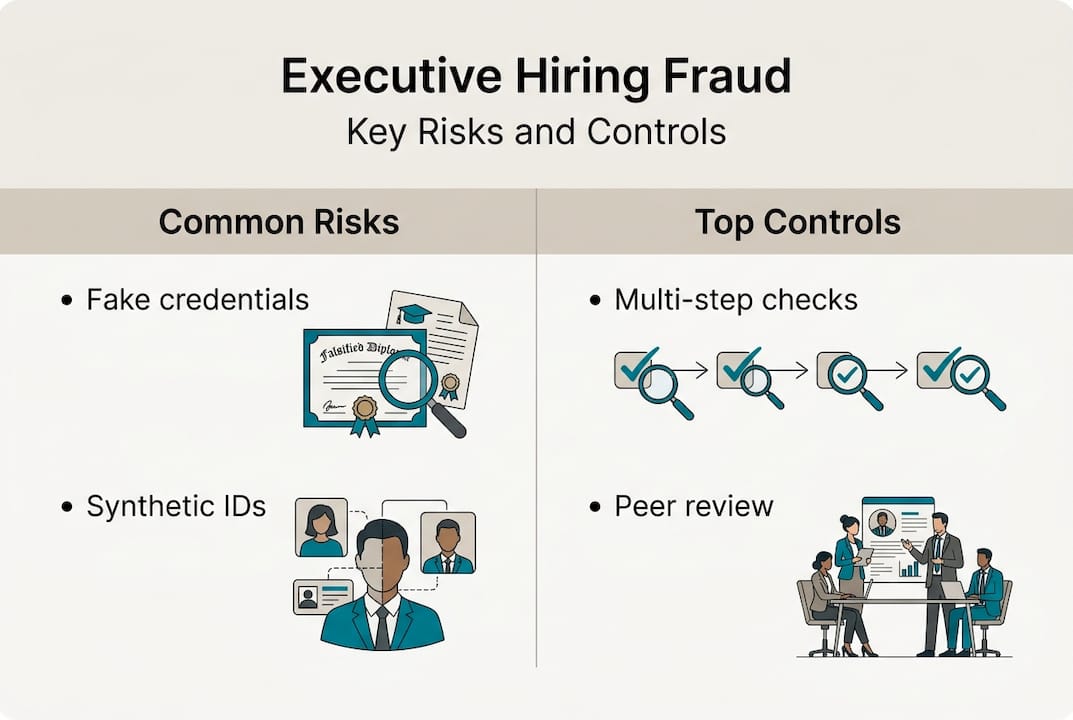
Executive hiring fraud is not a single tactic. It is a category of coordinated deception that exploits every gap in the recruitment lifecycle. The most common forms include credential fabrication, identity theft, AI-assisted impersonation, ghost employees, and post-hire fraud by executives who already hold privileged access.
Remote hiring has fundamentally changed the risk profile. When interviews happen over video and documents are submitted digitally, bad actors face far fewer barriers. AI tools now allow fraudsters to generate convincing resumes, fabricated transcripts, and even conduct video interviews using voice-cloning and deepfake technology. Credential fabrication and identity fraud are now common in executive hiring, not occasional anomalies.
The data confirms the severity. 59% of hiring managers suspect AI-enhanced applicant fraud, and 31% report having interviewed someone using a false identity. These numbers reflect organizations across industries, not outliers.
| Fraud type | Primary vector | Executive-level impact |
|---|---|---|
| Credential fabrication | Fake diplomas, certifications | Unqualified leadership decisions |
| Identity theft | Stolen professional profiles | Reputational and legal exposure |
| AI impersonation | Deepfake video, voice cloning | Bypasses remote interview controls |
| Ghost employees | Payroll manipulation | Direct financial loss |
| Post-hire theft | System access exploitation | Data exfiltration, IP loss |
Most organizations concentrate fraud prevention at the volume-hiring level. Background check vendors are calibrated for high-throughput, lower-stakes roles. The assumption is that executive candidates, vetted through search firms and referrals, carry inherently lower fraud risk. That assumption is wrong. Use exec recruiting fraud analytics to understand where your process has the most exposure.
There is also a cultural barrier. Leaders rarely discuss executive-level fraud openly. Reputational concerns and competitive sensitivity keep these incidents quiet. That silence prevents organizations from learning from each other. Accessing industry fraud benchmarks allows talent teams to understand how peers are managing this risk without exposing their own vulnerabilities publicly.
"The question is no longer whether executive hiring fraud will affect your organization. It is whether your current controls are sufficient to detect it before real damage occurs."
Inside the fraud: How sophisticated schemes target executive hiring
Understanding that fraud exists is not enough. Talent leaders need to understand how it works at the executive level, because the mechanics are far more sophisticated than a falsified job title on a resume.
Consider documented cases. The Optum ghost employee scheme resulted in over $1.2 million in fraudulent payroll. The TopDevz case involved insider theft by individuals who had passed standard vetting. State-backed IT worker scams, documented by U.S. federal agencies, involved coordinated networks of fraudulent applicants placing operatives inside corporations for long-term intelligence gathering. State-sponsored schemes, ghost hiring, and post-hire theft at the executive level are real and growing.
Here is how a sophisticated scheme typically unfolds:
- Profile construction: The fraudster builds a synthetic identity using real data from professionals on LinkedIn combined with fabricated credentials.
- AI-assisted application: Generative AI tools produce polished resumes and cover letters tailored precisely to the job description.
- Reference coordination: A network of accomplices poses as former colleagues or supervisors, providing consistent references.
- Interview performance: AI tools assist with real-time interview coaching. Deepfake video overlays mask physical identity in video calls.
- Post-hire exploitation: Once placed, the individual leverages privileged system access to exfiltrate data, divert funds, or enable further infiltration.
The financial consequences are severe. Fraudulent executive hires can cost organizations over $120,000 each and trigger years of financial or IP loss. That figure does not capture downstream regulatory penalties or brand damage.
Pro Tip: Review exec hiring threat profiles to map specific fraud vectors against your existing controls. Gaps become visible quickly when you compare your process against documented attack patterns.
Synthetic identities are particularly difficult to detect because they do not trigger standard fraud alerts. The identity is real enough to pass basic checks but constructed to conceal the true individual. Organizations without dedicated verification for executive hiring networks are especially vulnerable at this stage.

Prevention strategies: What actually works for executive roles
Basic background checks are not designed for executive-level fraud. A criminal record check and an employment verification call will not detect a deepfake interview, a coordinated reference network, or a synthetic identity. Prevention at the executive level requires a structured, multi-stage approach.
Here is what leading organizations are implementing:
- Lifecycle identity verification: Verify identity at three points: pre-interview, at offer, and during onboarding. Use government-issued ID confirmation and biometric checks at each stage.
- Official credential evaluation: Require transcripts sent directly from institutions and use accredited credential evaluation services. Do not accept candidate-provided copies.
- Multi-format skills validation: Combine live technical exercises, structured behavioral interviews, and AI-assisted content analysis to detect coached or AI-generated responses.
- Reference triangulation: Go beyond provided references. Independently identify and contact former colleagues not listed by the candidate.
- Continuous post-hire monitoring: For executives with privileged system access, implement ongoing behavioral monitoring and periodic re-verification.
Multi-layered checks, official credential review, and ongoing verification measurably reduce executive fraud exposure. Organizations that embed verification at multiple lifecycle stages report significantly fewer post-hire incidents.
"Separating protocols by role criticality is not optional. It is the foundation of a defensible executive hiring process."
Best practice separates protocols for high-risk and high-criticality roles from standard hiring flows. A CFO or CISO hire warrants a fundamentally different verification process than a mid-level manager.
Pro Tip: Connect with peer fraud detection practices to learn how talent leaders at comparable organizations have structured their executive verification protocols. Peer learning accelerates implementation faster than building frameworks from scratch.
Aligning your verification framework with hiring fraud benchmarking data helps confirm whether your controls meet current industry standards or fall below them.
Balancing fraud risk, candidate experience, and hiring speed
Rigorous fraud prevention creates real operational tension. Executive candidates, particularly those currently employed, have limited patience for lengthy or invasive verification processes. Applying excessive scrutiny can signal distrust, damage your employer brand, and push qualified candidates toward competitors.
At the same time, under-investing in verification for executive roles exposes the organization to significant financial, legal, and reputational risk. The balance is not easy, but it is achievable with the right segmentation strategy.
Key considerations for talent leaders:
- Segment your process: Apply your most rigorous protocols to executive and critical infrastructure roles. Streamline verification for high-volume, lower-risk positions to preserve efficiency.
- Communicate the purpose: Brief candidates on why verification steps exist. Framing it as organizational security, not personal distrust, reduces friction.
- Build cross-department alignment: Security, legal, and HR must operate from a shared framework. Fragmented verification across departments creates gaps that bad actors exploit.
- Audit your AI tools: If your organization uses AI in screening or interviewing, ensure those tools are regularly audited for both bias and susceptibility to AI-assisted fraud.
26% of applicants mistrust automated evaluation processes. Over-reliance on AI screening without human oversight increases both fraud risk and candidate dropout rates simultaneously.
The cost of getting this wrong is substantial. Executive failure rates reach 40 to 70%, with turnover costing up to 213% of annual salary. Fraud compounds that already significant risk. Understanding AI impersonation risks in your current hiring stack is a practical starting point for identifying where your process is most exposed.
Talent leaders who benchmark their approach against peer hiring experiences consistently find they can maintain rigorous fraud controls without creating excessive candidate friction, provided the process is clearly structured and efficiently managed.
Why leaders must break the silence on executive hiring fraud
The professional reluctance to discuss executive hiring fraud openly is understandable. No organization wants to signal vulnerability. No leader wants to be associated with a high-profile fraud incident. But that silence is itself a risk factor.
When fraud incidents are handled quietly and internally, the broader industry loses the opportunity to learn from them. Patterns go unrecognized. Fraudsters move from one organization to the next, exploiting the same gaps. Prevention frameworks stagnate because no one is sharing current threat intelligence.
Proactive risk discussion and cross-functional committees lead to stronger C-suite fraud defense. This is not theoretical. Organizations that participate in structured peer networks respond faster to emerging fraud tactics because they are not building knowledge from scratch each time.
True resilience in executive hiring comes from collective intelligence. That means formalizing internal risk committees that include security, HR, legal, and finance. It also means contributing to and drawing from exec search peer insights through trusted industry networks where leaders can share what is working without exposing competitive information.
The organizations that will be best positioned in the next three years are those willing to treat executive hiring fraud as a shared industry challenge, not a private embarrassment.
Advance your executive hiring resilience with IX Communities
For talent leaders ready to strengthen their executive hiring fraud defenses, IX Communities provides direct access to the resources and peer networks that make a measurable difference.

Through the Talent Leaders Peer Mentoring Program, Chief Talent Officers and recruitment heads connect with peers who are actively managing the same executive hiring risks. Benchmark Surveys deliver current data on fraud prevention practices across large corporations, giving your team a clear baseline for comparison. The ESIX Recruiter Peer Mentorship Programs offer structured guidance from experienced practitioners who have built executive verification frameworks at scale. IX Communities is where talent leadership professionals share, benchmark, and learn in a secure environment.
Frequently asked questions
What are the most common types of executive hiring fraud?
Fake credentials, AI-generated profiles, identity fraud, ghost employees, and post-hire theft are the most prevalent forms of fraud targeting executive hiring processes.
How much can a fraudulent executive hire cost an organization?
Fraudulent executive hires typically cost over $120,000 directly, with additional losses from IP theft, regulatory penalties, and leadership disruption extending the financial impact significantly.
Which prevention steps are most effective for executive hiring?
Multi-stage identity checks, official credential audits, coordinated reference verification, and continuous post-hire monitoring are the most effective controls for executive-level roles.
How does remote hiring and AI increase executive fraud risks?
Remote and AI-powered processes lower the barriers for impersonation, document forgery, and coordinated fraud schemes, making them significantly harder to detect without lifecycle verification controls in place.