

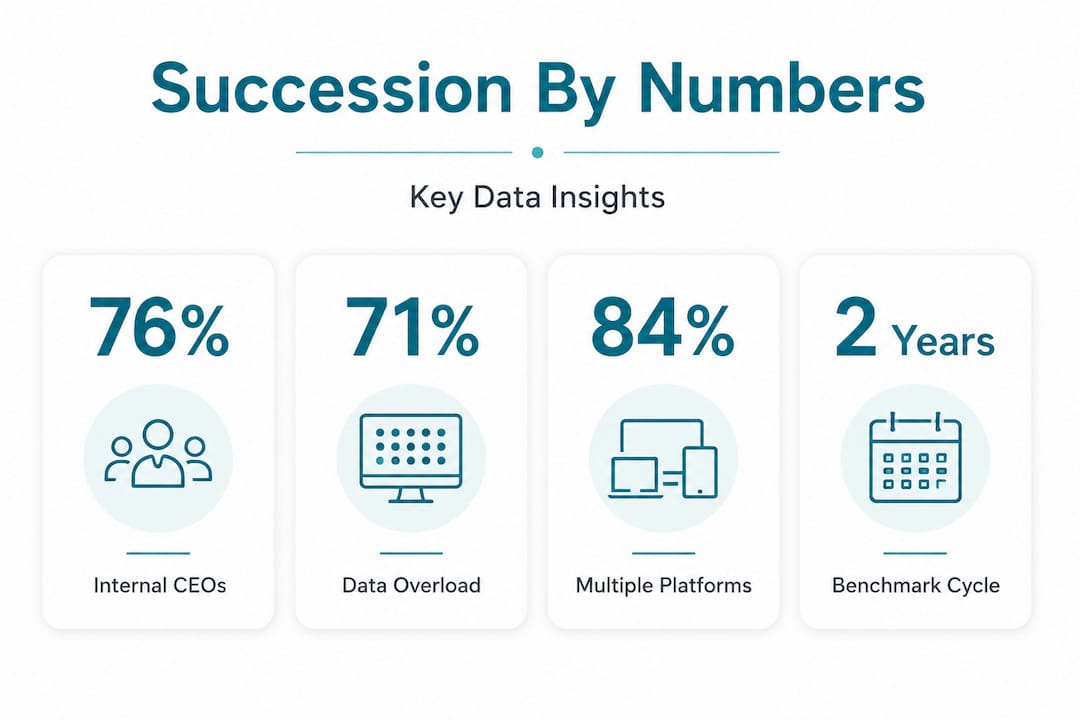
Succession planning, defined as the process of identifying and preparing internal candidates for critical leadership roles, is widely assumed to be an internal exercise. But leading organizations do not treat it that way. 76% of incoming CEOs in the first half of 2025 were internal hires, yet boards consistently evaluated both internal and external candidates before making a final call. That gap between outcome and process is exactly where large-scale talent strategy gets interesting, and where smart talent acquisition leaders find their competitive edge.
Table of Contents
- What does '76 percent' actually mean in CEO succession?
- How external talent data strengthens succession planning
- When to rely on external talent data: Nuances and edge cases
- Making talent data work: Integration, overload, and data-driven decisions
- Perspective: The uncomfortable truth about external talent data in succession
- Empower your succession strategy with the right data and community
- Frequently asked questions
Key Takeaways
| Point | Details |
|---|---|
| External benchmarking matters | Comparing internal successors against external talent makes succession decisions more robust and market-aligned. |
| 76% internal hires still use external data | Boards that choose internal candidates nearly always evaluate them alongside external talent for the best fit. |
| Integration beats intuition | Unified talent data empowers evidence-based succession, reducing reliance on gut instinct. |
| Benchmarking is ongoing | Best practice is to benchmark external talent every two years—not just when there’s a crisis. |
| Blend internal and external strategies | Sustainable succession combines internal development, upskilling, and external calibration—never just outside hires. |
What does '76 percent' actually mean in CEO succession?
The headline figure is often misread. When people see that 76% of CEOs were internal hires, the assumption is that boards simply reached into the existing pipeline, selected the strongest internal candidate, and moved on. The actual board process is considerably more rigorous than that.
In practice, boards typically review a median of one internal candidate alongside a median of two external candidates before settling on a final decision. That means even when an internal hire is the outcome, external talent served as an active reference point throughout the evaluation. The 76% figure describes who got the job, not how the decision was made.
What the board process actually looks like
The succession process at the board level follows a structured evaluation logic, not a simple preference for insider candidates. Key factors boards weigh include:
- Candidate readiness: Has the internal candidate been developed with specific successor competencies in mind?
- Market competitiveness: Would an external candidate bring skills or networks the internal slate cannot match?
- Strategic fit: Does the organization need continuity or transformation at the top?
- Speed of transition: How quickly must the new leader become effective in the role?
- Risk profile: What are the costs of a misaligned external hire versus an underprepared internal one?
| Decision factor | Internal candidate priority | External candidate priority |
|---|---|---|
| Cultural continuity | High | Low |
| Speed to productivity | High | Moderate |
| Novel skill sets | Low | High |
| Market benchmarking | Dependent on review | Primary purpose |
| Cost of transition | Lower | Higher |
This process reflects a clear internal-first orientation, but one that uses external data as a calibration mechanism rather than a fallback option. Understanding global succession trends shows that the shift toward internal-first strategies is accelerating across large organizations, even as external benchmarking becomes more systematic. The takeaway for talent leaders is direct: being internal-first does not mean being externally blind.
How external talent data strengthens succession planning
After clarifying board practices, the next question is practical. Why does layering in external data so significantly improve succession outcomes for talent leaders operating at scale?

External benchmarking, defined as the systematic comparison of internal succession candidates against market-available talent with equivalent or greater qualifications, serves three distinct functions. It identifies emerging skill gaps before they become leadership crises. It pressure-tests whether internal candidates are genuinely competitive or simply the best available within a limited pool. And it establishes a consistent standard that internal development programs can actually target.
The biannual review standard
External talent benchmarking pressure-tests the readiness of internal successors, and the recognized best practice is to conduct these reviews every two years for CEO and senior executive roles. Many organizations fall short of this cadence, running external comparisons only when a transition is imminent. That reactive approach limits the strategic value of the data considerably.
Here is a numbered process for integrating external data into regular succession reviews:
- Define the benchmark criteria for each critical role, including functional expertise, leadership competencies, and emerging capabilities tied to the business strategy.
- Map the internal slate against those criteria using current assessments, not historical performance data.
- Commission an external market scan to identify candidates at comparable or advanced readiness levels currently available in the market.
- Score internal candidates relative to external benchmarks, not just relative to each other.
- Identify specific capability gaps that the external market consistently shows at higher levels.
- Feed findings back into development plans for internal successors, closing gaps before the next transition cycle.
| Approach | Internal-only succession | Integrated internal and external |
|---|---|---|
| Bias risk | High — limited reference points | Low — external calibration included |
| Skill gap visibility | Reactive | Proactive |
| Development program targeting | General | Precision-focused |
| Board confidence | Variable | Consistently higher |
| Candidate readiness accuracy | Often overestimated | Validated against market |
Tracking talent acquisition trends over time shows a clear pattern: organizations that integrate external benchmarking into recurring succession cycles produce stronger internal pipelines, not because they hire more externally, but because their internal candidates are developed to a higher standard.
Pro Tip: Use consistent methodologies across every external benchmarking cycle. Changing assessment frameworks between reviews creates incomparable data sets and undermines the value of longitudinal tracking.
For talent leaders building the case internally, framing external benchmarking as a quality control mechanism for internal development, rather than as a recruitment exercise, tends to generate broader organizational support. Consider resources on intelligent succession planning to see how leading teams make this framing work in practice.
When to rely on external talent data: Nuances and edge cases
External data is powerful across most succession contexts. But there are specific situations where its use becomes critical rather than simply beneficial. Talent leaders should recognize these scenarios and have protocols in place before they arise.
External benchmarking is especially vital for roles with thin succession benches or rapidly shifting skills needs. These are the conditions where relying solely on internal assessment creates the most significant blind spots and risk.
Red flags that demand external data review
- Shallow internal pipeline: Only one viable internal candidate exists for a critical role.
- Rapid capability shift: The role now requires skills that were not core competencies two years ago, such as AI governance, cyber risk, or regulatory compliance in new markets.
- Urgent, unplanned transition: A CEO or senior executive departure occurs with less than three months' notice.
- Geographic or legal constraints: International expansion or regulatory change requires leadership credentials the current internal pool does not hold.
- Post-merger integration: Acquired organizations bring entirely different leadership cultures that internal candidates may not be equipped to manage.
- Board-requested validation: Directors specifically ask for an external market comparison before approving an internal successor.
The contrarian view worth stating clearly here is that external hiring is not automatically the right solution when internal candidates look weak by comparison. The comparison exists to calibrate internal development, not to default to the market. Organizations that interpret every external benchmarking exercise as a signal to hire externally end up with higher transition costs, longer productivity ramp times, and greater cultural disruption.
"Treating external benchmarking as a trigger for external hiring misunderstands its strategic purpose. The goal is to sharpen the internal pipeline, not to replace it."
Pro Tip: Begin external benchmarking at least six months before any anticipated leadership transition. Waiting until a departure is announced eliminates the strategic value of the data entirely.
For detailed frameworks on applying this logic at the leadership level, reviewing leadership hiring best practices provides concrete guidance on timing and process structure.
Making talent data work: Integration, overload, and data-driven decisions
Relying on external data is only as effective as the systems and integration supporting it. This is where many organizations stall.
Talent data overload drives leaders to rely on gut instinct, with 71% of C-suite and HR executives reporting that fragmented, unintegrated data pushes them toward intuition-based decisions rather than evidence-based ones. The problem is not a shortage of data. Most large organizations have significant internal data on candidate performance, assessment scores, and development history. The problem is that this data sits across multiple disconnected platforms.
Across large corporate environments, 84% of talent teams use between three and ten platforms to manage talent information. Only 5% report having fully connected systems that integrate internal and external signals into a single decision-support framework. That gap is where succession planning breaks down in practice.
| Integration symptom | Poor integration | Optimal integration |
|---|---|---|
| Decision speed | Slow — manual data pulls | Fast — unified dashboards |
| Consistency | Low — different data per reviewer | High — standardized data access |
| External data use | Sporadic, ad hoc | Systematic, scheduled |
| Insight quality | Fragmented | Consolidated and actionable |
| Succession confidence | Low | High |
The path to better integration is not necessarily a major technology investment, although platform consolidation helps. The more immediate steps are process-based.
Top four steps to avoid being paralyzed by data:
- Designate a single source of truth for succession-related talent data, whether that is an HRIS, a talent management platform, or a dedicated succession tool.
- Define what data matters for each role before collecting it. More data is not better data. Clarity on decision criteria limits irrelevant inputs.
- Create a structured external data protocol that specifies the source, timing, and format of external benchmarks so comparisons remain consistent across cycles.
- Assign data ownership within the talent function so someone is accountable for keeping internal and external data current and connected.
Insights on talent management convergence show that organizations closing the integration gap are pulling ahead on succession confidence and board-level credibility. Access to integrated benchmarking tools and peer-validated methodologies accelerates that progress significantly.
Perspective: The uncomfortable truth about external talent data in succession
There is a pattern worth naming directly. Organizations that feel behind on succession planning tend to pursue external talent data as a correction mechanism, as though more market information will compensate for underdeveloped internal pipelines. It rarely works that way.
External hires frequently function as reactive solutions when internal talent systems are weak. The organizations that achieve long-term succession success are the ones that integrate internal redeployment, targeted reskilling, and strategic benchmarking into a unified approach, not the ones that rely heavily on any single element.
The best-in-class companies we observe are not choosing between strong internal pipelines and rigorous external benchmarking. They do both, systematically, and they build transparency into every layer of the process. Candidates know where they stand. Boards have validated comparisons. Development programs have precise targets derived from external data.
What distinguishes these organizations from others is that they start with an internal-first commitment and use external data to strengthen that commitment rather than undermine it. They are not using market scans to identify replacement hires. They are using market scans to understand exactly what their internal successors need to close before a transition occurs.
The organizations connecting talent management and recruiting into a single strategic function are the ones best positioned to execute this well. When talent acquisition and talent management operate in silos, external benchmarking data rarely reaches the development programs that need it most.
Pro Tip: Before seeking additional external data sources, audit how current data is being used within your succession process. Underutilized data is a more common problem than insufficient data.
The future of succession planning will be decided by integration and transparency, not by the volume of data any organization can access.
Empower your succession strategy with the right data and community
Talent leaders who want to implement the practices outlined in this article need more than methodology. They need access to current, peer-validated benchmarks and a network of professionals operating at the same level of complexity.
IX Communities, including ESIX and TLIX, provides exactly that through purpose-built benchmarking solutions designed for large corporate talent and recruiting functions. Members gain access to real-world succession data, structured peer comparisons, and frameworks tested across industries. The peer network for talent leaders enables direct exchange with practitioners who have solved the integration and benchmarking challenges described in this article. For talent acquisition leaders committed to building succession strategies that hold up under board scrutiny, membership for HR leaders provides the tools and community access to move from insight to execution.
Frequently asked questions
What is meant by external talent data in succession planning?
External talent data refers to information on candidates and leadership benchmarks outside your organization, used to compare and strengthen internal succession plans. External benchmarking data pressure-tests internal talent readiness and provides market calibration for development programs.
How often should external benchmarking be done in succession planning?
Best practice is to conduct external benchmarking of key succession candidates every two years for CEO and C-suite roles. Korn Ferry advises biannual reviews as the standard for maintaining current and actionable succession data.
Why not just hire externally if internal candidates aren't ready?
External hires fill immediate gaps but often struggle with cultural fit and do not address the root causes of a weak internal pipeline. Reskilling internal talent is generally more sustainable and less disruptive than defaulting to external solutions.
What challenges do leaders face when integrating internal and external talent data?
Fragmented platforms and data overload are the primary obstacles, pushing leaders toward gut-based rather than evidence-based decisions. 71% of leaders report that data overload increases reliance on instinct rather than structured analysis.
Does using external talent data make succession decisions slower?
Not when systems are properly integrated. Well-connected talent intelligence platforms can accelerate succession decisions by surfacing validated internal and external comparisons quickly, reducing the time boards spend requesting additional information before approving a candidate.