

High-performing talent acquisition teams are defined by disciplined process design and stable organizational structures, not by budget size or headcount growth. What sets these teams apart is a deliberate shift away from reactive hiring toward systems that prioritize decision quality, candidate experience, and evidence-based evaluation. For talent acquisition leaders in mid to large corporations, understanding these distinctions is the foundation of sustainable hiring performance. The practices covered here draw from 2026 research and practitioner insights across enterprise recruiting functions.
What high-performing talent acquisition teams do differently
The clearest differentiator between top and average talent acquisition teams is organizational stability. Fewer than 50% of top-performing teams raised headcount in the past year, compared to 60% of underperforming teams that did. That gap reflects a fundamentally different operating philosophy. Top teams reorganize roles and modernize infrastructure rather than defaulting to headcount growth when workload increases.
Stability reduces churn within the recruiting function itself. When team members hold clear, consistent roles, process ownership improves and institutional knowledge compounds over time. Recruiters spend less time relearning workflows and more time executing them well. That continuity directly benefits candidates, hiring managers, and the quality of decisions made throughout the hiring process.

Hybrid work models and centralized communication tools reinforce this stability. Teams that standardize how information flows, whether through shared applicant tracking systems or structured intake meetings, reduce the coordination overhead that often derails mid-process hiring decisions. The operational discipline that comes from stable structures is one of the key traits of successful hiring teams.
Key practices that support organizational stability include:
- Defining clear role ownership for sourcing, screening, and coordination functions
- Conducting regular role audits to realign responsibilities before adding new positions
- Standardizing intake processes so hiring managers and recruiters begin each search with shared expectations
- Using centralized communication channels to prevent information silos across hybrid teams
Pro Tip: Before requesting additional headcount, map your current team's workload distribution. Top teams consistently find that reorganizing existing roles recovers more capacity than adding new ones.
How do top TA teams use AI without expanding headcount?
Top talent acquisition teams treat AI as an assumed part of the team, not as an optional add-on. Successful teams design processes backward from decision quality, identifying where AI adds capacity and where human judgment must remain central. This mindset separates teams that use AI well from those that adopt it reactively and see limited results.
The adoption data reflects this approach. Top-performing teams report AI use in analytics at 43% and in interview scheduling at 42%. These are high-volume, lower-risk tasks where AI reduces administrative burden without compromising the integrity of hiring decisions. The efficiency gains free recruiters to focus on relationship-building and evaluation work that requires human judgment.
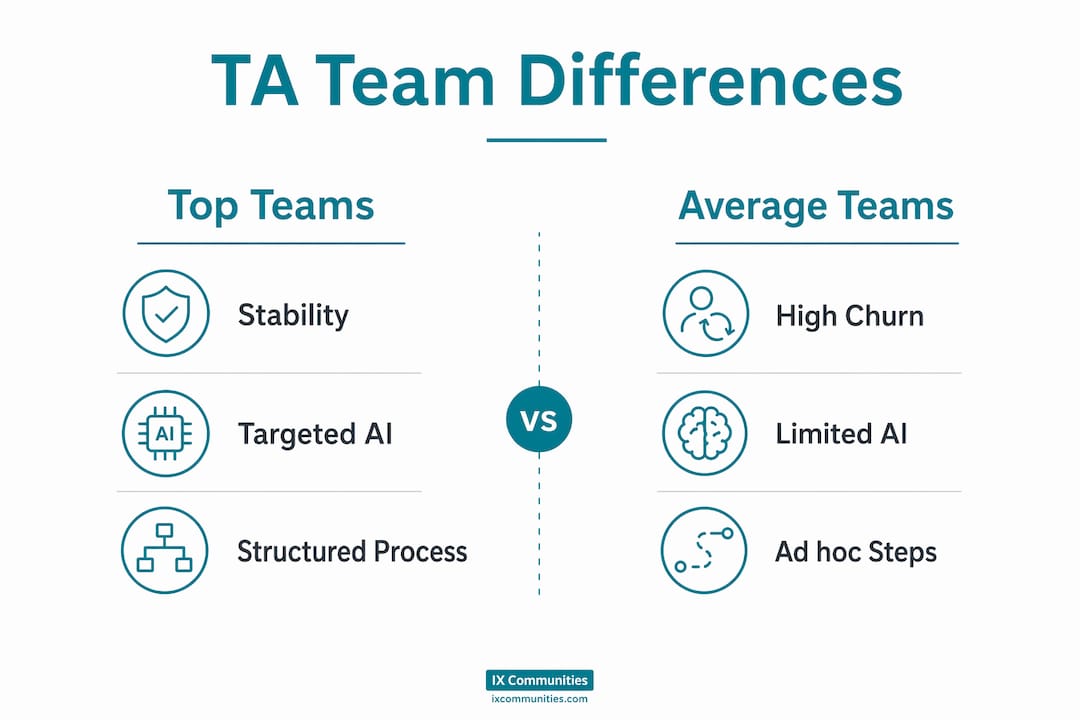
The distinction between discovery tasks and trust tasks is critical. AI performs well at surfacing candidate signals, screening resumes at scale, and scheduling coordination. It performs poorly, and creates legal and ethical risk, when used to make final hiring decisions. Top teams avoid replacing human judgment with AI on decisions that carry accountability, such as offer approvals or candidate rejections.
| Task type | AI role | Human role |
|---|---|---|
| Resume screening | Initial signal surfacing | Final shortlist review |
| Interview scheduling | Automated coordination | Candidate relationship management |
| Hiring analytics | Data aggregation and trend reporting | Interpretation and decision-making |
| Final hiring decision | Not applicable | Full human accountability |
Risks of overreliance on AI include:
- Amplifying existing bias in historical hiring data
- Reducing candidate experience quality when automation replaces human touchpoints
- Creating legal exposure when AI influences protected-class hiring decisions
- Eroding recruiter skill development by removing judgment-building tasks
Pro Tip: Map every step of your hiring process and label each one as either a "discovery task" or a "trust task." Apply AI only to discovery tasks. Protect trust tasks for human decision-makers. For a grounded view of where AI actually delivers value, the analysis of AI in recruiting is worth reviewing before committing to new tools.
Why quality of hire now outranks speed as the primary metric
Quality of hire has surpassed speed as the defining success metric for talent acquisition leaders in 2026. 66% of employees who leave jobs attribute their departure to a mismatch between role expectations set during hiring and the reality of the job. Early attrition is now treated as a recruitment failure, not a management problem. That shift in accountability changes how top teams design every stage of the hiring process.
Structured interviews are the most direct tool for improving hire quality. Structured interviews are twice as predictive of job performance compared to unstructured ones, and they reduce mis-hires by 30–40%. The consistency of structured formats also reduces interviewer bias, which compounds the accuracy benefit over time. Teams that still rely on conversational, unstructured interviews are leaving significant predictive accuracy on the table.
Candidate experience is a commercial factor, not just a courtesy. 86% of candidates report that a negative interview experience worsens their perception of the company. That perception affects offer acceptance rates, referral behavior, and employer brand in talent markets where word spreads quickly. Top teams measure candidate experience at each stage and treat declining scores as early indicators of process failure.
The shift from volume processing to fit assessment shows up in how top teams use realistic job previews. Giving candidates an accurate picture of the role before they accept reduces the expectation gap that drives early attrition. This practice requires more upfront investment in job design and recruiter preparation, but it pays back in retention and reduced rehiring costs. Understanding why hiring is getting harder in the current market makes the case for this investment even clearer.
Metrics that top teams track alongside quality of hire include:
- 90-day retention rate as a direct indicator of hire accuracy
- Offer acceptance rate as a signal of candidate experience quality
- Hiring manager satisfaction scores collected 60–90 days post-hire
- Early attrition rate segmented by role type and sourcing channel
How do top teams separate sourcing for critical roles versus volume roles?
Separating top-talent hiring from high-volume hiring is one of the most operationally significant practices that distinguishes high-performing teams. Conflating the two creates a structural problem: the KPIs, cycle times, and evaluation criteria appropriate for volume roles actively degrade the quality of critical hires when applied uniformly. Top teams build distinct workflows, assign separate ownership, and measure success differently for each motion.
The operational design for critical roles follows a different sequence:
- Build the candidate list before the role opens. Top teams maintain continuously updated lists of potential candidates for high-impact positions. When a role becomes active, the sourcing work is already done.
- Apply forensic interviewing methods. Critical hires require structured, evidence-based interviews that probe specific past behaviors and outcomes. Generic competency questions do not produce the signal quality needed for senior or high-impact roles.
- Capture interview notes automatically and systematically. Hiring processes lose approximately 60% of interview signal when teams rely on memory alone. Structured note capture, whether through interview scorecards or dedicated tools, grounds decisions in documented evidence rather than recall.
- Assign hiring manager accountability for closing. Hiring managers must engage early and actively to sell the role to top candidates. Recruiters coordinate the process, but leadership closes the candidate. Passive hiring manager involvement is a consistent failure point in critical role searches.
- Set distinct cycle time expectations. Volume roles benefit from speed. Critical roles benefit from thoroughness. Applying the same time-to-fill target to both creates pressure that compromises evaluation quality for senior positions.
For high-volume roles, proactive candidate communities change the economics of sourcing entirely. Proactive candidate communities cut time-to-fill by 40% for high-volume roles by engaging passive candidates before roles open. Given that 70% of the workforce is passive but open to engagement, warm talent pools consistently outperform static databases in both speed and conversion rate.
Key Takeaways
High-performing talent acquisition teams outperform peers by combining stable organizational structures, targeted AI use, and a consistent focus on hire quality over hiring speed.
| Point | Details |
|---|---|
| Stability over headcount growth | Top teams reorganize roles rather than adding staff, maintaining process continuity and clear ownership. |
| AI for discovery, not decisions | Use AI in analytics and scheduling; keep final hiring decisions fully human-led to manage risk and accountability. |
| Quality of hire as the primary metric | Structured interviews and realistic job previews reduce early attrition and improve long-term retention rates. |
| Separate sourcing motions by role type | Apply distinct workflows, KPIs, and cycle times to critical hires versus high-volume roles to protect evaluation quality. |
| Proactive candidate pipelines | Building talent pools before roles open cuts time-to-fill and improves candidate quality for volume hiring. |
What I've learned about building TA teams that actually last
The teams I've seen sustain high performance over multiple years share one trait that rarely appears in benchmarking reports: they treat process design as a recurring discipline, not a one-time project. Most teams build a hiring process once and then defend it. Top teams revisit it quarterly, asking whether the current workflow still produces the decision quality they need.
The AI conversation is where I see the most confusion right now. Leaders either avoid AI entirely out of caution or adopt it broadly without mapping which tasks it actually improves. The teams getting real value from AI are the ones who started by documenting their existing process, identified the steps that consumed the most time with the least judgment required, and applied AI there first. That is a workflow design exercise, not a technology procurement exercise.
The quality-over-speed shift is real, but it requires a harder internal conversation than most leaders expect. Hiring managers have been conditioned to measure recruiting by time-to-fill. Changing that expectation means presenting data on early attrition costs and mis-hire rates in business terms, not HR terms. When a talent acquisition leader can show that a 30-day longer process reduced 90-day attrition by a measurable amount, the conversation about speed versus quality changes quickly.
The most durable lesson is that sustainable high performance in talent acquisition comes from systems, not from individual effort. Teams that depend on a few exceptional recruiters to carry the function are one resignation away from a performance crisis. The goal is to build workflows that distribute the cognitive load, capture institutional knowledge, and produce consistent outcomes regardless of who is running the process on any given day.
— Simon
Ixcommunities resources for talent acquisition leaders
Ixcommunities connects talent acquisition leaders at mid to large corporations with the peer networks, benchmarking data, and mentorship programs that support the practices described in this article.
The ESIX Recruiter Peer Mentorship Program gives recruiting professionals structured access to experienced peers who have navigated the same operational and strategic challenges. For senior leaders, the Talent Leaders Peer Mentoring Program provides a confidential forum to benchmark practices, share what is working, and pressure-test decisions with peers from comparable organizations. Both programs are built for the specific context of large corporate talent functions, where generic HR advice rarely applies.
FAQ
What makes a talent acquisition team high-performing?
High-performing talent acquisition teams combine stable organizational structures, evidence-based hiring processes, and targeted AI use to produce consistent quality of hire. They prioritize decision quality over speed and measure success through retention and hiring manager satisfaction rather than time-to-fill alone.
How do top TA teams use AI in recruiting?
Top teams apply AI to high-volume, lower-risk tasks such as resume screening, interview scheduling, and hiring analytics. Final hiring decisions remain human-led to maintain accountability and avoid legal and ethical risk.
Why is quality of hire more important than time-to-fill?
66% of employees who leave jobs cite a mismatch between hiring expectations and job reality as the cause. Early attrition is a direct cost of poor hire quality, making retention a more accurate measure of recruiting effectiveness than speed.
How should TA teams handle critical hires differently from volume roles?
Critical roles require forensic interviewing, continuous candidate list building, structured note capture, and active hiring manager involvement in closing. Volume roles benefit from proactive talent communities and faster processing cycles with distinct KPIs.
What is the biggest operational mistake TA teams make?
The most common mistake is applying the same workflow, metrics, and cycle time expectations to both critical and high-volume roles. Conflating these two hiring motions degrades evaluation quality for senior positions and creates pressure that undermines the accuracy of high-impact hiring decisions.