

Understanding how AI is changing talent acquisition is no longer optional for HR leaders. The real challenge is separating genuine capability from vendor promises. Most TA teams have purchased at least one AI tool, but producing measurable results at scale is a different matter entirely. This article gives you a clear, evidence-based account of what AI actually does well in recruiting today, where it falls short, what compliance requirements demand your attention, and how to build an AI recruitment strategy that holds up under scrutiny.
Table of Contents
- Key takeaways
- How AI is changing talent acquisition: adoption vs. reality
- Where AI actually delivers in recruiting workflows
- Legal, compliance, and ethical requirements
- Implementing AI responsibly in talent acquisition
- What the future of AI in talent acquisition actually looks like
- My perspective on separating hype from reality
- How Ixcommunities supports AI-ready talent acquisition teams
- FAQ
Key takeaways
| Point | Details |
|---|---|
| Adoption outpaces scale | Most TA teams have AI tools deployed, but fewer than half run them across most requisitions. |
| Scheduling and sourcing lead | AI delivers the most consistent results in repetitive, early-stage tasks like scheduling and candidate communications. |
| Integration is the real bottleneck | ATS write-back failures drive the majority of AI vendor switches, not feature gaps. |
| Compliance is non-negotiable | EU AI Act and ADA requirements create real legal exposure for AI-driven hiring tools used without proper governance. |
| Human oversight stays central | AI supports recruiter decisions; it does not replace them, especially for soft skills and nontraditional backgrounds. |
How AI is changing talent acquisition: adoption vs. reality
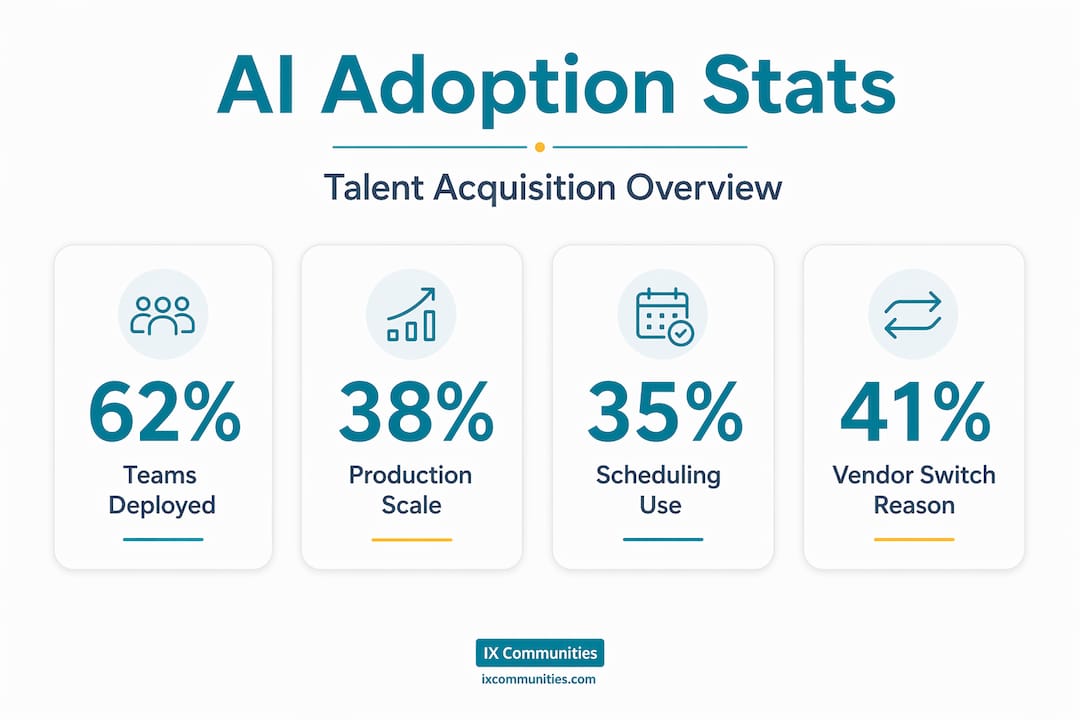
The broad claim that AI has transformed recruiting deserves scrutiny. 62% of TA teams have deployed at least one AI recruiting tool, yet only 38% have it running at scale across most requisitions. That gap between purchase and production tells you more about the real state of AI in talent acquisition than any vendor demo ever will.
What does this look like in practice? A large financial services firm buys an AI sourcing platform with strong performance benchmarks. Eighteen months later, the tool runs on fewer than a quarter of open roles because it never fully synced with the ATS. The team defaults to manual workflows for high-volume positions, and the tool gets used mainly for executive searches where a recruiter has time to manage the integration manually.
This is not an isolated case. ATS write-back integration failures are the single largest cause of AI recruiting vendor switches, accounting for 41% of platform changes. Vendors routinely overstate how clean their integrations are. Budget then gets reallocated toward categories where AI has demonstrated consistent, measurable returns.
Pro Tip: Ask vendors to demonstrate a live ATS write-back in your specific environment before signing any contract. If they cannot show it working in a sandbox with your stack, treat that as a red flag, not a feature gap to be resolved post-signature.
Scheduling automation leads AI adoption at 35% full production use, outpacing video screening and voice AI. This reflects where AI actually delivers reliable ROI: tasks that are repetitive, rule-based, and disconnected from nuanced human judgment.
| Category | Production-scale use | Common challenge |
|---|---|---|
| Scheduling automation | 35% | Low; mature integrations available |
| Resume screening | ~25% | Bias risk; requires regular auditing |
| Candidate communications | ~22% | Consistency across ATS platforms |
| Video and voice screening | Below 15% | Bias concerns; candidate experience complaints |
Where AI actually delivers in recruiting workflows
The real benefits of AI in recruiting are concentrated in early-stage, process-heavy work. Interview scheduling, job posting, and initial candidate communications are where AI frees recruiter time reliably. These are not glamorous use cases, but they are meaningful ones. A recruiter who is not spending 40% of their week on scheduling logistics can spend that time on stakeholder management, candidate relationship-building, and assessing cultural fit.

Chatbots and automated status updates also improve candidate experience in measurable ways. Candidates who receive timely, consistent communication are less likely to drop out of the process and more likely to accept offers. AI tools handle this at scale without requiring recruiter intervention for every touchpoint.
The myths about AI in talent acquisition tend to cluster around capability overreach. Here is where those myths break down:
- AI does not reliably assess soft skills. Behavioral interview scoring and cultural fit predictions remain areas where AI tools generate more noise than signal.
- AI struggles with nontraditional backgrounds. Candidates who have career gaps, lateral moves, or non-linear paths are frequently misscored by models trained on historical hiring data that reflects prior biases.
- AI accelerates repetitive tasks but does not replace human decisions. The ROI case for AI in recruiting is strongest when framed around giving recruiters more time, not reducing recruiter headcount.
- Over-automation creates candidate attrition. Processes that feel entirely automated, with no human touchpoint until the final stages, generate candidate complaints and reduce offer acceptance rates in competitive talent markets.
Pro Tip: Map your recruiting workflow and identify the three tasks that consume the most recruiter time without requiring judgment. Those are your highest-value AI targets. Everything else should wait until integration is proven.
You can find more detail on the specific gaps in AI recruiting tools in a related analysis covering executive search contexts, where these limitations are even more pronounced.
Legal, compliance, and ethical requirements
This is the area where many TA teams are genuinely underprepared. The truths about AI in hiring include significant legal exposure that vendor sales cycles rarely surface clearly.
The ADA requires employers to provide accommodations in AI-driven assessments and validate that those tools do not screen out qualified disabled applicants by measuring impaired sensory abilities rather than actual job-relevant skills. That is not a theoretical concern. If your video interview AI flags speech patterns associated with certain disabilities as negative indicators, you may be running an unlawful hiring process regardless of whether that was the vendor's intention.
The EU AI Act classifies employment AI as high-risk, with strict provider and deployer duties taking effect in August 2026. Organizations deploying these tools must maintain technical documentation, conduct conformity assessments, and implement human oversight at every decision point. AI literacy is also a legal requirement under the EU AI Act. HR teams operating in Europe or managing European candidates must train staff on AI risks and oversight responsibilities, not as a best practice, but as a compliance obligation.
Avoiding black-box AI systems is not just an ethical preference. Transparency and auditability are now central to managing both legal and operational risk in AI hiring. A vendor that cannot explain how their scoring model works or provide bias audit documentation should not be in your process.
Here is a structured approach to compliance readiness:
- Audit all current AI tools against ADA accommodations requirements and document vendor responses.
- Identify which tools qualify as high-risk under the EU AI Act and confirm conformity documentation is in place.
- Build a multidisciplinary governance team that includes HR, legal, IT, and cybersecurity stakeholders.
- Require vendors to provide bias testing results from datasets comparable to your candidate population.
- Establish a regular audit schedule for AI-generated decisions with a documented human review process.
Non-compliance creates compounding risk. Regulatory penalties are only part of the exposure. Candidate trust, employer brand reputation, and internal employee relations are all affected when AI-driven discrimination becomes visible.
Implementing AI responsibly in talent acquisition
Responsible implementation of AI tools for talent acquisition starts before you sign a contract. The practices below reflect what separates teams that achieve production-scale results from those stuck in perpetual pilot mode.
- Sandbox test ATS integrations before purchase. Pre-sign sandbox testing is the highest-leverage step to prevent operational failure. Test ATS write-back in your exact environment with realistic data volumes.
- Use a risk-based governance framework. The NIST AI Risk Management Framework provides a structured baseline covering fairness, transparency, privacy, and continuous monitoring. Applying it to every AI tool you evaluate creates a consistent standard across vendors.
- Train recruiters before deployment, not after. AI literacy requirements are real, both legally and operationally. Recruiters who do not understand what an AI tool is doing will either over-rely on it or ignore it entirely.
- Audit training datasets regularly. Historical hiring data embeds historical bias. A model trained on five years of hiring decisions from a homogeneous workforce will replicate that pattern unless corrected actively.
- Pilot with defined metrics and control groups. Track time-to-fill, candidate drop-off rate, offer acceptance rate, and quality-of-hire for roles processed with AI tools versus roles processed without them. Anecdote is not measurement.
- Validate accessibility compliance proactively. AI assessment tools must be evaluated for whether they create barriers for disabled applicants. Waiting for a complaint is not a governance strategy.
Guidance on recruiter training for AI tools covers the specific skill gaps most corporate TA teams need to address before scaling deployment.
Pro Tip: Build your AI governance team before you buy your next tool, not after you discover a compliance problem. HR, legal, IT, and cybersecurity should all review vendor contracts and technical documentation together.
What the future of AI in talent acquisition actually looks like
The future of AI in talent acquisition will be defined by consolidation and accountability, not expanded automation. Here is what TA leaders should plan for:
- AI will consolidate into categories with proven integration records. Scheduling, sourcing, and candidate communications will continue to scale. Speculative capabilities like AI-driven personality assessment are likely to shrink under regulatory pressure.
- Human-AI partnership is the operating model, not full automation. The organizations achieving results are those where AI handles process and humans handle judgment.
- Compliance requirements will increase. Organizations operating in multiple jurisdictions should expect AI governance obligations to expand, not contract, over the next three to five years.
- AI insights will extend into retention and development. Once hiring data is structured consistently, organizations can use it to identify patterns in early attrition, career progression, and skills gaps.
- Continuous monitoring is not optional. AI models drift over time as candidate populations, job requirements, and labor markets shift. Scheduled revalidation should be built into every AI tool contract and governance plan.
My perspective on separating hype from reality
I have worked with talent acquisition leaders long enough to recognize a consistent pattern in how AI adoption goes wrong. The tool gets purchased because a vendor presentation was compelling. Integration details get treated as a post-sales problem. Then six months later, the team is managing two workflows instead of one, the ROI case falls apart, and someone is on the phone with legal trying to understand what the platform actually did with candidate data.
The underrated success factor in every AI implementation I have seen work is integration. Not features, not the model architecture, not the benchmark data in the sales deck. Whether the tool connects reliably to your existing ATS determines whether it ever runs at production scale.
Compliance is the other area where I see persistent underestimation. Most TA teams treat it as a legal department problem rather than an operational one. That approach fails the moment a disabled candidate files a complaint or an EU regulator asks for conformity documentation. Transparency is not a competitive advantage in AI hiring. It is the baseline requirement.
My honest recommendation: approach AI with specific objectives, test integration before purchase, build governance before deployment, and measure impact with real controls. The reality of AI in executive recruiting confirms that most teams overestimate what AI will do in year one and underestimate what is required to sustain it in year two.
— Simon
How Ixcommunities supports AI-ready talent acquisition teams
Ixcommunities provides corporate TA and HR leaders with the peer networks, benchmarking data, and structured knowledge sharing needed to navigate AI adoption with confidence. Through ESIX peer mentorship programs, recruiting professionals connect with peers who have already worked through AI integration challenges, compliance reviews, and governance frameworks in large corporate environments.
Ixcommunities membership includes access to updated guidance on AI governance, compliance shifts, and practical implementation resources. The Community Connection program brings TA leaders together around the specific operational and regulatory challenges AI creates. Benchmark surveys provide data on AI adoption rates, tool effectiveness, and where peer organizations are investing, giving your team a reliable reference point for evaluating your own strategy.
FAQ
What percentage of TA teams use AI at scale?
Only 38% of TA teams run AI tools at production scale across most requisitions, even though 62% have deployed at least one AI recruiting tool.
What is the most common reason companies switch AI recruiting vendors?
ATS integration failures are the leading cause, accounting for 41% of AI recruiting vendor switches. Testing integrations in a sandbox before purchase significantly reduces this risk.
Does AI in hiring need to comply with disability discrimination law?
Yes. The ADA requires employers using AI in hiring to provide reasonable accommodations and confirm that assessment tools do not screen out qualified disabled candidates by measuring irrelevant impaired abilities.
What does the EU AI Act require for recruiting AI tools?
The EU AI Act classifies employment AI as high-risk, requiring conformity documentation, human oversight, and mandatory AI literacy training for staff. These obligations apply starting August 2026.
Can AI replace recruiter judgment in hiring decisions?
No. AI tools for talent acquisition are designed to accelerate repetitive process tasks, not substitute for human judgment in candidate evaluation. Soft skills, cultural fit, and nontraditional career paths still require direct human assessment.