

Almost 84% of talent leaders plan to expand AI use in 2026, yet the overwhelming majority of HR organizations report that their AI tools have not produced meaningful business results. That gap is not a technology problem. It is an implementation, governance, and expectation problem. This article examines where AI is genuinely being used in executive recruiting, where it is not delivering despite being deployed, and what talent acquisition leaders in large corporations need to know to close the distance between investment and impact.
Table of Contents
- AI adoption in executive recruiting: Hype and headline numbers
- Behind the numbers: Why value realization lags adoption
- Where AI delivers: Real-world use cases and quantifiable impact
- The nuance: Limitations, edge cases, and human essentials
- Strategies for making AI deliver: Leadership best practices
- Why chasing more AI isn't the answer for executive recruiting
- Accelerate real progress in executive recruiting with IX Communities
- Frequently asked questions
Key Takeaways
| Point | Details |
|---|---|
| Widespread AI adoption | AI is present across almost all executive recruiting teams—but this doesn’t guarantee transformative results. |
| Value gap remains | Most leaders see little meaningful return from their AI investments due to integration and trust issues. |
| Strongest in early stages | AI delivers greatest value in mapping, sourcing, and efficiency, but falls short in nuanced executive assessments. |
| Human judgment still necessary | Critical activities like executive fit and candidate authenticity require human insight and oversight. |
| Focus on hybrid strategies | Leaders get most from AI by combining it with governance, transparency, and upskilled recruiters. |
AI adoption in executive recruiting: Hype and headline numbers
Many organizations claim AI is everywhere. The data appears to support that claim at first glance. However, looking more closely at what that really means for executive recruiting reveals a more complicated picture.
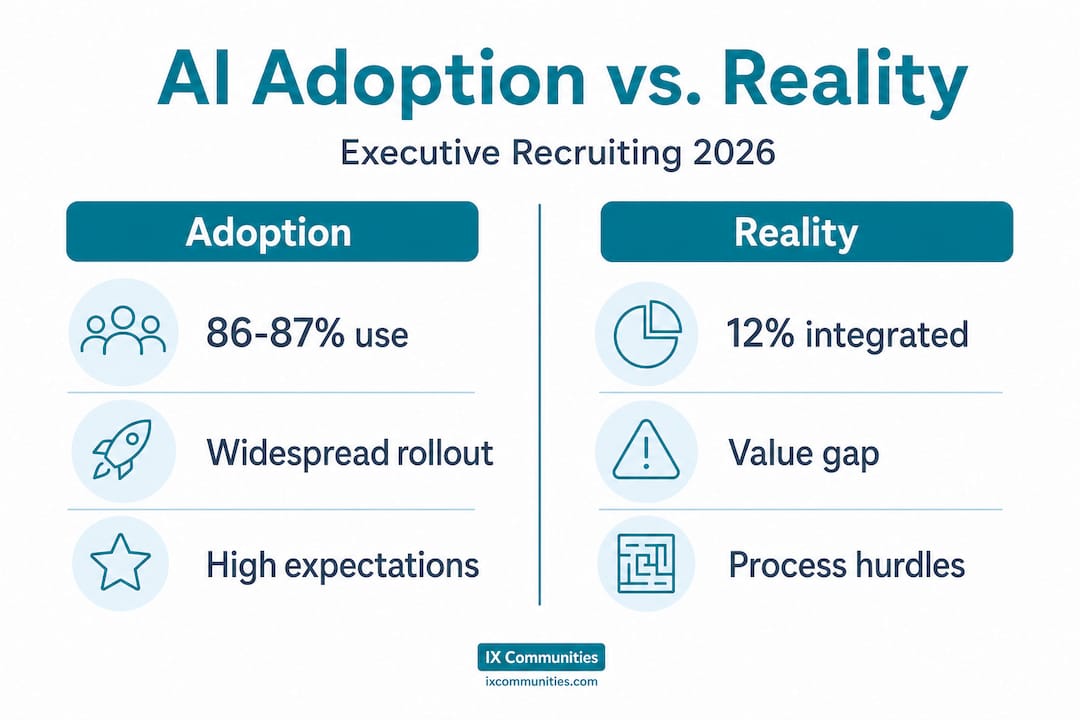
According to iCIMS and Aptitude Research, 86% of companies report using AI in some capacity, and the HR Research Institute places that number even higher, at 87% of companies using AI in hiring. On the surface, these numbers suggest broad transformation. In practice, they often represent something far more limited: a few AI-powered features switched on inside an existing ATS, a resume screening plugin, or an experimental chatbot for candidate FAQs.
The distinction between experimenting with AI and fully integrating it into executive recruiting workflows is significant. Experimentation means a tool has been purchased and occasionally accessed. Integration means AI is embedded in how recruiters find, evaluate, and recommend executive candidates every day. For the majority of organizations in the large corporate segment, the reality sits much closer to experimentation.
| AI adoption status | Percentage of companies |
|---|---|
| Using AI in some capacity | 86-87% |
| Fully integrating AI into workflows | Minority of adopters |
| Planning expanded AI use in 2026 | 84% |
| Reporting significant business value | 12% |
Executive search operates in a narrower, higher-stakes environment than high-volume recruiting. The candidate pools are smaller, the organizational impact of each hire is greater, and the nuances of fit matter enormously. AI tools designed primarily for volume recruiting do not automatically transfer their advantages to the executive level. Understanding that distinction is the first step toward making better decisions about where to invest and where to hold back.
As explored in analysis of AI transforming executive search, the tools showing the most traction are those narrowly focused on research acceleration and data aggregation, not broad-spectrum transformation of the entire search lifecycle.
Behind the numbers: Why value realization lags adoption
For all the investment and vendor promises, most talent leaders feel short-changed. The numbers confirm this clearly.

A Gartner 2025 survey found that 88% of HR leaders report no significant business value from AI tools, 47% say their AI implementations have failed to meet expectations, and only 23% believe vendors delivered on their stated promises. These figures are not outliers. They reflect a systemic pattern across industries and company sizes.
The reasons behind this gap are practical, not theoretical. The most common friction points include:
- Integration timelines: Vendors promise 90-day implementations. Real-world integrations regularly take 8 to 14 months, delaying any measurable return.
- Governance gaps: Many organizations deploy AI tools without clear policies for how outputs should be reviewed, challenged, or overridden by human recruiters.
- Trust deficits: When recruiters do not understand how an AI system reached a recommendation, they frequently bypass or ignore it, rendering the tool functionally unused.
- Data quality issues: AI systems are only as good as the data fed to them. Inconsistent job descriptions, poorly structured candidate records, and legacy ATS data produce unreliable AI outputs.
- Bias and compliance risk: Without proper auditing, AI tools can reinforce historical hiring patterns that create legal exposure, particularly in executive-level roles subject to board and regulatory scrutiny.
A critical insight that is often missed: AI is being deployed but not always used. Tools get purchased at the enterprise level and made available to recruiting teams. But when those teams do not trust the recommendations, or when the interface adds steps rather than removing them, adoption at the user level stays low. The system looks active on a dashboard while remaining practically dormant in daily work.
Pro Tip: Before purchasing any new AI recruiting tool, audit how your existing AI features are actually being used by individual recruiters. Unused features are a clearer signal than adoption rates reported by vendors.
The issues that talent leaders overlook with AI often come down to process design rather than tool selection. And the gaps in AI recruiting that persist across organizations are almost always organizational rather than technological.
Where AI delivers: Real-world use cases and quantifiable impact
Despite the challenges, AI does produce genuine operational improvements in specific, well-defined applications. The key is knowing which problems AI is actually suited to solve.
Research from JM Search and SearchWide identifies the core use cases where AI delivers in executive recruiting:
- Market intelligence and talent mapping: AI tools can scan public data, company databases, and professional networks to identify executive-level talent in target organizations. This work, which previously took researchers days, can be completed in hours.
- Resume synthesis and pattern recognition: AI can process hundreds of executive profiles quickly, flagging candidates who match a defined scorecard and surfacing patterns across large candidate pools.
- Scorecard and assessment support: Structured scoring tools powered by AI reduce inconsistency in how candidates are evaluated against job criteria, increasing comparability across a slate.
- First-pass screening automation: For roles that receive large volumes of applications, AI handles initial screening efficiently, freeing senior recruiters to focus on assessment and relationship management.
The research estimates that AI reduces research time in executive search by 60 to 80% in the early stages of a search. That is a genuine and significant gain.
On timelines, data from Josh Bersin shows a 15 to 25% improvement in time-to-fill for roles where AI is embedded effectively, and a 66% reduction in time-to-interview in some organizations. These are meaningful numbers when multiplied across dozens of executive searches per year.
"AI handles the volume and velocity of early-stage research better than any team of humans. But the judgment calls that matter in executive search, the ones about leadership presence, organizational culture, and long-term executive potential, these remain distinctly human." — SearchWide Global
However, the integration caveat matters. Those time savings often do not arrive on the schedule organizations expect. Integration timelines of 8 to 14 months versus the 90 days vendors promise represent a real cost in delayed ROI, recruiter frustration, and organizational disruption.
Pro Tip: Prioritize AI tools that connect directly with your existing ATS rather than those requiring standalone platforms. The fewer integration steps, the faster you reach usable data and measurable results.
For a detailed look at where changes in AI executive search are showing up in daily practice, the patterns are consistent: early-stage research gains are strong, while late-stage decision quality remains human-dependent.
The nuance: Limitations, edge cases, and human essentials
Not every problem is solved by AI in executive search. Some challenges are made more complicated by it.
The most significant limitation is the one that matters most at the executive level: AI cannot reliably assess cultural fit, leadership chemistry, or organizational readiness. These dimensions require context that is relational and interpretive. No training dataset captures the difference between a leader who can manage through a company's specific moment of change and one who simply matches a job description.
Passive executive candidates present another fundamental challenge. Senior leaders who are not actively seeking new roles are rarely found through standard AI sourcing methods. They require human relationship networks, trusted referrals, and outreach built on reputation. AI tools have limited reach into this segment, which constitutes a large portion of the most attractive executive candidates.
Key limitations and risks organizations face include:
- Explainability gaps: When AI cannot explain why it ranked a candidate highly, recruiters and hiring committees cannot trust or validate the recommendation. This is particularly problematic in executive search, where decisions face board-level scrutiny.
- Data leaks and security exposure: 79% of organizations report facing significant AI-related challenges, and 67% have experienced data leaks linked to AI tool usage. In executive search, where candidate confidentiality is paramount, this risk is especially serious.
- AI-generated fraud: Korn Ferry research projects that 25% of resumes will be substantially AI-generated by 2028, with some falsified entirely. Without human verification processes, AI screening tools can be systematically deceived at scale.
- Bias amplification: Without explainable AI (XAI) frameworks, AI tools can reinforce patterns from historical data that reflect past biases rather than future leadership potential.
"Organizations that deploy AI without governance frameworks are not moving faster. They are accumulating risk faster." — Korn Ferry Talent Acquisition Research
Addressing these issues requires deliberate AI governance strategies built before tools are deployed, not retrofitted after problems emerge. Equally important is establishing standards for candidate authenticity in AI driven processes, particularly at the executive level where stakes and scrutiny are highest.
Strategies for making AI deliver: Leadership best practices
If AI alone is not the answer, how do forward-thinking leaders make it work in real conditions?
The most effective approach is not to chase the broadest AI adoption but to focus investment where evidence of return exists. HR Chief's 2025 analysis of talent acquisition practices recommends that leaders prioritize ATS-integrated AI, invest in governance infrastructure, and adopt hybrid human-AI models, particularly for senior and executive roles where human judgment cannot be fully delegated to automation.
A practical framework for talent acquisition leaders includes:
- Audit current AI usage at the recruiter level. Identify which tools are actively used versus technically available. Close that gap before purchasing additional capabilities.
- Define success metrics before deployment. Time-to-fill, time-to-interview, and cost-per-hire are measurable. Vague "transformation" goals are not. Require vendors to tie claims to these metrics.
- Build governance before scaling. Establish clear policies covering how AI outputs are reviewed, how bias is audited, and how candidate data is protected. These policies need to exist before a tool goes live.
- Invest in recruiter upskilling. Recruiters who understand how AI tools work are more likely to use them effectively and to catch errors. Upskilling is an ROI multiplier.
- Keep humans accountable for executive decisions. AI can inform and support, but the final recommendation for an executive placement should involve human judgment, documented and defensible.
- Start with one high-impact use case. Talent mapping or market intelligence are strong starting points. Prove value there before expanding to candidate assessment or predictive analytics.
The future skills every executive recruiter needs now include the ability to critically evaluate AI outputs, not just accept them. Organizations that invest in that capability will extract more value from the same tools than those that treat AI as a passive resource.
Why chasing more AI isn't the answer for executive recruiting
The conversation in most leadership circles defaults to the same question: which AI tool should we add next? That may be the wrong question.
Josh Bersin's research indicates that only 37% of talent professionals trust AI for candidate selection, and 79% want greater transparency into how AI-driven recommendations are made. These numbers describe a workforce that is skeptical, not resistant. Recruiters are willing to use AI when they understand it and when it demonstrably helps. They bypass it when it does not.
The organizations seeing the most consistent improvement from AI are not those with the most sophisticated tools. They are organizations that have done the slower, less visible work of aligning their AI investments with defined process improvements, training their teams to work alongside AI rather than hand off decisions to it, and measuring actual outcomes rather than reporting adoption percentages.
Most teams overestimate AI's power to transform executive recruiting in a single deployment cycle. They undervalue the incremental gains that come from careful, well-governed implementation of one or two tools that genuinely fit their current workflows. The compounding effect of reliable incremental improvement over 18 to 24 months consistently outperforms the disruption cost of rushing to implement broad AI transformation.
Human expertise in executive search is not a temporary limitation waiting for technology to catch up. It is a structural feature of how executive talent is identified, evaluated, and retained. The recruiters and talent leaders who treat what's changing with AI as a set of specific tools to integrate thoughtfully, rather than a wholesale replacement of existing judgment, are the ones building sustainable competitive advantage.
Accelerate real progress in executive recruiting with IX Communities
The gap between AI adoption and AI impact is real, and the leaders closing that gap are not doing it alone. They are learning from peers who have navigated the same implementation challenges, governance gaps, and vendor promises.
IX Communities, through ESIX and TLIX, gives talent acquisition leaders in large corporations direct access to the resources that matter. Explore benchmark surveys built on real-world data from organizations like yours, connect with experienced colleagues through the peer mentoring program designed specifically for senior talent leaders, and join a network focused on practical, accountable progress in executive recruiting. IX Communities membership provides a secure environment where you can share candidly, benchmark honestly, and build strategies grounded in evidence rather than vendor claims.
Frequently asked questions
How common is AI adoption in executive recruiting today?
AI is used by 86 to 87% of companies in some capacity within hiring processes, with nearly all talent leaders planning further AI integration by 2026. However, full workflow integration remains limited, particularly in executive search.
Is AI delivering real business value in executive search?
Despite widespread use, 88% of HR leaders report no significant business value from AI tools in recruiting, indicating a major gap between adoption and impact.
Where does AI provide the most benefit in executive recruiting?
AI is most effective for market intelligence, talent mapping, and automated resume review, where it reduces research time by 60 to 80%. Human expertise remains essential for cultural fit assessments and reference validation at the executive level.
What risks come with AI in executive search?
Key risks include integration delays, data leaks reported by 67% of organizations, trust and bias issues, and a projected rise in AI-generated fraudulent resumes reaching 25% by 2028, all requiring active governance.
How should leaders maximize AI returns in executive recruiting?
Leaders should prioritize ATS-integrated AI, establish governance frameworks before deployment, invest in recruiter upskilling, and focus on measurable ROI metrics such as time-to-fill rather than broad transformation claims.