

Most HR professionals already know that talent acquisition is "more than recruiting." But knowing it and practicing it as a distinct discipline are two different things. What is talent acquisition, really? At its core, it is a proactive, strategy-driven function that connects workforce planning to long-term business goals. It goes well beyond filling open roles. This guide covers the full scope of talent acquisition: what it means, why it matters, how to build effective strategies, and how to measure progress. If you manage hiring at a corporate level, this is the foundation you need.
Table of Contents
- Key Takeaways
- What is talent acquisition and how it works
- Why talent acquisition matters as a business function
- Talent acquisition strategies and best practices
- Common challenges in talent acquisition
- Measuring and improving talent acquisition
- My perspective on talent acquisition as a strategic discipline
- Deepen your talent acquisition practice with Ixcommunities
- FAQ
Key Takeaways
| Point | Details |
|---|---|
| TA is not reactive hiring | Talent acquisition is a long-term function focused on pipeline building, not just filling open roles. |
| Strategic alignment is required | Effective talent acquisition connects workforce plans directly to business goals and financial planning. |
| Metrics beyond time-to-fill matter | Pass-through rates, quality of hire, and retention reveal more about TA health than speed alone. |
| Skills-first thinking expands pipelines | Moving beyond titles and degrees opens stronger candidate pools and reduces hiring risk. |
| Peer benchmarking accelerates improvement | Comparing practices with other corporate TA teams reveals gaps and proven approaches faster than internal review alone. |
What is talent acquisition and how it works
Talent acquisition is the function within an organization responsible for identifying, attracting, assessing, and hiring the right people to meet both current and future workforce needs. It is structured around workforce planning, not just vacancy management. That distinction shapes everything.
Where recruiting reacts to an open role and works to fill it, talent acquisition builds the conditions that make great hiring possible before the need is urgent. Think of it as the difference between showing up prepared versus showing up late. Hiring success requires treating talent acquisition as a core business function with long-term workforce intelligence, not a support task that activates when a manager raises a request.
The talent acquisition process covers several interconnected components:
- Workforce planning: Forecasting what roles, skills, and headcount the business will need at 6, 12, and 18 months out.
- Employer branding: Shaping how the organization is perceived as a place to work, well before candidates apply.
- Candidate pipeline building: Developing relationships with potential future hires before roles are posted publicly.
- Multi-channel sourcing: Using direct outreach, talent networks, referrals, job boards, and professional communities to reach qualified candidates.
- Assessment and selection: Evaluating candidates against role-specific criteria, including skills, competencies, and organizational fit.
- Onboarding integration: Connecting new hires to the organization's culture and expectations from day one.
The lifecycle does not end at the offer letter. Strong talent acquisition teams treat onboarding as part of the same process, because early attrition is often a symptom of a misaligned hiring decision upstream.
Why talent acquisition matters as a business function

The importance of talent acquisition becomes clear when you look at what happens without it. Organizations that treat hiring as purely operational consistently face reactive scrambles, misaligned hires, and budget overruns. Strategic talent acquisition shifts TA from a cost center to a growth enabler by aligning with business objectives. That is not a positioning statement. It is a structural shift in how hiring decisions get made.
Consider what the data shows. 63% of organizations prioritize developing critical talent sourcing strategies for 2026, reflecting how seriously HR leadership now views this function. And external forces are adding pressure. Geopolitics and talent matching challenges have shifted CPO focus to targeted job design, upskilling, and AI integration, which means talent acquisition is now operating in a more complex environment than it was even two years ago.
"Hiring success requires treating talent acquisition as a core business function with long-term workforce intelligence." — SkillPanel
The metrics that reflect this strategic role include:
- Quality of hire: Are new employees performing well and staying?
- Retention rates at 6 and 12 months: Are hires matching the role and culture expectations set during sourcing?
- Pass-through rates by stage: Where are candidates dropping out or being screened out disproportionately?
- Hiring plan accuracy: Are TA teams delivering the workforce the business planned for, on schedule?
One concept gaining traction in this space is the Talent Architect role. SHRM research defines these as recruiters who operate with a skills-first mindset, broadening candidate pools beyond degree requirements and job titles. Organizations using this approach consistently access deeper talent without lowering the bar for performance.
Talent acquisition strategies and best practices
Knowing what talent acquisition means is the starting point. Knowing how to build effective talent acquisition strategies is where real improvement happens. Here is a practical framework:
-
Build candidate pipelines proactively. Warm candidate pipelines built months before roles open separate high-performing TA teams from reactive ones. Start with passive outreach to target candidates in critical skill areas before a vacancy creates urgency.
-
Invest in employer brand. Candidates research companies before they apply. Your employer brand is your first screening tool. Inconsistent messaging between your careers page, social presence, and actual employee experience drives away qualified applicants before the first conversation.
-
Use multi-channel sourcing with purpose. Different roles require different channels. Executive and technical talent often respond to direct outreach rather than job board applications. Allocating channel spend based on role type is more efficient than a uniform posting strategy.
-
Involve stakeholders early. Effective TA requires close collaboration across HR, finance, and the C-suite to align workforce plans with business goals. When TA teams operate in isolation from financial planning cycles, they often hire reactively or approve headcount that no longer fits updated business priorities.
-
Adopt AI with defined use cases. 83% of global employers expect to scale AI adoption in workforce strategies within 6 to 12 months. The organizations doing this well are not automating the entire process. They are using AI for specific tasks: resume screening, interview scheduling, candidate communication, and market intelligence gathering. For a more grounded view of where AI actually delivers value, see how AI in executive recruiting compares adoption claims to real-world results.
-
Define success before you post a role. Hiring managers who cannot clearly articulate what success looks like in 90 days produce inconsistent hiring decisions. TA teams should facilitate this clarity, not just accept a job description as the brief.
Pro Tip: When building your annual talent acquisition plan, map each hiring priority to a specific business outcome. If you cannot connect a planned hire to revenue, risk reduction, or capability growth, that hire may not be ready to approve.
Common challenges in talent acquisition
Understanding what does talent acquisition mean in theory is easier than executing it under real organizational conditions. These are the most consistent obstacles corporate TA teams face:
-
Treating TA as a transactional function. Most recruiting strategies fail because organizations treat hiring as a tactical task rather than a strategic business function. When this happens, TA teams spend their time processing requisitions instead of shaping workforce strategy.
-
Candidate drop-off at mid-process stages. Many organizations lose strong candidates between the screening and the final interview stage. This is rarely a sourcing problem. It is a process design problem, often caused by slow scheduling, unclear communication, or too many interview rounds.
-
Hiring plan misalignment. When talent acquisition teams are not involved in annual planning cycles, they receive approved headcount requests that no longer reflect current business priorities. Late involvement means late adjustments, which compound into delays.
-
Underinvestment in TA infrastructure. Small TA teams managing high requisition volumes without adequate tools or workforce planning support cannot operate strategically. They default to reactive hiring because the workload leaves no time for pipeline building or market analysis.
-
Siloed data and limited visibility. Without clean tracking of candidate journeys, TA teams cannot identify where their process breaks down or which sources produce the highest quality hires.
Pro Tip: Conduct a quarterly pass-through audit by stage. If you are losing candidates at a specific step, treat it as a process problem, not a sourcing problem. Most mid-process drop-off is fixable without increasing your talent pool.
Measuring and improving talent acquisition
Knowing how to improve talent acquisition requires knowing what to measure. Time-to-fill is a useful operational metric, but it tells you very little about whether you hired the right person or whether your process is sound.
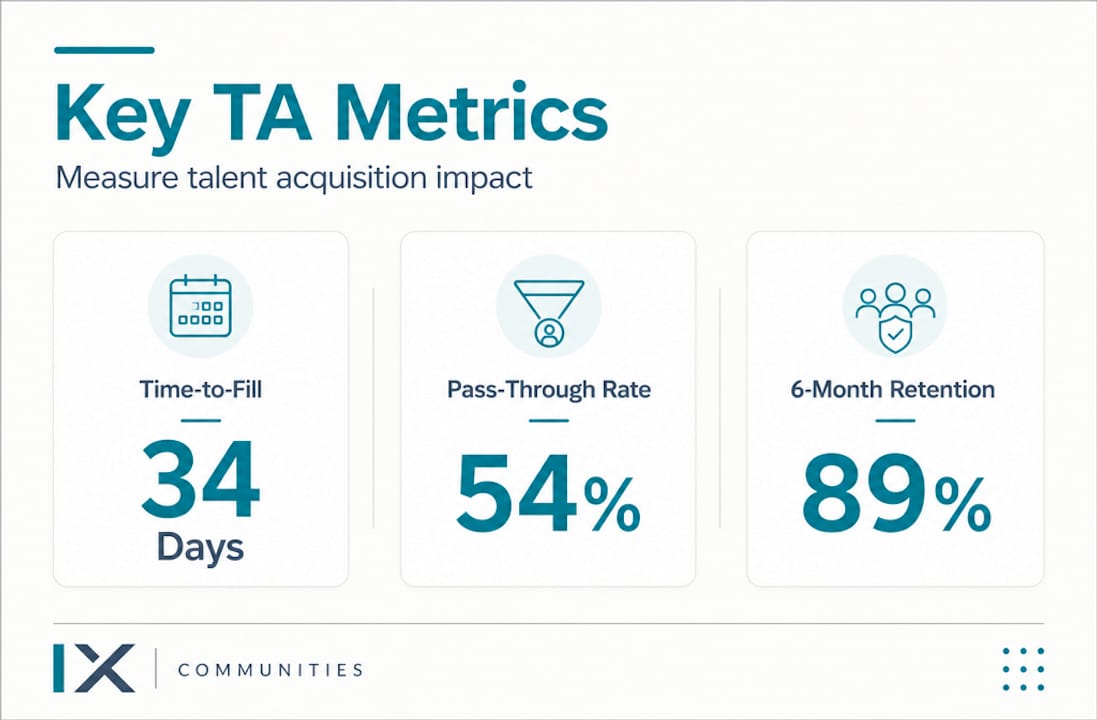
Pass-through hiring stage metrics identify bottlenecks better than simple time-to-fill measures. When you track the percentage of candidates advancing from each stage, patterns emerge quickly. A high drop-off at the phone screen stage signals sourcing or job description misalignment. A high drop-off at the final interview stage often signals a process or stakeholder issue.
| Metric | What it measures | Why it matters |
|---|---|---|
| Pass-through rate by stage | % of candidates advancing at each step | Pinpoints process bottlenecks |
| Quality of hire | Performance and retention of new hires | Validates sourcing and selection decisions |
| Hiring plan accuracy | Headcount delivered vs. planned | Measures TA's alignment to business goals |
| Time-to-fill by role tier | Speed from req open to offer accepted | Benchmarks operational efficiency |
| Candidate satisfaction score | Experience rating from applicants | Reflects employer brand and process quality |
For 5-stage hiring process timelines, best-practice design includes a rapid initial screen within 48 hours of application, structured interviews completed within one week, and offer delivery within days of final selection. Delays at any stage increase candidate drop-off significantly.
Pro Tip: Use market intelligence data from peer benchmarking to contextualize your internal metrics. A time-to-fill of 45 days may look slow internally but is average or even fast for your industry and role type. Context changes decisions.
My perspective on talent acquisition as a strategic discipline
I have observed many corporate talent acquisition functions over the years, and the pattern that repeats most consistently is this: organizations that invest in TA as a strategic function do not just hire faster. They hire with greater precision and face fewer costly mis-hires.
What I have found is that the most common gap is not sourcing capability or tool access. It is the absence of a genuine relationship between TA leadership and the business units they support. When TA sits downstream of decision-making, it becomes a fulfillment function. When it sits at the planning table, it becomes an asset.
The shift from process to intelligence in recruiting is real. The teams that get there first are not the ones with the most technology. They are the ones that built trust with finance and leadership early, and used that access to shape workforce plans rather than react to them.
My view is that talent acquisition professionals need fewer systems and more strategic positioning within their organizations. The tools exist. The access to data exists. What separates good from great is whether TA leadership has a seat in the conversation before the need becomes urgent.
— Simon
Deepen your talent acquisition practice with Ixcommunities
Ixcommunities provides talent acquisition and recruiting leaders at large corporations with the peer networks, benchmarking data, and tools needed to operate at a strategic level.
Through the Talent Leaders Peer Mentoring Program and the ESIX Recruiter Peer Mentorship Programs, TA professionals can connect with peers facing the same organizational challenges, share what is working, and benchmark their practices against leading corporate teams worldwide. The Benchmark Surveys provide data-driven context for internal metrics, and the Technology Stack Reference Tool helps teams evaluate and prioritize their recruitment technology investments. For HR and TA leaders looking to move beyond reactive hiring, IX Communities Membership offers a structured, secure environment to learn from the most experienced corporate talent teams in the world.
FAQ
What does talent acquisition mean?
Talent acquisition is the strategic, long-term function of identifying, attracting, and hiring talent aligned with current and future business needs. It differs from recruitment in that it is proactive and workforce-planning driven, not just reactive to open roles.
How does talent acquisition differ from recruitment?
Recruitment fills specific open positions on a reactive basis. Talent acquisition builds pipelines, develops employer brand, and aligns hiring to business strategy well before roles become urgent.
What are the most important talent acquisition metrics?
Pass-through rates by hiring stage, quality of hire, retention at 6 and 12 months, and hiring plan accuracy are the most useful metrics. Time-to-fill matters operationally but should not be the primary measure of TA effectiveness.
How can HR teams improve their talent acquisition process?
Start by auditing your pass-through rates at each stage to identify where candidates drop off. Then align your TA team to business planning cycles so workforce needs are identified earlier and sourcing can begin proactively.
Why is employer branding part of talent acquisition?
Employer branding shapes candidate perception before any formal hiring process begins. Strong employer brand reduces sourcing costs, improves offer acceptance rates, and attracts candidates who are already aligned with the organization's values and expectations.