

Slow time-to-fill, overloaded recruiters, and hiring managers who don't know what to expect from the process. These are symptoms of a structural problem, not a headcount problem. How to structure a high-performing talent acquisition team is one of the most consequential decisions a TA leader can make, and most organizations get it wrong by defaulting to full-cycle generalists until something breaks. This article provides a practical framework for building a talent acquisition team that scales with your business, operates on clear ownership, and delivers consistent hiring quality.
Table of Contents
- Key takeaways
- How to structure a high-performing talent acquisition team
- Designing the right team structure
- Workflow design and technology adoption
- Building and developing your recruitment team
- Why structure beats headcount
- Resources for TA leaders at Ixcommunities
- FAQ
Key takeaways
| Point | Details |
|---|---|
| Align structure to business needs | Map hiring volume, complexity, and pipeline maturity before assigning roles or specializations. |
| Specialize roles at defined thresholds | Introduce dedicated sourcers, coordinators, and ops roles when requisition loads exceed what generalists can handle well. |
| Hybrid models work best at scale | Most large organizations benefit from centralized operations combined with embedded business unit recruiters. |
| Workflow ownership drives speed | Defining clear handoffs at each hiring stage reduces delays more than simply adding recruiters. |
| Incentive alignment sustains quality | Rewarding recruiters on quality and speed metrics, not just activity, produces better long-term outcomes. |
How to structure a high-performing talent acquisition team
Before designing any team structure, you need a clear picture of what you are actually asking that team to do. This means looking at three dimensions: hiring volume, role complexity, and pipeline maturity.
Start by analyzing how many requisitions your team manages at any given time, what types of roles you hire most frequently, and how far in advance your business can forecast headcount needs. A company hiring 400 individual contributors annually has very different structural requirements from one filling 80 senior technical and leadership positions per year.
From there, map your critical roles and future hiring forecasts. Where do delays most often occur? Which business units consume the most recruiter bandwidth? Where does candidate experience consistently fall short? These answers reveal where specialization is needed before you decide on titles or reporting lines.
Setting the right KPIs is equally important. Teams focused on quality of hire consistently outperform those tracking activity volume alone. Metrics like 90-day retention, hiring manager satisfaction, and offer acceptance rate tell you far more about structural effectiveness than call counts or submittals per week.
- Define KPIs across three dimensions: speed (time to fill, time to hire), quality (quality of hire, retention at 90 days), and experience (candidate and hiring manager satisfaction scores)
- Identify your top three hiring bottlenecks by stage before restructuring
- Set quarterly team goals tied to business hiring plans, not just annual targets
- Distinguish between reactive hiring demand and proactive pipeline building when forecasting
Pro Tip: Run a 30-day audit of where requisitions stall most in your ATS. The data usually reveals a structural gap in ownership, not a recruiter performance issue.
Designing the right team structure
The most common structural mistake in talent acquisition is keeping everyone in a full-cycle model long after volume and complexity have exceeded what that model can support. Specialization is not just about efficiency. It is about quality.

The core TA functions that should exist as distinct accountabilities in a mid-to-large organization include sourcing, recruiting, interview coordination, recruiting operations, employer branding, and DEI-focused hiring practices. Each of these requires different skills, tools, and time horizons. Combining them all in one role creates a predictable failure pattern.
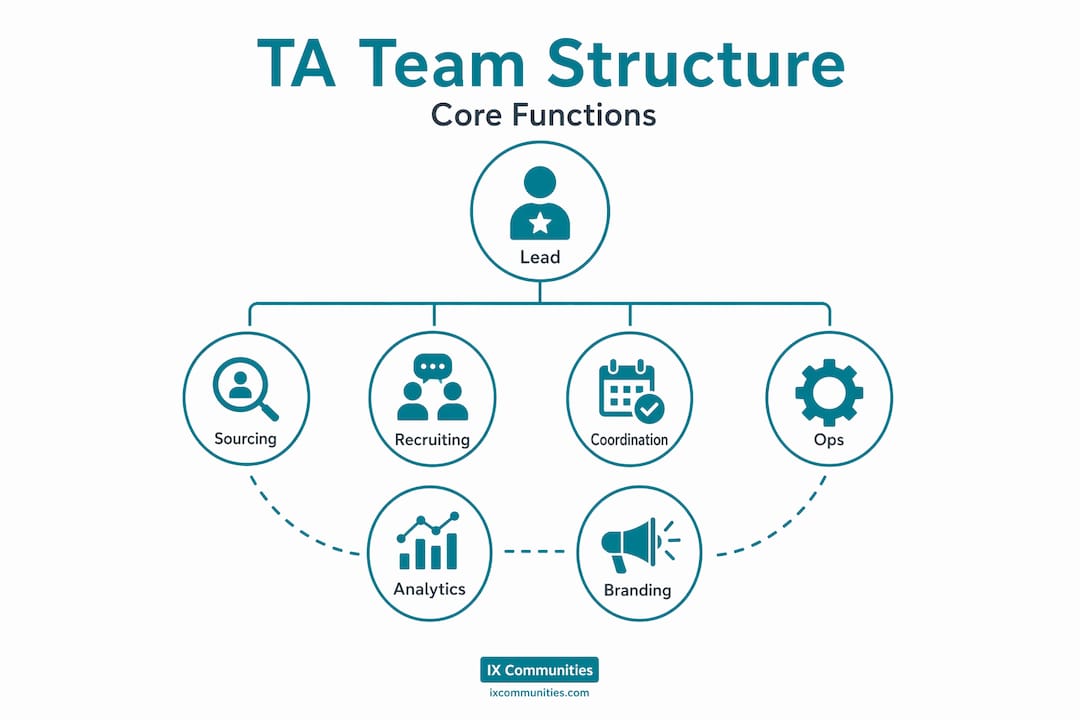
When choosing a structural model, the three main options are centralized, decentralized, and hybrid. Most Fortune 500 companies use a hybrid structure that combines centralized operations with business unit-embedded recruiters. This approach, sometimes called the hub-and-spoke model, places shared sourcing, coordination, and operations functions at the center while recruiters maintain close relationships with specific business lines.
| Model | Strengths | Limitations |
|---|---|---|
| Centralized | Consistency, shared tooling, cost control | Slower to respond to business unit nuances |
| Decentralized | Deep business context, fast response | Inconsistent process, duplicated effort |
| Hybrid | Balances scale and context | Requires strong coordination and governance |
A key threshold worth knowing: dedicated sourcers become operationally necessary when recruiters are managing more than 15 requisitions concurrently. Beyond that point, proactive pipeline building collapses. Recruiters shift entirely to reactive intake work, passive candidate engagement drops, and time-to-fill increases.
- Sourcers: Build and maintain candidate pipelines; own top-of-funnel
- Recruiters: Manage candidate relationships from screen to offer
- Coordinators: Own scheduling, logistics, and ATS data quality
- Recruiting Ops: Manage process design, metrics, tech stack, and compliance
- Employer Brand: Manage EVP content and candidate perception
Pro Tip: Clarify in writing which decisions belong to recruiters and which belong to hiring managers. Confusing these two roles dilutes accountability and adds weeks to hiring cycles.
Workflow design and technology adoption
Even the right team structure will underperform without well-defined workflows. Workflow design means specifying who owns each stage of the hiring process and what the expected handoff looks like at every transition point.
Map each stage from intake to offer: who initiates, who executes, who approves, and what triggers movement to the next stage. When handoffs are undefined, delays accumulate silently. A requisition can sit for days between the sourcing and recruiting stages simply because no one has a clear obligation to act.
Separating TA functional roles with defined accountability prevents bottlenecks and reduces hiring pipeline delays. This is especially true at the coordination stage, where scheduling and feedback collection are frequently the source of the most preventable delays in the process.
| Hiring stage | Owner | Key metric |
|---|---|---|
| Intake and job brief | Recruiter + Hiring Manager | Time to open requisition |
| Sourcing and outreach | Sourcer | Pipeline fill rate |
| Screening | Recruiter | Screen-to-interview conversion |
| Interview scheduling | Coordinator | Days between stages |
| Debrief and decision | Hiring Manager | Feedback lag time |
| Offer and close | Recruiter | Offer acceptance rate |
On the technology side, AI-assisted screening and async video interviews are two of the highest-impact tools for removing bottlenecks at scale. Async interviewing in particular has enabled top TA teams to compress senior interview timelines from weeks to days by removing scheduling friction from early-stage assessment. If you want to explore how executive recruiting is shifting toward intelligence-driven processes, the article on executive recruiting transformation covers this in depth.
Pro Tip: Track "feedback lag time" — the hours between interview completion and structured debrief — as a separate metric. In most organizations, this single gap accounts for more than a third of total time-to-hire delays.
Building and developing your recruitment team
Structuring a team is not a one-time decision. It requires ongoing attention to who you hire onto the team, how you develop them, and how you review and update the structure as demands shift.
When hiring recruiters, prioritize systems thinking and stakeholder collaboration over raw years of experience. A recruiter who understands how process design affects candidate experience will adapt faster than one who simply knows the motions. Look for comfort with data tools, willingness to give structured feedback, and the ability to manage relationships across multiple business functions simultaneously.
Developing the team means investing in three specific areas:
- Technology proficiency — Every recruiter and sourcer should be fluent in your ATS, your sourcing tools, and any AI screening or CRM platforms in use. Gaps here create workarounds that erode process consistency.
- Inclusive hiring practices — Structured interviews and skills-based assessments are linked to a 35% increase in team productivity. Training recruiters to apply these consistently is one of the higher-return investments available to a TA leader.
- Data-driven decision making — Recruiters who can read their own pipeline metrics and identify patterns will proactively raise problems before they become delays. Build this skill deliberately through regular metrics reviews, not just quarterly reporting.
Review your team structure formally at least twice per year. If certain recruiters are consistently overloaded while others have capacity, that is a signal about role alignment, not individual performance. Separate functions before adding headcount. In most cases, adding a coordinator or a recruiting ops resource eliminates more bottlenecks than adding another full-cycle recruiter.
Aligning incentives with team goals is the lever most organizations overlook. When recruiters are rewarded on submittals and fills rather than quality of hire and hiring manager satisfaction, they optimize for the wrong outcomes. Tie at least a portion of performance reviews to quality metrics, stakeholder feedback, and pipeline health.
Pro Tip: When redesigning your team structure, involve mid-level recruiters in the process. They know where the actual friction points are. Their input typically surfaces solutions that do not require additional budget.
Why structure beats headcount
In my experience, the single most common mistake TA leaders make is hiring their way out of a structural problem. I have seen organizations double their recruiting headcount and still miss hiring targets because the underlying workflow had no clear ownership model.
What I have found actually works is focusing on workflow and explicit ownership before making any headcount decisions. When every stage of the hiring process has a named owner and a defined handoff, hiring outcomes become predictable. That predictability is what hiring managers actually want. It is also what reduces candidate experience complaints.
The other lesson I keep returning to is that strong recruiting operations roles create leverage across the entire team. One well-placed recruiting ops professional who manages the ATS, maintains process documentation, and tracks pipeline metrics will improve the output of five recruiters more than a sixth recruiter would. Scaling without operational structure creates chaos at speed. Operations is not overhead. It is the infrastructure that makes everything else work. Leaders who want to stay current on how these principles are evolving in practice will find consistent value in reviewing current talent acquisition trends across the industry.
— Simon
Resources for TA leaders at Ixcommunities
If you are working through a team redesign or trying to benchmark your current structure against peer organizations, Ixcommunities offers resources built specifically for talent acquisition leaders at large companies.
The Talent Leaders Peer Mentoring Program connects TA leaders with experienced peers for structured guidance on team design, process improvement, and technology decisions. For data-driven context, the Benchmark Surveys tool lets you compare your team's KPIs and structure against organizations with similar hiring profiles. The Technology Stack Reference Tool helps TA teams evaluate and select recruiting technology aligned to their workflow needs. These resources are available through Ixcommunities membership, where talent and recruiting professionals at large corporate organizations share knowledge in a secure environment.
FAQ
What is the best talent acquisition team structure for large companies?
Most large companies benefit from a hybrid model that combines centralized sourcing and operations with embedded business unit recruiters. This structure balances consistency across the organization with the context needed to serve individual business lines effectively.
When should a TA team add a dedicated sourcer?
A dedicated sourcer becomes necessary when individual recruiters are managing more than 15 open requisitions at once. Beyond that threshold, proactive pipeline work stops, and the team shifts entirely to reactive hiring.
What KPIs matter most for a high-performing recruitment team?
Quality of hire, time to fill, offer acceptance rate, and hiring manager satisfaction are the metrics that most accurately reflect team performance. Teams that track quality of hire specifically tend to outperform those that focus on activity volume.
How does workflow design affect hiring speed?
Defined ownership and clear handoffs at each hiring stage reduce the accumulative delays that slow most hiring pipelines. Tracking metrics like feedback lag time and days between stages reveals where the process breaks down.
What is the difference between a recruiting team and a hiring team?
The recruiting team owns the process: sourcing, screening, coordinating, and closing candidates. The hiring team, led by the hiring manager, owns the hiring decision itself. Confusing these two accountabilities slows the process and reduces quality.