

Executive mis-hires are among the most expensive decisions an organization can make. A mis-hire at the executive level can cost up to 213% of that person's annual salary when you factor in severance, replacement costs, lost productivity, and cultural disruption. That number alone makes a compelling case for treating executive recruiting not as an ad hoc process, but as a disciplined function with clearly defined roles, workflows, and performance standards. This guide breaks down how high-performing executive recruiting teams are structured, how they operate, and what separates teams that consistently deliver from those that rely on luck.
Table of Contents
- Team structure and roles in executive recruiting
- Executive search methodologies and workflow
- In-house, external, and hybrid models: Pros and cons
- Performance metrics and industry benchmarks
- Expert nuances: Partner-led models and adaptive strategies
- What most guides miss about executive recruiting teams
- Enhance your executive recruiting with IX Communities
- Frequently asked questions
Key Takeaways
| Point | Details |
|---|---|
| Structure influences success | Specialized roles and effective reporting lines amplify executive recruiting team performance. |
| Methodology matters | Adopt market mapping and 3D assessment for higher quality executive hires. |
| Model choice impacts outcomes | Internal, external, and hybrid setups have unique strengths and risks for executive searches. |
| Measure what matters | Track metrics like cost-per-hire and quality-of-hire to drive recruiting efficiency. |
| Advanced strategies drive results | Partner-led models and adaptive recruiting tactics help future-proof your executive hiring operation. |
Team structure and roles in executive recruiting
Building on the importance of team structure, let's break down the key roles and hierarchy inside executive recruiting teams.
Most organizations assume that having a few strong recruiters is enough. In practice, the structure around those recruiters determines how effectively they can perform. Executive recruiting teams in large corporations typically feature a Head or VP of Talent Acquisition reporting directly to the CHRO, supported by specialized executive recruiters, sourcers operating at a 1:3 ratio to recruiters, and coordinators who manage scheduling and logistics.
This layered model is intentional. Each role serves a distinct purpose, and when roles overlap or are poorly defined, performance suffers.
Core roles and what they actually do
- Head or VP of Talent Acquisition: Sets strategy, manages internal stakeholder relationships, owns performance metrics, and oversees team capacity and hiring plans.
- Executive recruiters: Lead individual searches, manage candidate relationships, facilitate assessments, and advise hiring managers on market conditions and expectations.
- Sourcers: Drive pipeline by identifying and engaging passive candidates through direct outreach, talent mapping, and market intelligence. They do not close candidates but generate qualified interest.
- Recruiting coordinators: Handle interview scheduling, candidate communications, offer letters, and onboarding logistics. Freeing recruiters from this work is critical to maintaining search quality.
- Research analysts (in mature teams): Conduct competitive intelligence and talent mapping to support proactive sourcing before a role even opens.
Reporting lines and organizational placement
Where the recruiting function sits inside an organization matters. Teams that report through HR generalist chains often face resource competition and reduced strategic influence. Direct CHRO reporting lines give executive recruiting leaders the visibility and authority to align closely with business priorities.
| Role | Reports to | Primary focus |
|---|---|---|
| Head / VP of TA | CHRO | Strategy, stakeholder alignment |
| Executive recruiter | Head of TA | Full-cycle search |
| Sourcer | Head of TA or senior recruiter | Pipeline generation |
| Coordinator | Recruiter or TA ops | Scheduling, logistics |
| Research analyst | Head of TA | Market intelligence |
You can explore different team structures for executive recruiting to understand how large organizations adapt this model based on hiring volume and function. For teams starting from scratch, a structured approach to building an executive recruiting function step by step reduces early missteps.
Pro Tip: Track the savings your internal team generates compared to agency fees paid for equivalent roles. This metric builds internal credibility and justifies investment in sourcers and coordinators. Most organizations underestimate this figure significantly.
Executive search methodologies and workflow
Once roles are understood, it is essential to grasp how these teams operate. The methodologies and workflow that underpin executive recruiting are what distinguish a professional function from a reactive hiring process.

Executive search follows a deliberate sequence, not a standard corporate recruiting funnel. Each stage is designed to surface candidates who are not actively looking, assess them rigorously, and manage the confidentiality that senior-level searches almost always require.
The step-by-step executive search process
- Position scoping: The recruiter works with the hiring executive to define the role requirements, success criteria, compensation range, and cultural expectations. This step is often rushed, which is a primary cause of failed searches.
- Market mapping: Sourcers build a landscape of potential candidates across competitor organizations, adjacent industries, and functional communities. This is proactive intelligence work, not reactive resume review.
- Direct outreach: Targeted, personalized outreach to passive candidates. Market mapping and direct outreach are paired with 3D assessment covering skills, leadership capability, and cultural alignment to generate a qualified shortlist.
- Candidate assessment: Executive searches use structured interviews, behavioral frameworks, and leadership assessments. Culture fit is evaluated deliberately, not as an afterthought.
- Presentation and decision support: Recruiters present detailed candidate reports to hiring committees, including assessment findings, market context, and compensation benchmarking.
- Offer and close: Executive recruiters manage offer negotiations, counteroffers, and start date logistics, often requiring extended attention given the complexity of executive compensation packages.
- Onboarding support: High-performing teams provide 90-day onboarding support to protect the hire and accelerate integration.
Timeline and model expectations
Executive search processes emphasize passive candidates, confidentiality, and timelines of 90 to 180 days. Retained models are standard for VP-level and above roles with compensation exceeding $250,000 base. In retained searches, the recruiting team commits exclusively to the engagement and operates with a defined milestone structure.
| Search type | Typical timeline | Fee model | Best for |
|---|---|---|---|
| Internal executive team | 90 to 150 days | Fixed cost | Known markets, aligned culture |
| Retained external firm | 90 to 180 days | Retained fee | Confidential, cross-industry searches |
| Contingency external | 60 to 90 days | Fee at placement | Lower VP, defined skills |
| Hybrid model | 90 to 150 days | Blended | Complex, sensitive, or high-volume |
Pro Tip: Resist the pressure to optimize for time-to-fill on executive roles. Speed misapplied at this level increases mis-hire risk substantially. A deliberate process that moves toward intelligence-driven recruiting consistently outperforms speed-focused approaches. Track quality-of-hire as your primary indicator of search effectiveness, and monitor talent acquisition trends to keep your methodology current.
In-house, external, and hybrid models: Pros and cons
Understanding methodology leads directly to the question of team model. Should you use an internal, external, or hybrid executive recruiting approach? The answer depends on the nature of your searches, your industry position, and your team's existing capabilities.
Internal teams
Internal executive recruiting functions offer significant advantages in organizational alignment and cost efficiency. Recruiters who understand your culture, your leadership language, and your competitive position can source and assess more contextually than external partners. They build internal relationships that support long-term talent pipeline development.
The limitations are real, though. Internal teams often lack the broad networks that come from years of external search work across industries. Senior candidates may also respond differently to outreach from a named company versus a retained search firm, particularly for confidential replacements.
External retained search firms
Internal teams save agency fees but lack networks. External retained firms offer precision, confidentiality, and reach that most internal teams cannot replicate for certain search profiles. For roles requiring cross-industry perspective or where the incumbent is still in place, external search remains the more reliable option.
The cost is the primary barrier. Retained fees typically range from 25% to 35% of first-year compensation. For a VP role at $300,000 base, that represents $75,000 to $105,000 per placement.
Hybrid models
Retained external for precision versus in-house for cost savings and alignment is the traditional framing. Hybrid models challenge this binary by combining internal strategy and relationship management with external sourcing reach. This model works particularly well for confidential searches, cross-industry moves, and organizations in transition.
Benchmark this: Track cost-per-hire and mis-hire rates separately for internally sourced and externally sourced executive placements. Most organizations discover that the fully loaded cost of an external search is offset by lower mis-hire rates when the process is rigorous. The ExecSmart hybrid approach offers a structured framework for organizations evaluating this model. Consider also reviewing AI's role in executive search as technology continues to change what internal teams can do independently.
Key considerations when selecting a model:
- Volume and frequency of executive hiring
- Sensitivity and confidentiality requirements of the search
- Internal team's existing network depth in the target function or industry
- Compensation level and complexity of the role
- Current organizational capacity and recruiter bandwidth
Performance metrics and industry benchmarks
With models in mind, evaluating performance is crucial. The metrics and benchmarks that matter most for executive recruiting teams are specific, and they differ meaningfully from general recruiting KPIs.
Benchmarks to know
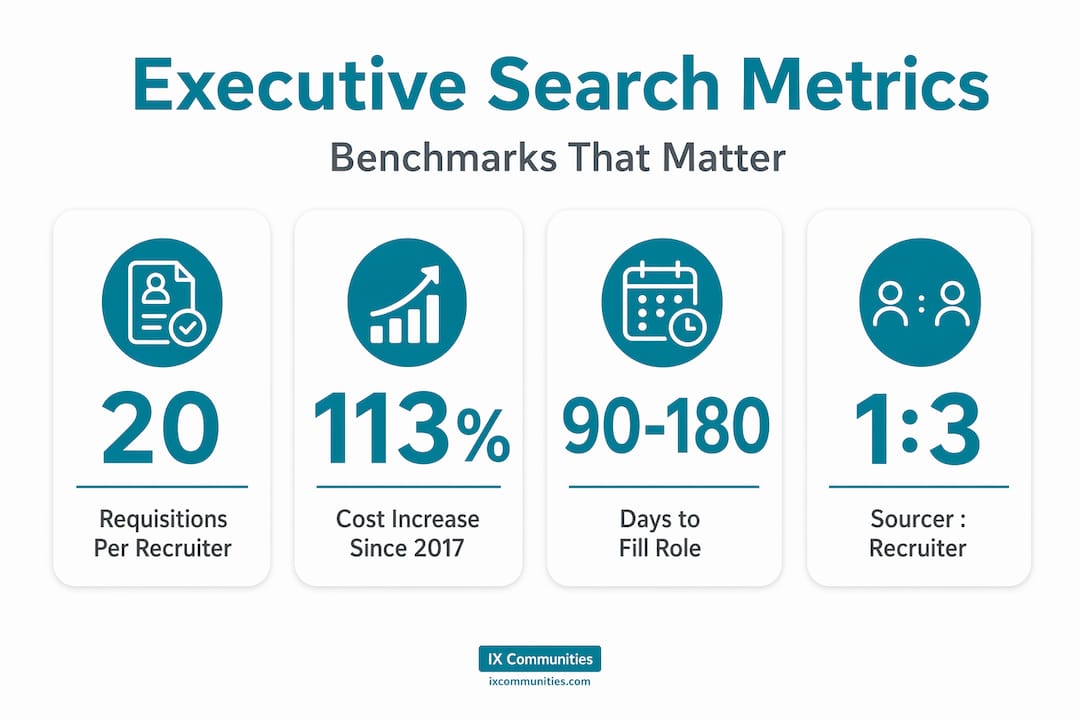
Recruiters typically manage approximately 20 requisitions, and executive cost-per-hire has risen 113% since 2017. Average time-to-fill across all roles is approximately 45 days, though executive searches run substantially longer. These figures establish the baseline from which your team's performance should be evaluated.
| Metric | General recruiting | Executive recruiting |
|---|---|---|
| Requisitions per recruiter | ~20 | 5 to 10 |
| Time-to-fill | ~45 days | 90 to 180 days |
| Cost-per-hire | Varies by industry | Significantly elevated |
| Quality-of-hire (12-month retention) | ~80% | Target 90%+ |
| Sourcer-to-recruiter ratio | 1:5 | 1:3 |
Metrics that actually drive decisions
- Quality-of-hire: Measured at 6 and 12 months post-placement through performance reviews, retention, and hiring manager satisfaction. This is the most meaningful indicator of search effectiveness.
- Time-to-productivity: How long it takes a placed executive to reach full operating capacity. Longer onboarding support from the recruiting team correlates with faster productivity.
- Savings versus agency fees: Document every search handled internally and calculate the equivalent external fee avoided. This metric directly supports team investment justification.
- Candidate experience scores: Executive candidates talk. Poor experiences damage employer brand at leadership levels.
- Pipeline depth: Number of qualified candidates engaged per search. Shallow pipelines indicate sourcing gaps.
Adopting a 1:3 sourcer-to-recruiter ratio, tracking agency fee savings, and focusing on quality-of-hire over time-to-fill are the most practical steps for improving executive recruiting performance. For organizations looking to establish benchmarks against peers, reviewing executive recruiting benchmarks provides comparative data across similar organizations. Teams focused on continuous improvement benefit from tracking executive recruiting metrics that actually matter and from applying insights around streamlining executive search to reduce time without sacrificing quality.
Expert nuances: Partner-led models and adaptive strategies
Beyond benchmarks, elite teams thrive by leveraging advanced strategies and nuanced approaches. This is where structure and methodology come together in ways that standard guides rarely address.
Partner-led models in executive search firms
In high-performing external firms, partner-led models distribute accountability across experienced senior professionals. For example, ON Partners operates with 16 partners each leading individual searches, creating accountability structures that differ fundamentally from associate-driven models. Understanding this when you select external partners helps you evaluate the seniority and continuity of who is actually working your search.
Talent mapping during hiring lulls
Internal executive recruiting teams evolve performance through specialization and data-driven operations. One of the most valuable practices is continuous talent mapping, even when no open roles exist. This means maintaining live intelligence on high-potential candidates across priority functions so that when a role opens, the sourcing phase is compressed significantly.
Multi-pillar recruiting: Active and proactive
High-performing internal teams operate on two simultaneous tracks. The active track responds to open requisitions with urgency. The proactive track builds pipelines, nurtures relationships, and develops market intelligence before demand arrives. Teams that operate only in reactive mode consistently underperform on time-to-fill and quality-of-hire because they start from zero each search.
Key characteristics of elite executive recruiting teams:
- Deep specialization by function or industry, not just by requisition volume
- Structured candidate relationship management between active searches
- Regular calibration sessions with business leaders to anticipate talent needs
- Data-driven review of pipeline quality, not just headcount or activity
- Clear boundaries between sourcing, assessing, and coordinating responsibilities
Pro Tip: Consistency matters more than speed in executive search. Maintaining consistency rather than optimizing for speed produces better placements, stronger candidate relationships, and fewer mis-hires. Talent leaders who resist pressure to accelerate timelines artificially report higher quality-of-hire outcomes. The connection between executive search and talent management also deserves attention as organizations seek greater continuity between search outcomes and long-term leadership development.
What most guides miss about executive recruiting teams
The standard conversation about executive recruiting teams focuses almost entirely on org charts and vendor selection. That framing misses something important.
The real differentiator is not which model you choose or how many sourcers you employ. It is whether your team operates with disciplined workflows, rigorous performance feedback loops, and a commitment to continuous calibration. Most teams have roles on paper that function as blurred generalist assignments in practice. When everyone does a little of everything, no one does anything with real depth.
Speed is the wrong priority for executive search. Organizations that pressure their recruiting teams to compress executive timelines artificially introduce risk into a process that is already difficult to execute well. Internal executive teams enhance performance through specialization and data-driven operations, but they must balance that with external network access where their own reach is limited. Prioritizing consistency over speed is not a conservative instinct; it is a performance strategy supported by outcomes data.
The other underexamined issue is the danger of underestimating what a specialized internal function can achieve when properly resourced. Many talent leaders accept unnecessary external dependency because their internal teams were never given the structure, tools, or hiring support to develop true executive search capability. Building that capability takes time and investment, but it compounds. An internal team that develops deep functional expertise and a strong candidate network is a long-term asset. An external firm is a transaction.
Data-driven operations are the new competitive edge in executive recruiting, and few teams have fully operationalized this. Tracking recruiting intelligence at the pipeline, assessment, and placement level allows leaders to identify where searches break down, where sourcing is shallow, and where assessment rigor is inconsistent. This feedback loop is what separates teams that improve over time from those that repeat the same errors across search cycles.
Enhance your executive recruiting with IX Communities
The insights in this article point toward a consistent theme: structured teams, rigorous methodologies, and benchmarked performance are the foundation of executive recruiting excellence.
IX Communities brings together talent acquisition leaders from large corporations to share practices, compare benchmarks, and strengthen their functions through peer-level exchange. The peer mentoring program for talent leaders connects you with peers who are navigating the same structural and performance challenges. Access to recruiting benchmarks gives your team a data-grounded baseline for evaluating your own metrics against comparable organizations. Explore membership benefits to learn how joining the IX Communities network supports ongoing development for talent leaders responsible for executive recruiting performance.
Frequently asked questions
What is the optimal sourcer to recruiter ratio for executive teams?
A 1:3 sourcer-to-recruiter ratio is considered ideal, allowing each sourcer to generate qualified pipeline at a scale that keeps executive recruiters focused on assessment and stakeholder management rather than initial outreach.
What causes time-to-fill to be longer for executive roles?
Executive search processes emphasize passive candidates, confidentiality, and specialized multi-stage assessment, resulting in standard timelines of 90 to 180 days that cannot be compressed without introducing mis-hire risk.
How much does a mis-hire really cost?
A mis-hire at the executive level can reach up to 213% of annual salary once replacement, severance, productivity loss, and team disruption are fully accounted for.
How do internal and external recruiting models differ?
Internal teams offer cost savings and cultural alignment, while external retained firms provide broader networks and confidentiality handling for sensitive searches. The hybrid model is commonly used when a search requires both.
What are the most important metrics to track for executive recruiting teams?
Recruiters managing approximately 20 requisitions is a standard benchmark, but for executive functions the priority metrics are quality-of-hire, cost-per-hire, time-to-productivity, and savings generated versus external agency fees.