

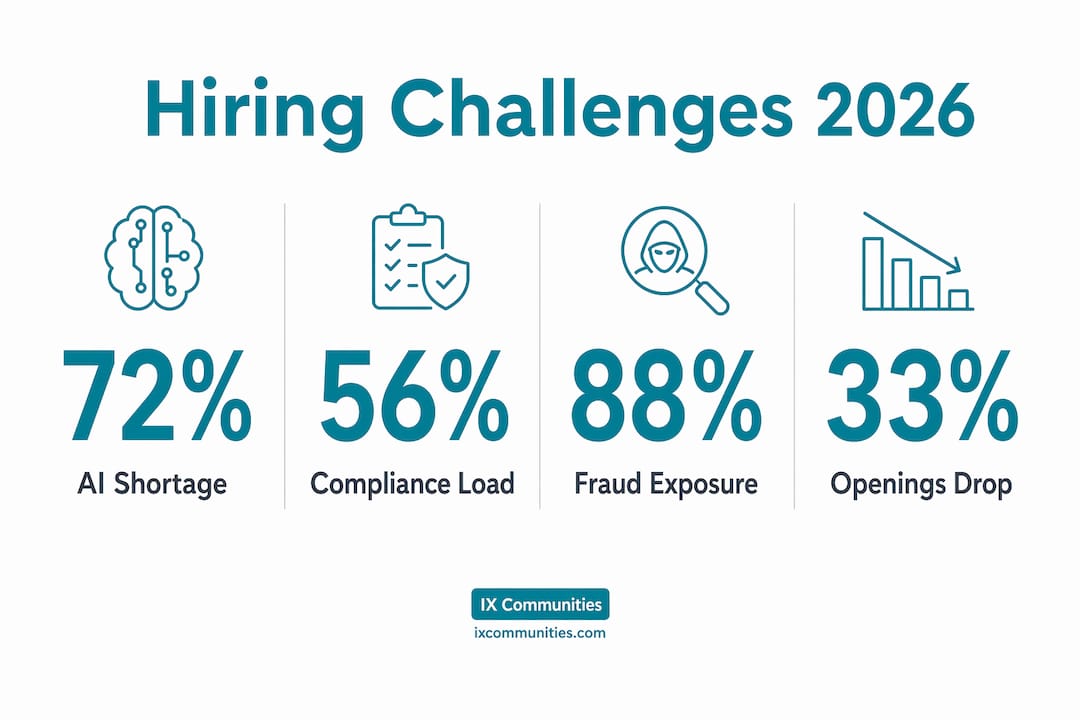
Hiring is getting harder because economic caution, skill shortages, compliance complexity, and AI-driven candidate fraud are converging to slow recruitment across every industry. ManpowerGroup's Q1 2026 data shows a Global Net Employment Outlook of 24%, down 4 percentage points year-over-year. The Indeed Hiring Lab reports that while total job openings hold at 6.9 million, the information sector has seen openings fall 33% year-over-year. GetReal Security adds a newer dimension: 41% of enterprises have hired a fraudulent candidate. These are not isolated data points. They are symptoms of a structural shift in what recruitment now requires.
Why hiring is getting harder: economic conditions and measured strategies
The current hiring environment is defined by deliberate restraint, not paralysis. ManpowerGroup's 2026 data confirms that employers are shifting to precision hiring, focusing on specific capabilities and business-critical roles rather than broad headcount expansion. Only 19% of new hires are backfilling recent departures, which signals that organizations are reshaping roles rather than simply replacing them. That reshaping takes time, internal alignment, and more precise job design.
Larger organizations are moving more slowly than midsize ones. The approval chains, workforce planning cycles, and budget reviews that govern enterprise hiring add weeks to processes that smaller firms complete in days. Economic uncertainty amplifies this effect. When leadership is uncertain about revenue projections, hiring requisitions stall at the approval stage.
The practical result for HR teams is a higher volume of open roles sitting unfilled for longer periods. Recruiters are not failing to source candidates. They are waiting on internal decisions about what the role actually needs to be. That distinction matters when diagnosing where your process is breaking down.
- Roles are being redesigned mid-search, forcing restarts in sourcing and screening
- Budget approvals are taking longer due to economic uncertainty at the leadership level
- Precision hiring demands more detailed job architecture upfront, slowing requisition creation
- Larger organizations face more internal coordination requirements before a role goes live
Pro Tip: Before opening a requisition, confirm that the role definition has sign-off from both the hiring manager and finance. Roles that reopen after sourcing has started cost twice the time and effort.
What skill shortages, especially in AI, mean for recruiters
The talent supply problem is most acute in technology. 72% of employers report difficulty filling roles that require AI capabilities, making AI skills the hardest category to source globally according to ManpowerGroup's 2026 Talent Shortage Survey. This is not a temporary gap. The demand for AI-literate professionals is growing faster than training pipelines can produce them.

Sector-level data from the Indeed Hiring Lab reinforces this picture. The information sector has seen job openings fall 33% year-over-year, while professional services show similar contraction. This creates a counterintuitive situation: fewer openings in some sectors, yet those openings are harder to fill because the required skills are increasingly specialized. Volume of applicants does not solve a skill-path mismatch. Receiving 200 applications for a machine learning engineer role does not help if 190 of those candidates lack the specific model deployment experience the role requires.
| Sector | Year-over-year change in openings | Primary skill gap |
|---|---|---|
| Information | Down 33% | AI and machine learning |
| Professional services | Declining | Data analysis and automation |
| Healthcare | Stable to growing | Clinical technology integration |
| Manufacturing | Moderate growth | Advanced robotics and process automation |
The implication for HR teams is that job descriptions and evaluation criteria need to be rebuilt from the ground up for many technical roles. Posting the same requirements used three years ago will not attract the right candidates today. Role framing must reflect current skill paths, not legacy job architectures.
Pro Tip: Partner with your learning and development team to map which internal candidates could be upskilled for hard-to-fill roles. Internal mobility reduces time-to-fill and builds institutional knowledge simultaneously.
How compliance complexity and rising costs slow recruitment
Regulatory burden is now a direct constraint on hiring speed. Employment Hero's data shows that 56% of UK businesses report increased complexity in employing staff, driven by rising costs and new employment law requirements. Full-time employment costs rose 9.6% in a single year. That figure represents a meaningful shift in the cost-per-hire calculation that HR teams present to leadership.
The administrative side is equally significant. 51% of firms reported increases in HR administration and recruitment processing costs over the past year. More time spent on compliance documentation means less time spent on sourcing, screening, and candidate engagement. In compliance-heavy environments, paperwork and approvals, not sourcing volume, become the hidden constraints slowing requisition throughput.
The downstream effect is that some organizations are delaying hiring decisions entirely. When the cost and complexity of bringing on a new employee rises, leadership scrutinizes each requisition more carefully. HR teams then face a longer internal sales process to get roles approved, on top of the external recruitment work.
- Employment law changes require updated offer letters, contracts, and onboarding documentation
- Payroll processing complexity increases with each new jurisdiction or classification type
- Benefits administration adds overhead that scales with headcount, creating hesitation around net-new roles
- Legal review of employment terms adds days or weeks to offer timelines in regulated industries
How AI-driven candidate fraud is reshaping hiring workflows
Candidate fraud is no longer an edge case. 88% of enterprises face deepfake and impersonation attacks at least occasionally during hiring, according to GetReal Security. The 41% that have already hired a fraudulent candidate represent a significant operational and security risk. Fraudulent hires in technical roles can access sensitive systems, intellectual property, and customer data before the deception is discovered.
Recruitment has shifted from resume screening to continuous identity verification. Mature organizations now treat verification as an ongoing control rather than a one-time background check. This adds stages to every hiring pipeline and requires investment in detection technology. The trade-off between speed and verification is real. Every additional verification step adds time, but skipping steps creates exposure.
"Candidate fraud transforms recruitment from a simple resume screening exercise to a continuous identity verification challenge requiring multi-stage pipelines." — GetReal Security Research, 2026
A structured verification pipeline for high-risk roles now typically includes:
- Initial identity document verification at the application stage
- Live video interview with behavioral analysis to detect deepfake presentation
- Technical skills assessment conducted in a monitored environment
- Reference verification with direct callback to confirmed employer contacts
- Post-hire access monitoring during the first 90 days of employment
HR teams that have not yet updated their screening protocols for AI-generated fraud risk are operating with a significant blind spot. The risks leaders overlook in executive hiring are particularly acute, given the access levels involved.
Practical approaches for navigating today's recruitment challenges
The organizations managing these challenges most effectively share a common approach: they treat recruitment as a data-informed function rather than a process-driven one. Aggregate labor market metrics like national unemployment rates tell HR teams very little about the specific talent pools they are competing in. Sector and role-level intelligence is what drives better decisions.
The following practices reflect what leading HR teams are implementing now:
- Use segmented labor market data. National hiring statistics mask significant sector variation. The Indeed Hiring Lab's JOLTS analysis shows that headline stability hides sharp divergences by industry. Build sourcing strategies around role-specific supply and demand data, not aggregate figures.
- Rebuild job architectures for current skill paths. Roles requiring AI capabilities need descriptions that reflect how those skills are actually developed and demonstrated today. Legacy job descriptions filter out qualified candidates who have non-traditional backgrounds.
- Invest in identity verification technology. Tools that detect deepfakes and verify identity documents at scale are now a standard part of enterprise hiring infrastructure, not an optional add-on.
- Streamline compliance workflows with dedicated HR technology. Automating offer letter generation, contract management, and onboarding documentation reduces the administrative drag that slows time-to-hire.
- Align internal approval processes with hiring timelines. The biggest delays in many organizations are internal, not external. Mapping your requisition approval workflow and identifying bottlenecks is a faster win than optimizing your sourcing channels.
Pro Tip: Benchmark your time-to-fill by role category against peer organizations in your sector. Without that comparison, it is impossible to know whether your delays are process problems or market conditions. Ixcommunities' benchmark surveys provide exactly this kind of peer-level data.
For HR teams working to improve candidate authenticity in AI-driven recruitment, the combination of structured verification and updated evaluation criteria is the most defensible approach available today.
Key takeaways
Hiring is harder today because economic caution, AI skill shortages, compliance overhead, and candidate fraud are each adding friction to recruitment processes that were not designed to handle all four simultaneously.
| Point | Details |
|---|---|
| Precision hiring slows pipelines | Role redesign and internal approvals add weeks before sourcing even begins. |
| AI skills are the hardest to fill | 72% of employers struggle to source AI-capable candidates, requiring updated job architectures. |
| Compliance costs delay decisions | A 9.6% rise in employment costs makes leadership more cautious about approving new requisitions. |
| Candidate fraud is now widespread | 88% of enterprises face deepfake attacks, requiring multi-stage identity verification in every pipeline. |
| Segmented data outperforms averages | Sector-level labor market intelligence produces better sourcing decisions than national headline metrics. |
The compounding nature of today's hiring challenges
The most significant shift I have observed in talent acquisition over the past few years is not any single factor. It is the compounding effect of multiple pressures arriving at the same time. Economic caution slows internal approvals. Skill shortages mean the approved role is hard to fill anyway. Compliance complexity adds administrative overhead to every offer. And now, candidate fraud means the person who finally clears your screening may not be who they claim to be.
What concerns me most is that many HR teams are still diagnosing these as separate problems and applying separate fixes. They optimize their applicant tracking system, update their job descriptions, and add a background check vendor, but they do not step back to see how these pressures interact. A role that takes 90 days to fill is rarely the result of one broken step. It is usually four or five friction points stacking on top of each other.
The organizations I find most credible on this topic are the ones sharing real data with peers, not publishing polished case studies. Knowing that your 90-day time-to-fill is actually 30 days better than your sector average changes how you prioritize your next investment. That kind of calibration only comes from honest peer comparison, not vendor benchmarks.
The path forward requires HR teams to treat recruitment as a discipline that demands continuous learning, not periodic process updates. The conditions in 2026 are genuinely different from 2022, and the teams that recognize that will make better decisions than those still operating on pre-pandemic assumptions.
— Simon
How Ixcommunities supports HR teams facing these challenges
Ixcommunities operates ESIX, TLIX, and IXCommunities as peer networking and benchmarking groups specifically for talent leadership professionals at large corporate organizations. When hiring conditions shift as significantly as they have in 2026, having access to peers who are navigating the same pressures is a concrete operational advantage.

The ESIX Recruiter Peer Mentorship Programs connect recruiting professionals with experienced mentors who have managed hiring through comparable market conditions. The Talent Leaders Peer Mentoring Program provides a structured forum for senior HR leaders to exchange strategies on skill shortages, compliance demands, and fraud prevention. Both programs operate within a secure environment designed for candid, peer-level exchange. If your team is working through the challenges described in this article, Ixcommunities provides the peer context to make better-informed decisions.
FAQ
Why is hiring getting harder in 2026?
Hiring is harder because economic caution, AI skill shortages, rising compliance costs, and AI-driven candidate fraud are each adding friction to recruitment pipelines simultaneously. ManpowerGroup's Q1 2026 data shows the Global Net Employment Outlook fell 4 percentage points year-over-year, reflecting deliberate rather than expansive hiring.
What is precision hiring and why does it slow recruitment?
Precision hiring is the practice of filling only business-critical roles with tightly defined capability requirements rather than expanding headcount broadly. It slows recruitment because role redesign and internal approvals must be completed before sourcing begins, adding weeks to the process.
How widespread is AI-driven candidate fraud?
GetReal Security reports that 88% of enterprises face deepfake and impersonation attacks at least occasionally, and 41% have already hired a fraudulent candidate. This has made multi-stage identity verification a standard requirement in enterprise hiring pipelines.
Which sectors are experiencing the most staffing difficulties?
The information sector has seen job openings fall 33% year-over-year according to the Indeed Hiring Lab, while professional services show similar contraction. Both sectors face acute AI and data skills shortages that make remaining openings harder to fill despite lower overall volume.
How can HR teams reduce time-to-fill in this environment?
The most effective approach combines segmented labor market data, updated job architectures that reflect current skill paths, and streamlined internal approval workflows. Benchmarking time-to-fill against sector peers, rather than national averages, identifies whether delays are process problems or market conditions.