

Talent acquisition groups are specialized organizational structures that drive better hiring outcomes by integrating strategy, standardized processes, and shared expertise across a centralized team. The benefits of talent acquisition groups extend well beyond filling open roles faster. They reduce cost-per-hire, improve quality-of-hire, and create scalable talent pipelines that compound in value over time. For corporate HR leaders managing high-volume or complex hiring environments, the distinction between tactical recruiting and a structured talent acquisition group is the difference between reacting to headcount needs and anticipating them.
What are the key benefits of talent acquisition groups vs. traditional recruiting?
Strategic talent acquisition frameworks can reduce cost-per-hire by 25 to 40% and increase quality-of-hire by 30 to 50% compared to tactical recruiting. That gap exists because traditional recruiting treats each hire as an isolated transaction, while talent acquisition groups treat hiring as a multi-year operating system with integrated pillars covering sourcing, assessment, employer branding, and workforce planning.
The advantages of talent acquisition over transactional models are most visible in three areas:
- Cost efficiency: Centralized groups eliminate duplicated sourcing efforts across business units, reduce agency reliance, and negotiate better vendor terms through consolidated spend.
- Quality consistency: Standardized interview frameworks and employer value proposition (EVP) design produce comparable hire quality across recruiters and locations, rather than leaving outcomes to individual judgment.
- Scalability: A structured group can activate talent pipelines across geographies without rebuilding sourcing infrastructure from scratch for each new market or role type.
- Technology leverage: Talent acquisition groups deploy applicant tracking systems (ATS), AI-enabled shortlisting tools, and analytics dashboards as shared infrastructure, not siloed point solutions.
- Employer brand cohesion: Centralized control over recruitment marketing produces a consistent candidate experience, which directly affects offer acceptance rates and long-term reputation.
The table below summarizes how talent acquisition groups compare to traditional recruiting across key performance dimensions.
| Dimension | Traditional recruiting | Talent acquisition group |
|---|---|---|
| Cost-per-hire | Higher, agency-dependent | 25–40% lower through centralized models |
| Quality-of-hire | Inconsistent across recruiters | 30–50% higher with standardized frameworks |
| Time-to-fill | Reactive, longer cycles | Reduced through proactive pipelines |
| Employer brand | Fragmented | Consistent, centrally managed |
| Technology use | Siloed ATS | Integrated AI and analytics stack |
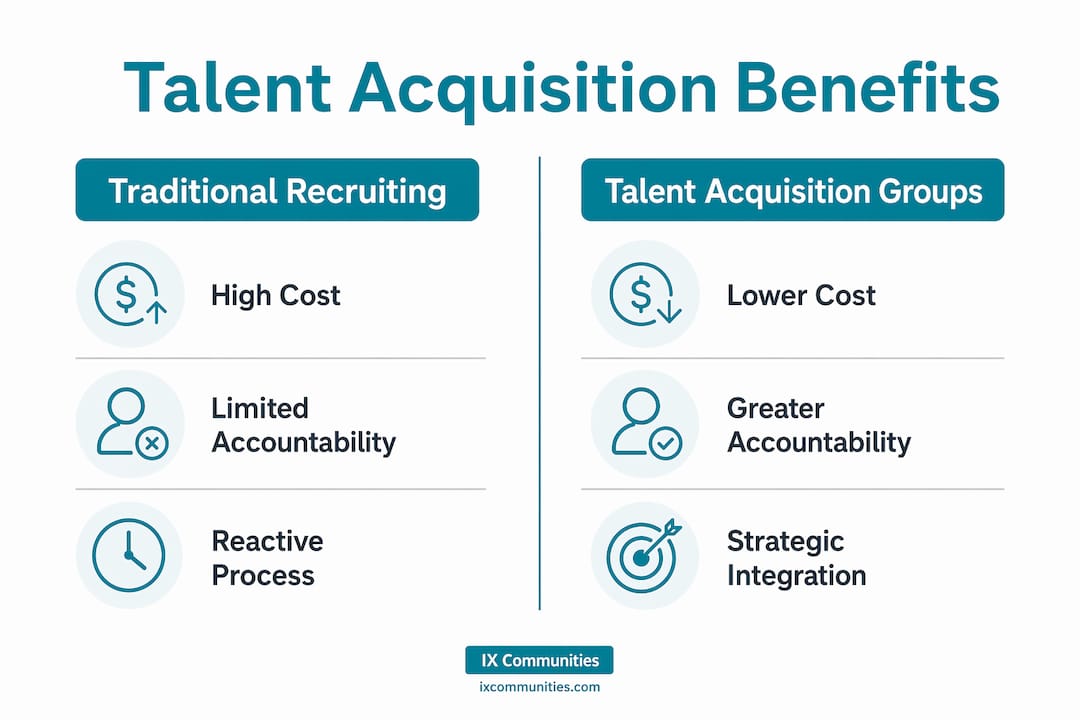
Talent acquisition groups also create accountability structures that traditional recruiting lacks. Strategic operating models mandate outcome KPIs covering cost, quality, and retention from the start of the planning cycle, not as afterthoughts.
How do talent acquisition groups operate within organizational frameworks?
Talent acquisition Centers of Excellence (CoEs) are the most common structural model for large organizations. A typical CoE for 1,000 to 5,000 employees includes 5 to 15 specialists covering strategy, employer brand, ATS administration, interview design, and sourcing methodology. That concentration of expertise produces hiring playbooks and training programs that standardize quality across the entire recruiting function.

The hub-and-spoke model extends CoE capabilities globally. A central hub holds specialized expertise and shared technology, while regional spokes adapt processes to local labor markets, languages, and regulatory requirements. This structure allows a multinational organization to maintain consistent hiring standards without imposing a one-size-fits-all process on every market.
HSBC's transformation, executed in partnership with Accenture, illustrates what this looks like at scale. HSBC shifted from reactive recruiting to proactive talent hubs with AI-enabled workflows, building over 45 learning assets and training more than 250 recruiters to support the transition. The result was a globally integrated talent acquisition function capable of activating pipelines across markets with consistent quality.
Key structural elements within a functioning talent acquisition group include:
- Specialist roles: Sourcers, employer brand managers, assessment designers, and workforce planners operating as a coordinated team rather than generalist recruiters handling everything.
- Agile squads: Cross-functional teams that can be deployed to high-priority hiring surges without disrupting steady-state operations.
- Shared governance: Defined decision rights for which roles require CoE involvement versus local recruiter autonomy.
- Change management infrastructure: Training programs and adoption plans for hiring managers, not just recruiters.
Pro Tip: When standing up a talent acquisition CoE, prioritize interview framework standardization and EVP design before deploying new technology. Process consistency produces more durable quality gains than any single tool.
What practical impacts do talent acquisition groups have on recruitment efficiency?
Talent acquisition groups accelerate hiring speed and reduce external agency dependency through two mechanisms: proactive pipeline development and AI-enabled candidate matching. HSBC's model uses AI shortlisting by capabilities and persona-driven candidate journeys, which reduces the time recruiters spend on manual screening and directs effort toward relationship-building and assessment.
The practical impact on recruitment efficiency follows a clear sequence:
- Pipeline activation: Talent acquisition groups maintain active candidate pools segmented by skill, geography, and career stage, so when a role opens, sourcing begins from a warm network rather than a cold search.
- Agency fee reduction: Proactive pipelines reduce the volume of roles escalated to external agencies, which typically charge 15 to 25% of first-year salary. Even a 20% reduction in agency-filled roles produces significant annual savings for large organizations.
- Internal mobility facilitation: Centralized groups track skills across the existing workforce and match internal candidates to open roles before external sourcing begins. This reduces repeated sourcing cycles and improves retention by creating visible career pathways.
- Skills forecasting: Talent acquisition groups work with workforce planning teams to anticipate hiring needs 12 to 18 months out, allowing sourcing to begin before demand becomes urgent.
- Cross-border talent mobility: Integrated hubs can identify candidates in one market and place them in another, reducing geographic constraints on talent access.
One distinction that separates high-performing talent acquisition groups from average ones is how they treat their candidate databases. Confusing ATS databases with talent networks limits pipeline strength. An ATS stores records. A talent network requires active nurturing, reactivation campaigns, and ongoing engagement to remain a viable sourcing asset. Groups that invest in relationship management beyond the ATS consistently outperform those that treat their database as a static inventory.
For HR leaders looking to improve talent acquisition, reviewing recruiting best practices that address pipeline architecture and candidate engagement is a practical starting point.
Pro Tip: Build a reactivation cadence for silver-medal candidates from prior searches. These individuals already cleared your assessment bar and often represent the fastest path to a quality hire when a similar role opens.
Why should HR leaders invest in talent acquisition groups now?
The compounding value of structured talent acquisition becomes most visible over a 3 to 5 year horizon. Organizations that deploy centralized operating models report that cost-per-hire savings and quality improvements often exceed the entire recruiting budget over five years. That return profile makes talent acquisition groups one of the highest-ROI investments available to corporate HR functions.
The strategic case for investment rests on several interconnected factors:
- Accountability for outcomes: Talent acquisition groups are structured to track downstream metrics including retention rates, performance ratings of new hires, and candidate experience scores. Traditional recruiting functions typically measure activity (requisitions opened, interviews scheduled) rather than outcomes.
- Competitive differentiation: Organizations with mature talent acquisition groups fill critical roles faster and with higher-quality candidates than competitors relying on reactive recruiting. In tight labor markets, that speed advantage directly affects business performance.
- Reduced enterprise complexity: Centralizing talent acquisition eliminates the fragmented vendor relationships, inconsistent processes, and duplicated technology investments that accumulate when business units manage recruiting independently.
- Training as a prerequisite: The success of talent acquisition group rollouts depends on training both recruiters and hiring managers to adopt new hiring playbooks. HSBC's 45-plus learning assets for 250-plus recruiters demonstrate the scale of change management required.
- Long-term retention impact: Higher quality-of-hire reduces first-year attrition, which carries its own cost savings in onboarding, lost productivity, and repeated sourcing.
HR leaders who want to understand how their current talent acquisition structure compares to peers can use benchmark surveys to identify gaps and prioritize investment areas. Understanding the connection between talent management and recruiting is also critical for building a business case that resonates with executive stakeholders.
Key takeaways
Talent acquisition groups deliver compounding cost, quality, and retention benefits by replacing reactive recruiting with a structured, accountable operating model built on standardized processes and shared expertise.
| Point | Details |
|---|---|
| Cost and quality gains | Centralized groups reduce cost-per-hire by 25–40% and improve quality-of-hire by 30–50%. |
| Structural models matter | CoEs and hub-and-spoke frameworks concentrate expertise and enable global scalability. |
| Pipeline vs. database | Active talent networks require ongoing nurturing beyond static ATS records to sustain pipeline strength. |
| Training drives adoption | Rollout success requires structured change management for both recruiters and hiring managers. |
| Long-term ROI compounds | Benefits accumulate over 3–5 years, often exceeding the total recruiting budget in savings. |
What I've learned about where talent acquisition groups actually fail
Most talent acquisition groups fail not because of poor strategy but because of poor sequencing. Organizations invest in AI platforms and ATS upgrades before they have standardized interview frameworks or a defined EVP. Technology amplifies whatever process sits underneath it. If that process is inconsistent, the technology produces inconsistent results faster.
The second failure pattern is treating the ATS as the talent network. I have seen large organizations with databases of 200,000 candidates that cannot fill a niche role in under 90 days because no one has maintained relationships with those candidates since they applied. A database is not a pipeline. A pipeline requires human contact, content, and context over time.
The third issue is measurement. Most recruiting functions still report on time-to-fill and requisitions closed. Those metrics measure activity, not value. Tracking quality-of-hire and retention as primary KPIs changes the conversation with business leaders from "how fast are we hiring" to "how well are we hiring." That shift in accountability is what separates a talent acquisition group from a recruiting department with a new name.
The organizations that get this right, like HSBC working with Accenture, invest heavily in change management and training before they declare the model live. They also build governance structures that define when the CoE leads and when local recruiters have autonomy. Without that clarity, centralization creates friction rather than efficiency.
— Simon
How Ixcommunities supports talent acquisition professionals
Ixcommunities operates ESIX, TLIX, and IXCommunities as the preeminent peer networking and benchmarking groups for talent leadership professionals worldwide. For HR leaders building or refining talent acquisition groups, the ESIX Recruiter Peer Mentorship Programs provide structured guidance from experienced practitioners who have navigated the same organizational challenges.
The Talent Leaders Peer Mentoring Program connects senior talent acquisition leaders with peers across large corporate environments, enabling direct knowledge exchange on operating model design, technology selection, and change management. Members gain access to benchmarking data, shared playbooks, and a secure environment where candid discussion of real challenges is the norm. For talent acquisition professionals looking to accelerate their group's performance, Ixcommunities membership provides the peer context that no conference or certification program replicates.
FAQ
What are the main benefits of talent acquisition groups?
Talent acquisition groups reduce cost-per-hire by 25 to 40% and improve quality-of-hire by 30 to 50% compared to tactical recruiting, while also building proactive talent pipelines that reduce agency reliance and accelerate time-to-fill.
How does a talent acquisition Center of Excellence differ from a standard recruiting team?
A talent acquisition CoE concentrates 5 to 15 specialists in areas like employer brand, ATS administration, interview design, and sourcing methodology, producing standardized playbooks and training that raise quality across the entire recruiting function rather than relying on individual recruiter judgment.
Why is training critical to talent acquisition group success?
Rollout success depends on training both recruiters and hiring managers to adopt new processes. HSBC developed over 45 learning assets for more than 250 recruiters to support its talent hub transformation, demonstrating that change management is as important as the operating model itself.
What metrics should talent acquisition groups track?
Talent acquisition groups should prioritize quality-of-hire, retention rates, and candidate experience scores alongside cost-per-hire. Tracking downstream outcomes rather than activity metrics like time-to-fill is what validates the business value of a structured talent acquisition group to executive stakeholders.
How do talent acquisition groups support internal mobility?
Centralized talent acquisition groups track skills across the existing workforce and match internal candidates to open roles before external sourcing begins, reducing repeated sourcing cycles and improving retention by creating visible career pathways for current employees.