

Most talent acquisition functions are still organized around a model built for a different era. The structure that made sense when recruiters handled everything from sourcing to offer letters no longer fits the work. Demand for talent acquisition specialists increased 87% year over year, reflecting how much organizational pressure has shifted onto TA. What roles should exist in a modern TA function is not a hypothetical question anymore. It is a structural decision that directly affects hiring quality, speed, and long-term talent strategy.
Table of Contents
- Key takeaways
- What roles should exist in a modern TA function
- Operations and candidate experience roles
- Analytics and AI management roles
- Strategic leadership and workforce planning
- My perspective on designing TA functions that actually work
- Strengthen your TA function with Ixcommunities
- FAQ
Key takeaways
| Point | Details |
|---|---|
| Specialization replaces generalism | Modern TA teams gain more from defined specialist roles than from full-cycle generalist recruiters. |
| AI creates new roles | AI programme managers and analytics specialists are now core positions, not optional additions. |
| Operations needs dedicated ownership | Candidate experience and workflow management require dedicated roles, not shared responsibilities. |
| Leadership must be strategic | Senior TA leaders are measured on workforce planning and ROI, not just hiring volume. |
| Structure drives outcomes | The right team structure for talent acquisition directly improves hiring quality and business alignment. |
What roles should exist in a modern TA function
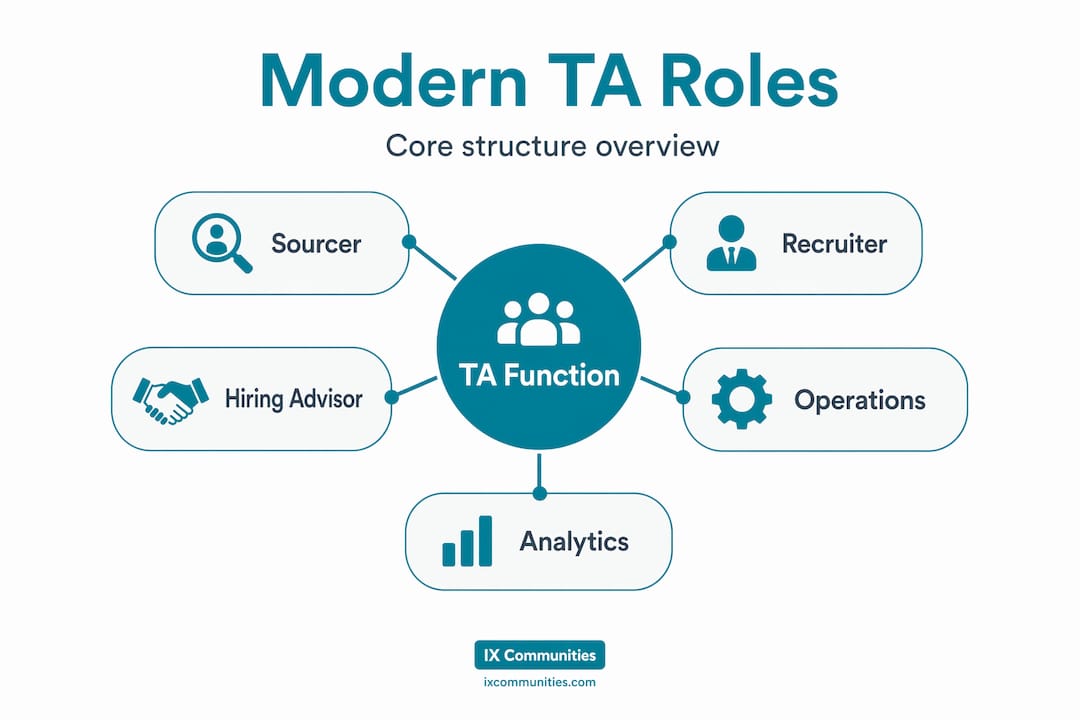
The answer starts with recognizing that TA is no longer one job shared across a small team. AI has replaced traditional coordinator and screener roles with new strategic positions like Hiring Advisors and AI Programme Managers. What remains requires human judgment, relationship depth, and business acumen.
Sourcers: targeted, data-informed talent identification
Sourcers focus on one thing: finding candidates before anyone else does. In a modern TA function, they are not running keyword searches on job boards. They use talent intelligence platforms, competitive mapping tools, and labor market data to build pipelines for roles that may not even be open yet.
The sourcer role has gained precision because of AI. Automated candidate discovery handles initial matching, which frees sourcers to focus on harder-to-find talent pools, niche technical communities, and passive candidate engagement. Their output feeds directly into recruiter and hiring advisor workflows, which is why the boundary between sourcing and recruiting should be clearly defined rather than blurred.
Strategic recruiters: from coordinators to advisors
The recruiter role has changed more than any other in modern TA functions. AI shifts recruiter time from roughly 65% administrative work to approximately 75% strategic and advisory work. That is a complete reversal of how most recruiters have historically spent their days.
Modern strategic recruiters own candidate relationships, manage assessments, and consult with hiring managers on market conditions and expectations. High-performing recruiters combine relationship skills with deep industry knowledge to assess technical competencies and cultural fit. They are not processing applicants. They are advising on hiring decisions.
Key responsibilities in this role include:
- Managing active candidate pipelines and guiding hiring manager expectations
- Conducting structured interviews and competency-based assessments
- Providing market intelligence on compensation, timelines, and candidate availability
- Coordinating with sourcers to prioritize pipeline development for critical roles
Pro Tip: If your recruiters are still spending significant time scheduling interviews or tracking applicants manually, your operations structure needs attention before your recruiting structure does.
Hiring advisors: embedded business unit partners
Hiring advisors represent the most significant structural addition to modern TA functions. They sit within or alongside specific business units, providing consultative support that goes well beyond filling open requisitions. This is where exec recruiters are becoming strategic advisors, owning workforce planning conversations, succession inputs, and long-range talent strategy at the business unit level.

A hiring advisor understands the product roadmap, the skills the team will need in 18 months, and the talent dynamics in that specific function. They translate business goals into hiring strategies, not the other way around.
Operations and candidate experience roles
Getting operations right is what separates TA functions that hire well from those that hire inconsistently. Two distinct roles have emerged as non-negotiable in well-structured modern TA teams.
TA operations specialists
TA operations specialists own the infrastructure. As automation handles scheduling, screening workflows, and communication triggers, the operations role shifts toward workflow design, system performance, and process governance. They are the people who ensure that automation is actually working as intended and that nothing falls through the gaps.
Their responsibilities are specific and measurable:
- Design and maintain automated workflows for candidate scheduling, status updates, and disposition communications
- Manage ATS configuration and data integrity to support accurate reporting
- Identify friction points in the hiring process and propose process changes
- Coordinate with IT and vendor contacts to resolve system issues and support integrations
- Track time-to-fill and process efficiency metrics by role type and business unit
Pro Tip: Treat TA operations as an internal product team. The "product" is the hiring process itself. Operations specialists should be reviewing their workflows quarterly, not just when something breaks.
Candidate experience leads
The candidate experience lead is a role that did not exist in most TA functions five years ago. It exists now because automation, if left unmanaged, creates a cold, transactional experience that drives candidates away. Candidate experience leads personalize communications, monitor Net Promoter Scores, and guide interview processes for high-priority roles.
This role is not about making hiring "feel nice." It is about protecting the employer brand, reducing candidate drop-off, and ensuring that the human touchpoints in a largely automated process are meaningful and well-executed. In competitive talent markets, candidate experience directly affects offer acceptance rates.
Analytics and AI management roles
These two roles are where many TA functions still have the most significant gaps. Both are new enough that job descriptions vary widely across organizations. Both are too important to leave vacant.
| Role | Primary focus | Key outputs |
|---|---|---|
| TA Analytics Specialist | Recruitment data interpretation | Funnel metrics, quality-of-hire tracking, sourcing channel ROI |
| AI Programme Manager | AI tool strategy and governance | Bias audits, tool performance reviews, team training on AI use |
TA analytics specialists
A TA analytics specialist transforms raw recruitment data into decisions. They track where candidates drop out of the funnel, which sourcing channels produce the highest quality hires, and how interview-to-offer ratios vary by role type and business unit. Without this role, TA leaders make decisions based on intuition and anecdote rather than evidence.
The analytics specialist works closely with both the operations team and senior TA leadership. They surface patterns that individual recruiters cannot see across the volume of activity in a large function. This is how AI changes executive search practices at the data layer, turning activity logs into strategy inputs.
AI programme managers
The AI programme manager is a role that owns technology tool strategy and monitors AI outputs to reduce bias and maintain quality. This is not a technical IT role. It is a TA-function role with a deep understanding of both recruiting workflows and AI tool capabilities.
They decide which AI tools belong in the stack, train the recruiting team on appropriate use, and audit outputs regularly to catch bias or performance degradation. As AI adoption in TA accelerates, this role becomes the accountability point for everything the function does with automated technology.
Strategic leadership and workforce planning
Corporate TA functions are progressing from siloed units to integrated platforms running end-to-end automated workflows with human strategic oversight. That shift requires a different kind of senior leadership.
Senior TA leaders are now measured on ROI and workforce planning impact, not just individual hiring execution. The most effective TA directors and VPs operate at the intersection of business strategy and talent supply. They are accountable for:
- Defining TA function design, role specialization, and capacity planning
- Owning the relationship with CHROs, business unit heads, and finance on talent costs
- Setting standards for AI tool governance and recruiter development
- Managing talent pipeline health across the organization, not just open requisitions
- Reporting on quality-of-hire, time-to-productivity, and cost-per-hire at a program level
Corporate functions of the future are evolving toward platform-based integrated operating models focused on judgment and business support. TA leadership must reflect that model. A TA director who is primarily managing recruiter workloads rather than advising on organizational talent health is operating one level below where the role now needs to function.
My perspective on designing TA functions that actually work
I've seen organizations go through TA redesigns that looked good on paper and failed in practice within six months. The pattern is almost always the same. They restructure roles without changing accountabilities, or they invest heavily in AI tools without creating the programme management role that makes those tools useful.
What I've learned is that the biggest mistake TA leaders make is treating the function redesign as a headcount exercise rather than a capability design exercise. The question is not how many people you need. It is what capabilities the function must have and which roles carry those capabilities most effectively.
The risk in removing middle management layers to fund AI is real. Mentorship, institutional knowledge, and operational judgment live in those roles. Eliminating them to pay for tools creates a function that is technically capable but organizationally fragile.
The essential TA roles today are not just about coverage. They are about depth. A function with one well-defined analytics specialist will outperform a function with three generalist recruiters who also do reporting on the side. Specialization done well produces compounding returns. Specialization done poorly just creates confusion about who owns what.
My advice: map your current function against the roles described here, identify the gaps, and prioritize filling them based on where your biggest hiring failures are occurring. That diagnostic exercise will tell you more about your next hire than any org chart template will.
— Simon
Strengthen your TA function with Ixcommunities
Building the right team structure for talent acquisition requires more than a reorganization chart. It requires access to peer data, benchmarked role designs, and real-world insights from leaders who have already navigated these decisions.
Ixcommunities supports talent acquisition leaders through structured peer learning and benchmarking resources built specifically for large corporate TA functions. The Talent Leaders Peer Mentoring Program connects TA professionals with experienced peers to work through function design, role specialization, and AI integration challenges. The benchmark surveys provide data on how peer organizations are structuring their teams, allocating roles, and measuring outcomes. For teams managing an expanding AI tool stack, the technology stack reference tool helps AI programme managers assess and organize their technology choices. Explore Ixcommunities membership to access the full range of resources available to TA leaders worldwide.
FAQ
What are the core roles in a modern TA function?
A modern TA function should include sourcers, strategic recruiters, hiring advisors, TA operations specialists, candidate experience leads, analytics specialists, AI programme managers, and senior strategic leadership. Each role carries distinct responsibilities that collectively cover the full scope of contemporary talent acquisition.
How has AI changed essential TA roles today?
AI has shifted recruiter time from predominantly administrative tasks to roughly 75% strategic and advisory work, while creating entirely new roles such as AI programme managers who govern tool strategy and bias auditing. Traditional coordinator and screener roles have largely been absorbed by automated workflows.
What does a TA analytics specialist do?
A TA analytics specialist interprets recruitment data to track funnel performance, sourcing channel effectiveness, and quality-of-hire trends. They provide TA leadership with the evidence needed to make decisions based on data rather than assumption.
Why does candidate experience need a dedicated role?
Without dedicated ownership, automated hiring processes create inconsistent and impersonal candidate interactions that damage employer brand and reduce offer acceptance rates. A candidate experience lead monitors NPS, personalizes key communications, and manages high-priority interview processes.
How should senior TA leaders measure their own effectiveness?
Senior TA leaders are now measured on workforce planning impact, cost-per-hire, quality-of-hire, and organizational talent health rather than individual requisition closure rates. Success at the leadership level means demonstrating ROI and contributing to long-range talent strategy alongside business unit heads and finance.