

Executive recruiting has never been a purely administrative function, yet for decades it was treated like one. That perception is changing fast. The question of why exec recruiters are becoming strategic advisors is now central to how talent functions operate, and the answer has direct implications for how your organization plans, builds, and retains leadership. 63% of organizations identify developing a critical talent sourcing strategy as their top priority for 2026. That number signals a structural shift, not a trend. Recruiting is being repositioned from a support function to a driver of business outcomes.
Table of Contents
- The changing landscape: From recruitment execution to talent architecture
- How AI technology is enabling recruiters to become strategic advisors
- The value strategic recruiters bring: Beyond filling roles to shaping leadership success
- Practical steps to transform recruiting teams into strategic advisory functions
- Measuring success: New metrics for strategic talent advisory roles
- Why many companies still underestimate the strategic recruiter's value — and how to avoid that pitfall
- Empower your talent leaders with IX Communities
- Frequently asked questions
Key Takeaways
| Point | Details |
|---|---|
| Recruiter role evolution | Executive recruiters are transitioning from administrative operators to strategic advisors who shape talent strategy. |
| AI enables transformation | Artificial intelligence automates routine tasks, freeing recruiters to focus on strategic workforce impact. |
| Critical advisor skills | Consulting, data literacy, storytelling, influence, and AI fluency are essential for strategic recruiting roles. |
| New success metrics | Measuring strategic recruiting relies on quality of hire, retention, and hiring manager satisfaction, not time-to-fill. |
| Organizational readiness | Successful transformation requires AI infrastructure, leadership buy-in, and updated talent practices. |
The changing landscape: From recruitment execution to talent architecture
The misconception that recruiters simply fill seats has long limited how organizations deploy them. In practice, the most effective exec recruiters are already operating as Talent Architects, a term that describes professionals who approach hiring through the lens of skills, long-term fit, and organizational strategy rather than speed and volume.
A Talent Architect does not just respond to a job requisition. They challenge it. They ask whether the role is structured correctly, whether the competency requirements reflect the actual business need, and whether the organization has overlooked internal candidates or adjacent talent pools. SHRM's 2026 Finding Talent report confirms that Talent Architects prioritize skills-first recruitment and relationship-building as core practices, not optional additions.
This evolution also changes how recruiters interact with hiring managers. Rather than order-takers, they function as Talent Advisors (professionals who use data and market context to guide hiring decisions). The relationship becomes collaborative. Turnover drops when roles are filled with a better-matched candidate from the start, and workforce stability improves when hiring is connected to longer-range planning.
Key characteristics of the Talent Architect model include:
- Challenging role requirements before a search begins
- Mapping skills gaps against business strategy
- Building pipelines of passive leaders before the need is urgent
- Consulting hiring managers on realistic market expectations
- Tracking outcomes beyond placement, including performance and retention
For a deeper look at how the executive recruiting process to intelligence is evolving, the shift from transactional steps to insight-driven decisions is worth examining closely.
How AI technology is enabling recruiters to become strategic advisors
Technology is the practical reason why exec recruiters are becoming strategic advisors at scale now, not ten years ago. AI tools have removed or compressed the administrative work that previously consumed most of a recruiter's day. AI now automates 60 to 80% of administrative tasks, recovering roughly 20% of the workweek for higher-impact activities.
That recovered time is what makes the advisory role possible. But time alone is not enough. Recruiters need a specific set of skills to use that time effectively. The five skills that define a capable Talent Advisor are:
- Consulting — The ability to diagnose organizational needs, ask the right questions, and reframe a hiring problem before attempting to solve it.
- Data literacy — Reading workforce analytics, interpreting compensation data, and presenting labor market trends in a way that informs decisions.
- Storytelling — Translating data and market insights into clear narratives that resonate with executives and hiring managers.
- Influence — Guiding stakeholders toward better hiring decisions, even when it means pushing back on entrenched assumptions.
- AI fluency — Understanding what AI tools can and cannot do, and using them to generate insight rather than just automate output.
Pro Tip: Do not measure a recruiter's effectiveness by how quickly they fill roles once AI is in place. Measure how well they use the freed time. Recruiters who spend recovered hours on market analysis, relationship development, and hiring manager coaching are the ones building durable advisory capabilities.
The table below illustrates how the recruiter's function shifts when AI handles administrative work:
| Task category | Traditional recruiter time allocation | AI-enabled recruiter time allocation |
|---|---|---|
| Resume screening and sourcing | 40% | 5% |
| Scheduling and coordination | 20% | 3% |
| Hiring manager consultation | 15% | 35% |
| Market research and analysis | 10% | 30% |
| Pipeline and relationship building | 15% | 27% |
For organizations currently assessing where AI fits, exploring AI in executive recruiting adoption provides a grounded view of what adoption actually looks like in practice versus theory.
The value strategic recruiters bring: Beyond filling roles to shaping leadership success
A recruiter who enters the process only after a role is posted is already operating too late. The most significant value a strategic executive search partner delivers happens before a requisition is formally opened. This is where exec recruiters as advisors separate themselves from transactional search.
Strategic executive search partners provide insights on compensation benchmarking, risk mitigation, and candidate longevity that shape the role itself, not just who fills it. They flag when a compensation band is too narrow to attract the caliber of leader the organization actually needs. They raise concerns about role scope or reporting structures that may cause a strong hire to exit within 18 months.
"The best executive search partners are not vendors. They are market translators who help organizations understand what is achievable given current talent conditions, competitive positioning, and internal culture."
Beyond advisory input at the front end, strategic recruiters maintain ongoing relationships with passive leaders. These are experienced executives who are not actively seeking new roles but may be open to the right conversation. When an urgent need surfaces, an advisor with those relationships can compress the search timeline significantly and deliver candidates who have been assessed over time, not just during a formal process.
The shift in how success is measured matters here. Traditional placement counts and speed metrics do not capture what a strategic recruiter actually contributes. Relevant outcomes include:
- Leadership retention at 12 and 24 months post-placement
- Hiring manager satisfaction with the process and outcome
- Candidate performance relative to defined competencies at six months
- Time to full productivity for placed executives
For organizations where executive search and talent management are converging, the recruiter's scope naturally expands to include succession and development planning alongside active search.
Practical steps to transform recruiting teams into strategic advisory functions

Knowing that exec recruiters should operate as advisors and actually building a team capable of doing it are different challenges. The transformation requires deliberate investment across three areas: infrastructure, skills, and measurement.
Follow this sequence to begin the transition:
- Audit your current administrative burden. Identify which tasks consume recruiter time without generating insight. Sourcing, scheduling, and status updates are prime candidates for automation. Without removing this load, the transition to strategic roles fails regardless of training or intent.
- Select and implement AI tools with clear use cases. Adopt AI for defined tasks first. Resume screening, interview scheduling, and candidate communication are well-supported by current tools. Avoid broad AI deployments without clear measurement of time recovered.
- Build the five advisory skills through structured development. Partner with internal learning and development or external programs focused on consulting skills and data interpretation. Shadow programs where senior recruiters work alongside business strategists are particularly effective.
- Redesign how recruiters engage hiring managers. Replace the status-update call with a structured intake meeting that covers market conditions, role design, candidate availability, and realistic timelines. This reframes the recruiter as a consultant from the first conversation.
- Redefine success metrics at the team level. Quality of hire, hiring manager satisfaction, and leadership retention should replace time-to-fill as the primary indicators. Revisit scorecards quarterly and communicate outcomes to executive stakeholders.
Pro Tip: Start with one business unit as a pilot for the advisory model. Document the difference in hiring manager experience, candidate quality, and 90-day retention compared to units still using a traditional approach. The comparison makes the business case without requiring a large upfront commitment.
Resources on transforming recruiter training can support the skills development component of this transition.
Measuring success: New metrics for strategic talent advisory roles
Traditional recruiting metrics were built for a transactional model. Time-to-fill, cost-per-hire, and application volume made sense when speed and throughput defined recruiting performance. They do not capture the contribution of an advisor whose value shows up months after a placement closes.
Talent Advisors are evaluated on quality of hire, time to productivity, and overall workforce impact, not the speed at which roles are processed. This requires a different data infrastructure and a different conversation with leadership about what recruiting success actually means.
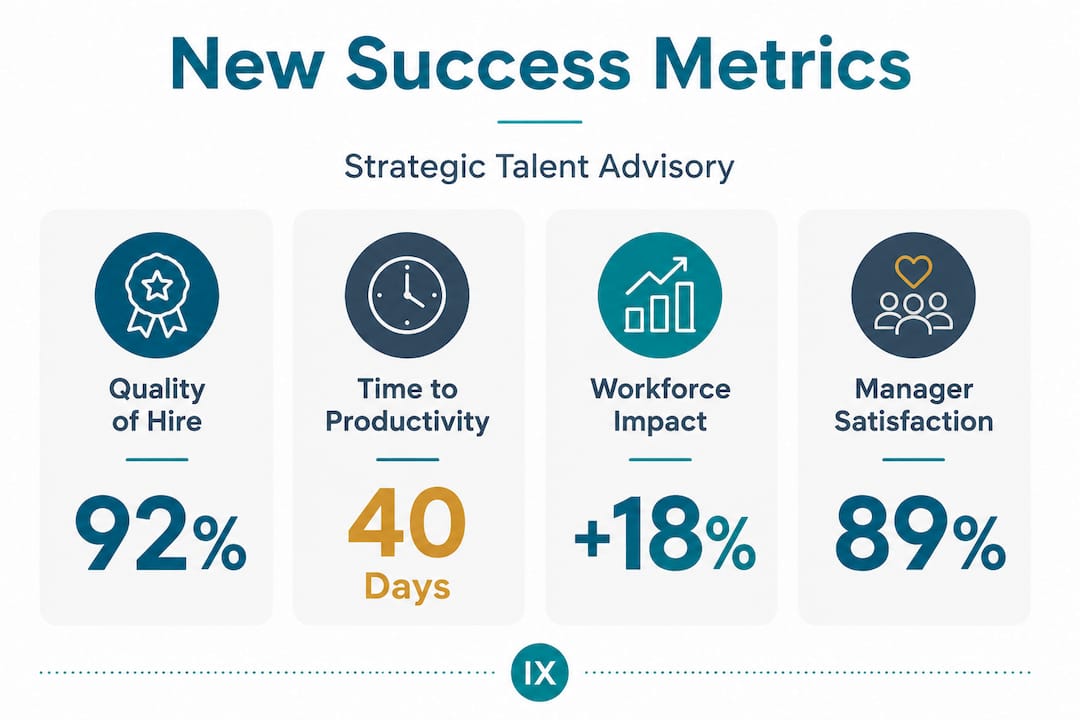
The comparison below shows how the measurement framework shifts:
| Metric | Traditional recruiter KPI | Strategic talent advisor KPI |
|---|---|---|
| Speed | Time-to-fill (days) | Time to full productivity (months) |
| Volume | Number of placements | Strategic gap closure rate |
| Process | Offer acceptance rate | Hiring manager satisfaction score |
| Quality | 90-day retention | 24-month leadership retention |
| Business alignment | Requisition completion | Workforce strategy contribution |
Additional indicators that reflect advisory impact include:
- Passive pipeline depth: Number of qualified, pre-assessed leaders available for future roles
- Proactive market briefings delivered: Documented instances where the recruiter provided unsolicited insight that influenced a business decision
- Role design contributions: Cases where recruiter input changed a job description, level, or reporting structure before the search began
- Succession plan contribution: Percentage of leadership gaps addressed through existing pipeline relationships
Data literacy is essential here. Recruiters who can translate workforce data into a clear narrative for the C-suite build credibility quickly. Those who present spreadsheets without context remain perceived as operational support. Developing future skills for executive recruiters includes building the capacity to communicate findings in formats that resonate with senior decision-makers.
Why many companies still underestimate the strategic recruiter's value — and how to avoid that pitfall
The evidence for repositioning exec recruiters as strategic advisors is not new. What is notable is how slowly most organizations are acting on it. There are several reasons for this, and none of them are about capability.
The most common barrier is metric inertia. Leaders who have managed recruiting teams for years are accustomed to dashboards built around time-to-fill and headcount closed. Abandoning those benchmarks requires admitting they were insufficient measures of real performance. That admission is uncomfortable, and it rarely happens without pressure from above.
The second barrier is infrastructure. Only 25% of HR practitioners feel confident in their understanding of future workforce needs, which is precisely the gap that a capable Talent Advisor would fill. But if the organization has not invested in AI tools to reduce the administrative load, recruiters do not have the time to develop or apply that understanding. The role cannot evolve without the conditions to support it.
There is also an organizational perception problem. When a recruiter is consistently treated as a transactional service provider, that expectation calcifies. Hiring managers stop including recruiters in early planning conversations. Business leaders do not think to consult them on workforce strategy. The recruiter's potential advisory contribution never surfaces because no one thinks to ask.
The practical implication for talent leaders is to invest in changes with AI in executive search as a foundational step, and simultaneously advocate for a redefined seat at the table for your recruiting leadership. Neither change alone is sufficient. A skilled advisor without time is ineffective. A recruiter with free time but no standing in business conversations will simply fill that time with low-value tasks.
The organizations that close this gap will not just hire better. They will plan better, because they will have a function that connects real-time market intelligence to workforce decisions before the situation becomes reactive.
Empower your talent leaders with IX Communities
For talent leaders building this transition, the path forward is clearer when you are not working through it alone.
IX Communities supports recruiting and talent leaders at mid to large organizations through peer mentorship programs designed specifically for professionals navigating the shift to strategic advisory roles. Members gain access to benchmarking data, peer networks, and structured learning built around the challenges that are specific to executive talent functions. The IX Communities membership connects talent leaders across industries in a secure environment where real practice and honest comparison are the standard. The talent leaders peer mentoring program provides a direct channel to experienced professionals who have already made this transition and can offer guidance grounded in practice.
Frequently asked questions
What is the difference between a traditional recruiter and a strategic talent advisor?
A traditional recruiter focuses on administrative hiring tasks such as sourcing and scheduling, while a strategic talent advisor functions as a trusted business partner, influencing workforce strategy and measuring success through quality of hire rather than speed.
How does AI impact the role of executive recruiters?
AI automates many administrative tasks, recovering approximately 20% of the workweek so recruiters can focus on advisory activities such as market analysis, hiring manager consultation, and workforce planning.
What skills should recruiters develop to become effective strategic advisors?
Recruiters need to build capability in consulting, data literacy, storytelling, influence, and AI fluency to function effectively in strategic advisory roles rather than remaining focused on administrative execution.
How can organizations measure the success of strategic talent advisory?
Success is measured through quality of hire, retention, and workforce impact rather than traditional metrics like time-to-fill, with hiring manager satisfaction and strategic gap closure serving as primary indicators.