

Talent intelligence is the strategic practice of combining internal workforce data with real-time external labor market insights to enable data-driven talent decisions. This shift defines the talent intelligence revolution what leaders need to know: HR moves from reactive hiring to proactive workforce design. Organizations that adopt this approach align talent strategy directly with business goals, anticipate workforce risks before they become crises, and produce measurable outcomes that hold up to board-level scrutiny. The stakes are high. Leaders who treat workforce planning as an administrative function will fall behind those who treat it as a data discipline.
How talent intelligence changes HR and leadership strategy
The transition from manual workforce planning to AI-accelerated workforce design is the defining shift in HR leadership today. Traditional planning relied on spreadsheets, annual surveys, and gut instinct. AI-driven workforce transformation replaces that cycle with continuous, real-time analysis of skills availability, market movement, and internal capability gaps. The result is a planning function that responds to business change in weeks, not quarters.

Talent intelligence also links skills management directly to business priorities. When HR can map internal competency models against external market availability, leaders stop asking "Do we have the right people?" and start asking "Where are the gaps, and how fast can we close them?" That shift changes the nature of leadership conversations entirely.
The cultural impact is measurable. Companies using integrated talent intelligence models report 80% of employees looking forward to work and 63% employee approval of HR. Those numbers reflect what happens when HR decisions feel fair, consistent, and grounded in real data rather than manager preference.
- Talent intelligence connects compensation, performance management, and learning and development into one unified view
- It reduces the time between identifying a skill gap and acting on it
- It gives HR leaders defensible data when presenting workforce plans to the CFO or board
- It shifts culture by making talent decisions more transparent and consistent
Pro Tip: Start your talent intelligence program by targeting one specific critical skill shortage. Targeting a specific skill gap as a pilot can deliver tangible ROI within six months and builds internal support for broader adoption.
What leaders need to know about implementing talent intelligence
Talent intelligence is a cultural pivot, not a software purchase. Leaders who treat it as a technology project consistently underdeliver. The organizations that succeed treat it as a cross-functional discipline that requires buy-in from recruiting, learning and development, compensation, and finance before a single algorithm runs.
Breaking down data silos is the first real challenge. Recruiting data, performance data, and compensation data often live in separate systems with separate owners. Cross-functional data integration must precede any advanced analytics work. Without it, the models produce outputs that reflect the gaps in the data, not the reality of the workforce.
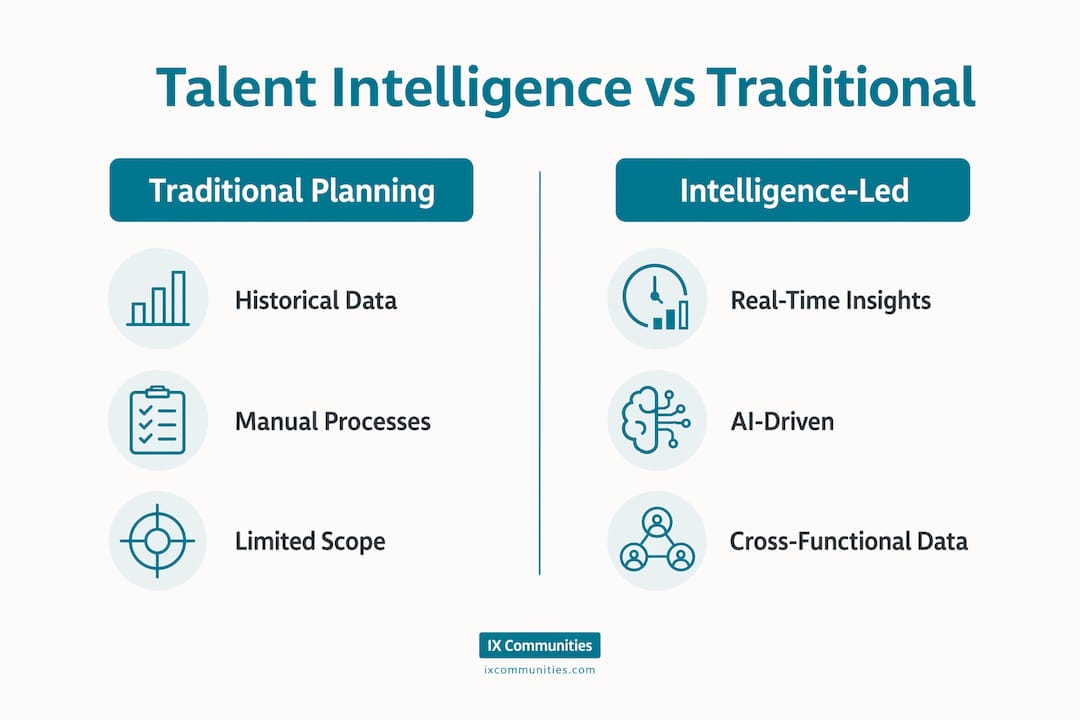
Data governance quality determines whether predictive modeling helps or misleads. Without clean historical data, AI-driven workforce models deliver biased results. A flawed model that confidently predicts the wrong hire is worse than no model at all. Leaders must treat data integrity as a non-negotiable foundation, not an IT concern.
Here are the critical steps for leaders during adoption:
- Audit existing data sources. Identify which HR systems hold usable data and where the gaps are before selecting any analytics tools.
- Establish data governance standards. Assign ownership for data quality across recruiting, L&D, and compensation teams.
- Define the first use case. Choose one specific workforce problem, such as a skill shortage or retention risk, to solve first.
- Align stakeholders early. Bring finance and operations into the conversation before the pilot launches, not after.
- Measure and report outcomes. Set clear metrics for the pilot and report results in business terms, not HR terms.
Pro Tip: The talent intelligence revolution what leaders need to know often gets reduced to tool selection. Resist that. Workforce intelligence best practices show that governance and culture decisions drive more of the outcome than the platform choice.
How talent intelligence supports leadership alignment and risk management
Talent intelligence grounds leadership conversations in shared data frameworks. When every leader in the room works from the same workforce picture, the conversation shifts from defending assumptions to making decisions. Shared data frameworks allow leaders to confidently anticipate workforce risks and align priorities rather than react to them after the fact.
Workforce risk management becomes proactive under this model. Leaders can see where critical skills are thinning out, which roles face external supply constraints, and where retention pressure is building. That visibility changes how organizations plan succession, structure teams, and allocate learning budgets. External talent data, in particular, powers better succession decisions by showing what the market can realistically supply versus what must be developed internally.
Balancing employee growth with shifting business priorities is another area where talent intelligence adds clarity. Leaders can model different scenarios, such as upskilling versus external hiring, and compare the cost, time, and risk of each path before committing.
| Dimension | Traditional workforce planning | Intelligence-led workforce planning |
|---|---|---|
| Data source | Internal surveys, manager input | Internal data plus real-time labor market feeds |
| Planning cycle | Annual or biannual | Continuous, updated as conditions change |
| Risk identification | Reactive, after vacancies appear | Proactive, based on predictive modeling |
| Decision confidence | Based on intuition and experience | Based on defensible, quantitative proof points |
| Cross-functional alignment | Siloed by department | Unified view across HR functions |
Real-world outcomes from advanced talent intelligence
Talent selection and retention are two sides of the same intelligence-led strategy. Enterprise HR leadership roles now combine these functions to create a unified workforce insight capability. Organizations that separate them miss the compounding effect: better selection reduces retention pressure, and better retention data improves future selection criteria.
The business outcomes are concrete. Organizations using talent intelligence report improvements in hiring quality, reductions in time to fill critical roles, and stronger employee engagement scores. The connection between talent management and recruiting becomes a measurable advantage when both functions draw from the same data pool.
AI-powered analytics also support the kind of B2B workforce planning that service-based organizations need when skills demand shifts faster than traditional hiring cycles can accommodate.
Measurable benefits organizations report from talent intelligence programs include:
- Faster identification of critical skill shortages before they affect project delivery
- Higher offer acceptance rates driven by better candidate fit data
- Reduced first-year attrition from improved role alignment at hire
- Stronger internal mobility rates as skills mapping reveals hidden talent
- More credible workforce plans that win CFO and board approval
The shift from process to intelligence in executive recruiting reflects this broader trend. Leaders who once relied on relationships and intuition now expect data to validate every major talent decision.
Key Takeaways
Talent intelligence succeeds when leaders treat it as a cross-functional data discipline, not a software deployment, grounding every workforce decision in defensible, real-time evidence.
| Point | Details |
|---|---|
| Define talent intelligence correctly | It combines internal workforce data with external labor market insights, not just recruitment analytics. |
| Start with one skill gap | A focused pilot targeting one critical shortage can deliver ROI within six months and build momentum. |
| Prioritize data governance | Clean, accurate historical data is the foundation; without it, predictive models produce misleading outputs. |
| Break down silos first | Recruiting, L&D, and compensation data must be integrated before advanced analytics can deliver value. |
| Ground leadership in shared data | Unified data frameworks shift leadership conversations from assumption-based to decision-ready. |
What I've learned about leading through the talent intelligence shift
The most common mistake I see is organizations buying a platform before they have answered the governance question. They invest in sophisticated analytics tools, then spend the next 18 months arguing about whose data is correct. The technology is not the hard part. Getting recruiting, compensation, and learning teams to agree on a single source of truth is the hard part.
The second pattern I notice is that leaders underestimate how much this work changes the HR function's relationship with the rest of the business. When HR shows up with defensible, quantitative workforce plans, the CFO conversation changes. Finance stops treating headcount as a cost line and starts treating it as a capability investment. That shift does not happen automatically. It requires HR leaders to present workforce data in business terms, consistently, over time.
My honest recommendation is to resist the pressure to go broad too fast. Pick the one talent gap that is causing the most business pain right now. Solve it with data. Report the outcome in revenue or delivery terms. Then use that win to fund the next phase. The talent intelligence revolution what leaders need to know is not a single transformation event. It is a series of credibility-building decisions that compound over time.
— Simon
Ixcommunities resources for talent intelligence leaders
Ixcommunities operates ESIX, TLIX, and IXCommunities, the preeminent peer networking and benchmarking groups for talent leadership professionals worldwide. Large corporate talent and recruiting departments use these communities to share practices, benchmark performance, and learn in a secure environment.
The ESIX Recruiter Peer Mentorship Programs connect recruiting leaders with experienced peers who have navigated the exact implementation challenges described in this article. The Talent Leaders Peer Mentoring Program supports HR executives building workforce intelligence capabilities at scale. Ixcommunities also provides benchmark surveys that give members real data to compare their talent programs against peer organizations, removing the guesswork from workforce planning decisions.
FAQ
What is talent intelligence in HR?
Talent intelligence is the practice of combining internal workforce data with real-time external labor market insights to make defensible, data-driven talent decisions. It shifts HR from reactive hiring to proactive workforce design.
How does talent intelligence differ from traditional HR analytics?
Traditional HR analytics reports on past activity, such as time to fill or turnover rates. Talent intelligence uses predictive modeling and external market data to anticipate future workforce risks and opportunities before they occur.
What is the biggest implementation risk for talent intelligence?
Poor data governance is the primary risk. Without clean, accurate historical data, predictive models produce biased outputs that can lead to poor hiring and workforce planning decisions.
How do leaders build a business case for talent intelligence?
Leaders build the strongest case by starting with a focused pilot that targets one critical skill shortage, measuring the outcome in business terms, and using that result to justify broader investment.
How does talent intelligence support employee retention?
Talent intelligence identifies retention risks early by analyzing skills gaps, engagement patterns, and market compensation data. Organizations that act on these signals reduce first-year attrition and improve internal mobility rates.