

Recruitment Process Outsourcing (RPO) is the transfer of ownership of all or part of an employer's recruitment process to an external specialist, who assumes responsibility for results under agreed service-level agreements. According to TechTarget's definition, the provider takes on finding, screening, and assessing candidates — not just supplying them. Organizations typically engage RPO for three reasons:
- Scalable hiring capacity: the ability to ramp volume up or down without adding permanent headcount to the TA function
- Improved quality-of-hire: access to specialist sourcing expertise, structured assessment, and dedicated recruiter focus
- Predictable recruitment cost: replacing variable agency spend with a defined cost model tied to outcomes
RPO is most common when an organization faces sustained high-volume hiring, needs specialized sourcing for hard-to-fill roles, or is undergoing a full TA transformation.
Key Takeaways
Recruitment Process Outsourcing transfers ownership of recruitment to an external specialist accountable for results under defined SLAs, making it a governance and accountability decision as much as a sourcing one.
| Point | Details |
|---|---|
| RPO definition | An external provider assumes ownership of all or part of recruitment, accountable for outcomes under agreed SLAs. |
| Fit signals | High volume, persistent sourcing gaps, heavy agency spend, and willingness to share data and governance are the clearest positive indicators. |
| KPIs to track | Time-to-fill, cost-per-hire, offer-acceptance rate, 90-day retention, and hiring manager satisfaction are the core measures. |
| Pricing caution | Per-hire, retainer, and gainshare models each carry different risk profiles; always negotiate against a documented internal baseline. |
| Vendor red flags | No transition plan, vague candidate ownership language, and KPIs defined as activity metrics rather than outcomes should stop any deal. |
| Ixcommunities | Peer benchmarking reports and mentorship programs give TA leaders the comparative data needed to evaluate RPO proposals before committing. |
Table of Contents
- What recruitment process outsourcing covers and how it works
- Common RPO engagement models and when to use each
- The measurable benefits of RPO and the KPIs to track
- How RPO pricing typically works
- How to decide whether RPO is a good fit for your organization
- How to choose an RPO provider: criteria, questions, and red flags
- What to expect during RPO implementation
- How RPO differs from BPO, MSP, contingent staffing, and retained search
- Peer-benchmarked KPIs and common outcomes from enterprise RPO
- The tradeoffs TA leaders need to weigh before committing to RPO
- Peer benchmarking before you commit to an RPO provider
- Sources
What recruitment process outsourcing covers and how it works
A typical RPO engagement can span the full hiring lifecycle: sourcing, screening, interview coordination, offer management, and early onboarding, all supported by recruiting technology such as an applicant tracking system. Hudson RPO's practitioner guide describes this scope clearly, noting that the provider integrates into the client's hiring process rather than operating as a separate vendor lane.
The key distinction from traditional agency use is ownership. ADP's RPO guide frames RPO as the long-term transfer of ownership of recruitment, where comprehensive partnerships include daily administration, strategic guidance, and exclusive candidate ownership. In practice, this means the RPO provider's recruiters often work under the client's employer brand, use the client's ATS, and are accountable to the client's hiring timelines.
Ownership transfer is the defining feature of RPO. When a provider assumes ownership, they are accountable for process design, delivery quality, and outcomes — not just candidate supply. That accountability is what separates RPO from a staffing agency relationship and is the basis for SLA-linked contracts.
Day-to-day governance typically includes weekly status reporting on open requisitions, monthly performance reviews against KPIs, and quarterly strategy sessions to adjust scope. Escalation pathways should be defined in the contract before go-live, specifying who resolves disputes over candidate ownership, data access, or SLA breaches.
Understanding the full recruitment process steps your team currently owns is a practical starting point before scoping what to transfer.
Common RPO engagement models and when to use each
Forbes Advisor's RPO guide notes that RPO has evolved from serving primarily large enterprises to offering customizable solutions for organizations of different sizes and hiring programs. Four models cover most use cases.
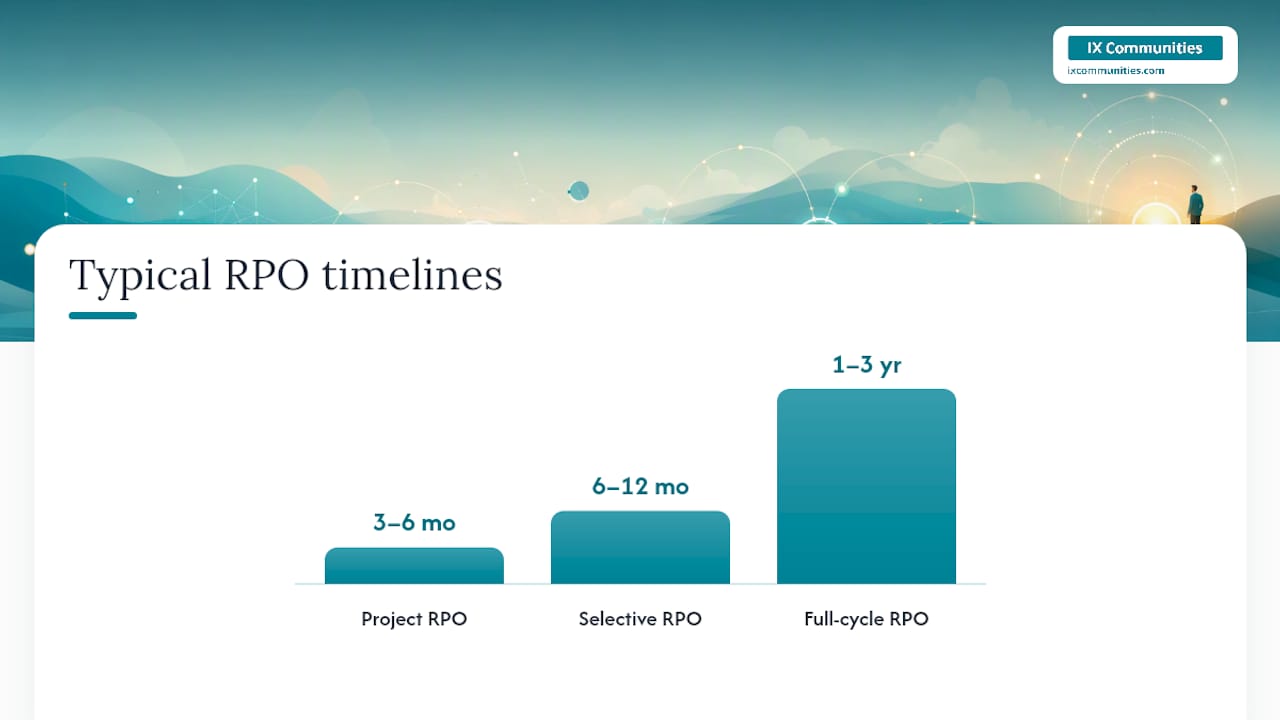
Project RPO is time-bound and volume-specific. A company opening a new facility or launching a product line hires an RPO provider for a defined number of roles over a fixed period. The contract ends when the project closes.
Selective RPO (also called single-function RPO) outsources one part of the hiring process or one skill category. A technology company might outsource only engineering sourcing while keeping all other hiring in-house. This model suits organizations with strong internal TA capacity that have one persistent gap.
Full-cycle RPO transfers end-to-end recruitment ownership to the provider. The provider supplies recruiters, technology, and reporting, and is accountable for all hires across the organization. This is the model most commonly associated with RPO and is suited to organizations undergoing TA transformation or managing large, ongoing hiring programs.
Hybrid RPO blends in-house recruiters, contract staff, and vendor resources. ADP's guide highlights blended models as practical for organizations with fluctuating requisition volumes, where a fixed full-cycle contract would be either over- or under-resourced at different points in the year.
| Model | Scope | Typical timeline | Contract shape | Buyer signal |
|---|---|---|---|---|
| Project RPO | Defined role set | 3–6 months | Fixed fee or per-hire | Surge hiring, new site opening |
| Selective RPO | One function or skill | 6–12 months | Monthly retainer or per-hire | One persistent sourcing gap |
| Full-cycle RPO | All requisitions | 1–3 years | Managed service / SoW | TA transformation, high volume |
| Hybrid RPO | Mixed in-house and vendor | Ongoing | Blended retainer + per-hire | Fluctuating volume, partial capability |
Pro Tip: Analysts emphasize that the primary barrier to RPO success is choosing a model without matching it to your actual hiring profile. Run a 12-month look-back on volume, role mix, and time-to-fill variance before selecting a model.
The measurable benefits of RPO and the KPIs to track
The core business benefits of RPO fall into six categories:
- Faster time-to-fill: dedicated sourcing pipelines and pre-screened talent pools reduce the time between requisition open and accepted offer
- Lower cost-per-hire: replacing agency fees with a defined RPO cost model typically reduces per-hire spend, particularly at volume
- Improved quality-of-hire: structured screening, consistent assessment criteria, and specialist sourcing produce more predictable hire quality
- Better candidate experience: a single, managed process with defined communication touchpoints reduces candidate drop-off
- Access to technology and talent pools: RPO providers bring ATS integrations, sourcing tools, and pre-built talent communities that most in-house teams cannot replicate at the same cost
- Scalability: volume can be adjusted within the contract without the lag of hiring or releasing internal TA staff
The KPIs that matter most in an RPO engagement are time-to-fill, cost-per-hire, quality-of-hire (measured by 90-day retention and hiring manager satisfaction scores), offer-acceptance rate, and candidate Net Promoter Score. Tracking hiring manager satisfaction separately from candidate NPS gives you two distinct signals: one on internal process quality, one on external brand experience.
Statistic note: Practitioner guides and vendor case studies, including Genius's RPO benefits analysis, cite claims such as large percentage reductions in cost-per-hire and time-to-fill. These figures are illustrative and case-specific. Use your own baseline data to model realistic improvement targets rather than applying vendor-published percentages directly.
A simple ROI model: calculate your current fully-loaded cost-per-hire (internal recruiter time, job board spend, agency fees, hiring manager time). Set a target improvement percentage based on peer benchmarks for your industry and volume tier. Multiply the improvement by your annual hire count to estimate annual savings, then compare against the RPO contract cost.
Common recruitment challenges that RPO directly addresses include inconsistent sourcing quality, high agency dependency, and poor visibility into pipeline metrics.
How RPO pricing typically works
RPO pricing varies by model, volume, and scope. Four structures cover most contracts.
Per-hire fee: the provider charges a fixed amount per filled role. This is common in project RPO and straightforward to budget. Cost rises directly with volume, which makes it predictable but potentially expensive at scale.
Monthly retainer (managed service): a fixed monthly fee covers a defined scope of service, typically for full-cycle RPO. Predictable for budgeting; requires careful scope definition to avoid disputes over what is included.
Gainshare / cost-per-hire reduction model: the provider's fee is tied to demonstrated savings against a baseline cost-per-hire. Aligns incentives but requires a credible baseline and agreed measurement methodology before contract start.
Outsourced FTE model: the client pays for dedicated recruiter headcount supplied by the provider. Common in hybrid models where the client wants named, embedded recruiters rather than a managed output.
Primary cost drivers include hiring volume (higher volume typically reduces per-hire cost), role complexity and seniority (executive and technical roles cost more to source), geographic spread and compliance requirements (multi-state or international hiring adds cost), technology access (providers who supply their own ATS or sourcing tools may charge separately), and onboarding responsibilities (the more of the post-offer process the provider owns, the higher the fee).
| Scenario | Model | Key cost driver | Approximate structure |
|---|---|---|---|
| High-volume hourly hiring | Per-hire or managed service | Volume, standardized process | Lower per-hire fee at scale |
| Specialized technical or executive roles | Per-hire or outsourced FTE | Role complexity, sourcing depth | Higher per-hire fee, longer fill time |
A hiring process audit before contract negotiation gives you the baseline data needed to evaluate which pricing model aligns with your actual cost structure.
How to decide whether RPO is a good fit for your organization
RPO fits well when several conditions are present simultaneously. Sustained high hiring volume, inconsistent outcomes across business units, heavy reliance on agency spend, limited internal TA technology, and an upcoming large-scale hiring program are all positive signals. Organizations preparing for geographic expansion or a significant workforce transformation also tend to benefit.
RPO is a poor fit when hiring volume is low and infrequent, when the organization requires highly localized or boutique cultural hiring that depends on deep internal relationships, or when leadership is unwilling to share data, governance access, or process ownership with a third party. The last point is often underestimated: RPO requires genuine data sharing and process transparency to function.
A practical fit test: If you cannot answer these four questions with current data, RPO will be difficult to scope and even harder to measure. What is your current annual hire volume? What is your average cost-per-hire by role category? What is your average time-to-fill by department? What percentage of hires come through agencies versus direct sourcing? Organizations that lack this baseline often find that the first value an RPO provider delivers is simply establishing the measurement infrastructure.
Fit checklist for TA leaders:
- Annual hire volume exceeds the capacity of your current internal team
- You have at least one persistent sourcing gap by function or geography
- Current cost-per-hire is above industry benchmark for your sector
- Time-to-fill variance across business units is high and unexplained
- Your TA team spends more than 30% of its time on administrative tasks
- Leadership is willing to define and share hiring KPIs with a vendor
Why hiring is getting harder in 2026 provides useful context on the labor-market pressures that make this checklist more urgent for many organizations.
How to choose an RPO provider: criteria, questions, and red flags
Evaluating RPO providers requires a structured approach across six dimensions: delivery model and recruiter quality, technology and ATS integration capability, data and reporting infrastructure, transition and knowledge transfer planning, compliance and data security, and cultural alignment with your hiring brand.
Vendor evaluation checklist:
- Request a sample SLA document and confirm KPIs are specific and measurable
- Ask for a technology stack overview and confirm ATS integration compatibility
- Review the transition plan: who owns knowledge transfer, and over what timeline?
- Confirm candidate ownership terms in writing before any proposal stage
- Verify data security certifications and confirm where candidate data is stored
- Ask for references from clients with a similar hiring profile (volume, role mix, geography)
- Confirm the escalation pathway for SLA breaches
Must-ask questions for vendor calls:
- Who are the named recruiters assigned to our account, and what is your recruiter-to-requisition ratio?
- How do you handle volume spikes beyond the contracted scope?
- What happens to candidate data and pipeline records if we exit the contract?
- How do you measure and report quality-of-hire, and at what interval?
- What is your process for replacing an underperforming recruiter on our account?
- How do you manage compliance for multi-state hiring?
- What ATS platforms have you integrated with in the last 12 months?
- Can you provide a client reference who exited the contract and describe how that transition was managed?
Key contract terms to negotiate: SLAs linked directly to KPIs (not activity metrics), explicit candidate ownership language, exit and transition terms with a defined handover period, data ownership clauses that confirm all pipeline data reverts to the client, and confidentiality provisions covering your talent strategy and compensation data.
Red flags that should stop a deal: no written transition plan, vague or missing candidate ownership language, KPIs defined as activity metrics rather than outcomes, single-person dependency on a named account manager with no backup, and unwillingness to provide client references from completed or exited engagements.
Why recruiting CRMs fail offers relevant context on technology and integration risks that apply equally to RPO vendor selection.
Pro Tip: Ask every finalist provider to walk you through a real SLA breach scenario from a current client engagement. How they describe the resolution process tells you more about operational maturity than any RFP response.
What to expect during RPO implementation
A standard RPO implementation moves through four phases, each with defined gating criteria before the next begins.
| Phase | Typical duration | Key activities | Gating criteria |
|---|---|---|---|
| Discovery and design | 4–6 weeks | Process mapping, ATS setup, SLA definition, recruiter assignment | Signed SLA, confirmed tech integration, named account team |
| Transition and knowledge transfer | 4–8 weeks | Handover of open requisitions, hiring manager introductions, brand and culture briefings | All active reqs transferred, hiring manager sign-off |
| Pilot and early hires | 6–8 weeks | First hires under RPO management, KPI baseline established | First hires completed, initial KPI data available |
| Scale and steady-state | Ongoing | Full volume, monthly reporting, quarterly strategy review | Consistent KPI performance against SLA targets |
Governance cadence after go-live: weekly check-ins during the transition phase, monthly executive reviews against KPI dashboards, and quarterly strategy resets to adjust scope, volume projections, and contract terms. The quarterly reset is where most organizations either extend scope or identify gaps in the original design.
An implementation checklist for TA teams: confirm ATS access and permissions before day one, brief all hiring managers on the new process and point of contact, establish a shared reporting dashboard, define the internal escalation path for hiring manager complaints, and schedule the first quarterly review before go-live.
Recruiting best practices your team should retain internally even during full-cycle RPO include employer brand management, executive hiring strategy, and workforce planning.
How RPO differs from BPO, MSP, contingent staffing, and retained search
These models are frequently confused in vendor conversations, and the distinctions matter for contract terms and buyer expectations.
- RPO vs. BPO: RPO is a subset of business process outsourcing, but BPO covers multiple HR or business functions. RPO is scoped specifically to recruitment. Buyers who conflate the two often end up with contracts that include HR administration or payroll functions they did not intend to outsource, which changes cost and governance significantly.
- RPO vs. MSP (Managed Service Provider): MSP manages contingent and contract workforce procurement, typically through a vendor-neutral model. RPO manages permanent and direct-hire recruitment. Organizations with both permanent and contingent hiring needs sometimes use both models simultaneously.
- RPO vs. contingent staffing: A staffing agency supplies candidates for discrete roles and retains ownership of the recruitment process. RPO providers assume ownership of process design and delivery, not just candidate supply. The accountability model is fundamentally different.
- RPO vs. retained search: Retained search is a high-touch, relationship-driven model for senior or executive roles, typically with a single search firm. RPO is a volume and process model. The two are not interchangeable, though some organizations use retained search for C-suite roles while running RPO for all other hiring.
When to prefer each:
- Use RPO when you need scalable, process-owned recruitment for permanent roles at volume
- Use MSP when your primary challenge is managing a large contingent or contractor workforce
- Use contingent staffing for discrete, short-term role fills where process ownership is not required
- Use retained search for senior leadership roles where relationship depth and confidentiality are the primary requirements
The difference between RPO and BPO is particularly worth clarifying in contract negotiations, as scope creep from RPO into broader HR outsourcing is a common and costly mistake.
Peer-benchmarked KPIs and common outcomes from enterprise RPO
Benchmark ranges for common RPO KPIs vary by industry, role type, and organization size. The figures below reflect ranges commonly cited in practitioner guides and should be validated against your internal baseline and peer data before use as targets.
| KPI | Typical benchmark range | Notes |
|---|---|---|
| Time-to-fill (all roles) | 30 days | Varies significantly by role seniority and market |
| Cost-per-hire | $4,000 (mid-market) | Agency-heavy models often run higher before RPO |
| Offer-acceptance rate | 85% | Lower rates often indicate compensation or process issues |
| Hiring manager satisfaction | 75% favorable | Measured via post-hire survey at 30 days |
| 90-day retention (quality indicator) | 88% | Strong proxy for quality-of-hire in volume hiring |
Common implementation pitfalls observed by practitioners: underestimating the time required for knowledge transfer (particularly for niche or technical roles), failing to brief hiring managers on the new process before go-live, setting KPI targets without an internal baseline, and not defining exit terms before signing. Each of these is recoverable, but all are easier to prevent than to fix mid-engagement.
RPO providers need time to learn your hiring brand, build pipelines, and calibrate with hiring managers. Holding them to full-performance targets in month two creates friction that damages the relationship before it has a chance to mature.*
Screening automation used by RPO providers is one area where technology expectations often diverge between client and vendor. Confirm the provider's screening methodology and tooling during the evaluation phase, not after contract signature.
The tradeoffs TA leaders need to weigh before committing to RPO
RPO is not a decision to make based on vendor sales materials alone. The core tradeoff is control versus scale. When you transfer process ownership to an external provider, you gain capacity and specialist expertise, but you accept a degree of dependency on that provider's recruiters, technology, and judgment. That dependency is manageable with strong governance, but it does not disappear.
The second tradeoff is speed versus quality. RPO providers are incentivized to fill roles, and without well-designed quality-of-hire metrics in the SLA, time-to-fill can become the dominant measure. TA leaders who want RPO to improve hire quality, not just hiring speed, need to build quality metrics into the contract from day one and review them monthly.
The third consideration is internal capability. Organizations that outsource recruitment entirely for several years sometimes find that internal TA knowledge atrophies. If your long-term strategy includes rebuilding an in-house TA function, design the RPO engagement with a knowledge transfer obligation built into the exit terms from the start.
Positioning RPO to executive stakeholders works best when framed around measurable outcomes: cost-per-hire reduction against a defined baseline, time-to-fill improvement by role category, and quality-of-hire measured by 90-day retention. Executives respond to numbers tied to business outcomes, not to process descriptions. Why exec recruiters are becoming strategic advisors is relevant context for how the TA function's strategic role changes when operational hiring is outsourced.
Peer benchmarking before you commit to an RPO provider
Before signing an RPO contract, the most useful data you can have is what peers at comparable organizations actually experienced: their cost-per-hire baselines, their KPI targets at month six, the vendor questions that surfaced the most useful information, and the contract terms they wish they had negotiated differently.
Ixcommunities gives TA leaders direct access to that peer data. Benchmark surveys cover KPI ranges by industry, organization size, and hiring model, giving you the baseline comparisons needed to evaluate an RPO proposal against what peers are actually paying and achieving. The ESIX peer mentorship program connects you with experienced talent leaders who have evaluated, implemented, and in some cases exited RPO engagements, offering direct guidance that no vendor RFP process can replicate. Guest speaker sessions and peer panels bring practitioner perspectives on RPO selection and governance to members on a regular basis. For TA leaders who want to make a well-grounded recommendation to their executive team, Ixcommunities membership provides the peer input and benchmark data to do that with confidence.
Sources
The sources below were used to build this article and represent the highest-value references for TA leaders who want to go deeper on RPO definitions, pricing, and vendor selection.
- What Is Recruitment Process Outsourcing (RPO)? | Definition from TechTarget
- What is Recruitment Process Outsourcing? | Guide to RPO - ADP