

AI now handles the administrative and data-intensive work that once consumed the majority of recruiter time, freeing talent acquisition professionals to focus on judgment-intensive decisions that machines cannot reliably make. The role of AI in recruiting today is augmentation: automating sourcing at scale, parsing and ranking resumes, screening candidates through conversational interfaces, scheduling interviews, and generating analytics that surface patterns across the hiring funnel. High-stakes decisions about culture fit, leadership potential, and offer negotiation remain human responsibilities.
What TA teams can expect from AI today:
- Sourcing at scale: AI maps talent supply across job boards, LinkedIn, and internal databases, then surfaces ranked candidate lists based on role requirements.
- Resume parsing and matching: Natural language processing (NLP) extracts structured data from unstructured resumes and scores candidates against job criteria.
- Conversational screening: Chatbots conduct initial qualification conversations, collect availability, and answer candidate questions around the clock.
- Interview scheduling: Automated coordination tools eliminate the back-and-forth between recruiters, candidates, and hiring managers.
- Funnel analytics: Predictive models identify drop-off points, forecast time-to-fill, and flag sourcing channels that produce quality hires.
SHRM reports that between 35% and 45% of companies have adopted AI in hiring workflows. The same source notes that 85% of employers say AI saves time and 86.1% report it accelerates hiring. Those figures reflect adoption across company sizes and sectors; they do not represent an upper limit.
Table of Contents
- What measurable impact does AI have on recruiting KPIs?
- Where is AI actually used across the hiring workflow?
- Which AI tool categories should TA teams evaluate?
- What are the ethical and legal requirements for AI in U.S. hiring?
- How do you pilot, evaluate, and scale AI in talent acquisition?
- How does AI change what recruiters actually do?
- Peer benchmarking metrics for AI pilot results
- Key Takeaways
- AI in recruiting rewards governance, not just adoption
- Ixcommunities supports TA teams benchmarking AI in hiring
- Useful sources and further reading
What measurable impact does AI have on recruiting KPIs?
The business case for AI in talent acquisition rests on documented improvements across several key performance indicators. Research published in F1000Research found a significant positive effect for recruitment efficiency (β = 0.61, p < 0.001), while the same study found only a modest effect on bias mitigation (β = 0.21, p < 0.05). That gap between efficiency gains and fairness outcomes is one of the most important findings for TA leaders to internalize before building a business case.

| KPI | Typical baseline | AI-enabled outcome | Evidence strength |
|---|---|---|---|
| Time-to-shortlist | 5 days | Up to ~40% faster in high-volume contexts | Moderate (varies by sector) |
| Cost-per-hire | Varies by role | Moderate reduction reported | Moderate (practitioner examples) |
| Recruiter time on admin | a substantial portion of the work week | Significantly reduced | Strong |
| Candidate response rate | Low for cold outreach | Higher with personalized AI sequencing | Moderate |
| Candidate NPS | Baseline varies | Improved with chatbot availability | Emerging |
| Diversity pipeline | Baseline varies | Modest improvement; not automatic | Weak without governance |
The ~40% faster shortlisting figure comes from high-volume hiring contexts and does not transfer uniformly to specialized or executive roles. For those segments, AI's contribution is more about surfacing overlooked candidates than compressing timelines. See AI in talent acquisition: what's real vs. hype for a more detailed breakdown of where vendor claims diverge from documented outcomes.
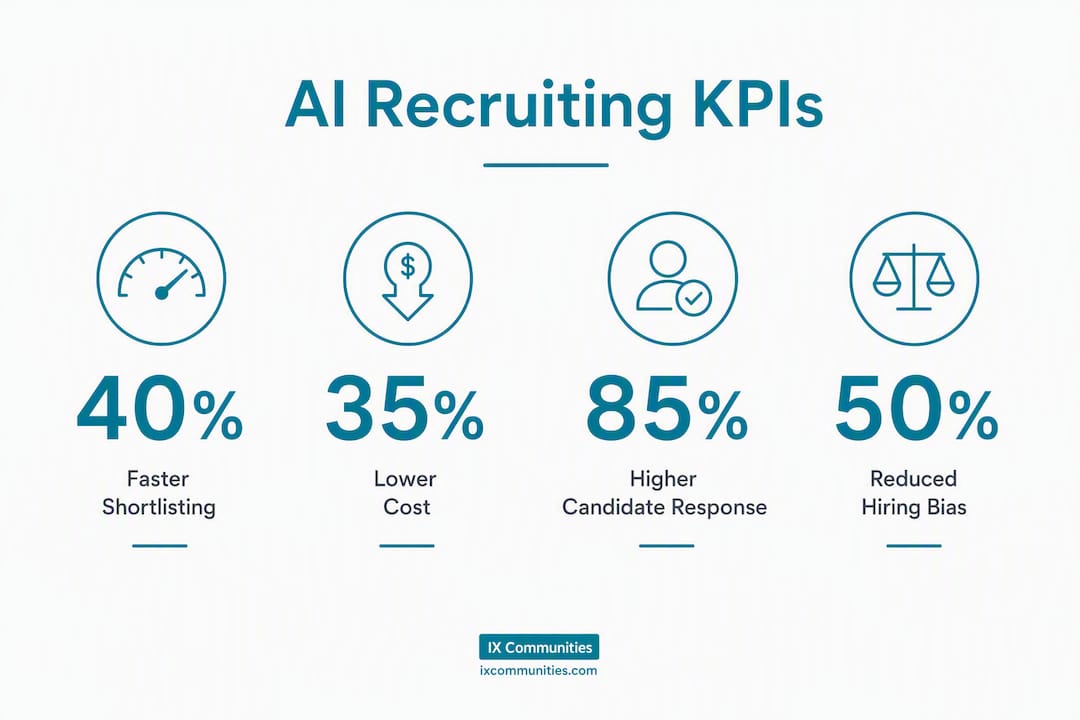
Candidate experience improvements are real but conditional. When chatbots are well-designed and candidates receive timely status updates, satisfaction scores rise. When chatbots are opaque or fail to escalate to a human, the effect reverses. Diversity outcomes follow a similar pattern: AI can widen the sourcing net and reduce some forms of subjective screening error, but it does not automatically produce a more diverse pipeline without deliberate fairness testing.
Where is AI actually used across the hiring workflow?
A systematic review covering AI applications in recruitment from 2020 through early 2025 categorizes the main techniques as NLP, machine learning (ML) classification, predictive models, generative chatbots, and interview analysis. Each maps to a distinct stage in the hiring workflow.
- Sourcing: ML ranking models scan talent databases and public profiles, score candidates against role requirements, and generate prioritized outreach lists. The practical output is a ranked shortlist that a recruiter reviews rather than builds from scratch.
- Resume screening: NLP extracts skills, tenure, and credentials from unstructured documents and matches them to job criteria. Recruiters see a scored list rather than a raw stack.
- Candidate outreach and engagement: Generative AI drafts personalized outreach sequences; conversational AI handles initial qualification, collects availability, and answers FAQs. Candidates can engage at any hour without waiting for a recruiter.
- Interview scheduling: Coordination agents read calendar availability across all parties and confirm slots automatically, eliminating the scheduling bottleneck that delays many funnels.
- Interview analysis: AI transcribes and analyzes recorded interviews, flagging structured competency signals and generating summaries for hiring managers. This is one of the more contested applications from a legal standpoint.
- Assessments: Adaptive testing platforms adjust question difficulty in real time and score responses against validated competency models. Proctoring tools monitor for irregularities during remote assessments.
- Workforce planning and analytics: Predictive models forecast attrition, model talent supply for future roles, and identify internal mobility candidates before a vacancy opens.
- Onboarding handoffs: AI-generated summaries of candidate profiles, interview notes, and assessment results pass structured context to onboarding teams, reducing information loss at the hire/start boundary.
| Capability tier | Typical tools | Impact on funnel | Implementation effort | ATS integration complexity |
|---|---|---|---|---|
| Entry-level automations | Resume parsers, scheduling assistants | Moderate time savings | Low | Low to moderate |
| Candidate engagement agents | Conversational AI, outreach sequencers | Higher response rates, better candidate experience | Moderate | Moderate |
| Predictive analytics overlays | Scoring models, attrition forecasters | Improved shortlist quality, strategic planning | High | High |
For a closer look at where AI is being used in talent acquisition today, the practical distribution of adoption skews heavily toward the top of the funnel: sourcing, screening, and scheduling account for the majority of current deployments.
Which AI tool categories should TA teams evaluate?
The vendor market for AI in recruiting has fragmented into several distinct categories. Understanding what each category solves, and what it does not, is the starting point for a rational evaluation process.
- ATS with native AI features: Modern applicant tracking systems now embed resume scoring, candidate ranking, and basic chatbot functionality. The advantage is a single data environment; the limitation is that native AI features are often less sophisticated than purpose-built tools.
- Sourcing and search platforms: These tools scan external talent pools, score candidates against job requirements, and generate outreach. A TA team would choose this category when the primary constraint is pipeline volume or passive candidate reach.
- Conversational screening and chatbots: Deployed at the top of the funnel to qualify applicants, collect information, and answer questions. Best suited to high-volume roles where recruiter bandwidth is the bottleneck.
- Assessment and proctoring platforms: Structured cognitive, skills-based, or behavioral assessments with automated scoring. Useful when hiring managers need standardized evidence of competency before the interview stage.
- Interview analysis engines: Tools that transcribe, score, and summarize recorded interviews. These carry the highest legal scrutiny and require the most careful governance before deployment.
- Scheduling and coordination assistants: Narrow tools that automate calendar management. Low risk, fast ROI, and easy to integrate.
- Analytics and workforce planning tools: Platforms that aggregate funnel data, model talent supply, and forecast hiring needs. These require clean, consistent data inputs to produce reliable outputs.
One consistent risk across all categories is data fragmentation. Practitioners recommend using AI as an overlay that syncs bi-directionally with the ATS, keeping the ATS as the single source of truth. Buying point solutions that create a parallel candidate database leads to ghost candidates, stale information, and broken reporting. Automated HR document workflows face the same risk; integrating document automation with your ATS from the start prevents data silos from forming downstream.
What are the ethical and legal requirements for AI in U.S. hiring?
The legal and ethical obligations for AI in U.S. hiring are specific and consequential. TA leaders who treat compliance as a post-deployment concern rather than a design requirement expose their organizations to significant legal and reputational risk.
U.S. legal framework:
- EEOC adverse impact: Title VII of the Civil Rights Act applies to AI-assisted selection decisions. If an AI tool produces statistically significant disparate impact on a protected class, the employer bears the burden of demonstrating job-relatedness and business necessity. The EEOC has issued technical guidance confirming that employers remain liable for discriminatory outcomes produced by third-party AI tools.
- FTC guidance: The FTC has signaled that automated decision-making tools that deceive consumers or produce unfair outcomes fall within its enforcement authority. Transparency about AI use in hiring is increasingly expected.
- NIST AI Risk Management Framework: NIST's framework provides a practical structure for assessing explainability, accountability, and risk across AI systems. TA teams can use it to structure vendor evaluations and internal governance.
Research confirms that fairness, transparency, and accountability remain central unresolved challenges in hiring AI. Operationalizing fairness requires deliberate design, not passive reliance on vendor claims.
Ethics and compliance checklist:
- Confirm the vendor provides demographic impact reports and adverse impact analyses.
- Verify that audit logs capture the inputs and outputs of every AI-assisted decision.
- Document training data provenance: what data was the model trained on, and does it reflect your candidate population?
- Provide candidate notice where required (several U.S. states and municipalities now mandate disclosure of AI use in hiring).
- Define data retention and deletion policies for candidate data processed by AI tools.
- Require feature-level explanations: can the vendor explain why a specific candidate was ranked where they were?
Pro Tip: Schedule algorithmic audits at least twice per year, not just at deployment. Model drift, changes in applicant pools, and role requirement updates can all shift a tool's impact on protected groups over time. Sample-based human review of AI rankings before each new role type goes live is a practical first control.
AI does not automatically reduce bias. The evidence is clear that trust and explainability are not significantly improved by AI deployment alone (β = 0.08, not statistically significant in the F1000Research study). Governance must be built in deliberately.
How do you pilot, evaluate, and scale AI in talent acquisition?
A structured pilot process reduces the risk of deploying AI tools that underperform, create compliance exposure, or fragment candidate data. The following sequence applies whether a team is evaluating its first AI tool or expanding from a single use case to an enterprise deployment.
- Define the job AI should do. Write a specific job description for the AI: what decisions or tasks will it handle, what inputs will it receive, and what outputs will it produce? Vague mandates produce vague results.
- Set measurable success criteria before the pilot begins. Choose two or three KPIs (time-to-shortlist, recruiter hours saved, candidate response rate) and establish baselines. Without pre-pilot baselines, post-pilot claims are unverifiable.
- Run a time-bound pilot with human-in-the-loop review. Four to eight weeks on a single role type or business unit is sufficient to generate meaningful data. Every AI output should be reviewed by a recruiter during this phase.
- Measure KPIs against baselines and assess fairness. Pull demographic data on who the AI surfaced, ranked, and advanced. Compare to your historical funnel. Flag any disparities before proceeding.
- Iterate on configuration before scaling. Most AI tools require calibration: adjusting weighting, retraining on your data, or refining the job criteria the model uses. Treat this as a required step, not an optional one.
- Scale with governance in place. Define who owns the AI tool, who reviews its outputs, and how disputes about AI recommendations are resolved. Document the governance structure before expanding to additional role types.
Vendor evaluation questions for RFPs:
- How does the tool integrate with our ATS, and is the sync bi-directional?
- What explainability features are available at the individual candidate level?
- Can you provide a demographic impact report from a comparable deployment?
- What are your data retention and deletion policies for candidate data?
- How frequently is the model updated, and what is the SLA for notifying customers of changes?
- Can you provide sample outputs (ranked lists, screen summaries) from a test data set?
Red flags to watch for:
- Opaque ranking logic with no candidate-level explanation.
- One-way data flow that writes to a proprietary database rather than syncing back to the ATS.
- No audit logs for AI-assisted decisions.
- Vendors who decline to share sample outputs or test cases during evaluation.
- Claims of bias elimination without supporting demographic impact data.
Pro Tip: Treat the AI agent like a new hire. Onboard it with a structured calibration period, require recruiters to review and correct its outputs for the first several weeks, and document what you learn. Practitioners consistently recommend this approach as the most reliable way to align AI output with company-specific hiring standards before granting it greater autonomy.
How does AI change what recruiters actually do?
The day-to-day work of a recruiter shifts significantly when AI handles sourcing, screening, and scheduling. The change is not a reduction in headcount; it is a reallocation of time toward work that requires human judgment.
- Less time on: Resume review, cold outreach drafting, interview scheduling, status update emails, and manual reporting.
- More time on: Candidate relationship management, stakeholder advising, offer negotiation, employer brand conversations, and strategic workforce planning.
- New required skills: Data literacy (reading funnel analytics and interpreting model outputs), vendor governance (auditing AI tools and managing SLAs), AI calibration (adjusting model inputs and reviewing outputs), and consultative interviewing.
The replacement question comes up in every leadership discussion about AI in hiring. The evidence-based answer is that AI augments rather than replaces recruiters, particularly for complex or senior roles. Research on executive search consistently shows that relationship-intensive, judgment-heavy hiring decisions remain human-led. What AI replaces is the administrative overhead that prevented recruiters from spending more time on those decisions.
Hybrid human-machine decision models, where AI makes recommendations and humans retain accountability, produce better outcomes than fully automated systems. That finding holds across sectors and role types.

Pro Tip: Redesign recruiter KPIs when you deploy AI. If throughput metrics (resumes reviewed, calls made) remain the primary measure of performance, recruiters have no incentive to use AI outputs thoughtfully. Shift toward candidate engagement quality, hiring manager satisfaction, and quality-of-hire proxies.
Peer benchmarking metrics for AI pilot results
TA teams that run AI pilots without a structured benchmarking framework often struggle to present results to leadership in a way that drives decisions. The following template provides a starting point for capturing and comparing pilot data.
| Metric | Pre-pilot baseline | Pilot result | Peer benchmark target | Notes |
|---|---|---|---|---|
| Time-to-shortlist (days) | Record actual | Record actual | Up to ~40% reduction in high-volume roles | Varies by role type |
| Candidate funnel conversion (apply → screen) | Record actual | Record actual | Improvement expected with chatbot screening | Track by channel |
| Quality-of-hire proxy (retention, hiring manager rating) | Record actual | Record actual | No universal benchmark; track internally | Requires post-hire data |
| Diversity at shortlist stage | Record actual | Record actual | Neutral or positive vs. baseline | Requires demographic data |
| Candidate NPS | Record actual | Record actual | Improvement with chatbot engagement | Survey at application stage |
| Model explainability score | N/A | Vendor-provided | Audit log available; candidate-level explanation available | Binary: yes/no |
Suggested peer discussion prompts for Ixcommunities meetings:
- Which KPI moved most in your pilot, and which one surprised you by not moving?
- Where did you find governance gaps you had not anticipated before deployment?
- How did your hiring managers respond to AI-generated candidate summaries?
- What did you learn about your ATS data quality that the AI pilot exposed?
- How are you presenting AI pilot results to your executive team, and what questions are you getting?
When presenting pilot results to leadership, lead with three numbers: time-to-shortlist change, cost-per-hire change, and one quality-of-hire proxy. Follow with a risk summary that addresses fairness findings and any compliance actions taken. Close with a recommended next step and the resource requirement to execute it. Benchmark surveys from Ixcommunities give TA leaders access to peer data that contextualizes their own pilot results against comparable organizations.
Key Takeaways
AI augments recruiter capacity by automating administrative tasks and surfacing data-driven shortlists, but governance, fairness testing, and human oversight are required for the efficiency gains to hold without legal or reputational risk.
| Point | Details |
|---|---|
| Augmentation, not replacement | AI handles sourcing, screening, and scheduling; high-stakes hiring decisions remain human responsibilities. |
| Efficiency gains are documented | Up to ~40% faster shortlisting in high-volume contexts; moderate cost-per-hire reduction in practitioner examples. |
| Bias is not automatic | F1000Research found only a modest effect on bias mitigation (β = 0.21); governance and audits are required. |
| Governance before scale | Define success criteria, run a time-bound pilot with human review, and audit fairness before expanding. |
| Ixcommunities peer benchmarking | Ixcommunities benchmark surveys and peer groups give TA leaders structured data to contextualize AI pilot results. |
AI in recruiting rewards governance, not just adoption
The most common mistake TA leaders make with AI is treating deployment as the finish line. The organizations that see sustained gains from AI in recruiting are not necessarily the ones that adopted earliest; they are the ones that built governance structures, calibrated their tools against real candidate populations, and created feedback loops between AI outputs and recruiter judgment.
The efficiency numbers are real. Faster shortlisting, lower cost-per-hire, and higher candidate response rates are documented outcomes. But the F1000Research data makes a point that vendor marketing rarely emphasizes: explainability and trust do not improve automatically when AI is deployed. They require deliberate design. A tool that produces a ranked list without a candidate-level explanation is not just a compliance risk; it is a tool that recruiters cannot learn from or correct.
The peer benchmarking dimension is underused. Most TA teams run pilots in isolation, without access to comparable data from organizations at a similar scale and maturity. That isolation makes it harder to distinguish a genuine performance gain from a favorable pilot condition, and it makes it harder to build a credible business case for leadership. Structured peer comparison changes that dynamic.
The future of AI in hiring will be shaped less by the tools themselves and more by the governance frameworks and peer knowledge networks that TA leaders build around them.
Ixcommunities supports TA teams benchmarking AI in hiring
TA leaders who are piloting or scaling AI in their recruiting functions face a specific challenge: the vendor market moves faster than internal governance can keep up, and there is limited peer data available to validate whether pilot results are genuinely strong or simply better than a weak baseline.
Ixcommunities addresses that gap directly. Through ESIX Recruiter Peer Mentorship Programs, members work with experienced talent leaders on governance design, pilot structure, and AI vendor evaluation. The benchmark surveys provide structured peer data on time-to-shortlist, cost-per-hire, and quality-of-hire metrics across comparable organizations, giving TA teams the context they need to present credible results to leadership. Members also bring AI pilot findings directly to peer group discussions for structured feedback from leaders running similar programs. To access peer benchmarking data and mentorship for your AI recruiting initiative, explore Ixcommunities membership.
Useful sources and further reading
The following sources support the claims in this article and provide additional depth for TA leaders building business cases or governance frameworks.
- The Evolving Role of AI in Recruitment and Retention — SHRM's primary resource on adoption rates, time savings, and practitioner guidance on ATS integration and AI calibration.
- AI in Recruiting: Smarter Hiring Starts Here — Practical implementation guide covering tool categories and candidate experience considerations.
- The Future of Hiring: The Role of AI in Modern Recruitment — SHRM's forward-looking analysis of AI's strategic impact on talent acquisition.
- Ixcommunities Benchmark Surveys — Peer benchmarking data for TA leaders comparing AI pilot metrics against comparable organizations.