

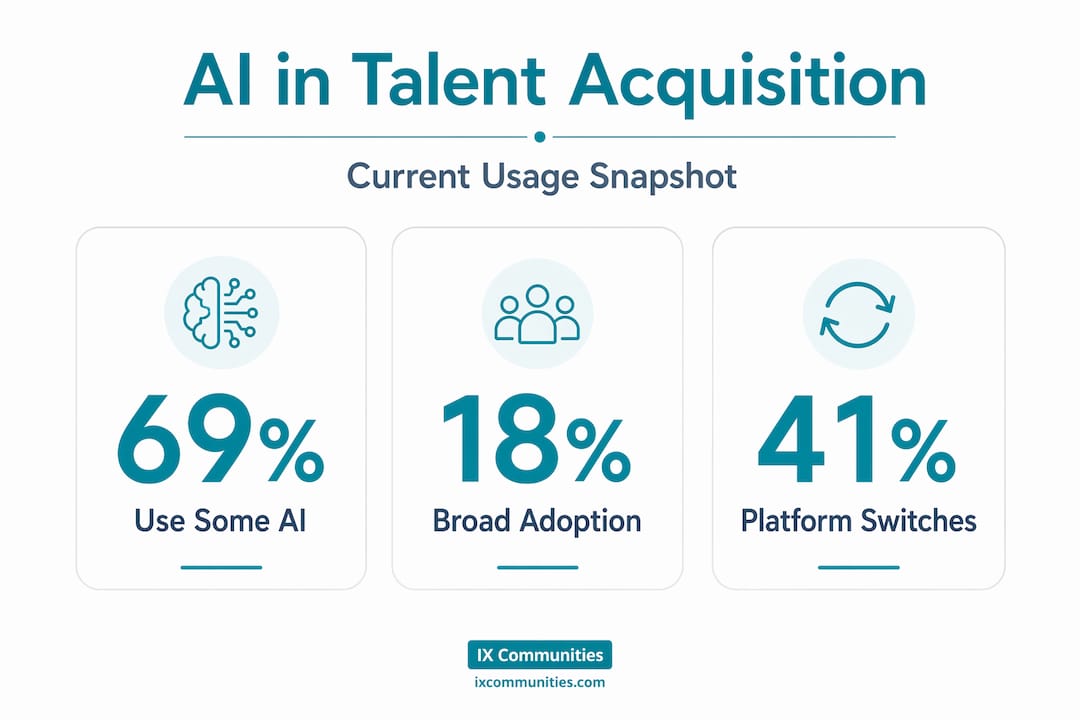
The gap between AI adoption claims and real deployment tells a different story than most vendors present. Only 18% of companies use AI broadly across their hiring processes, even though 69% report using it in some capacity. For talent acquisition professionals trying to make informed technology decisions, the question of where AI is actually being used in talent acquisition today matters more than what vendors claim is possible. This article focuses on what is running in production, where the real gaps are, and how TA leaders can deploy AI where it genuinely improves outcomes.
Table of Contents
- Key takeaways
- Where AI is actually being used in talent acquisition today
- Challenges and gaps in AI deployment
- Emerging AI capabilities in recruiting
- Practical recommendations for TA leaders
- My perspective on the AI reality in talent acquisition
- How Ixcommunities supports TA leaders navigating AI
- FAQ
Key takeaways
| Point | Details |
|---|---|
| Adoption gap is real | Most organizations have an AI tool active but run it across less than half of open requisitions. |
| Proven deployment areas | Screening, scheduling, and sourcing show consistent production-scale results in 2026. |
| Integration drives failure | ATS compatibility problems are the leading cause of platform abandonment within two years. |
| Agentic AI is emerging | Autonomous sourcing agents now operate continuously but still require structured human approval steps. |
| Measurement determines impact | Tracking requisition coverage and recruiter hours saved separates AI impact from AI activity. |
Where AI is actually being used in talent acquisition today
Understanding where AI delivers real value starts with separating tool availability from meaningful use. 62% of TA teams have at least one AI recruiting tool live, but only 38% run those tools across more than half of relevant requisitions. That discrepancy reflects the core challenge in the industry right now: AI is present but often underdeployed.
Here is where production-scale use is concentrated in 2026:
- Resume screening and ranking. Automated resume parsing and candidate ranking are the most common live applications. These tools process large applicant volumes and surface ranked shortlists, reducing time spent on initial review.
- Interview scheduling. AI scheduling assistants coordinate availability across candidates and hiring panels without manual back-and-forth. This category has strong adoption and measurable time savings.
- AI-driven structured interviews. Interview automation platforms run structured evaluations at scale. Eightfold AI Interviewer reduces time-to-interview by up to 99% and compresses time-to-hire from 42 days to less than a day using role-based rubrics.
- Candidate communication. AI chat assistants handle FAQ responses, status updates, and application confirmations without recruiter involvement in routine exchanges.
- Candidate sourcing. AI sourcing tools search public databases, match profiles to role requirements, and generate initial outreach drafts for recruiter review.
Pro Tip: Track which specific requisitions your AI tools are covering, not just whether the tools are deployed. Funnel-wide coverage is what drives measurable time savings.
High-volume pipeline execution is where the numbers become most compelling. A Southeast Asia financial services organization using Darwinbox AI processed over 35,000 resumes with AI-powered ranking and interview support, cutting time-to-hire by 48%. Those results depend on scale and a well-defined funnel. The same tools deployed in a lower-volume environment typically show smaller gains.
| AI Application | Production Scale | Still Mostly Pilot |
|---|---|---|
| Resume screening | Yes | No |
| Interview scheduling | Yes | No |
| Structured AI interviews | Selective | Some contexts |
| Candidate sourcing agents | Growing | Some sectors |
| Voice AI screening | No | Yes |
| Async video AI evaluation | No | Yes |
AI adoption is consolidating into the categories where it works reliably. Voice AI and async video remain mostly in pilot phase because consistency and trust issues have not been resolved at scale.
Challenges and gaps in AI deployment
Knowing where AI works is only part of the picture. Understanding why deployments stall or fail is equally useful for TA leaders evaluating their own environments.
ATS integration failures account for 41% of AI recruiting platform switches within 24 months. That is the single largest operational driver of platform abandonment. A tool that cannot pass data cleanly to and from your ATS creates manual workarounds, inconsistent records, and recruiter frustration. No AI capability offsets that friction.

Trust is the second major constraint. Only 41% of hiring teams fully trust AI to support hiring decisions, despite 77% of HR teams using AI regularly. That gap between usage and trust shapes how teams deploy these tools. Many organizations use AI for surface tasks like scheduling and parsing while keeping human reviewers on anything that directly affects candidate advancement decisions.
Common barriers TA leaders report include:
- Misunderstanding AI as a replacement for workflow automation tools, leading to misconfigured deployments
- No clear governance framework defining where AI can and cannot make autonomous decisions
- Difficulty attributing recruiter time savings to specific AI functions
- Vendor claims that do not match performance in their specific ATS environment
- Insufficient training for recruiters on how to interpret and act on AI outputs
"Transparency, explainability, and governance frameworks for AI remain key to earning hiring teams' trust." — ICIMS and Aptitude Research, 2026
The distinction between AI adoption and AI impact comes down to deployment approach, requisition coverage, and measurement rigor. Organizations that track specific outcomes tend to expand AI use confidently. Those that measure only tool availability often underuse what they have purchased.
Pro Tip: Before switching platforms, audit whether your current AI tool's underperformance is a capability issue or an integration and configuration issue. Most failures trace back to the latter.
You can explore specific AI trust and transparency concerns in more detail if your team is working through adoption resistance internally.
Emerging AI capabilities in recruiting
The most significant shift happening in 2026 is the move from AI tools that assist recruiters to AI systems that act on their behalf within defined boundaries. This is the agentic AI category.
Juicebox autonomous recruiting agents increase recruiter efficiency fivefold and reduce sourcing time by half. These agents continuously search public sources, identify matching candidates, and draft outreach messages. A recruiter reviews and approves before anything is sent. That human-in-the-loop structure is what separates effective agentic workflows from noisy, low-quality automation.
Darwinbox's integrated AI capabilities show how agentic workflows operate at enterprise scale. Their platform combines resume ranking, interview scheduling, and structured interview support into a single coordinated workflow rather than a set of disconnected tools. That integration is central to high-volume AI-powered resume processing that actually reduces time-to-hire at scale.
Here is how the shift from AI copilots to agentic AI changes daily recruiting work:
- Continuous sourcing. Agents run overnight or across weekends without recruiter input, maintaining an active pipeline even when the team is offline.
- Proactive outreach drafting. Rather than waiting for a recruiter to initiate a search, agents surface candidates and prepare initial messages for review.
- Workflow orchestration. Agentic systems coordinate across screening, scheduling, and communication rather than operating as point solutions in separate parts of the funnel.
- Approval checkpoints. Well-designed systems require explicit human sign-off before advancing candidates or sending communications, maintaining quality control.
Most organizations still use AI in isolated areas. The next phase involves orchestration across sourcing, screening, and engagement. That transition requires both the right technology stack and internal readiness to define where human judgment must stay in the loop. For a deeper look at what is actually changing in AI-driven workflows, the operational implications go beyond just tool selection.
It is also worth noting that 74% of candidates now use AI in their job search. Candidate-side AI adoption is outpacing employer-side deployment in meaningful ways. That shift affects how resumes are written, how applications are submitted, and ultimately how effective screening algorithms perform.
Practical recommendations for TA leaders
The following guidance reflects what separates organizations using AI effectively from those that have tools deployed but not performing.
-
Focus on requisition coverage first. Measure the percentage of active requisitions where AI is running across the full funnel. A tool that screens 20% of roles is not delivering the efficiency gains your organization purchased.
-
Prioritize ATS-validated integrations. Before selecting any AI hiring tool, confirm documented integration compatibility with your specific ATS version. Request case studies from clients using the same ATS environment.
-
Define a governance framework before scaling. Specify which decisions AI can make autonomously, which require human review, and which are off-limits entirely. This framework protects against legal exposure and builds recruiter confidence.
-
Train recruiters on AI output interpretation. AI tools surface ranked candidates and generate evaluations. Recruiters need training to understand what those outputs mean, where to apply judgment, and how to document decisions that affect compliance.
-
Measure recruiter hours saved, not just time-to-hire. The largest operational differentiator in AI recruiting deployments is measurement of requisition coverage, completion rates, and recruiter hours saved. Time-to-hire alone does not reveal whether AI is the cause of improvement.
-
Consolidate toward integrated platforms. Siloed AI tools that handle only one part of the funnel create data gaps and coordination overhead. Integrated platforms that connect sourcing, screening, scheduling, and communication produce better outcomes because data flows between steps.
-
Evaluate candidate experience alongside efficiency gains. AI can suggest overlooked candidates while human recruiters remain essential decision-makers. The goal is not to remove human contact but to concentrate it where it adds the most value.
Pro Tip: Use your ATS data to calculate what percentage of your last 90 days of hires involved AI at more than one stage. That number tells you more about your actual deployment than any vendor report.
The AI governance practices for leadership hiring share useful frameworks that apply equally to volume hiring contexts.
My perspective on the AI reality in talent acquisition
I have watched organizations announce ambitious AI initiatives and then continue running most of their recruiting on manual processes 12 months later. The gap between stated adoption and actual deployment is not usually a technology problem. It is an implementation and change management problem.
What I have found consistently is that teams that rush to deploy AI across every stage before establishing measurement standards end up with data they cannot interpret. They cannot tell whether the tool is improving outcomes or just adding activity. That uncertainty breeds skepticism among recruiters, and skeptical recruiters find ways to route around tools they do not trust.
The organizations getting real results in 2026 started narrow. They deployed AI in one stage, measured the specific outcome, validated it worked, then expanded. Scheduling automation is usually the right starting point because the time savings are immediate and quantifiable. From there, adding screening and sourcing in sequence with defined approval workflows builds confidence and data simultaneously.
The hardest part is not the technology. Human oversight is not a limitation of current AI. It is a design requirement. The recruiters I have seen struggle most with AI adoption are the ones who were told the tool would handle decisions for them. The recruiters who succeed treat AI as a capable colleague that needs clear instructions and regular review, not a system that runs itself.
— Simon
How Ixcommunities supports TA leaders navigating AI
Ixcommunities operates the ESIX, TLIX, and IXCommunities peer networking groups specifically for talent acquisition leaders at large corporate organizations. These groups provide a secure environment to share real deployment experiences, benchmark technology decisions against peers, and access structured frameworks for AI governance and implementation.
If you are working through questions about AI tool selection, ATS integration strategy, or how to build internal governance for AI-assisted hiring decisions, the Talent Leaders Peer Mentoring Program connects you with experienced practitioners who have navigated these challenges directly. For teams looking to benchmark their current AI deployment against comparable organizations, the benchmark surveys offer quantified reference points across screening, sourcing, and scheduling adoption rates. The technology stack reference tool helps evaluate which platforms have validated integrations with the ATS environments most common in large enterprise settings. Ixcommunities membership provides access to all of these resources alongside peer community access, events, and practitioner-led training programs.
FAQ
What percentage of companies use AI broadly in hiring?
Only 18% of companies use AI broadly across their hiring processes, even though 69% report using it in some capacity, according to the ICIMS and Aptitude Research 2026 report.
Which AI applications in HR are running at production scale?
Resume screening, interview scheduling, structured AI-driven interviews, and candidate sourcing agents are the primary AI tools for hiring running consistently at production scale in 2026. Voice AI and async video screening remain mostly in pilot phase.
Why do AI recruiting platforms get replaced so quickly?
ATS integration failures cause 41% of AI recruiting platform switches within 24 months. Compatibility issues with existing ATS environments are the leading driver of platform abandonment.
How does agentic AI differ from standard AI recruiting tools?
Agentic AI systems operate continuously and autonomously to source candidates, draft outreach, and coordinate workflows. Standard AI tools respond to recruiter input. Both approaches require human approval at key decision points to maintain quality and reduce risk.
How AI improves talent acquisition at high volume?
At high volume, AI improves talent acquisition by processing thousands of resumes, ranking candidates against structured criteria, and coordinating interview scheduling simultaneously. The Darwinbox case study shows a 48% reduction in time-to-hire across 35,000 processed resumes when AI is applied across the full funnel.