

Digital tools have reshaped executive search in measurable ways, yet nearly half of hiring managers fear that AI screening tools are filtering out top talent because of narrow candidate profiles and untested bias. Efficiency metrics have improved, but the trust that candidates, executives, and talent leaders place in the hiring process has not kept pace. This guide examines exactly where trust breaks down in digital executive hiring, what the data reveals about AI's actual performance, and what talent acquisition leaders at mid to large corporations can do right now to restore confidence in the process.
Table of Contents
- Understanding trust in executive search
- How digital hiring is breaking down trust
- AI's promise and pitfalls for executive search
- Actionable trust-building strategies in executive search
- Our perspective: Trust isn't digital, it's relational
- Connect with peer leaders for actionable insight
- Frequently asked questions
Key Takeaways
| Point | Details |
|---|---|
| Trust is foundational | Executive search success relies on transparency and reliability from both technology and human actors. |
| Digital tools bring both risk and reward | AI increases retention and efficiency but can erode trust when not managed for bias and transparency. |
| Hybrid models work best | Combining AI with human judgment helps minimize bias and maximize trustworthy outcomes. |
| Practical strategies matter | Regular audits, peer mentorships, and clear communication restore trust in digital hiring. |
Understanding trust in executive search
Trust in executive search is not a soft concept. It is a measurable variable that affects whether top-tier candidates engage with a process, whether internal stakeholders accept a placement, and whether search partners get repeat engagements. In the executive search context, trust rests on three interconnected pillars: transparency in how decisions are made, fairness in how candidates are evaluated, and a verifiable track record that demonstrates consistent, unbiased outcomes.
Digital transformation has complicated each of these pillars. When search decisions were made by experienced consultants working through structured interviews and reference networks, the reasoning behind each recommendation could be explained in plain language. A hiring committee could ask, "Why this candidate?" and receive a direct answer grounded in observable criteria. Today, when algorithmic tools pre-rank or filter candidates, the reasoning is often invisible to both the hiring team and the candidate. That invisibility is where trust begins to erode.
The scale of the executive search industry makes this problem consequential. The global executive search market is valued between $22 billion and $32 billion, growing at a compound annual rate of 5 to 6 percent. Retained search represents 65 percent of total revenue, and search fees typically range from 25 to 33 percent of a placed executive's first-year compensation. These are not trivial transactions. When a firm pays a six-figure fee to fill a C-suite role, the expectation of a transparent, defensible process is entirely reasonable.
Consider what trust actually requires in this environment:
- Transparency: Candidates and hiring teams should be able to understand how evaluation criteria are set and applied.
- Fairness: Every candidate should be assessed against the same criteria, with bias controls in place and documented.
- Track record: Search partners, whether internal teams or external firms, need to demonstrate consistent, measurable placement success over time.
- Accountability: When a process fails, there should be a clear owner and a clear corrective path.
"Trust in executive search is earned through repeated, observable evidence of fairness and good judgment, not through technology alone."
Understanding the Execsmart approach helps talent leaders see how structured frameworks can reinforce each of these pillars systematically. Tracking executive search trends through peer benchmarking also reveals how organizations that invest in process transparency consistently report stronger stakeholder satisfaction. The foundation of trust is not the tool being used. It is the clarity and accountability built around that tool.
How digital hiring is breaking down trust
With the concept of trust established, let's examine where digital hiring falls short. The most widely discussed failure point is the "black box" effect of AI screening. When a candidate submits an application and receives an automated rejection, they have no meaningful way to understand what criteria were applied or how their profile was assessed. For mid-level candidates, this is frustrating. For senior executives, it is often a deal-breaker that sends them straight to personal networks rather than formal processes.

The bias problem is real and better documented than many hiring leaders realize. Recent research shows that AI models exhibit a pro-female selection bias, with a 56.9 percent selection rate for female candidates versus 43.1 percent for male candidates, alongside a strong positional bias that favors first-listed candidates at a 63.5 percent rate. These patterns are not random noise. They reflect systematic distortions baked into training data and model architecture. If your organization is not testing for these specific biases, you are making consequential hiring decisions on faulty assumptions.
Pro Tip: Before renewing any AI screening contract, require the vendor to provide documented results from their most recent bias audit. Ask specifically about positional bias, demographic skew, and false negative rates for candidates from non-traditional backgrounds.
The following table compares trust factors across digital and traditional executive search:
| Trust factor | Traditional search | Digital or AI-assisted search |
|---|---|---|
| Decision transparency | High, consultant explains reasoning | Low, algorithm logic is often opaque |
| Bias risk | Moderate, human bias is present but auditable | High, systematic bias can be embedded and hard to detect |
| Candidate experience | Personalized, relationship-driven | Standardized, often impersonal |
| Speed | Slower, weeks to shortlist | Faster, hours to generate a ranked list |
| Accountability | Clear, consultant is accountable | Diffuse, system and vendor share responsibility |
| Stakeholder confidence | Generally high with strong consultant | Variable, depends on process transparency |
The AI-driven hiring breakdown is most visible when senior candidates disengage. Executives who have built strong reputations rarely need to submit to an automated screening process. They reach out directly to board members, former colleagues, and trusted advisors. This is not arrogance. It is a rational response to a process they do not trust. Organizations that rely heavily on AI gatekeeping for executive roles often find that the best candidates never enter the formal funnel at all.
The result is a self-reinforcing problem. AI tools are trained on historical placement data, but if top candidates consistently bypass those tools, the training data skews toward candidates who tolerate the process, not necessarily the best candidates. Executive networks become the primary channel for the highest-quality placements, while formal digital processes handle a diminishing share of the best talent. Using a solid AI transparency guide as a reference point can help talent leaders set concrete expectations with technology vendors before problems escalate.
AI's promise and pitfalls for executive search
Understanding the breakdowns, we need to weigh AI's strengths and shortcomings to chart a way forward. The case for AI in executive search is not trivial. 88 percent of executive search firms now use AI-powered screening tools, and data-driven hiring approaches have been shown to increase executive retention by 20 percent. These are significant performance gains that talent leaders cannot ignore, especially when a failed executive placement can cost an organization three to five times the executive's annual salary.
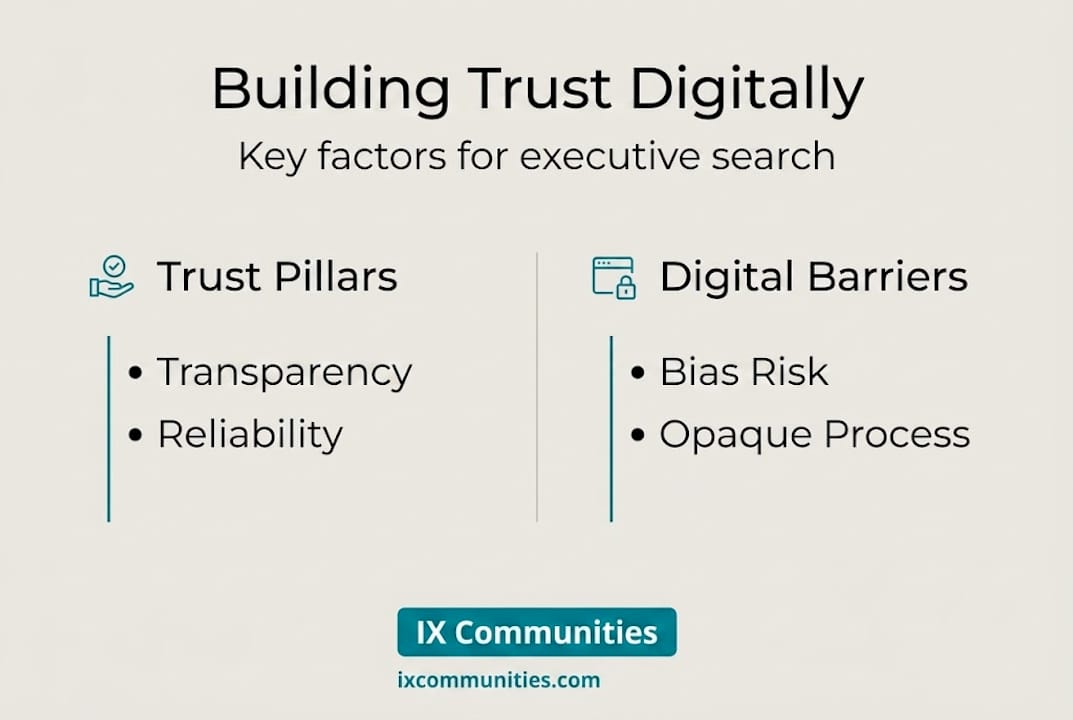
The key is understanding exactly what AI does well and where human judgment remains essential. The table below outlines the specific performance areas:
| Area | AI strength | AI limitation |
|---|---|---|
| Candidate sourcing | Rapid search across large databases | May miss candidates with non-linear careers |
| Skills matching | Consistent application of defined criteria | Cannot assess cultural fit or leadership style |
| Bias control | Can reduce some in-group favoritism | Introduces new bias patterns if not audited |
| Prediction accuracy | Strong on structured roles with historical data | Weaker on novel or senior leadership roles |
| Process speed | Significantly faster than manual review | Speed can sacrifice depth of evaluation |
Building a balanced executive hiring process that captures AI's benefits while managing its risks requires a sequential approach. Here is a practical sequence that works across most mid to large corporate environments:
- Define criteria before activating tools. Set explicit, documented evaluation criteria before any AI tool is configured. This forces clarity and creates an auditable baseline.
- Run parallel human review in early cycles. During the first few search cycles with any new AI tool, have experienced talent leaders review the same candidate pool independently. Compare results and document divergence.
- Audit for the specific bias patterns identified in research. Test for positional bias and demographic skew at least quarterly.
- Use AI output as input, not as a decision. Treat AI rankings as a starting point for human review, never as a final shortlist.
- Build candidate-facing transparency. Communicate to candidates what tools are used and what criteria are applied. This alone significantly improves candidate experience ratings.
"Hybrid models succeed not because they balance technology and humans, but because they establish clear accountability at every step."
The hybrid executive search model is gaining traction precisely because it captures the speed benefits of AI while preserving the judgment quality of experienced practitioners. Using AI-driven decision support tools designed for organizational contexts, rather than generic recruitment software, also reduces the risk of misapplication.
Actionable trust-building strategies in executive search
To move from insight to application, let's focus on actionable trust strategies that talent acquisition leaders can implement now.
The foundation of any trust-building framework in digital executive hiring is transparency. This means making the process visible, not just the outcome. Candidates should receive clear information about what evaluation stages exist, what criteria are applied at each stage, and who makes final decisions. This does not require disclosing proprietary scoring models. It requires communicating enough that candidates feel they were evaluated fairly, regardless of the outcome.
A practical framework for transparency and bias reduction includes these components:
- Publish your evaluation criteria internally and externally. Let candidates, hiring managers, and business leaders see the criteria before the search begins.
- Create a bias review committee. Assign two or three leaders who review AI shortlists against documented criteria before any candidate is advanced or rejected.
- Implement structured feedback loops. After each placement, survey hiring managers, the placed executive, and any finalists who did not advance. Ask directly about process fairness and transparency.
- Document and report bias audit results. Share results with senior leadership quarterly and hold vendors accountable for improvement.
- Set human override thresholds. Define in advance which decisions require mandatory human review, regardless of AI output.
Pro Tip: Build a simple feedback survey that goes to every candidate who exits your process, at any stage. Ask three questions: Was the process clear? Did you feel fairly evaluated? Would you recommend this process to a peer? Track scores over time and use them as a leading indicator of trust.
Peer networks are also a powerful and underutilized resource for trust-building. When talent leaders share what is and is not working through structured peer exchange, the entire community benefits from collective learning without the trial-and-error costs each organization would face alone. The trust-building benchmarks available through peer communities give talent leaders a concrete reference point for how their processes compare to peers at organizations of similar size and complexity.
The peer mentorship programs available to talent leaders provide structured access to practitioners who have already navigated the trust challenges of digital transformation. Rather than learning from vendor case studies designed to sell a product, you get unfiltered perspective from professionals who have faced the same accountability pressures you face.
Key action steps to implement now:
- Diversify candidate sources. Do not rely solely on AI-generated pools. Maintain active relationships with executive networks that surface candidates who opt out of standard digital funnels.
- Make process transparency a contractual requirement. When engaging external search partners or technology vendors, include transparency standards as a contract term, not a request.
- Assign human oversight roles formally. Designate specific individuals who are responsible for reviewing AI recommendations. Do not allow the technology to operate without a named human accountable for its outputs.
Our perspective: Trust isn't digital, it's relational
Stepping back, here is our candid perspective on what matters most. There is a widespread assumption in talent acquisition that better technology will eventually solve the trust deficit in executive search. The data does not support that assumption. Retention improves with AI, efficiency improves with AI, but trust is not a function of process speed or database scale.
Trust is built through consistent, honest interactions between people. It is built when a candidate receives direct feedback rather than an automated rejection. It is built when a hiring committee can explain why a candidate advanced and why another did not. It is built when leaders are personally accountable for the decisions made under their watch.
The executive search community at IX Communities operates on exactly this principle. Technology is a resource, not a relationship. Organizations that treat digital tools as trust-building mechanisms will continue to find that candidates and stakeholders remain skeptical. Organizations that treat technology as one input into a fundamentally human process, anchored in transparency and personal accountability, will build the kind of credibility that survives market cycles, leadership changes, and the next wave of digital disruption.
Connect with peer leaders for actionable insight
Restoring trust in digital executive search requires more than frameworks and audits. It requires learning from professionals who have already navigated these challenges in real organizations.
IX Communities provides talent acquisition leaders with access to structured leader mentoring programs, benchmarking tools, and peer networks designed specifically for mid to large corporate talent teams. Through community resources built for secure, candid knowledge exchange, members gain practical insight that is directly applicable to their hiring programs. Explore membership benefits and connect with a community where trust-building in executive search is a shared priority, not a proprietary secret.
Frequently asked questions
How does AI impact executive search outcomes?
AI-powered screening is used by 88 percent of executive search firms and has been shown to increase executive retention by 20 percent, but it can introduce bias and reduce transparency if not regularly audited.
Why do executives sometimes bypass digital hiring tools?
Executives tend to rely on personal networks when they perceive digital processes as opaque or biased, as black box AI erodes confidence in the fairness of automated evaluations.
What are actionable ways to build trust in digital executive hiring?
Trust is strengthened through regular bias audits, clear process communication to candidates, structured feedback loops after each search cycle, and formal human oversight at all decision points.
Does digital transformation make executive search more trustworthy?
Digital tools can enhance search efficiency and improve retention metrics, but they only build lasting trust when paired with transparent evaluation criteria and accountable human decision-making at each stage.