

Despite unprecedented advances in recruitment technology, 72% of employers still report difficulty finding the right talent, with AI skills now the hardest to source globally. The talent acquisition trends 2026 brings do not point to technology solving the problem on its own. They point to something more demanding: rethinking how recruiting work is designed, how AI is deployed responsibly, and how human judgment fits alongside automation. This article outlines what large corporate TA teams need to know right now, from tech stack evolution to candidate experience redesign to skills-first hiring.
Table of Contents
- Key takeaways
- Talent acquisition trends 2026: the tech stack evolution
- Redesigning recruiting workflows for AI integration
- Automation and human connection in candidate engagement
- Emerging candidate experience and sourcing trends
- My perspective on what actually moves the needle
- How Ixcommunities supports TA leaders in 2026
- FAQ
Key takeaways
| Point | Details |
|---|---|
| AI is not a shortcut | Technology adoption without workflow redesign creates confusion, not efficiency gains. |
| Skills-first hiring is accelerating | Performance-based assessments are replacing credential checks as the primary filter for candidates. |
| Candidate experience drives drop-off | Scheduling friction alone causes a 42% dropout rate, making process design a critical priority. |
| Ethical AI requires active management | Bias in AI hiring tools scales faster than human bias, requiring regular audits and governance. |
| Human connection is non-negotiable | Automation frees recruiter time, but trust with candidates is built through direct human interaction. |
Talent acquisition trends 2026: the tech stack evolution
The shift away from legacy applicant tracking systems is no longer a future-state conversation. It is happening now. Post and pray recruiting is widely recognized as obsolete, and the teams still relying on it are feeling the gap in quality and speed. The modern TA tech stack functions less like a single platform and more like a connected system of specialized tools, each handling a discrete part of the recruiting workflow.
AI-powered sourcing tools now scan passive talent pools and rank candidates based on behavioral signals, not just keyword matches. Predictive analytics flag which candidates are likely to accept offers, which roles are at risk of going unfilled, and which sourcing channels return the best quality hires. Conversational AI handles initial candidate communication, screens for basic qualifications, and schedules interviews without recruiter involvement. The result is faster top-of-funnel processing, but only when the underlying process is sound.
What stands out among high-performing TA teams is that they treat their tech stack as a system, not a collection of tools. Integration between sourcing, CRM, ATS, assessment, and offer management creates a continuous data flow that surfaces insights humans alone could not generate. Recruiters in this model act as both advisors and technologists, interpreting signals and making judgment calls at the moments that matter most.
- AI copilots now assist recruiters with real-time candidate coaching notes, suggested follow-up messaging, and pipeline health alerts
- Modular stacks allow teams to swap out underperforming tools without disrupting the full workflow
- Conversational AI reduces administrative load on recruiters by handling scheduling and FAQ responses at scale
- Compliance and bias auditing tools are now integrated directly into screening workflows rather than treated as separate reviews
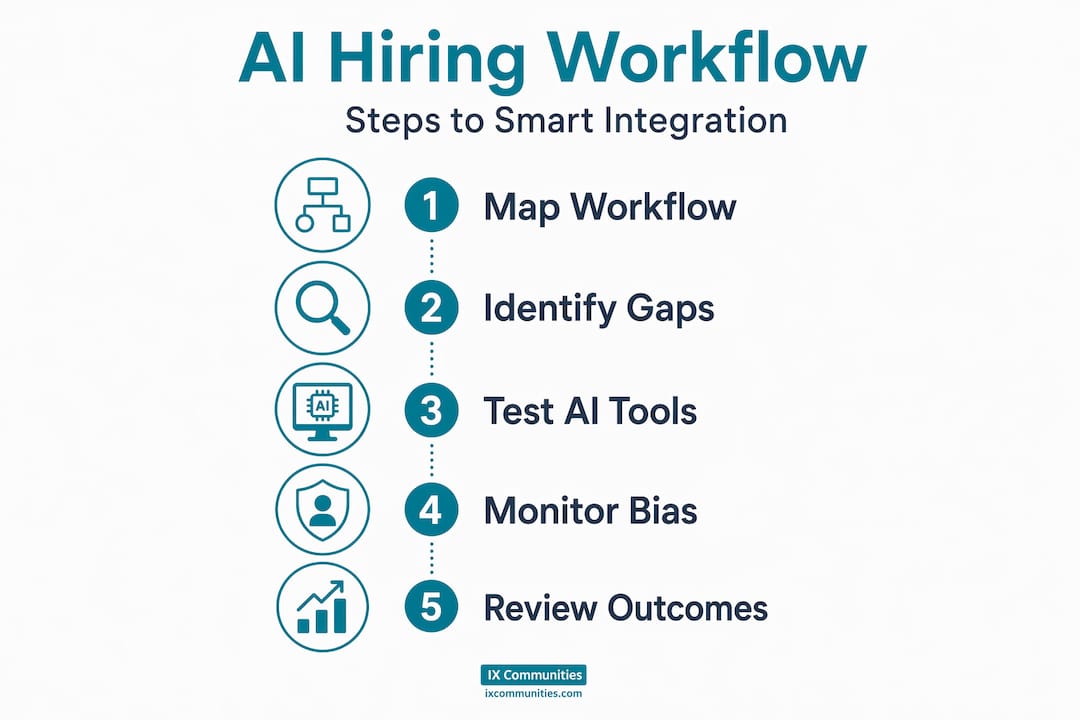
Pro Tip: Before evaluating any new AI hiring tool, map exactly which part of your current workflow it replaces or improves. Buying tools without that clarity is the single fastest way to create a more expensive version of the same problem.
One area requiring careful attention is ethical AI use. Bias in AI hiring tools can scale faster than human bias because the model applies the same flawed logic to thousands of candidates simultaneously. TA teams need regular audits of their AI models, clear documentation of training data sources, and a defined escalation path when the system flags something that does not align with equitable hiring standards. You can also review AI's real limitations in executive recruiting for a grounded perspective on where these tools fall short.
Redesigning recruiting workflows for AI integration
Technology alone does not improve outcomes. The organizations seeing real gains from AI in recruiting are the ones that redesigned their workflows before deploying the tools, not after. The most common failure pattern is automating a broken process at scale, which produces faster mistakes rather than faster results.
74% of global people leaders now prioritize reviewing organizational structure and job design, with 83% expecting AI scaling within the next 6 to 12 months. Those two facts together describe both the opportunity and the risk. Scaling AI into workflows that were designed for a different era of recruiting will amplify whatever inefficiencies already exist.
The table below illustrates how traditional workflow design compares to a redesigned, AI-integrated approach:
| Traditional workflow design | Redesigned AI-integrated workflow |
|---|---|
| Job descriptions define the role | Outcome maps define what success looks like |
| Recruiter owns full process end to end | AI handles administrative tasks; recruiter owns decisions |
| Feedback captured after hire | Continuous feedback loops inform real-time process adjustments |
| Static sourcing channels | Dynamic, data-driven channel selection based on role and market |
| Annual process reviews | Ongoing iteration based on quality-of-hire and pipeline metrics |
The redesign shift that matters most is moving from job-centered thinking to outcome-centered thinking. Rather than writing a job description and sourcing to it, high-performing teams start by defining what a successful hire will accomplish in 30, 90, and 180 days. That framing changes which candidates you target, which questions you ask, and how you evaluate fit. It also makes AI matching more accurate because you are feeding the system outcome signals rather than credential proxies.
AI transformation projects fail more often because of poor organizational design choices than technology limitations. The teams that thrive are treating TA leaders as organizational design architects, responsible not just for filling roles but for how work itself is structured. That is a significant shift in scope and one that requires different skills than traditional recruiting leadership.
Pro Tip: Run a workflow audit before your next major AI tool purchase. Document every step from job open to offer accepted, identify which steps add value and which exist out of habit, then ask which of the habit-steps can be eliminated entirely before you automate anything.
For further reading on how search leaders are approaching this practically, executive search changes in 2026 offers useful leadership-level perspectives.
Automation and human connection in candidate engagement
The most effective recruiters in 2026 are not the ones resisting automation. They are the ones using it aggressively on the right tasks so they can show up fully on the tasks that require human judgment. HR tech in 2026 is explicitly designed to make work more human by clearing the administrative backlog that currently consumes recruiter capacity.
What this looks like in practice:
- AI handles interview scheduling, calendar coordination, and reminder communications without recruiter involvement
- Automated screening tools process high-volume applications and surface the top tier for human review
- Chatbots answer candidate FAQs around the clock, reducing the gap between application and first meaningful contact
- Personalized outreach sequences are generated by AI but reviewed and adjusted by recruiters before sending
What AI cannot handle is the conversation that determines whether a high-value candidate chooses your organization over a competitor. That decision is made in a human exchange. Candidates evaluate whether the recruiter understands their career goals, whether the organization feels authentic, and whether they sense genuine interest. Those signals cannot be automated. They require a recruiter who has time, context, and preparation to have a real conversation.
Employer branding follows the same logic. Candidates increasingly conduct due diligence on organizations through employee reviews, social channels, and direct conversations before they ever engage with a recruiter. Authentic content from employees, transparent communication about culture, and personalized outreach that reflects actual knowledge of the candidate's background all matter more than polished job postings.

The risk of over-automation is candidate commoditization. When every interaction is templated, candidates notice. Human connection remains the only reliable way to build the trust required for candidates to say yes to an offer, relocate for a role, or refer a colleague. TA teams that lose that thread in pursuit of efficiency will pay for it in offer decline rates.
Emerging candidate experience and sourcing trends
The candidate experience trends shaping 2026 are concrete and measurable. A 42% candidate dropout rate is directly attributable to scheduling friction in interview processes. That is not an abstract engagement problem. It is a process design problem with a known fix. AI-driven scheduling tools that offer candidates self-service calendar access have been shown to reduce time-to-fill from an average of 44 days to 14 days.
Beyond scheduling, the most significant shift is the move from credential-based hiring to skills-first assessments. Performance-based hiring evaluates what candidates can actually do rather than where they went to school or which company names appear on their resume. This approach broadens the talent pool, reduces bias, and produces more predictive hiring outcomes.
The shift in sourcing strategy is equally significant. Here are the key moves TA teams are making to reach candidates in 2026:
- Moving from job boards to community-based sourcing. Top talent increasingly comes from niche, private communities rather than public job boards. Discord servers, Slack groups, professional forums, and invitation-only networks are where highly skilled candidates spend time.
- Building social capital before direct outreach. Recruiting teams that contribute useful content, answer questions, and participate authentically in these communities before sourcing candidates generate significantly better response rates than cold outreach.
- Using content-led approaches to create inbound interest. Thought leadership content that speaks to specific professional challenges attracts candidates who are already aligned with the organization's work. This reduces both time-to-hire and early attrition.
- Designing practical assessments into the process early. Skills-first hiring requires replacing lengthy interview loops with focused, role-relevant tasks. Candidates complete a short exercise that reflects the actual work, which gives both parties better information faster.
For more context on how these talent acquisition trends transform recruiting, the shift from pedigree to performance is one of the most durable changes in the field right now.
My perspective on what actually moves the needle
I have spent considerable time analyzing what separates TA teams that see real results from AI integration versus those that accumulate tools and see marginal improvement. The pattern is consistent. The teams winning are not the ones with the most sophisticated technology. They are the ones that invested first in redesigning their processes and developing their recruiters before scaling any automation.
There is a persistent misconception that the future of talent acquisition is primarily a technology problem. It is not. The technology is widely available and increasingly affordable. The harder work is developing recruiters who can operate as both empathetic advisors and informed technologists. That combination is rare, and organizations that build it have a durable advantage.
What I have seen go wrong repeatedly is this: a team deploys an AI sourcing tool, gets excited by the volume of candidates it surfaces, and then loses those candidates in a process that is slow, impersonal, and poorly communicated. The AI delivered. The process failed. No amount of additional technology fixes that.
My position is that recruiter training and skill development is the highest-leverage investment a TA leader can make right now. Not because technology does not matter, but because technology only delivers its value through the people using it. Ethical AI stewardship, workflow literacy, and genuine candidate relationship skills are what separate good teams from great ones in 2026.
— Simon
How Ixcommunities supports TA leaders in 2026
Ixcommunities provides talent acquisition professionals in large corporations with the peer networks, tools, and benchmark data needed to act on the trends covered above.
Through ESIX, TLIX, and IXCommunities, members access structured peer dialogue on exactly the challenges described in this article, from AI governance to workflow redesign to candidate experience measurement. The ESIX Recruiter Peer Mentorship Programs connect recruiters with experienced peers navigating the same technology and process shifts in a secure, confidential environment. For senior leaders, the Talent Leaders Peer Mentoring Program offers structured collaboration with peers across large corporate TA functions. Members also have access to the Technology Stack Reference Tool and up-to-date benchmark surveys that provide real-time data on how peer organizations are structuring their recruitment technology and processes.
FAQ
What is the biggest talent acquisition trend in 2026?
The integration of AI into recruiting workflows is the defining trend, but the real shift is in workflow redesign. Teams that redesign processes around outcomes before deploying AI are seeing the strongest results in speed and quality of hire.
How does AI affect candidate experience in 2026?
AI reduces scheduling friction and automates routine communication, which directly addresses the 42% candidate dropout rate tied to slow or cumbersome interview scheduling. When deployed correctly, it shortens time-to-fill significantly.
What does skills-first hiring mean in practice?
Skills-first hiring replaces credential screening with performance-based assessments that evaluate what a candidate can actually do. This broadens the talent pool and produces more accurate predictions of on-the-job success.
How should TA teams manage bias in AI hiring tools?
Regular audits of AI model outputs, documentation of training data sources, and defined escalation protocols are the baseline requirements. Bias in AI tools scales faster than human bias because the same logic applies to thousands of candidates simultaneously.
Where are top candidates being sourced in 2026?
Increasingly, top talent is found in niche private communities rather than public job boards. Building presence and contributing value in those communities before sourcing produces significantly better outreach response rates.