

A talent community is an opt-in, relationship-driven network of potential candidates who have not yet applied for a specific role. For Heads of TA, Chief People Officers, and executive and diversity recruiting leaders, these communities represent a shift from reactive hiring toward sustained pipeline development. Industry research indicates that well-managed talent communities can reduce time-to-fill by up to 50% by keeping prequalified talent engaged between open requisitions. Peer-focused programs such as Ixcommunities' ESIX and TLIX extend this model to the practitioner level, giving corporate TA teams a confidential space to benchmark, share, and learn from peers.
Table of Contents
- What are talent communities and why do they matter for recruiting leaders?
- What does a sustainable talent community actually require?
- How do talent communities differ from talent pools and ATS records?
- How do you launch a talent community in a realistic timeline?
- How do you measure community ROI and benchmark against peers?
- What are the most common pitfalls and how do you avoid them?
- How peer networking and benchmarking work in practice: an Ixcommunities example
- Key Takeaways
- Why Ixcommunities prioritizes peer networking and benchmarking
- Ixcommunities membership for corporate TA leaders
- Useful sources and further reading
What are talent communities and why do they matter for recruiting leaders?
Talent communities deliver measurable business outcomes that reactive sourcing cannot replicate. When a role opens, a community-backed team reaches into a warm, pre-engaged pipeline rather than starting cold outreach from scratch. The direct results include faster time-to-fill, lower cost-per-hire, and a stronger employer brand signal to passive candidates.
Key business benefits include:
- Faster sourcing cycles. Pre-qualified members already understand the employer's culture and value proposition, compressing screening time.
- Reduced agency spend. A functioning community reduces dependency on third-party search firms for mid-level and specialist roles.
- Employer brand lift. Consistent, value-adding content keeps the organization visible to passive talent year-round.
- Market intelligence. Community engagement surfaces compensation expectations, competitor moves, and skill availability before a requisition is even opened.
Peer benchmarking adds a second layer of value. ESIX and TLIX benchmarking products give corporate TA teams access to validated survey data and comparative reports, turning community membership into a source of strategic intelligence rather than just a candidate pipeline.
Stat to note: Industry guidance cites that organizations maintaining active talent communities can reduce time-to-fill by up to 50% compared with those relying on reactive sourcing alone.
What does a sustainable talent community actually require?
The minimum viable components that convert a sign-up list into a functioning community are people, content, governance, technology, and a clear value exchange. Without all five, the program degrades into an ignored repository.
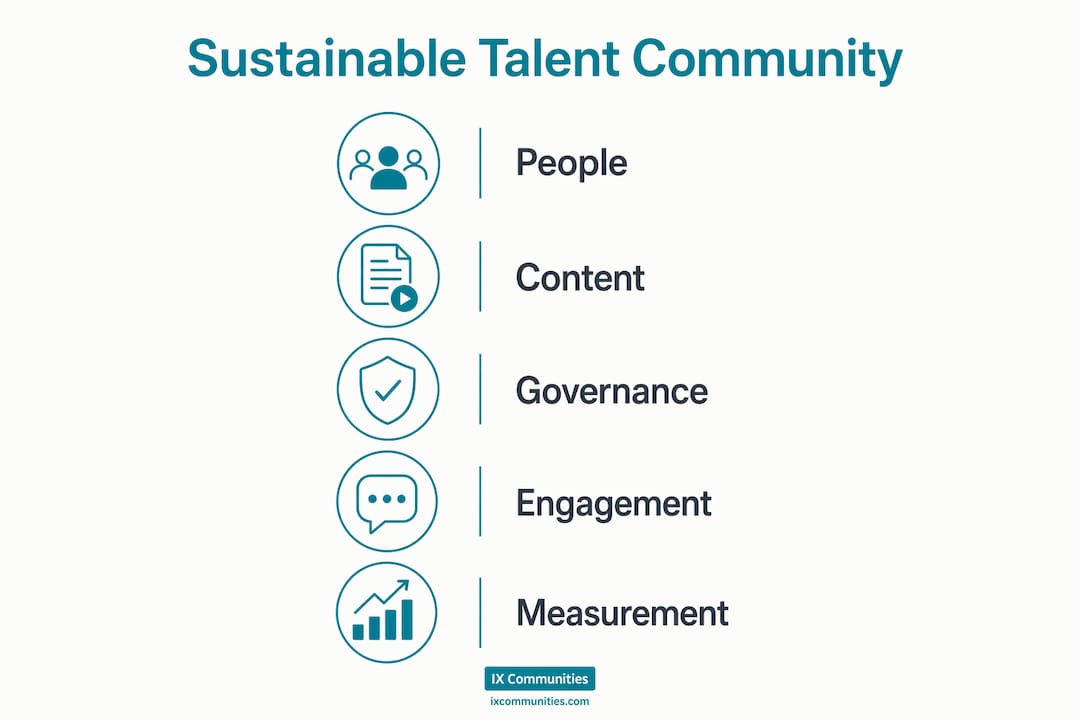
| Component | Role in the Community |
|---|---|
| Membership criteria | Defines who belongs and segments members by role interest, seniority, and geography |
| Community manager | Owns engagement cadence, responds to members, and monitors health metrics |
| Engagement channels | Email, events, forums, and social touchpoints that deliver two-way interaction |
| Program calendar | Scheduled content, events, and surveys that maintain a predictable cadence |
| Tech stack | CRM or community platform that tracks opt-ins, engagement, and pipeline activation |
| Measurement hooks | KPI tracking tied to time-to-fill, engagement rate, and pipeline conversion |
Two rules govern execution. First, keep opt-in friction low: limit the initial sign-up to name, email, location, and area of interest. Collect richer profile data gradually through engagement triggers. Second, design for two-way engagement. Members who receive only job alerts disengage quickly; members who receive career content, event invitations, and mentorship access stay connected.
Segmentation into targeted sub-communities, such as women in technology or veterans, improves engagement and reduces drop-off compared with broad-spectrum outreach. For talent networking best practices, consider pairing sub-communities with dedicated content tracks from the start.
Pro Tip: A shared community manager role (0.5 FTE) paired with a content or events partner is a realistic minimum for a first-year program. Scale to a dedicated FTE once the pilot sub-community demonstrates pipeline activation.

How do talent communities differ from talent pools and ATS records?
The distinction is intent and engagement level. Communities are opt-in relationships. Talent pools are passive internal records. Pipelines are role-qualified candidates in active consideration.
- Talent community: External, opt-in, relationship-based. Members know they are in it and expect value in return. Use for long-term nurturing, employer brand building, and early-stage sourcing.
- Talent pool: Internal, curated CRM segment. Candidates may not know they are included. Use for structured sourcing, compliance tracking, and reporting.
- ATS pipeline: Role-specific, application-triggered. Use for active requisition management, interview scheduling, and offer tracking.
Each system serves a distinct purpose and should integrate rather than compete. A candidate who engages with a community event can move into a talent pool segment when a relevant role opens, and then into the ATS when they apply. For early executive sourcing, the community layer surfaces passive interest before a formal search begins. For DEI sub-communities, the opt-in structure supports both engagement and data governance.
How do you launch a talent community in a realistic timeline?
The recommended sequence runs from strategy through pilot, not from platform selection through strategy. Buying technology before defining the value exchange is the most common launch failure.
- Write a strategy brief. Define the audience, value exchange, and success metrics before selecting any platform.
- Select a platform. Choose a CRM or community tool that supports segmentation, opt-in management, and engagement tracking.
- Build a content and events calendar. Plan at least 90 days of content before launch, including at least one live or virtual event.
- Design the opt-in flow. Keep the sign-up form to four fields. Test it on mobile before going live.
- Define segmentation logic. Set up sub-community tags at launch; retrofitting segmentation later is costly.
- Launch a pilot cohort. Start with one sub-community of 100–300 members before scaling.
A realistic MVP launch takes 60–90 days from strategy brief to first engagement send. Year-one cadence should target one to two value-adding touchpoints per month, one live event per quarter, and one benchmarking or pulse survey per half-year.
Core year-one costs include a platform license, community manager time, content production, and event facilitation. Optional partner services, such as corporate wellbeing programming, can extend the value exchange for members without requiring internal build.
Pro Tip: Run a peer-benchmark pulse survey with your pilot cohort in month three. The data gives you an early ROI story to present to leadership and validates the community's value exchange before you scale.
How do you measure community ROI and benchmark against peers?
The highest-priority KPIs are time-to-fill for community-sourced hires, engagement rate, pipeline conversion, cost-per-hire delta, and employer Net Promoter Score (eNPS).
| KPI | Definition | How to Calculate | Reporting Cadence |
|---|---|---|---|
| Time-to-fill (community) | Days from requisition open to offer accepted for community-sourced hires | Track separately from standard channel hires | Monthly |
| Engagement rate | Percentage of members who open, click, or attend in a given period | Active members / total members | Monthly |
| Pipeline conversion | Percentage of community members who become applicants | Applicants from community / total community members | Quarterly |
| Cost-per-hire delta | Difference in cost-per-hire between community and non-community sourced roles | Community CPH vs. blended CPH | Quarterly |
| eNPS / EMB | Member satisfaction and likelihood to recommend | Standard NPS survey to members | Semi-annually |
Track community-driven hires separately to demonstrate incremental ROI. Presenting a blended cost-per-hire figure to finance obscures the community's contribution. ESIX and TLIX benchmarking data provides peer-validated context for each metric, which is a credible framing for leadership reviews. For a deeper look at measurement frameworks, the Ixcommunities resource on how high-performing TA teams measure success covers reporting structures in detail.
What are the most common pitfalls and how do you avoid them?
Most talent community programs fail not at launch but in months three through twelve, when engagement cadence slips and members stop hearing from the organization.
- Treating sign-ups as a list. Sending only job alerts to community members signals that the program exists for the employer's benefit, not the member's. Mitigation: build a value-first content calendar before the first send.
- Understaffing the program. Without a dedicated owner, communities degrade into ignored repositories. Mitigation: assign a named community manager with a defined SLA for member replies (48 hours is a reasonable standard).
- Over-contacting members. More than two unsolicited outreaches per month accelerates unsubscribes. Mitigation: set a documented contact frequency policy and honor it.
- Excessive data collection at sign-up. Long forms reduce opt-in conversion. Mitigation: four fields maximum at sign-up; enrich profiles progressively.
A governance checklist should include: named community manager, documented SLA for member responses, a consent and privacy notice aligned with applicable U.S. data protection requirements, an escalation path for member complaints, and a quarterly program review with leadership.
How peer networking and benchmarking work in practice: an Ixcommunities example
Ixcommunities operates ESIX and TLIX as membership-driven peer communities for corporate talent acquisition and executive recruiting leaders. Members access confidential benchmarking surveys, moderated peer forums, expert guest speaker sessions, and a proprietary search consultant database. The program design addresses the core failure mode of most talent communities: the absence of a genuine value exchange.
"The value for employers is in decreasing their time to fill and cost per hire... having a warm pipeline of talent means that corporate recruiters don't have to spend time reaching out cold through various resume databases." — Wikipedia: Talent community
What to look for in a peer community provider: secure data handling, member confidentiality protocols, active facilitation by experienced practitioners, and validated survey methodology. Ixcommunities' ESIX and TLIX programs are structured around these criteria. For context on how peer groups compare, the Ixcommunities blog covers top communities for talent acquisition networking in detail.
Key Takeaways
Talent communities deliver measurable pipeline value only when they combine a clear value exchange, dedicated management, and KPI tracking that separates community-sourced hires from standard channel results.
| Point | Details |
|---|---|
| Definition | A talent community is an opt-in, relationship-driven network of candidates who have not yet applied for a specific role. |
| Core success condition | A clear value exchange and a named community manager are the two non-negotiable requirements for long-term community health. |
| Time-to-fill impact | Active talent communities can reduce time-to-fill by up to 50% compared with reactive sourcing. |
| Measurement imperative | Track community-sourced hires separately to demonstrate incremental ROI to finance and leadership. |
| Ixcommunities | ESIX and TLIX peer benchmarking memberships give TA leaders validated survey data and confidential peer forums to benchmark and improve community program performance. |
Why Ixcommunities prioritizes peer networking and benchmarking
The core premise behind Ixcommunities' approach is straightforward: corporate TA leaders make better decisions when they can compare their programs against validated peer data in a confidential setting. ESIX and TLIX are built on that premise. The peer forum model, moderated conversations, and proprietary benchmarking surveys exist because self-reported internal data has limited value without external context.
Membership pages and benchmarking resources are available at Ixcommunities.
Ixcommunities membership for corporate TA leaders
Corporate talent acquisition leaders at mid-to-large organizations qualify for Ixcommunities membership, which includes access to ESIX and TLIX peer forums, confidential benchmarking surveys, mentorship programs, expert speaker sessions, and a proprietary search consultant database.
Heads of TA and Chief People Officers use ESIX peer mentorship programs to connect with peers managing comparable programs, and access benchmark surveys to validate their community's performance against industry data. To request membership information or a benchmarking pilot, visit the Ixcommunities membership page and submit an inquiry directly.
Useful sources and further reading
- Talent Community: How to Build a Talent Pipeline — PeopleScout's practitioner guide on treating talent communities as long-term pipeline assets, with strategic framing for TA leaders.
- What Is a Talent Community? Definition and Guide — Hyring's glossary entry covering opt-in mechanics, value exchange principles, and segmentation guidance.
- Is joining a talent network ever actually worth it? — Quartz reporting on candidate skepticism and the consequences of under-resourced community programs.
- Talent community (Wikipedia) — Foundational overview of talent community mechanics, employer benefits, and common execution failures.
- What Are Talent Communities? A Guide for Recruiters — Ixcommunities' introductory guide covering definitions and practical framing for corporate recruiting teams.
- How talent communities drive better recruitment results — Ixcommunities resource on outcomes, measurement, and tactical advice for TA leaders building community programs.
- Essential talent networking best practices for HR leaders — Governance and member-first design guidance for HR leaders managing or launching peer networks.
- Creating talent leadership forums: a practical guide — Ixcommunities guide on designing moderated peer forums and structured events for talent leadership communities.