

Talent leadership forums are defined as curated peer groups where senior talent leaders and HR professionals meet regularly to address shared strategic challenges through structured, peer-driven dialogue. Creating talent leadership forums gives corporate HR teams a direct method to reduce executive isolation, sharpen strategic thinking, and build the kind of trusted advisor relationships that formal training programs rarely produce. The most effective forums combine clear purpose, deliberate member selection, and a repeatable meeting structure. Ixcommunities operates at the center of this practice, connecting large corporate talent and recruiting departments through secure, peer-driven benchmarking and networking groups worldwide.
What are the essential requirements for creating talent leadership forums?
A talent leadership forum requires three foundational elements before the first meeting: a defined purpose, the right members, and organizational backing. Without all three, groups lose focus within a few months.
Define the forum's purpose first. The focus should align directly with your organization's talent development goals. Common themes include succession planning, scaling recruiting operations, or building leadership pipelines across business units. A vague mandate produces vague conversations.
Select the right group size and composition. Research confirms that intimate advisory groups work best with 6–10 members, while skip-level development programs can accommodate 12–24 participants. Smaller groups create the psychological safety that honest peer dialogue requires. Larger groups work when the goal is broader exposure rather than deep problem-solving.

Build the membership with intentional diversity. Members should share a common challenge but bring different industry backgrounds, functional specialties, and organizational contexts. A forum made up of identical profiles produces echo chambers, not perspective.
Secure executive sponsorship. Forum success relies on executive buy-in, professional facilitation, and a clear confidentiality agreement signed before the first session. Without sponsorship, forums struggle to secure budget, protected time, and organizational credibility.
Establish meeting cadence and confidentiality rules upfront. Monthly or bimonthly meetings work for most groups. Every member must agree in writing that discussions stay within the group. This is non-negotiable for building the trust that makes peer dialogue useful.
- Define a single strategic focus area before recruiting members
- Set group size at 6–10 for depth, or 12–24 for broader development programs
- Require signed confidentiality agreements before the first session
- Confirm executive sponsorship and a dedicated budget
- Agree on meeting frequency, location format (in-person or virtual), and attendance expectations
Pro Tip: Write a one-page forum charter before you recruit a single member. It should state the purpose, membership criteria, meeting cadence, and confidentiality rules. Sharing this document during recruitment conversations signals seriousness and filters out members who are not ready to commit.
How to structure and facilitate high-impact forum meetings
Meeting structure is the single biggest factor separating forums that produce results from those that drift into casual conversation. A well-designed agenda protects time, keeps discussion focused, and creates the accountability loop that drives change between sessions.
Effective leadership forum meetings follow a 75–90 minute format built around three phases: opening, spotlight, and commitment. Each phase serves a distinct purpose.
- Opening wins (10–15 minutes). Each member shares a brief update on a commitment made at the previous meeting. This creates immediate accountability and signals that the group takes follow-through seriously.
- Spotlight sessions (20–25 minutes per member). One or two members present a current, high-stakes challenge. The group asks questions rather than jumping to advice. Peer-driven spotlight sessions consistently outperform formal presentations in engagement and practical value.
- Peer problem-solving (15–20 minutes). The group responds to the spotlight challenge with questions, experiences, and frameworks. The facilitator manages airtime and prevents any single voice from dominating.
- Closing commitments (5–10 minutes). Each member states one to three specific, measurable actions they will take before the next meeting. Accountability partners are assigned to check in between sessions.
- Feedback on the session (5 minutes). A brief round of feedback on what worked and what to adjust keeps the format from going stale.
"The power of a leadership forum lies more in perspective and courageous questioning than in direct advice. The best forums help leaders see their own blind spots. A well-placed question from a peer does more than an hour of expert instruction."
The facilitator's role is to protect the structure, not to teach. Member-led discussions produce more trust and more useful insight than facilitator-led lectures. Psychological safety grows when members see that the group respects confidentiality and that no one uses the forum to sell, recruit, or compete.
Pro Tip: Rotate the spotlight member role so that every participant presents a challenge within the first three meetings. Early exposure builds trust faster than waiting for members to volunteer.
What are effective strategies for recruiting and curating members?
Member curation is where most forums succeed or fail. Open invitations attract the wrong people. Intentional selection builds the right room.
Careful member selection maintains forum focus and longevity. The goal is not to fill seats but to find people who are ready to contribute, willing to be vulnerable, and aligned with the group's purpose.
A practical recruitment process works in three stages. First, identify candidates through your professional network, HR associations, or peer referrals. Second, conduct a 30-minute interview call to assess alignment, readiness, and communication style. Third, share the forum charter and ask candidates to confirm their commitment in writing before the first session.
During the interview call, assess these factors:
- Alignment with the forum's focus. Does the candidate face challenges relevant to the group's theme, such as succession planning decisions or talent acquisition scaling?
- Readiness to contribute. Will this person share real challenges, or will they default to polished presentations?
- Confidentiality commitment. Does the candidate understand and accept that all discussions stay within the group?
- Diversity of perspective. Does this person add a viewpoint the group currently lacks?
- Time availability. Can this person attend consistently and complete commitments between sessions?
Intent-based networking at senior levels focuses on building trusted advisor relationships, not expanding contact lists. Recruit members who want the former. Members who join primarily for visibility or contacts rarely contribute at the level the group needs.
Onboarding matters as much as recruitment. Send new members a summary of group norms, past themes discussed (without identifying details), and the names and roles of other members. A brief one-on-one call with the facilitator before the first session reduces first-meeting anxiety and accelerates trust.
How to sustain engagement and measure forum impact over time
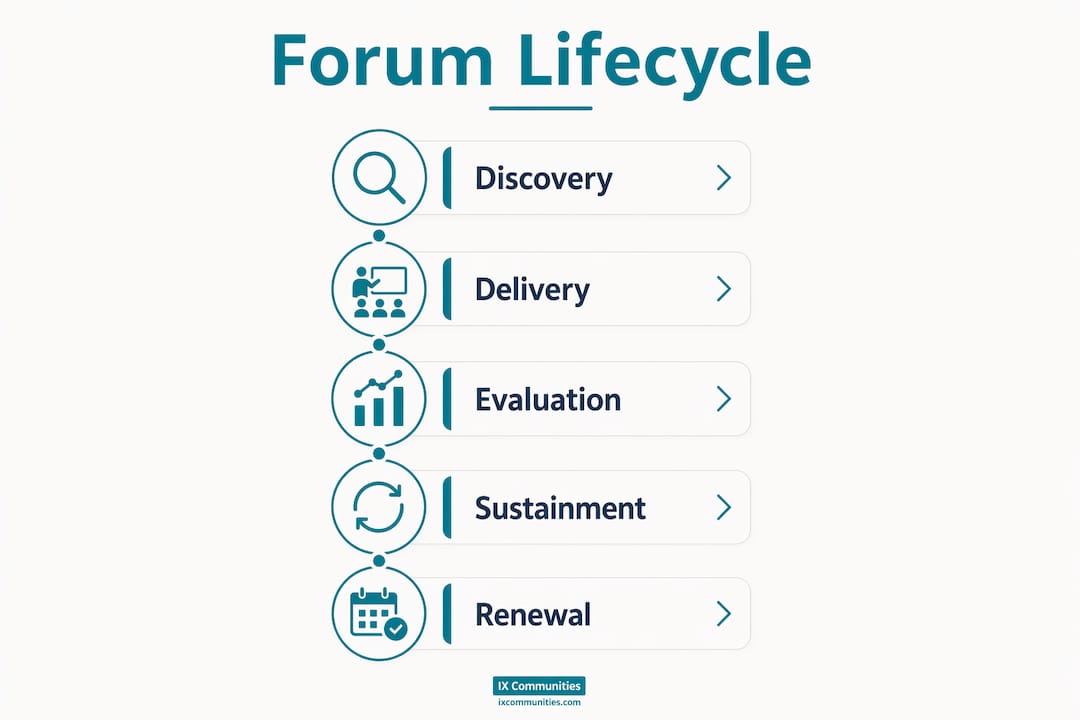
A well-launched forum can still lose momentum without deliberate attention to engagement and measurement. Leadership forums spanning 8–12 months allow time for three distinct phases: discovery, delivery, and evaluation. Each phase requires different facilitation priorities.
| Phase | Timeframe | Focus |
|---|---|---|
| Discovery | Months 1–3 | Build trust, establish norms, surface key challenges |
| Delivery | Months 4–9 | Deep-dive sessions, accountability tracking, guest speakers |
| Evaluation | Months 10–12 | Review commitments, measure outcomes, plan next cycle |
Track member commitments formally. After each meeting, record the commitments each member makes and review them at the next session. This creates a visible record of progress and signals that the group holds itself to a standard.
Incorporate thematic deep-dives and guest speakers during the delivery phase. A guest speaker on workforce analytics or talent acquisition collaboration can refresh the agenda and introduce frameworks the group has not encountered. Keep guest sessions to one per quarter so they supplement rather than replace peer dialogue.
Conduct a formal feedback survey at the midpoint and end of each program cycle. Ask members to rate the quality of discussions, the relevance of topics, and their own progress on stated commitments. Use the results to adjust the agenda for the next phase.
Pro Tip: Schedule a half-day retreat at the six-month mark. Retreats accelerate trust, allow time for deeper problem-solving, and give members a shared experience that strengthens the group's identity.
What common challenges arise and how do you troubleshoot them?
Even well-designed forums encounter predictable problems. Recognizing them early prevents group dissolution.
- Low engagement between meetings. This usually means commitments were too vague. Require each member to state a specific, measurable action with a deadline. Accountability partners should check in by message or call within two weeks of each meeting.
- One member dominating discussions. The facilitator must intervene directly. Redirect with a phrase like "Let's hear from someone who hasn't spoken yet." If the pattern continues, address it privately with the member before the next session.
- Confidentiality concerns. A single breach can destroy trust permanently. Address any suspected breach immediately, privately, and directly. Reinforce the confidentiality agreement at the start of each meeting cycle.
- Forum drifting into networking rather than problem-solving. Asking courageous questions is more valuable than exchanging contacts. Redirect sessions toward specific challenges. If the agenda feels thin, ask members to submit challenges in advance.
- Accountability slippage. When members stop following through on commitments, the group loses credibility. Address slippage as a group norm issue, not an individual failure. Revisit the charter and recommit as a group.
The most common reason forums dissolve is that they become too comfortable. Comfort is not the goal. Productive discomfort, where members challenge each other's assumptions, is where the real value lives.
Key Takeaways
Talent leadership forums succeed when they combine deliberate member curation, a structured meeting format, and a formal accountability system that converts peer dialogue into measurable professional change.
| Point | Details |
|---|---|
| Define purpose before recruiting | A clear strategic focus prevents vague discussions and member dropout. |
| Keep groups to 6–10 members | Smaller groups build the psychological safety that honest peer dialogue requires. |
| Use the 75–90 minute format | Structured agendas with spotlight sessions and closing commitments drive accountability. |
| Curate members intentionally | Interview candidates and require signed confidentiality agreements before the first session. |
| Run programs for 8–12 months | Phased programs allow discovery, delivery, and evaluation to produce measurable outcomes. |
What I have learned from watching leadership forums succeed and fail
The most common mistake I see is treating a talent leadership forum like a training program. It is not. Training delivers content to passive recipients. A forum works only when every member brings a real problem and the group takes it seriously.
The forums that produce the most impact are the ones where the facilitator does the least talking. When a facilitator fills silence with expertise, members stop bringing their hardest problems. They sense the room is not actually safe for uncertainty. The best facilitators ask one good question and then get out of the way.
Intent-based networking is the concept that changed how I think about forum design. Senior leaders do not need more contacts. They need two or three people who will tell them the truth about a decision they are about to make. Build the forum around that need, and engagement takes care of itself.
The accountability structure is also underrated. Most groups skip the closing commitments phase because the meeting runs long. That is exactly backwards. The commitments phase is the mechanism that makes everything else matter. Without it, the forum is just a conversation.
One more observation: the benefits of peer group participation compound over time. The first three months feel slow. By month six, members are bringing their most pressing organizational challenges to the group before they bring them to their own leadership teams. That shift is the signal that the forum is working.
— Simon
Peer mentoring programs built for talent leaders
Ixcommunities runs the Talent Leaders Peer Mentoring Program, a structured forum experience designed specifically for corporate talent and HR leaders. The program includes expert facilitation, curated member selection, and a formal accountability framework built on the same principles covered in this guide.
Members gain access to a secure, non-competitive peer environment where they can address real organizational challenges alongside leaders from large corporate talent and recruiting departments worldwide. The program also includes access to benchmark surveys and expert guest speakers who bring external perspective to forum discussions. If you are ready to build or join a high-impact peer forum, the Talent Leaders Peer Mentoring Program is the place to start.
FAQ
What is a talent leadership forum?
A talent leadership forum is a curated peer group of senior HR and talent leaders who meet regularly to address shared strategic challenges through structured dialogue, accountability, and peer support. Forums differ from training programs because the content comes from members, not instructors.
How many members should a leadership forum have?
The standard size for an intimate leadership forum is 6–10 members, which supports confidentiality and deep discussion. Larger programs designed for skip-level development can accommodate 12–24 participants.
How long should a talent leadership forum program run?
Most effective programs run for 8–12 months, structured across discovery, delivery, and evaluation phases. This timeline gives members enough time to build trust, work through real challenges, and measure progress.
How do you keep forum members engaged over time?
Engagement stays high when members make specific, measurable commitments at the end of each meeting and accountability partners follow up between sessions. Thematic deep-dives, guest speakers, and a mid-program retreat also prevent the agenda from going stale.
What is the biggest risk when building a leadership forum?
The most common risk is that the forum drifts from peer problem-solving into casual networking or lecture-style sessions. Maintaining a structured agenda with spotlight sessions focused on real challenges prevents this and keeps the group focused on genuine development.