

A talent community is a permission-based, opt-in group of professionals who have expressed interest in an organization before any specific job opening exists, receiving ongoing content and engagement to stay connected. This structure gives corporate recruiters a warm, accessible pipeline that reduces sourcing time and improves candidate quality. Unlike passive applicant databases, talent communities require active, two-way communication to function. Recruiters who understand this distinction gain a measurable advantage in speed, cost, and candidate relationships. This guide defines talent communities, clarifies how they differ from related concepts, and provides a practical framework for building one that delivers results.
What are talent communities, and how do they work?
A talent community is not a database. It is an actively managed group of professionals who have opted in to receive content, event invitations, and updates from an employer, with no immediate job application required. Opt-in paths typically include career site sign-ups, webinars, and event participation. The key word is permission. Members choose to engage, which means their interest in your organization is genuine and current.
The practical mechanics are straightforward. A recruiter or talent acquisition team creates a channel, often through a dedicated platform or community tool, where candidates can register. From that point, the organization delivers consistent value through content, networking opportunities, and event access. When a role opens, the community becomes the first sourcing pool. Because members already know the organization and have maintained some level of engagement, the time from identification to offer is significantly shorter than cold sourcing.
Talent networks, a closely related concept, function as automated platforms where candidates register without applying, receiving updates and event information proactively. The distinction between talent networks and talent communities is largely one of interactivity. Communities emphasize two-way engagement. Networks can be more broadcast-oriented. Both serve the same strategic purpose: building candidate interest before a role exists.
How talent communities differ from talent pools and pipelines
These three terms appear in most talent acquisition conversations, and they are frequently used interchangeably. They should not be. Each represents a different level of engagement, intent, and operational use.
| Concept | Size | Engagement | Intent | Primary use |
|---|---|---|---|---|
| Talent pool | Large | Passive | General interest | Long-term sourcing database |
| Talent community | Mid-size | Active, two-way | Opted-in, ongoing | Warm pipeline before roles open |
| Talent pipeline | Smaller | Qualified, ready | Role-specific | Immediate or near-term hiring |
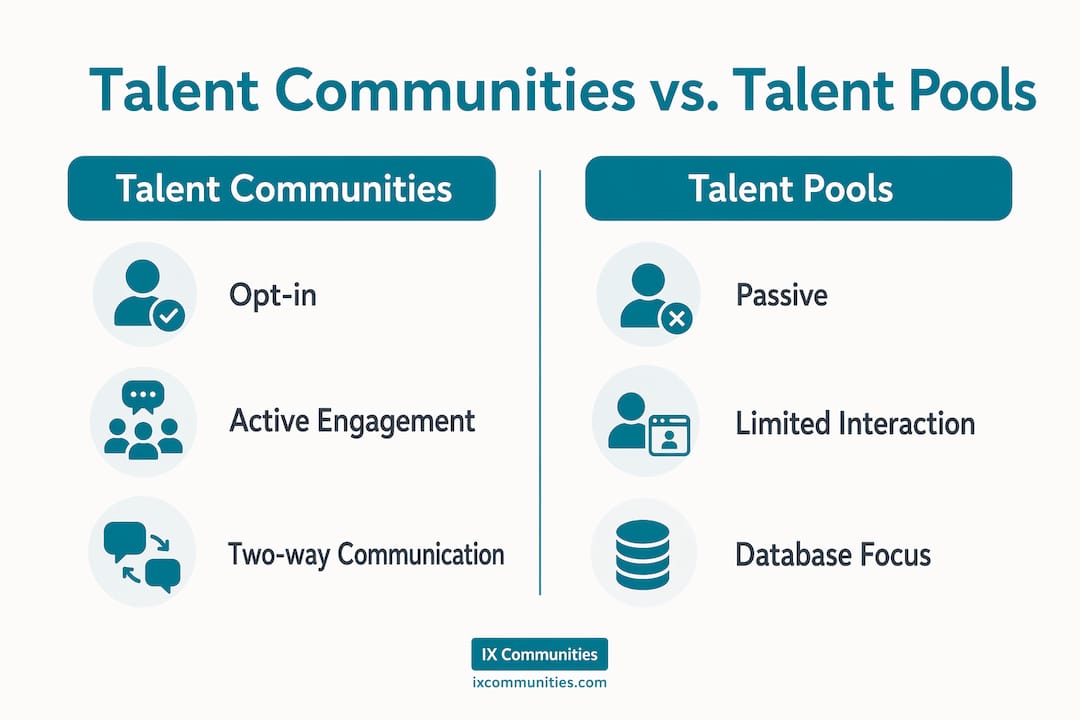
Talent pools are passive databases containing candidates who may have applied previously or been sourced externally. There is no ongoing relationship and no expectation of communication. Talent pipelines sit at the other end of the spectrum: smaller groups of candidates who have been assessed and are ready for specific roles. Talent communities occupy the middle ground. Members have opted in, they receive regular value, and they maintain a warm relationship with the employer brand.
This distinction matters for recruitment strategy. A talent pool tells you who exists. A talent pipeline tells you who is ready. A talent community tells you who is interested and engaged right now. For roles that require specific skills or cultural fit, the community is where the most efficient sourcing begins. Recruiters who treat all three as interchangeable miss the operational value each one provides.
What are the benefits of talent communities for recruiters?
The business case for talent communities is concrete. Recruiters with active talent communities can reduce hiring time by up to 50% and sourcing costs by 60%. That level of efficiency gain is not automatic. It depends on execution quality, which is why only 22% of recruiters report measurable hires from their communities. The gap between potential and result comes down to how the community is managed.
The benefits extend beyond speed and cost:
- Candidate quality improves because members have self-selected based on genuine interest in the organization, not just job availability.
- Employer brand strengthens through consistent, value-driven communication that positions the organization as a desirable place to work.
- Recruitment agility increases because active community ecosystems allow hiring teams to move faster when roles open, bypassing expensive sourcing phases.
- Candidate relationships deepen over time, reducing the friction that typically slows down offer acceptance and onboarding.
Pro Tip: Track engagement recency, not just subscriber count. A community of 300 actively engaged members will outperform a list of 3,000 dormant contacts every time. Smaller, highly engaged segments yield better ROI and faster conversions.
The importance of talent communities also shows up in employer brand metrics. Organizations that maintain active communities report stronger candidate experience scores and higher offer acceptance rates. Candidates who have been nurtured over time arrive at the interview stage with a clearer understanding of the organization's culture, values, and expectations. That alignment reduces early attrition and improves long-term retention.
How to build a talent community in three phases
Building a talent community that produces results follows a 90-day model with three distinct phases: Foundation, Activation, and Conversion. Each phase has a specific goal and set of activities.
Phase 1: Foundation (Days 1 to 30)
- Define the community's purpose and target audience. Segment by function, seniority, geography, or skill set. A community for software engineers requires different content than one for finance professionals.
- Select a platform that supports two-way interaction. Standard ATS modules are not built for community engagement. Dedicated tools or community platforms that allow discussion, event registration, and content sharing are more effective.
- Build the initial opt-in pathway. Add a community sign-up option to your career site, include it in event follow-ups, and promote it through LinkedIn and other professional channels.
Phase 2: Activation (Days 31 to 60)
- Establish a content cadence. The recommended frequency is twice weekly engagement, mixing job market insights, company updates, webinars, and networking events.
- Introduce two-way touchpoints. Ask members questions, run polls, host live Q&A sessions with hiring managers, and create opportunities for members to connect with each other.
- Segment your communications. A member interested in product roles should not receive the same content as someone interested in operations. Personalized communication increases engagement and reduces opt-out rates.
Phase 3: Conversion (Days 61 to 90)
- Integrate community engagement data into your ATS. When a role opens, filter community members by engagement score, skill match, and recency of activity.
- Reach out to high-engagement members directly before posting the role publicly. This gives them a sense of priority access and reinforces the value of community membership.
- Measure conversion rates, time-to-fill for community-sourced hires, and engagement metrics. Use this data to refine content and outreach for the next cycle.
Pro Tip: Review talent networking best practices specific to your industry before finalizing your platform and content strategy. What works in tech recruitment differs significantly from what works in healthcare or financial services.
Common pitfalls and how to avoid them
Most talent community programs underperform for the same reasons. Understanding these failure patterns before launch saves significant time and budget.
The most common mistake is launching with old applicant lists and treating the group as a static email list. This approach produces low engagement, high opt-out rates, and no measurable hiring outcomes. A talent community requires fresh, permission-based membership from the start.
Other frequent pitfalls include:
- One-way communication. Sending job alerts and company news without creating any mechanism for response or interaction is not community management. It is broadcasting. Successful communities require consistent two-way communication, segmented content, and value beyond job alerts.
- Measuring the wrong metrics. Subscriber count is a vanity metric. What matters is active engagement: open rates, event attendance, response rates, and ultimately, conversion to hire.
- Neglecting non-job content. Members who joined because of a webinar or industry event will disengage quickly if every subsequent message is a job posting. Content that educates, connects, or entertains keeps the community warm between hiring cycles.
- Confusing community tools with ATS features. Standard applicant tracking systems are designed for application management, not relationship building. Using an ATS as a community platform produces a one-dimensional experience that candidates recognize and disengage from quickly.
Pro Tip: Set a quarterly review of your active member ratio. If fewer than 30% of your community members have engaged with content in the past 60 days, your content strategy needs adjustment before you add more members.
For a broader view of how talent communities drive recruitment results, the patterns are consistent: organizations that treat communities as living engagement programs outperform those that treat them as databases.
Key takeaways
Talent communities deliver measurable hiring advantages only when built on permission-based membership, consistent two-way engagement, and segmented communication rather than passive database management.
| Point | Details |
|---|---|
| Definition clarity | A talent community is an opt-in, actively engaged group, not a passive applicant database. |
| Hiring efficiency | Active communities can reduce hiring time by up to 50% and sourcing costs by 60% with strong execution. |
| Three-phase build | Foundation, Activation, and Conversion provide a structured 90-day path to a functioning community. |
| Quality over quantity | Smaller, highly engaged segments produce better hire rates than large, dormant contact lists. |
| Avoid common failures | Launching with old lists or using one-way communication are the leading causes of underperformance. |
Why quality of engagement matters more than community size
After working closely with talent acquisition teams across large corporate organizations, the pattern that stands out most is this: the teams with the best hiring outcomes are rarely the ones with the largest communities. They are the ones with the most intentional engagement programs.
I have seen organizations with 10,000 community members struggle to fill roles from that pool, while a team with 400 well-segmented, regularly engaged members consistently sources 30% to 40% of their hires internally. The difference is not technology or budget. It is discipline. The high-performing teams treat their community like a professional network that requires ongoing investment, not a list that gets emailed when a role opens.
The market shift toward relationship-driven recruitment is not a trend. It is a structural change in how candidates evaluate employers. Professionals today have more information about organizations than ever before, and they make decisions about where to invest their attention accordingly. A talent community that delivers genuine value, through peer connections, market insights, and access to hiring managers, earns a level of candidate trust that no job board posting can replicate.
The teams I have observed that struggle most are those that measure success by sign-up volume. The ones that succeed measure it by engagement depth and conversion rate. If you are building or rebuilding a talent community in 2026, start with 200 highly relevant, opted-in members and a clear content plan. Scale from there based on engagement data, not ambition.
— Simon
How Ixcommunities supports talent community development
Ixcommunities operates ESIX, TLIX, and IXCommunities as peer networking and benchmarking groups specifically for talent leadership professionals at large corporate organizations. Members gain access to structured peer exchange, guest speakers, and benchmarking tools that directly support talent community strategy and execution.
For recruiters building or refining their talent communities, the ESIX Recruiter Peer Mentorship Programs provide direct access to experienced practitioners who have built and scaled successful communities across industries. The Ixcommunities membership also connects talent acquisition leaders with peers who share benchmarking data, engagement frameworks, and platform recommendations in a secure, confidential environment. These resources are designed for corporate talent teams that need practical, peer-validated guidance rather than generic consulting advice.
FAQ
What is the difference between a talent community and a talent pool?
A talent pool is a passive database of candidates with no ongoing engagement or communication structure. A talent community is an opt-in, permission-based group that receives regular content and participates in two-way interactions with the employer.
How long does it take to build a functional talent community?
A structured 90-day model covering Foundation, Activation, and Conversion phases is the standard framework for establishing a functioning talent community. Results in the form of measurable hires typically appear after the first full cycle is complete.
Why do most talent communities fail to produce measurable hires?
Only 22% of recruiters report measurable hires from their communities, primarily because poor execution treats communities like email lists rather than engaged networks. Lack of segmentation, one-way communication, and launching with old applicant data are the most common causes.
What content should a talent community receive?
Members should receive a mix of job market insights, company culture content, event invitations, and networking opportunities. Job alerts alone are insufficient. The recommended cadence is twice weekly, with content varied to maintain engagement across different member interests and career stages.
Do talent communities replace applicant tracking systems?
Talent communities do not replace ATS platforms. They function as a pre-application engagement layer that feeds warm, qualified candidates into the ATS when roles open. The two systems serve different purposes and work best when integrated rather than treated as alternatives.