

Talent networking is defined as the deliberate, ongoing practice of building and maintaining professional relationships to create a pipeline of qualified candidates before roles open. The best practices in talent networking combine personalized multi-touch outreach, diversified sourcing channels, and continuous engagement with both active and passive candidates. Recruiters who apply these practices consistently fill roles faster, hire better, and reduce turnover. Tools like Talentprise and Pin, platforms like LinkedIn, and structured referral programs each play a distinct role in a high-performing talent network.
What are the most effective strategies for building and maintaining talent networks?
The strongest talent networks start with warm connections and expand outward through referrals and mutual introductions. Cold outreach to a stranger with no shared context produces far lower response rates than a message routed through a mutual connection or a former colleague. Building professional connections from your existing network first gives every subsequent outreach a credibility advantage.

Personalized, multi-touch outreach across email, LinkedIn, and SMS is the standard for reaching passive candidates. Email outreach with three personalized touchpoints over 20 days yields response rates near 45%, doubling cold message averages. That gap exists because follow-up signals genuine interest rather than mass broadcasting.
Providing value before making an ask is the principle that separates productive networking from transactional recruiting. Sharing a relevant market salary report, a conference recommendation, or a career article positions you as a resource rather than a vendor. Candidates remember recruiters who gave them something useful, and that memory converts to responses when a role becomes relevant.
Key tactics for building and sustaining a talent network:
- Start with referrals. Ask current high performers to introduce you to peers in their field.
- Personalize every first message. Reference a specific project, publication, or shared connection.
- Use multi-channel sequences. Combine LinkedIn, email, and SMS across at least three touchpoints.
- Share market intelligence. Send salary benchmarks, industry reports, or event invitations.
- Follow up consistently. Schedule follow-ups every 90 days for top candidates not yet ready to move.
- Close every conversation with a next step. Confirm a future check-in, a referral request, or a resource to share.
Pro Tip: Apply the 3-goal rule to every networking conversation: learn one specific market insight, provide one piece of immediate value, and close with a forward-step question. This structure makes interactions more memorable and more productive.
How to diversify sourcing channels and avoid over-reliance on single platforms?
Relying on LinkedIn as the primary or sole sourcing channel creates real pipeline risk. Algorithm changes, increased recruiter competition, and candidate fatigue on any single platform can reduce response rates without warning. Effective talent networking strategies require a distributed sourcing model.
The principle is straightforward: no single channel should produce more than 40–50% of your candidate pipeline. That ceiling forces recruiters to develop and maintain multiple sourcing relationships simultaneously, which also produces better candidate diversity.
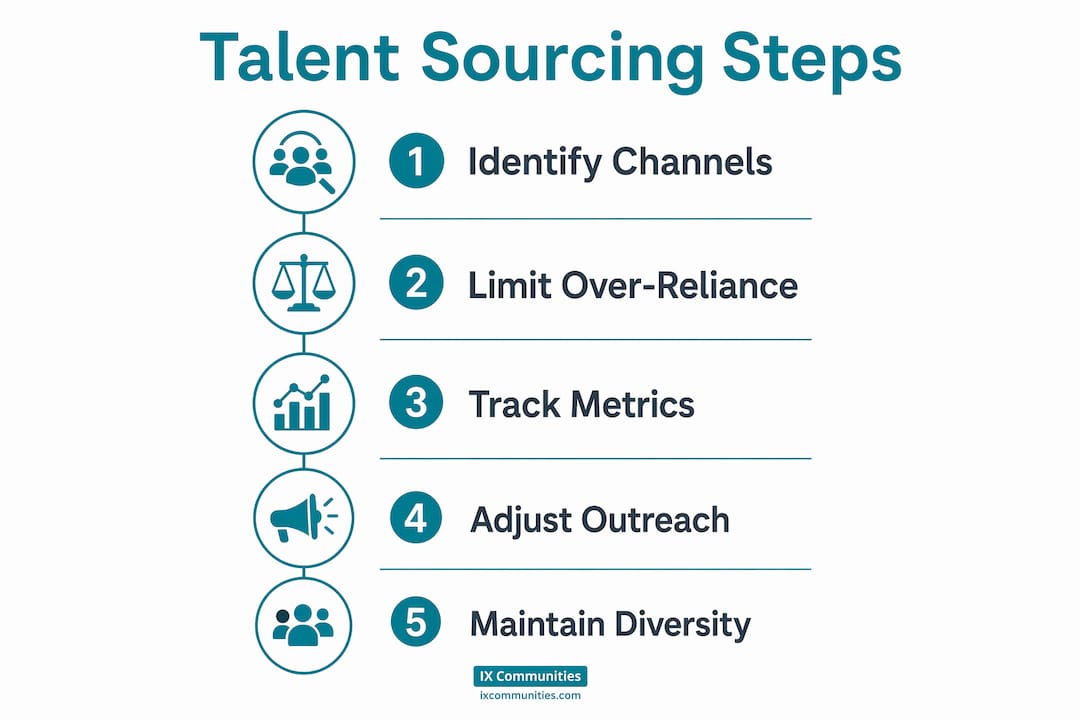
A practical sourcing map by channel type looks like this:
| Channel | Best use case | Pipeline contribution target |
|---|---|---|
| Mid-to-senior passive candidates | 30–40% | |
| Employee referrals | Culture-fit, high-retention hires | 20–30% |
| Professional associations | Niche or specialized roles | 10–20% |
| Targeted email campaigns | Re-engaging silver medalists | 10–15% |
| Industry events and conferences | Executive and leadership roles | 10–15% |
Diversifying sourcing channels requires tracking source of hire by quality, not just volume. A channel that produces 30% of applicants but only 5% of accepted offers is consuming resources without delivering results. Adjusting channel investment based on quality data is how recruiters build pipelines that convert.
- Audit your current channel mix. Calculate what percentage of hires came from each source in the last 12 months.
- Identify over-concentrated channels. Flag any source contributing more than 50% of your pipeline.
- Add one new channel per quarter. Test professional associations, alumni networks, or niche job boards relevant to your roles.
- Track quality, not just quantity. Measure offer acceptance rate and 90-day retention by source.
- Reallocate budget toward top-performing channels. Shift spend away from high-volume, low-conversion sources.
Pro Tip: Track source of hire by quality metrics, including offer acceptance rate and 12-month retention, not just application volume. That data tells you which channels produce candidates who actually stay.
What role do employee referrals and continuous engagement play in effective talent networking?
Employee referrals are the highest-converting sourcing channel available to corporate recruiters. Referrals convert from application to interview at 40%, compared to 12% for other sources, and reduce turnover by 15%. Those numbers reflect the fact that referred candidates arrive pre-screened by someone who understands both the role and the culture.
Sustaining a referral program requires more than a bonus structure. Programs with clear rules, timely feedback, and multi-stage bonuses sustain participation over time. When employees receive no feedback after submitting a referral, participation drops quickly. Closing that feedback loop is the single most underused improvement in most corporate referral programs.
Continuous engagement with passive candidates is equally critical. 64% of passive candidates respond only after follow-up messages, making structured 3–4 touch sequences across channels non-negotiable. A single outreach message, no matter how well written, reaches less than half the candidates who would eventually respond.
Effective continuous engagement practices include:
- Schedule 90-day follow-up cycles for top passive candidates not currently open to roles.
- Share career-relevant content such as compensation reports, skills trend data, or event invitations.
- Use exploratory conversations rather than job pitches. Ask about career goals, not current openings.
- Tag candidates by readiness tier. Warm, passive, and future-ready candidates need different message cadences.
- Recognize milestones. Congratulate candidates on promotions, publications, or work anniversaries.
"Proactive, trust-based visibility long before roles open is the defining characteristic of recruitment success in 2026. Reactive sourcing tied to open requisitions consistently underperforms."
Pro Tip: High-performing hires often become your best future referrers. Identify your top performers at the 6-month mark and personally ask them for introductions. That conversation costs five minutes and frequently produces your next best hire.
How to leverage data and structured processes to enhance talent networking outcomes?
Data is what separates a talent network that grows from one that stagnates. Recruiters who track outreach response rates, pipeline-to-hire ratios, and source-of-hire quality can identify exactly where their network is underperforming and correct it. Those who rely on intuition alone miss patterns that data surfaces immediately.
Structured interviews and competency scorecards maintain evaluation consistency regardless of which sourcing channel a candidate came through. A candidate sourced through a referral and one sourced through a LinkedIn campaign should be evaluated against the same criteria. Without that consistency, sourcing channel bias distorts hiring decisions.
Tools like Talentprise and Pin integrate sourcing, outreach tracking, and pipeline management into a single workflow. That integration eliminates the manual tracking that causes follow-ups to fall through the cracks. Recruiters using integrated platforms spend less time on administration and more time on relationship-building conversations.
Strategic candidate tagging by readiness tier is one of the most underused practices in talent acquisition. The table below shows how to structure that system:
| Readiness tier | Definition | Recommended outreach cadence |
|---|---|---|
| Warm | Actively exploring opportunities | Weekly or biweekly contact |
| Passive | Open to conversation, not searching | Every 60–90 days |
| Future | Not open now, high potential | Every 90–120 days |
| Silver medalist | Previously interviewed, strong fit | Immediate re-engagement on new roles |
Refining outreach timing based on response data also improves results. If your data shows that Tuesday morning emails generate twice the open rate of Friday afternoon messages, that is a scheduling decision, not a minor detail. Applying that insight across a 500-person pipeline produces a measurable lift in response rates. For a deeper look at building trust digitally in recruitment networks, the principles of consistent follow-through and transparent communication apply directly to candidate engagement.
What are key pitfalls to avoid and expert tips for sustaining a high-impact talent network?
The most common mistake in talent networking is treating it as a reactive activity. Recruiters who only reach out to candidates when a role opens are competing against every other recruiter doing the same thing at the same moment. Treating networking as a long-term investment rather than a job-search tool produces consistently better outcomes.
Overly self-focused conversations are the second most common failure. Asking a candidate about their career goals and listening for 10 minutes before mentioning a role builds more trust than leading with a job description. The role of networking in talent acquisition is to create relationships, not to broadcast openings.
Networked leadership based on expertise and trust produces 4.5x greater innovation and 2x higher employee trust levels compared to hierarchical models. That finding applies directly to how talent leaders should position themselves within their professional networks. Authority comes from demonstrated knowledge, not title.
Pitfalls to avoid and practices to adopt:
- Do not pitch roles in first contact. Open with a question about their work or career direction.
- Do not disappear between hiring cycles. Maintain contact year-round, not just when requisitions open.
- Do not skip the next step. Every conversation should end with a confirmed follow-up action.
- Do give before asking. Share a useful resource, make an introduction, or offer feedback before requesting anything.
- Do apply the 3-goal rule. Learn something, provide value, and close with a forward step in every interaction.
- Do treat your network as a diagnostic tool. Informal network analysis reveals communication gaps and influence patterns that formal org charts miss.
Pro Tip: Review your networking activity log at the end of each month. If more than 60% of your outreach happened because a role opened, your network is reactive. Shift at least 40% of your outreach to relationship maintenance with no immediate hiring agenda.
Key Takeaways
The most effective talent networking combines continuous, multi-channel engagement with structured data tracking and a long-term relationship mindset that operates independently of active hiring cycles.
| Point | Details |
|---|---|
| Multi-touch outreach works | Three personalized touchpoints over 20 days nearly doubles response rates compared to single-message outreach. |
| Referrals outperform all other sources | Referrals convert to interviews at 40% versus 12% for other channels and reduce turnover by 15%. |
| Diversify your sourcing channels | No single channel should produce more than 40–50% of your pipeline to reduce platform risk. |
| Tag candidates by readiness tier | Segment your network into warm, passive, future, and silver medalist tiers and tailor outreach cadence accordingly. |
| Network year-round, not reactively | Continuous engagement before roles open produces faster fills and higher-quality candidates than reactive sourcing. |
What I have learned from years of watching talent networks succeed and fail
The recruiters who consistently outperform their peers share one habit: they treat their talent network as a professional asset that requires regular maintenance, not a database to search when a role opens. That distinction sounds simple. Executing it requires discipline that most recruiting teams have not built into their workflow.
The technology side of this has improved significantly. Platforms like Talentprise and Pin now make it practical to run structured, personalized outreach sequences at scale without losing the human quality that makes candidates respond. The mistake I see most often is using those tools to send more messages rather than better ones. Volume is not the goal. Relevance is.
The shift toward networked leadership in talent acquisition is the most significant structural change I have observed in the past several years. Recruiters who build influence through expertise and genuine helpfulness fill roles that other recruiters cannot touch. That is not a soft observation. It shows up directly in pipeline quality and time-to-fill metrics. The recruiters worth watching are the ones who give more than they ask, follow up when they said they would, and treat every candidate conversation as a relationship worth maintaining regardless of whether a hire results.
— Simon
Ixcommunities peer programs for talent acquisition professionals
Talent acquisition professionals who want to apply these networking practices at a higher level benefit from structured peer learning environments. Ixcommunities operates ESIX, TLIX, and related peer communities where large corporate recruiting and talent departments share benchmarks, exchange best practices, and learn in a secure, confidential setting.
The ESIX Recruiter Peer Mentorship Program connects corporate recruiters with peers who face the same sourcing, engagement, and pipeline challenges. The Talent Leaders Peer Mentoring Program serves senior talent acquisition leaders who want to advance their networking discipline and leadership competencies alongside peers from comparable organizations. Both programs provide exclusive access to benchmarking data, shared frameworks, and a professional community built specifically for corporate talent functions.
FAQ
What is the most effective outreach sequence for passive candidates?
Three personalized touchpoints over 20 days across email and LinkedIn produces response rates near 45%, roughly double the average for cold single-message outreach. Structured follow-up every 90 days maintains relationships with top candidates not yet ready to move.
How many sourcing channels should a recruiter actively maintain?
Recruiters should maintain enough channels so that no single source produces more than 40–50% of their candidate pipeline. A practical mix includes LinkedIn, employee referrals, professional associations, targeted email campaigns, and industry events.
Why do employee referrals outperform other sourcing channels?
Referred candidates arrive pre-screened by someone who understands both the role and the culture, which is why they convert from application to interview at 40% compared to 12% for other sources. They also reduce turnover by 15% because the referring employee has already assessed cultural fit.
What is the 3-goal rule in talent networking conversations?
The 3-goal rule structures every networking conversation around three outcomes: learn one specific market insight, provide one piece of immediate value to the other person, and close with a forward-step question that confirms a next interaction. This approach produces more productive and more memorable professional exchanges.
How does networking support talent leadership beyond recruiting?
Networking functions as a diagnostic tool for talent leaders, revealing informal influence patterns and communication gaps that formal org charts do not show. Organizations with networked leadership built on expertise and trust report 4.5x greater innovation and 2x higher employee trust levels compared to hierarchical structures.