

Inconsistent hiring results across teams are rarely a strategy problem. They are a sharing problem. When large organizations fail to transfer what works from one recruiting team to another, the cost shows up in longer time-to-fill, weaker candidate experience, and hiring managers who lose confidence in the process. Knowing how to share best practice in Talent Acquisition is not a soft initiative. It is an operational priority. 63% of organizations name developing a critical talent sourcing strategy as their top priority in 2026. That goal is unreachable without a mechanism for consistent knowledge transfer.
Table of Contents
- Key Takeaways
- How to share best practice in Talent Acquisition: starting with a real audit
- Designing scalable methods for sharing recruitment strategies
- Using technology to support sharing across TA teams
- Building a culture that sustains knowledge sharing
- Common challenges and how to measure what works
- My perspective on what actually moves the needle
- How Ixcommunities supports best practice sharing at scale
- FAQ
Key Takeaways
| Point | Details |
|---|---|
| Audit before building | Identify existing knowledge silos and gaps before implementing any new sharing mechanism. |
| Structure drives adoption | Playbooks, scorecards, and templates give recruiters a repeatable format that travels well across teams. |
| Technology must support sharing | Misaligned tools block adoption regardless of content quality. Audit your stack specifically for collaboration features. |
| Culture requires reinforcement | Quarterly reviews and recognition programs keep best practices current and recruiter engagement high. |
| Measure what matters | Track adoption rates, hiring quality improvements, and time-to-fill changes to validate the impact of sharing initiatives. |
How to share best practice in Talent Acquisition: starting with a real audit
Before deploying any new program, you need an honest picture of what is currently happening. Most large organizations assume their teams are exchanging knowledge. In practice, 75% of organizations report difficulty filling full-time roles, and a significant portion of that difficulty traces back to fragmented approaches within the same company.
Start the audit by mapping every existing sharing method. That includes shared drives, Slack channels, onboarding materials, informal manager briefings, and any formal review processes. Then assess actual adoption. A shared folder with 400 untouched documents is not a knowledge-sharing system. It is a storage problem.
Key areas to examine during your audit:
- Knowledge silos: Which teams or business units operate without visibility into how other divisions recruit?
- Communication gaps: Where does information about what works stop moving through the organization?
- Technology alignment: Does your current stack support collaborative documentation, or does it only track applicants?
- Leadership buy-in: Are people leaders actively championing sharing, or is it treated as an HR administrative task?
- Recruiter capacity: Do your recruiters have dedicated time to contribute to and consume shared content?
Once the audit is complete, establish a cross-functional governance team. This group should include TA leaders, HR business partners, and at minimum one representative from each major business unit. Their job is to define objectives, set contribution standards, and hold the initiative accountable.
Pro Tip: Frame the governance team's first deliverable as a one-page charter. It should state clearly what success looks like, who owns what, and how often the group will review progress. This removes ambiguity from the start.
Designing scalable methods for sharing recruitment strategies
With the audit complete and governance in place, the next step is building the mechanisms that allow effective talent acquisition methods to travel across teams without losing accuracy or usability.
-
Build a centralized knowledge repository. Choose a platform your recruiters already use, whether that is your ATS, an intranet, or a dedicated knowledge management tool. A new platform nobody logs into defeats the purpose. The repository should hold playbooks by role family, interview scorecards, sourcing checklists, and candidate communication templates.
-
Standardize the format of every contribution. Unstructured knowledge does not scale. Structured interviews using calibrated scorecards are nearly twice as predictive of job performance. The same principle applies to documentation. A playbook that follows a consistent structure gets used. A narrative written in someone's personal style gets ignored.
-
Launch a community of practice. This is a recurring forum, monthly or biweekly, where recruiters share what is working and what is not. Keep sessions to 45 minutes. Assign a rotating facilitator. Record the sessions and archive them in the knowledge repository.
-
Embed sharing into recruiter onboarding. New recruiters should consume the repository as part of their first two weeks. This creates adoption from day one and signals that the organization takes collaborative hiring techniques seriously.
-
Tie contributions to performance conversations. When sharing is recognized in performance reviews, participation rises. Identify two or three metrics that reflect engagement with the knowledge system and make them visible to managers.
| Sharing method | Best suited for | Scaling difficulty |
|---|---|---|
| Centralized playbooks | Process consistency across roles | Low |
| Communities of practice | Peer learning and real-time problem solving | Medium |
| Peer mentorship programs | Deep skill transfer between individuals | Medium |
| Scheduled knowledge events | Broad awareness and visibility | Low |
| Performance-linked metrics | Sustained engagement over time | High |
Pro Tip: When building your knowledge repository, assign a content owner to each major category. Content without an owner becomes outdated within a quarter. Ownership creates accountability for accuracy.
Using technology to support sharing across TA teams
Technology should make sharing easier, not harder. The reality is that misaligned technology creates friction that can block scaling even well-designed sharing initiatives. Before buying new tools, audit what you have.

Review your ATS, your Recruitment CRM, and any talent intelligence platforms your team uses. For each tool, ask two questions: Does it allow collaborative documentation? Does it surface data in a way that multiple users can learn from?
Centralized talent intelligence dashboards consolidate internal and market hiring data into a single view, tracking pipeline health, source effectiveness, and compensation trends. When recruiters can see that view together, conversations about what is working become grounded in shared evidence rather than individual opinion.
Practical steps for technology alignment:
- Configure your CRM to trigger automated content updates when a process change is approved by the governance team
- Build analytics dashboards that track not just hiring outcomes but adoption of documented practices by individual team members
- Use your ATS workflow data to identify where handoffs break down, then address those gaps in your shared documentation
- Reduce duplicate data entry by integrating tools so that recruiters are not maintaining separate records for the same candidate
The goal is a technology environment where sharing recruitment strategies requires no extra effort. It should happen as a byproduct of normal workflow.
Pro Tip: Run a technology audit specifically focused on collaboration features, not just core recruiting functions. Many ATS platforms have built-in note-sharing, tagging, and template features that go unused because no one set them up intentionally.
Building a culture that sustains knowledge sharing
Mechanisms and tools are necessary. They are not sufficient. Long-term adoption of best practices in recruitment depends on whether your team culture treats sharing as normal and expected, not as an extra task.
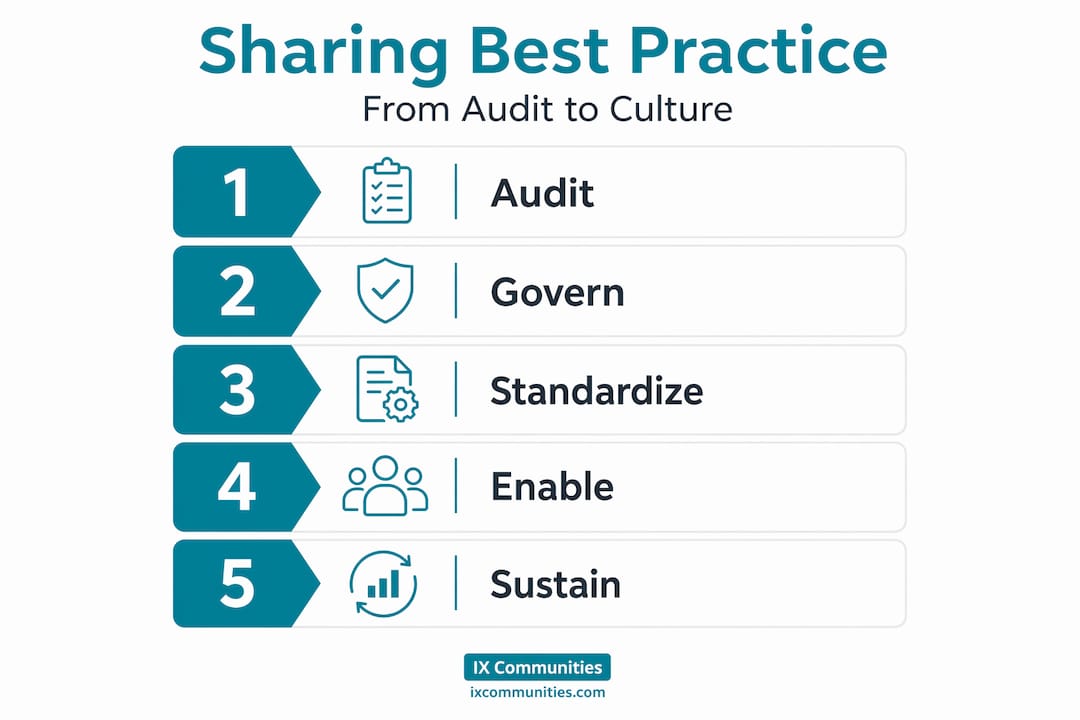
Successful sharing programs build trust before scale. Programs that feel like corporate broadcasting lose engagement fast. Recruiters need to see that the content they contribute is actually used, that their feedback changes how the organization operates, and that they are recognized for their contributions.
Practical ways to build that culture:
- Conduct quarterly audits of your best practice library. Best practices treated as living documents stay relevant. Those that are not reviewed become outdated and erode confidence in the entire system.
- Create open feedback loops. After every major hire or failed search, collect structured input from both the recruiter and the hiring manager. Feed that input back into the repository.
- Recognize contributors publicly. Name the recruiters who updated a template that improved offer acceptance rates. Tie recognition to specific outcomes, not just effort.
- Align sharing with business goals. When talent leaders connect the knowledge-sharing program to workforce planning and business performance, it earns executive attention and budget protection.
- Develop recruiter capabilities alongside sharing systems. Recruiters evolving as talent advisors need consultative skills that complement the tools they use. Training should reinforce both.
Explore talent networking best practices to understand how peer-to-peer relationships accelerate knowledge transfer in ways that formal systems alone cannot replicate.
Common challenges and how to measure what works
Even well-designed programs face resistance. Knowing the most common obstacles allows you to plan for them rather than react to them.
The three most frequent problems in sharing best practices in recruitment:
- Resistance to change: Experienced recruiters sometimes view documented practices as a constraint on their autonomy. Address this by involving senior recruiters in creating content. Authorship creates ownership.
- Information overload: A repository with 200 documents that no one reads is worse than a simple one-page guide that everyone follows. Prioritize depth over volume. Curate ruthlessly.
- Misaligned incentives: If managers reward speed over process adherence, recruiters will ignore sharing programs entirely. Make sure the metrics your governance team tracks are reflected in how performance is evaluated.
To measure success, track these categories:
| Metric category | Specific indicator |
|---|---|
| Adoption | Percentage of recruiters accessing the repository monthly |
| Hiring quality | Offer acceptance rate, 90-day retention rate |
| Process efficiency | Average time-to-fill by role family |
| Contribution rate | Number of documented practices submitted per quarter |
| Feedback volume | Number of structured reviews completed per hiring cycle |
Review these metrics quarterly, at minimum. Present results to both the governance team and senior leadership. Visibility at the top protects the program when competing priorities emerge.
My perspective on what actually moves the needle
In my experience, the organizations that do this well share one characteristic that rarely appears in planning documents. They treat best practice sharing as a product, not a project. A project has a launch date and a completion date. A product has an owner, a roadmap, and a user base that needs to be served continuously.
I have seen large TA functions invest months building knowledge repositories that were technically well-organized but practically ignored. The problem was almost never the content. It was that nobody was accountable for making the product useful. The moment an organization assigns a dedicated owner to the knowledge program, adoption behavior changes.
I also think the talent advisory shift matters more here than most leaders acknowledge. As HR leaders shift from traditional hiring toward skills-based, data-driven workforce building, the knowledge your recruiters need becomes more complex and changes faster. A sharing program built for static job descriptions will not serve a team operating on workforce architecture. The program has to evolve at the same pace as the strategy.
Invest time in your recruiter training infrastructure alongside your sharing systems. The two reinforce each other. Sharing without capability building produces compliance. Capability building without sharing produces fragmentation. You need both to improve hiring processes at scale.
— Simon
How Ixcommunities supports best practice sharing at scale
For talent acquisition leaders looking to go beyond internal programs, Ixcommunities provides structured, secure environments where large corporate TA and recruiting departments benchmark, share, and learn together.
Through ESIX Recruiter Peer Mentorship Programs, recruiters gain structured access to peers at comparable organizations, enabling the kind of direct knowledge exchange that internal programs rarely replicate. The IX Communities Membership connects talent leaders to communities, guest speakers, and benchmarking surveys designed specifically for large enterprise TA functions. For teams that want data to validate their sharing initiatives, Benchmark Surveys provide comparative metrics drawn from peers across the industry. If you are building or rebuilding how your team shares and learns, Ixcommunities offers the infrastructure to do it at scale.
FAQ
What is the most effective way to share best practices in talent acquisition?
Building a centralized knowledge repository with standardized formats, such as playbooks and scorecards, combined with regular communities of practice, produces the most consistent adoption. Tying contributions to performance metrics sustains engagement over time.
How do you overcome resistance when sharing recruitment strategies?
Involve experienced recruiters in creating content rather than distributing content to them. Authorship builds ownership. Pair this with clear metrics that demonstrate how documented practices improve outcomes.
How often should talent acquisition best practices be reviewed?
Quarterly auditing keeps best practices aligned with current market conditions and technology changes. Treating them as static documents causes them to become outdated and reduces recruiter confidence in the system.
What technology supports sharing recruitment strategies across large teams?
Applicant Tracking Systems with collaborative features, Recruitment CRMs with automated workflow triggers, and centralized talent intelligence dashboards all support the sharing process. The key is auditing for collaboration capability, not just core recruiting functionality.
How do you measure the success of a best practice sharing program?
Track adoption rates, offer acceptance rates, time-to-fill by role family, and quarterly contribution volume. Present results to senior leadership to maintain visibility and program support.