

Collaboration in talent acquisition is defined as the structured alignment of recruiters, hiring managers, and HR teams around shared goals, evaluation criteria, and communication processes throughout the hiring cycle. Organizations with strong recruiter and hiring manager collaboration reduce time-to-hire by 40% and turnover by 25%, while also reporting higher quality of hire scores. Those results are not accidental. They come from deliberate frameworks that replace informal handoffs with shared accountability. For talent acquisition professionals in mid to large corporations, understanding the role of collaboration in talent acquisition is the clearest path to measurable, repeatable hiring improvement.
How does collaboration in talent acquisition reduce time-to-hire?
Structured collaboration between recruiters and hiring managers cuts time-to-hire by removing the friction that slows most corporate hiring cycles. That friction is usually informational. Hiring managers wait on recruiter updates. Recruiters wait on feedback. Neither party has a shared view of where candidates stand.
Teams with structured collaboration make 20% more accurate hiring decisions. Accuracy at the screening stage means fewer rounds of interviews and fewer late-stage rejections. Both outcomes compress the overall timeline without cutting corners on candidate quality.

Technology plays a direct role here. ATS-integrated scorecards and centralized dashboards eliminate status update meetings and give every stakeholder real-time visibility. Recruiters spend less time on administrative follow-up and more time sourcing. Hiring managers review candidate data on their own schedule rather than waiting for a weekly email summary.
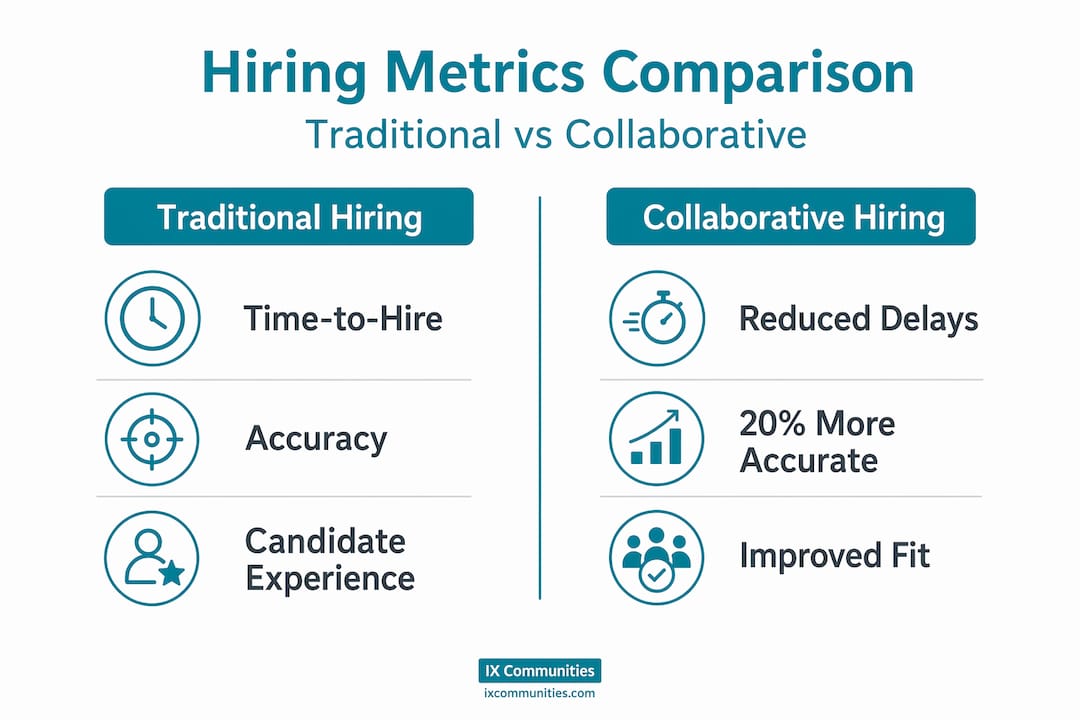
The table below compares traditional hiring metrics against collaborative hiring metrics across four key dimensions.
| Metric | Traditional hiring | Collaborative hiring |
|---|---|---|
| Time-to-hire | Extended by feedback delays | Reduced by up to 40% |
| Decision accuracy | Dependent on one or two reviewers | 20% more accurate with multiple stakeholders |
| Turnover rate | Higher due to poor fit assessment | Reduced by 25% |
| Candidate experience | Inconsistent across touchpoints | Consistent through shared process ownership |
Pro Tip: Run a 30-minute intake meeting at the start of every search. Focus the conversation on what success looks like 12 months into the role, not just the job description. That single shift aligns expectations before the first resume is reviewed.
What are the biggest collaboration challenges in hiring?
The most common objection to collaborative hiring is that it slows things down. That objection is based on a real problem but the wrong diagnosis. Unstructured collaboration causes delays. Parallel evaluation of candidate competencies by assigned stakeholders prevents slowdowns while maintaining accuracy. The issue is never too many people. The issue is unclear roles and no defined process.
Several specific challenges appear repeatedly in corporate hiring environments:
- Role ambiguity. When recruiters, HR business partners, and hiring managers all believe they own the final decision, the process stalls. Clear role definitions prevent this. Recruiters own sourcing and screening. Hiring managers own role requirements and final selection. HR owns compliance and process integrity.
- Inconsistent evaluation criteria. Without standardized scorecards, each interviewer assesses candidates against different mental benchmarks. Standardized scorecards and clear role definitions prevent subjective bias and speed decision-making.
- Feedback bottlenecks. A hiring manager who takes five days to provide interview feedback can derail an entire pipeline. Clear escalation paths within 48 hours and real-time communication channels prevent these recruitment blockers.
- Disengaged hiring managers. Hiring managers who see recruiters as administrative support rather than strategic partners disengage from the process early. Training that reframes the recruiter's role changes this dynamic.
Pro Tip: Establish a written escalation protocol at the start of each search. Define what happens if feedback is not received within 48 hours. A simple rule, applied consistently, removes the most common source of hiring delays.
Best practices for integrating collaboration into hiring workflows
Embedding teamwork in recruiting requires more than good intentions. It requires a repeatable operational structure that survives leadership changes, high-volume periods, and competing business priorities. The following practices build that structure.
-
Run weekly structured alignment meetings. Weekly 30–45 minute huddles between recruiters and hiring managers keep searches on track and surface blockers before they become delays. These meetings review pipeline status, candidate feedback, and any changes to role requirements. They replace ad hoc check-ins with a predictable cadence.
-
Deploy ATS-integrated scorecards. Scorecards built directly into your applicant tracking system create a shared evaluation record. Every interviewer scores candidates against the same criteria. Hiring decisions become faster and easier to defend, which matters for EEOC compliance and internal audit purposes.
-
Embed hiring KPIs in leadership reviews. Time-to-fill, quality of hire, and offer acceptance rate belong in the same leadership review where revenue and retention metrics appear. When hiring managers see their recruitment performance alongside their business results, collaboration becomes a professional priority rather than an HR request. For more on connecting these metrics to broader talent strategy, see how talent management and recruiting connect for measurable impact.
-
Train recruiters and hiring managers together. Joint training sessions build mutual understanding of each party's constraints and capabilities. Hiring managers learn what good sourcing looks like. Recruiters learn what business context shapes a role. That shared understanding reduces friction throughout the search.
-
Position recruiters as commercial advisors. Recruiters acting as commercial advisors bring market compensation data, supply and demand insights, and realistic timeline expectations to every search. That information refines hiring briefs and prevents the common problem of searching for a candidate profile the market cannot supply. The shift from order-taker to advisor is one of the most documented improvements in recruiting best practices for large organizations.
How does collaborative hiring improve candidate experience and cultural fit?
Collaborative hiring involving diverse stakeholders produces a more accurate picture of both the candidate and the role. Manager-only interviews capture one perspective. Team-based screening captures several, and the difference in outcome quality is significant.
Peer-to-peer interviews improve candidate comfort and provide realistic job previews that lead to better cultural fit. Candidates who speak with future teammates get an honest view of day-to-day work dynamics. That transparency reduces early attrition because new hires know what they are joining.
The benefits of team-based screening extend beyond the candidate experience:
- Bias reduction. Multi-stakeholder decision-making reduces unconscious bias and supports compliance with EEOC standards. No single interviewer's blind spots determine the outcome.
- Broader competency coverage. Different interviewers assess different dimensions. A technical lead evaluates skills. A peer evaluates collaboration style. A manager evaluates strategic fit. Together, they produce a complete candidate profile.
- Realistic job previews. When team members contribute to the job brief, the role description reflects actual work rather than an idealized version. Candidates self-select more accurately, which reduces mismatched hires.
- Stronger onboarding alignment. Teams that participate in hiring feel ownership over the new hire's success. That ownership accelerates onboarding and improves early retention.
Peer interviews bring unique value by reducing candidate pressure and providing authentic insights about team culture that structured manager interviews rarely surface.
Key Takeaways
Structured collaboration between recruiters, hiring managers, and HR teams is the single most reliable driver of faster, more accurate, and more inclusive hiring outcomes in large organizations.
| Point | Details |
|---|---|
| Collaboration cuts time-to-hire | Organizations with strong recruiter and hiring manager alignment reduce time-to-hire by 40%. |
| Structured roles prevent delays | Parallel evaluation with defined stakeholder roles prevents slowdowns without sacrificing accuracy. |
| Scorecards improve decision quality | Standardized ATS-integrated scorecards reduce bias and make hiring decisions 20% more accurate. |
| Peer interviews strengthen cultural fit | Team-based screening provides realistic job previews and reduces early attrition. |
| Recruiters as advisors improve outcomes | Recruiters who bring market data to intake meetings set realistic expectations and refine hiring briefs. |
What I have seen change when collaboration actually works
The conversation about collaboration in hiring tends to focus on process. That focus is correct but incomplete. The deeper shift is cultural, and it starts with how hiring managers perceive recruiters.
Hiring managers who see recruiters as strategic advisors rather than administrative support behave differently throughout a search. They show up to intake meetings prepared. They return feedback within 24 hours. They treat the recruiter's market data as useful input rather than a negotiating obstacle. That behavioral shift produces better searches, and it does not happen by accident. It happens when organizations invest in joint training and make hiring performance visible at the leadership level.
The other change I have seen is what happens when hiring KPIs appear in leadership reviews. Suddenly, a hiring manager's 12-day average feedback turnaround is not just a recruiter's frustration. It is a documented metric with a business impact. Visibility creates accountability. Accountability creates behavior change. That sequence is more reliable than any process redesign.
The misconception worth addressing directly is that more stakeholders means slower hiring. The data does not support that. Unstructured involvement slows hiring. Structured involvement, with defined roles and parallel evaluation, speeds it up. The organizations that get this right treat collaboration not as a courtesy but as an operating discipline.
— Simon
Strengthen your hiring outcomes with Ixcommunities
Talent acquisition professionals in large organizations who want to put these collaboration frameworks into practice need more than articles. They need peers who have solved the same problems at scale.
Ixcommunities provides exactly that environment. The ESIX Recruiter Peer Mentorship Programs connect talent acquisition professionals with experienced mentors who have built collaborative hiring systems inside large corporate environments. Members also gain access to community connection resources, benchmarking data, and peer networks through ESIX and TLIX, the preeminent groups for talent leadership professionals worldwide. For teams ready to benchmark their collaboration practices against industry peers, Ixcommunities membership provides the data and the network to do it.
FAQ
What is the role of collaboration in talent acquisition?
Collaboration in talent acquisition is the structured alignment of recruiters, hiring managers, and HR teams around shared evaluation criteria and communication processes. Organizations with strong collaboration reduce time-to-hire by 40% and turnover by 25%.
How does teamwork in hiring reduce mistakes?
Teams with structured collaboration make 20% more accurate hiring decisions. When 90% of companies report fewer hiring mistakes with multi-stakeholder screening, the evidence for structured teamwork is clear.
What is the best way to prevent collaboration from slowing hiring down?
Parallel evaluation of candidate competencies by assigned stakeholders prevents delays. Clear escalation paths within 48 hours and weekly 30–45 minute alignment meetings keep the process moving without sacrificing thoroughness.
How do peer interviews improve cultural fit?
Peer interviews reduce candidate pressure and provide realistic job previews that manager-only interviews cannot replicate. Candidates gain an honest view of team dynamics, which reduces early attrition after hire.
Why should recruiters act as strategic advisors in collaborative hiring?
Recruiters who bring market compensation data and supply and demand insights to intake meetings set realistic expectations and refine hiring briefs. That commercial perspective prevents searches built around candidate profiles the market cannot supply.